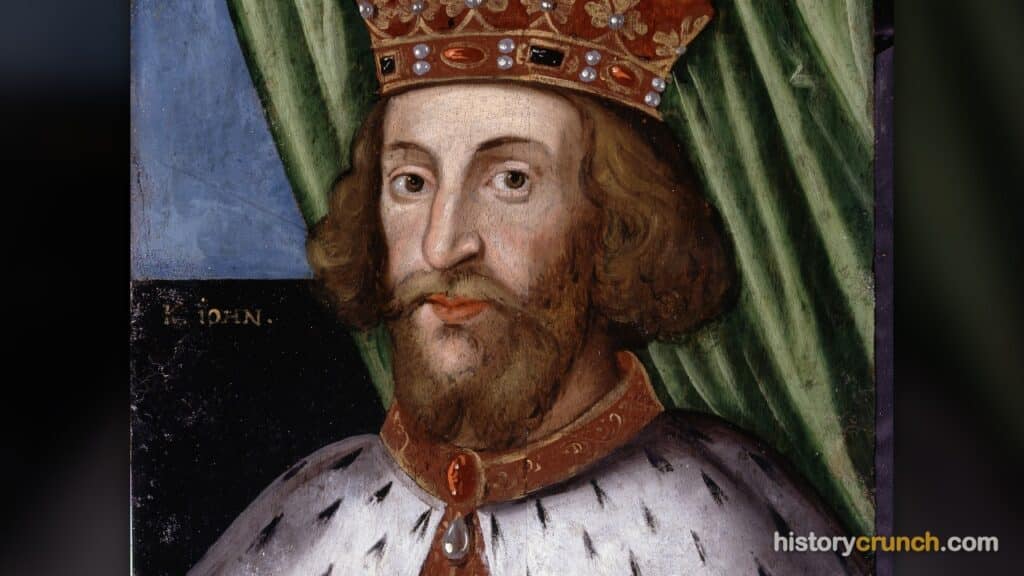
King John of England ruled from 1199 to 1216 CE and is remembered as one of the most important, and most criticized, kings in English history. His reign shaped the future of the English monarchy, mostly because of his failures rather than his successes. John lost the family’s vast lands in France, quarreled bitterly with the Church, and taxed his subjects so heavily that his own nobles rose against him. In the end, this conflict forced him to agree to the Magna Carta in 1215, a document that limited the power of the English crown and influenced ideas about law and government for centuries afterward.
John was a member of the Plantagenet, or Angevin, family, which ruled a large collection of territories often called the Angevin Empire. This empire was not a single country but a group of lands held by one ruling family. It included England, parts of Ireland, and a huge stretch of France that took in Normandy, Anjou, and Aquitaine. Holding this empire together required money, strong armies, and the loyalty of powerful nobles, and John struggled with all three.
Early Life and Background
King John was born in 1166 CE, the youngest son of King Henry II of England and Queen Eleanor of Aquitaine. As the youngest of several sons, John was not originally expected to inherit much land or power. In fact, his older brothers stood ahead of him, and this early position shaped both his personality and his reputation.
Because there seemed to be little territory left for him, John earned the nickname “Lackland” as a young man. His father, Henry II, tried to provide for him over time. For instance, in the 1170s and 1180s Henry gave John the title of Lord of Ireland and sent him to rule there. However, John’s time in Ireland went badly, and his inexperience and poor treatment of local leaders meant his authority never took hold.
John’s early life was also marked by family conflict. His older brothers repeatedly rebelled against their father over control of the empire. During one major revolt, John stayed loyal to Henry II and became his father’s favored son, which helped set him on a path toward greater power later in life.
Rise to Power
John’s path to the throne opened because of the fate of his older brother, King Richard I, often called Richard the Lionheart. When Richard became king, he spent much of his reign away from England, especially while fighting in the Third Crusade. During Richard’s absence, John tried to seize power from the officials Richard had left in charge, but his attempt failed.
Richard eventually forgave John and even named him as his heir. In 1199, Richard was killed while fighting in France, and John became king of England. At first, the French king, Philip II, agreed to recognize John’s control of the Angevin lands in France through a peace treaty made in 1200.
This early peace did not last. When war with France broke out again, John’s rule faced a serious test. More specifically, his ability to hold the empire together would soon collapse, and the events that followed would define his reign.
Loss of the French Territories
One of the most damaging events of John’s reign was the loss of Normandy and much of the family’s land in France. War with Philip II of France resumed in 1202, and although John won some early battles, he could not sustain his campaigns. Shortages of money and soldiers, along with his harsh treatment of Norman and other French nobles, turned many powerful local lords against him.
By 1204, John had lost Normandy and nearly all of his other French possessions to Philip II. This was a huge blow to the Angevin Empire and to John’s reputation as a ruler. In fact, the failure earned him a mocking new nickname, “Softsword,” which suggested he was a weak military leader compared to his brother Richard.
The loss also created deep problems at home. To fund his attempts to win back the French lands, John needed enormous amounts of money, and the only way to raise it was through heavier taxes and fees on his English subjects. This constant demand for money would become one of the main causes of the crisis at the end of his reign.
Conflict With the Church
John also came into serious conflict with the Roman Catholic Church, which held great power across medieval Europe. The dispute began over who should become the Archbishop of Canterbury, the most important church position in England. John and Pope Innocent III backed different candidates, and neither side would give in.
As punishment, the pope placed England under an interdict, which meant many normal church services were stopped across the whole country. When John still refused to back down, the pope excommunicated him, formally cutting him off from the Church. During this period, John seized church lands and income, using the money to help fund his government and military plans.
In the end, John gave in and made peace with the pope, even agreeing to hold England as a possession of the Church. This move helped him gain the pope as an ally, but the long quarrel had already added to the anger many people felt toward his rule.
The Magna Carta and the Barons’ Revolt
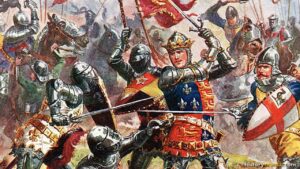
The greatest crisis of John’s reign came from his own nobles, known as barons. These powerful landholders had grown furious at John’s heavy taxes, his harsh use of feudal rights, and his failed wars in France. His final defeat by Philip II at the Battle of Bouvines in 1214 ended his hopes of recovering Normandy and pushed the barons past their breaking point.
In 1215, large numbers of rebel barons rose against John and even seized the city of London. They demanded that the king obey the law and respect their traditional rights, and they insisted these promises be written down. Under great pressure, John met the barons at Runnymede, a meadow near the River Thames, in June of 1215.
There, John agreed to the Magna Carta, whose name is Latin for “Great Charter.” The document contained dozens of clauses that limited the king’s power. For example, it promised the protection of church rights, protection for barons from unlawful imprisonment, access to swift justice, and limits on the fees that the crown could demand.
The Magna Carta was mainly meant to be a peace treaty that would end the crisis between the king and his nobles. In reality, it failed to bring peace. Soon after John agreed to it, fighting broke out again in a conflict known as the First Barons’ War, as neither side trusted the other to keep the agreement.
Later Life and Death
The final years of John’s reign were consumed by civil war. After the Magna Carta failed, John worked to have it canceled, and fighting between royal forces and the rebel barons spread across England. The rebels even invited Prince Louis of France to come and take the English throne, which threatened to end John’s rule entirely.
In the middle of this war, John fell ill and died in October of 1216 at Newark Castle. Many accounts say he died of dysentery, a serious sickness, while still trying to hold his kingdom together. He was later buried at Worcester Cathedral.
John was succeeded by his young son, who became King Henry III. Because Henry was only a child, his supporters reissued a revised version of the Magna Carta to win back the loyalty of the barons. In this way, the charter that John had tried to destroy survived and became a lasting part of English law.
Significance of King John of England
King John is significant mainly because his troubled reign led to the Magna Carta, one of the most important documents in the history of law and government. By forcing the king to accept written limits on his power, the charter helped establish the idea that even a ruler must obey the law. This principle became a foundation for later ideas about individual rights and constitutional government.
John is also remembered as the ruler who lost the Angevin Empire’s lands in France, including Normandy. This loss changed the direction of both English and French history and pushed the English monarchy to focus more on England itself. Over time, the reduced role of the crown at home helped shape the way England was governed.
Finally, John became one of the most famous “bad kings” in popular memory. He appears as the villain in many versions of the Robin Hood legend, where he is shown as a greedy and unfair ruler. While the real story of his reign is more complicated, this lasting image has kept his name well known for more than eight hundred years.
Frequently Asked Questions
Why was King John called John Lackland?
King John was called “Lackland” because, as the youngest son of Henry II, he was not expected to inherit much land. His older brothers stood ahead of him in line for the family’s territories, so as a young man he had little of his own. The nickname stuck even after he later gained the crown.
Who was King John’s brother?
King John’s most famous brother was King Richard I, known as Richard the Lionheart. Richard ruled England before John and spent much of his reign fighting abroad, including on the Third Crusade. When Richard died in 1199 without a legitimate child to inherit the throne, John became king.
Did King John really sign the Magna Carta?
King John agreed to the Magna Carta in 1215, though he did so by attaching his royal seal rather than writing a modern signature. In that period, rulers approved important documents by pressing a wax seal onto them. His agreement was given under heavy pressure from rebel barons who had already seized London.
How did King John die?
King John died in October of 1216, most likely from dysentery, a severe illness of the digestive system. He fell sick during the civil war against his own barons and passed away at Newark Castle. His body was buried at Worcester Cathedral, where his tomb can still be seen today.
Why is King John seen as a bad king?
King John is often seen as a bad king because his reign was full of failures, including losing Normandy, quarreling with the Church, and provoking a revolt by his own nobles. He also gained a reputation for cruelty and for demanding huge amounts of money through taxes and fees. Later stories, such as the Robin Hood legend, strengthened this negative image over the centuries.
Cite This Article
To cite this article as a source, use one of the formats below.
MLA: Millar, B. “King John of England: A Detailed Biography.” HistoryCrunch, 26 July 2026, https://historycrunch.com/king-john-of-england/.
APA: Millar, B. (2026). King John of England: A Detailed Biography. HistoryCrunch. https://historycrunch.com/king-john-of-england/
Chicago: Millar, B. “King John of England: A Detailed Biography.” HistoryCrunch. July 26, 2026. https://historycrunch.com/king-john-of-england/
Sources
- Norman Davies, Europe: A History.