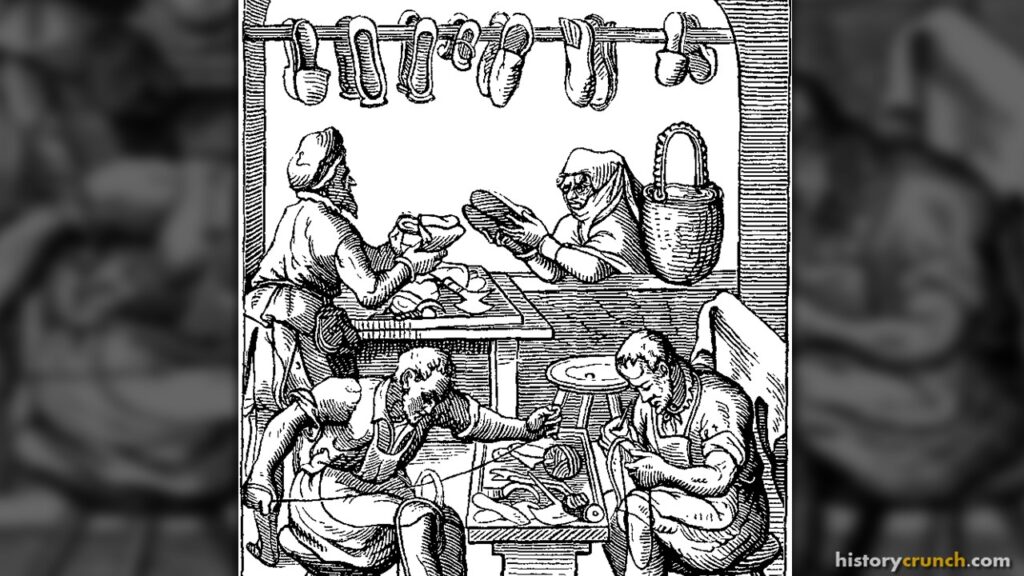
GuildsAn organized association of people in the same trade who worked together to protect their shared interests and regulate their work. in the Middle Ages were an important part of the economic and social life of medieval Europe. A guild was an association of craftsmen or merchants who worked in the same trade and joined together to protect their shared interests, maintain the quality of their work and regulate the conditions of their trade. Guilds were closely connected to the growth of towns and cities during the Middle Ages and played a central role in the development of medieval commerce and craftsmanship. In general, guilds in the Middle Ages were one of the most important economic institutions of the medieval period and had a lasting impact on the development of trade and skilled work in Europe.
 FactsthatCrunch
Why did towns grow alongside guilds in the Middle Ages: what was visible on the surface, and what deeper forces were actually driving it?
What Were the Middle Ages?
The Middle Ages, also known as the Medieval Period, refers to the period of European history that stretched from the 5th century to the 15th century. More specifically, historians generally place the beginning of the Middle Ages at 476 CE, with the fall of the Western Roman Empire, and its end at approximately 1500 CE, with the start of the Renaissance. Due to its length, the Middle Ages is divided into three smaller periods, including: the Early Middle Ages, the High Middle Ages and the Late Middle Ages. Guilds in the Middle Ages became particularly important during the High Middle Ages, as towns and cities across Europe grew in size and the demand for skilled craftsmen and organized trade increased significantly.
What Was a Guild in the Middle Ages?
A guild in the Middle Ages was an organized association of people who worked in the same trade or craft. Guilds were established in towns and cities across medieval Europe and covered a wide range of different trades and crafts, including: weavers, blacksmiths, bakers, shoemakers, carpenters, goldsmiths and many others. The main purpose of a guild was to protect the interests of its members by regulating the quality of their work, controlling the prices they charged and limiting competition from people outside the guild. As such, guilds gave their members a significant degree of economic security and social status within the community.
Guilds also played an important social role in medieval towns and cities. For instance, guilds often organized religious celebrations and feast days for their members, provided financial support for members who were sick or injured and contributed to the construction and maintenance of churches and public buildings in their communities. As well, guilds were responsible for the training of new craftsmen through a structured system of apprenticeshipA structured training system where a young person learns a skilled trade by living and working under an experienced craftsman. that ensured skills were passed on from one generation to the next. As such, guilds in the Middle Ages were not simply economic organizations but were deeply embedded in the social and religious life of medieval European communities.
Types of Guilds in the Middle Ages
There were two main types of guilds in the Middle Ages: merchant guildsAssociations of traders who controlled access to local markets and negotiated trading agreements with other towns and regions. and craft guildsAssociations of skilled workers in a specific trade, such as weaving or baking, responsible for quality standards and training.. Merchant guilds were the earlier of the two types and were associations of merchants who traded goods within a town or city. Merchant guilds were particularly powerful in the Early and High Middle Ages, when long-distance trade was growing rapidly across Europe. For instance, merchant guilds controlled access to local markets, negotiated trading agreements with other towns and regions and worked to protect the interests of their members against competition from outside traders. As such, merchant guilds played an important role in the growth of trade in the Middle Ages and helped connect different regions of Europe through organized networks of commerce.
Craft guilds, on the other hand, were associations of skilled craftsmen who made and sold goods within a specific trade. Craft guilds emerged later than merchant guilds and became particularly important during the High and Late Middle Ages as towns and cities grew in size and the demand for skilled craftsmen increased. For instance, a town might have separate guilds for weavers, bakers, carpenters, shoemakers and goldsmiths, each with its own rules, standards and leadership. Craft guilds were responsible for maintaining the quality of goods produced by their members, training new craftsmen through the apprenticeship system and regulating the prices and conditions of their trade. As such, craft guilds were central to the economic life of medieval towns and cities and helped ensure that the goods produced by their members met a consistent standard of quality.
FactsthatCrunchMerchant guilds were the earlier type, formed when long-distance trade was growing rapidly across Europe during the Early and High Middle Ages. Their main job was to control access to local markets and negotiate trading agreements with other towns and regions. They focused on keeping outside traders away from their members' business, not on making goods themselves.
Craft guilds emerged later, becoming especially important during the High and Late Middle Ages as towns grew larger and demand for skilled workers increased. A single town could have separate guilds for weavers, bakers, carpenters, shoemakers, and goldsmiths, each with its own rules and leadership. Their main job was to set quality standards for goods, train new workers through the apprenticeship system, and regulate prices within their specific trade.
The Apprenticeship System
One of the most important features of guilds in the Middle Ages was the apprenticeship system. The apprenticeship system was the method by which young people were trained in a skilled trade under the supervision of an experienced craftsman. The system generally involved three stages: apprentice, journeymanA qualified craftsman who had completed apprentice training and could earn daily wages working for different masters. and master craftsman.
The first stage was that of apprentice. At a young age, usually between ten and fifteen years old, a boy would be sent to live and work in the household of a master craftsman. As an apprentice, the boy would learn the basics of the trade by working alongside the master and carrying out simple tasks under his supervision. The apprenticeship typically lasted for several years, during which the apprentice received no wages but was provided with food, clothing and lodging by the master.
The second stage was that of journeyman. Once an apprentice had completed his training, he became a journeyman, meaning he was a qualified craftsman who could work for wages. Journeymen were free to travel from town to town and work for different master craftsmen, which is where the name journeyman came from, as the French word journée means day. A journeyman’s goal was to save enough money and develop enough skill to eventually become a master craftsman himself.
The third and final stage was that of master craftsman. To become a master, a journeyman had to produce a piece of work known as a masterpieceA piece of work a journeyman submitted to the guild to prove his skill and qualify as a master craftsman., which was submitted to the guild for evaluation. If the guild judged the work to be of sufficient quality, the journeyman was admitted as a master craftsman and was then entitled to open his own workshop, take on apprentices and become a full member of the guild. As such, the apprenticeship system ensured that the skills of each trade were maintained and passed on to new generations of craftsmen throughout the Middle Ages.
FactsthatCrunchWhat is the correct order of the steps a boy followed to become a master craftsman in a medieval guild?
Guilds and the Growth of Towns
Guilds in the Middle Ages were closely connected to the growth of towns and cities across Europe. As trade and commerce expanded during the High Middle Ages, towns grew in size and importance and became centers of economic and cultural life. Guilds played an important role in this process by providing an organized framework for the production and sale of goods within towns and by attracting skilled craftsmen to settle in urban areas. For instance, a town with a well-established guild of weavers or goldsmiths was likely to attract merchants and buyers from across a wide area, which helped the town grow in wealth and population.
As well, guilds contributed to the physical development of medieval towns by funding the construction of guild halls, which were large buildings used for meetings, celebrations and the storage of guild records and treasures. Guild halls were often among the most impressive buildings in a medieval town and were important symbols of the wealth and status of the guild and its members. For instance, some of the finest surviving examples of medieval guild halls can be found in cities such as Bruges in Belgium and York in England, where they remain important historical monuments today. As such, guilds in the Middle Ages were central to the development of urban life in medieval Europe.
FactsthatCrunchDuring the High Middle Ages, a town's decision to establish a recognized guild of skilled craftsmen drew merchants and buyers from across wide areas, setting off lasting changes in urban wealth and population.
Decline of Guilds at the End of the Middle Ages
By the end of the Middle Ages, guilds had begun to decline in importance as the economic conditions of Europe changed significantly. The growth of long-distance trade and the emergence of a more market-based economy made the strict regulations of the guild system increasingly difficult to maintain. For instance, as merchants began to trade goods across wider areas and in larger quantities, the ability of local guilds to control prices and restrict competition became less effective. As well, the development of new industries and technologies, particularly the invention of the printing press by Johannes Gutenberg in the mid-15th century, created new forms of economic activity that did not fit neatly within the guild system.
Furthermore, the Black Death, which devastated Europe in the 14th century, had a significant impact on guilds by killing large numbers of skilled craftsmen and disrupting the apprenticeship system. The shortage of workers caused by the Black Death gave surviving craftsmen greater bargaining powerThe ability of workers to demand better conditions or pay, increased here because the Black Death created a shortage of skilled craftsmen. and made it more difficult for guilds to enforce their traditional regulations. As such, the decline of guilds at the end of the Middle Ages was part of the broader transformation of the European economy that accompanied the transition from the medieval world to the modern era.
FactsthatCrunchWhat forces caused medieval guilds to lose their grip on European trade and craftsmanship?
Significance of Guilds in the Middle Ages
In conclusion, guilds in the Middle Ages were one of the most important economic and social institutions of the medieval period. They organized the production and sale of goods, trained new craftsmen through the apprenticeship system and contributed to the growth of towns and cities across Europe. As such, understanding guilds in the Middle Ages is important for gaining a complete picture of the economic and social life of medieval Europe and for understanding how many of the traditions and institutions of modern work and commerce came into being.
FactsthatCrunchMedieval craft guilds set strict rules about who could make and sell goods in a town. A weaver, baker, or goldsmith had to pass through years of apprentice and journeyman training before the guild admitted him as a master craftsman. Guilds also fixed quality standards and controlled prices, giving members economic protection that workers outside the guild did not have.
Modern trade unions carry forward the guild idea of workers joining together to protect their shared interests, negotiate pay, and set conditions on the job. Professional licensing boards in fields such as medicine, law, and construction serve the same function guilds once did: they test competence before allowing someone to practice a trade. The word 'journeyman' survives today in American labor contracts and union rules to describe a fully qualified worker who has completed a set period of training.
The core logic of medieval craft guilds was that workers in the same trade should set shared standards and protect each other. That logic passed directly into the labor unions and licensing systems that regulate skilled work today.
Explore Middle Ages · 476 – 1500 CE
Keep exploring Middle Ages with these History Crunch resources.
Key Vocabulary
Guild
Apprenticeship
Journeyman
Masterpiece
Merchant guilds
Craft guilds
Bargaining power
Frequently Asked Questions
What was the main purpose of a medieval guild?
A medieval guild existed to protect the shared interests of its members. It did this by setting standards for quality, controlling prices and limiting competition from outsiders. Guilds also gave members economic security and raised their social status within the town.
What were the two main types of guilds in the Middle Ages?
The two main types were merchant guilds and craft guilds. Merchant guilds came first and were groups of traders who controlled local markets and trade deals. Craft guilds developed later and were groups of skilled workers, such as weavers or bakers, who made and sold goods.
What were the three stages of the apprenticeship system?
The three stages were apprentice, journeyman and master craftsman. A boy began as an apprentice around age ten to fifteen, living and working in a master’s household without pay. He then became a paid journeyman, and finally a master if his masterpiece satisfied the guild.
Why is a journeyman called a journeyman?
The name comes from the French word journée, which means day. A journeyman was a qualified craftsman who could earn wages by the day. These workers were free to travel from town to town and work for different masters while saving money.
Why did guilds decline at the end of the Middle Ages?
Guilds declined because Europe’s economy changed toward a wider, market-based system. Long-distance trade made it hard for local guilds to control prices and block competition. New technology and the Black Death, which killed many skilled workers, further weakened the guild system.
What was a guild hall used for?
A guild hall was a large building used for meetings, celebrations and storing guild records and treasures. These halls were often among the finest buildings in a medieval town. Fine surviving examples can still be seen in cities such as Bruges in Belgium and York in England.
Cite This Article
To cite this article as a source, use one of the formats below.
MLA: Millar, B. “Guilds in the Middle Ages: A Detailed Summary.” HistoryCrunch, 16 October 2026, https://historycrunch.com/guilds-in-the-middle-ages/.
APA: Millar, B. (2026). Guilds in the Middle Ages: A Detailed Summary. HistoryCrunch. https://historycrunch.com/guilds-in-the-middle-ages/
Chicago: Millar, B. “Guilds in the Middle Ages: A Detailed Summary.” HistoryCrunch. October 16, 2026. https://historycrunch.com/guilds-in-the-middle-ages/
Sources
- Barbara Rosenwein, A Short History of the Middle Ages.
- Chris Wickham, Medieval Europe.
- Fordham Medieval Sourcebook
- Jacques Le Goff, Medieval Civilization 400-1500.