Religion was one of the most important aspects of life in the Middle Ages. Throughout the medieval period, the Catholic Church was the dominant religious institution in Europe and held enormous influence over the political, social and cultural life of people across the continent. For most people in medieval Europe, religion was not simply a private matter of personal faith but was a central part of everyday life that shaped everything from the laws and government of kingdoms to the art and architecture of cities and towns. In general, religion in the Middle Ages was defined by the power of the Catholic Church, the role of the Pope, the spread of Christianity and the interaction between Christianity, Islam and Judaism.

What Were the Middle Ages?
The Middle Ages, also known as the Medieval Period, refers to the period of European history that stretched from the 5th century to the 15th century. More specifically, historians generally place the beginning of the Middle Ages at 476 CE, with the fall of the Western Roman Empire, and its end at approximately 1500 CE, with the start of the Renaissance. Following the fall of the Western Roman Empire, the Catholic Church emerged as one of the most powerful and stable institutions in Europe. As the kingdoms and political structures of the Roman world collapsed, the Church provided a source of continuity, order and shared identity for the people of Europe. Throughout the Middle Ages, the vast majority of people in western Europe were Christians who practiced the Catholic faith and looked to the Church for guidance in both their spiritual and everyday lives.
Role of the Catholic Church in the Middle Ages
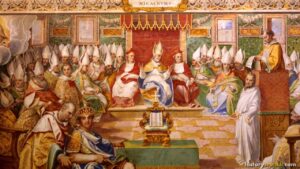
The Catholic Church was by far the most powerful and influential institution in the Middle Ages. Its influence extended far beyond purely religious matters and touched nearly every aspect of life in medieval European society. For instance, the Church ran most of the schools and universities of the Middle Ages, provided care for the sick and poor, and administered important legal and social functions such as marriage, inheritance and the recording of births and deaths. As such, the Catholic Church was deeply embedded in the everyday life of medieval Europeans in a way that is difficult to fully appreciate from a modern perspective.
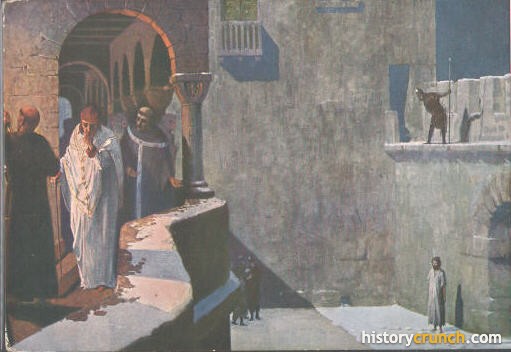
The head of the Catholic Church was the Pope, who was based in Rome and was considered to be the spiritual leader of all Christians in western Europe. The Pope held enormous authority during the Middle Ages and could influence the decisions of kings and emperors through his religious power. For instance, one of the most dramatic demonstrations of papal authority during the Middle Ages occurred in 1076 CE when Pope Gregory VII excommunicatedFormally removed from the Catholic Church, losing access to sacraments and burial in holy ground. the Holy Roman Emperor Henry IV, meaning he was formally expelled from the Church. Since being excommunicated meant that a person could not receive the sacramentsOfficial religious ceremonies of the Catholic Church that marked key moments in a Christian’s life, from birth to death. or be buried in consecrated ground, it was an extremely powerful punishment that could undermine the political authority of even the most powerful rulers. As such, the relationship between the Pope and the secular rulers of Europe was one of the most important and often contentious aspects of political life in the Middle Ages.
FactsthatCrunchExcommunication is the formal removal of a person from the Catholic Church. A person who was excommunicated could no longer receive the sacraments, which were the official religious ceremonies that marked key moments in a Christian's life. They also could not be buried in consecrated ground.
When Pope Gregory VII excommunicated Holy Roman Emperor Henry IV in 1076 CE, the punishment threatened Henry's political authority because his subjects were no longer bound to obey a ruler cast out of the Church.
Christianity in the Middle Ages
For most people in the Middle Ages, Christianity was not simply a set of beliefs but a way of life that structured their daily routine, their calendar and their understanding of the world. The Christian calendar was filled with religious feast days, fast days and holy days that organized the rhythm of medieval life throughout the year. For instance, important religious celebrations such as Christmas, Easter and the feast days of various saints were major events in the medieval calendar and were observed by people across all social classes. As well, the seven sacraments of the Catholic Church, including baptism, marriage and last rites, marked the key moments of a person’s life from birth to death and were considered essential for the spiritual well-being of every Christian.
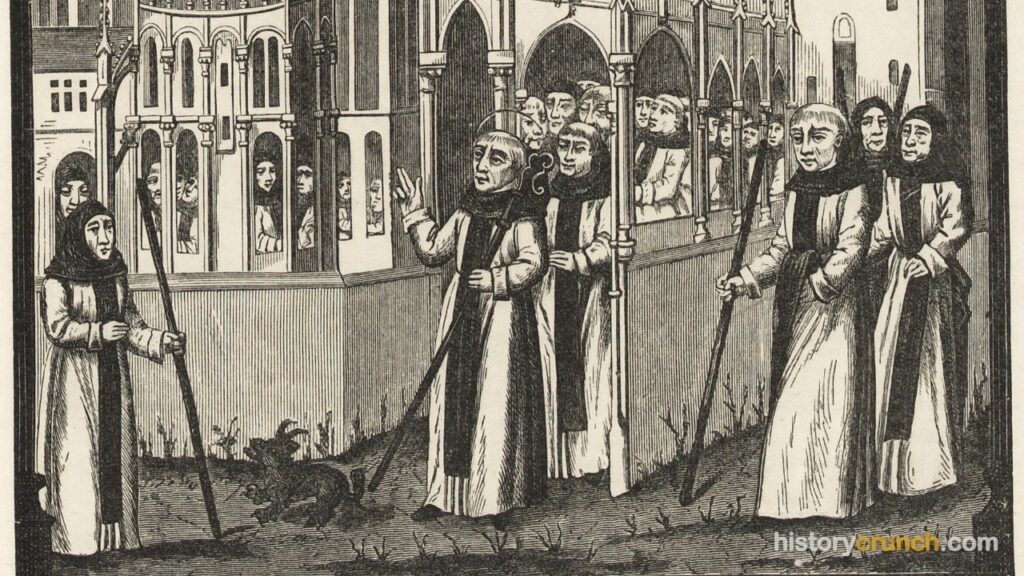
The local parish church was the center of religious and social life for most communities in the Middle Ages. For instance, the parish priest was responsible for conducting religious services, administering the sacraments and providing spiritual guidance to the people of his community. As well, the church building itself served as a gathering place for the community and was often the most prominent and well-constructed building in a medieval village or town. As such, the Catholic Church and its local representatives played a central role in the daily life of ordinary people throughout the Middle Ages.
FactsthatCrunchThe medieval year was organized around the Church calendar, filled with feast days, fast days and holy days that people of every social class observed.
Christmas, Easter and the feast days of various saints were major events in medieval life. The Church calendar set the rhythm of the year for nobles and peasants alike, telling communities when to celebrate and when to fast.
The Pope and Political Power in the Middle Ages
As stated above, the Pope held enormous political as well as religious authority during the Middle Ages. The relationship between the papacyThe office and authority of the Pope as head of the Catholic Church. and the secular rulers of Europe was complex and often marked by conflict. On one hand, kings and emperors needed the support and blessing of the Church to legitimize their rule, as the Church taught that all earthly authority came ultimately from God. On the other hand, the Pope and other Church leaders often sought to extend their authority over political matters, which brought them into conflict with powerful secular rulers.
One of the most significant political conflicts of the Middle Ages involving the Church was the Investiture ControversyAn 11th–12th century dispute over whether the Pope or secular rulers had the right to appoint Church officials., which took place in the 11th and 12th centuries. The Investiture Controversy was a dispute between the Pope and the Holy Roman Emperor over who had the right to appoint bishops and other Church officials. This was an important question because bishops and Church officials held significant political as well as religious power in medieval society, and both the Pope and secular rulers wanted to control these appointments. The conflict was eventually resolved through a series of compromises but highlighted the ongoing tension between religious and political authority that was a defining feature of the Middle Ages.
FactsthatCrunchIn the name of Almighty God, Father, Son and Holy Ghost, I withdraw … from Henry … the rule over the whole kingdom of the Germans and over Italy. And I absolve all Christians from the bonds of the oath which they have made or shall make to him; and I forbid any one to serve him as king.
Pope Gregory VII · Lenten Synod, Rome · February 22nd, 1076
In January 1076 CE, Henry IV gathered his bishops at Worms and demanded that Gregory VII step down as Pope. Gregory answered with this decree at a church council in Rome, cutting Henry off from the Catholic Church and freeing his subjects from their oaths of loyalty. The blow to Henry's authority was so great that in January of 1077 CE he traveled to Canossa in Italy and stood barefoot in the snow for three days to beg the Pope for forgiveness.
Islam in the Middle Ages
While Christianity was the dominant religion in western Europe during the Middle Ages, Islam was another major religious force that had a profound impact on the medieval world. Islam originated in the Arabian Peninsula in the 7th century CE and spread rapidly throughout the Middle East, North Africa and into parts of Europe in the centuries that followed. For instance, Muslim forces conquered large parts of the Iberian Peninsula, which is modern-day Spain and Portugal, in the early 8th century, bringing Islam into direct contact with Christian Europe.
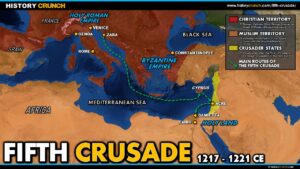
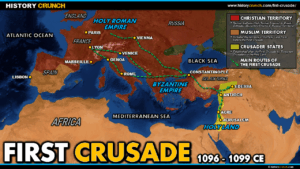
The interaction between Christianity and Islam during the Middle Ages was one of the most significant religious and political developments of the period. For instance, the Crusades, which were a series of religious wars carried out by Christian crusaders from Europe beginning in 1095 CE, were in large part a direct response to the spread of Islam and the Muslim control of the Holy Land. The CrusadesA series of religious wars launched by European Christians beginning in 1095 CE to take control of the Holy Land from Muslims. saw European knights and noblemen travel to the Middle East in an attempt to capture Jerusalem and other holy sites from Muslim control. While the Crusades were ultimately unsuccessful in their main goal of permanently securing the Holy Land for Christianity, they had a profound impact on both European and Middle Eastern society and led to increased interaction between Christian and Muslim civilizations. As such, the relationship between Christianity and Islam was one of the defining features of religion in the Middle Ages.
FactsthatCrunchIn 711 CE, Muslim forces crossed from North Africa into the Iberian Peninsula and rapidly conquered most of the region, bringing Islamic civilization into direct and lasting contact with Christian Europe across a land border. Christian kingdoms in the north of Iberia spent the following centuries working to reclaim that territory, a long struggle known as the Reconquista.
Islam confined mostly to Arabia, Middle East, and North Africa; Christian Europe largely separate from Muslim lands
Centuries of contact, conflict, and exchange between Christian and Muslim scholars and rulers on European soil
Judaism in the Middle Ages
Judaism was the third major religion that played an important role in the Middle Ages. Jewish communities existed throughout medieval Europe and the Middle East, though Jews faced significant persecution and discrimination in many parts of the medieval world. For instance, Jews were frequently subjected to restrictions on where they could live and what jobs they could hold, and were often blamed for disasters and misfortunes such as the Black Death. In some parts of Europe, Jews were forcibly expelled from their communities or subjected to violent attacks known as pogromsViolent organized attacks carried out against Jewish communities..
With that said, Jewish communities also made important contributions to the intellectual and cultural life of the Middle Ages. For instance, Jewish scholars played a significant role in preserving and transmitting ancient Greek and Roman texts, particularly in the Middle East and in Spain, where Jewish, Christian and Muslim scholars worked alongside one another during periods of relative tolerance. As well, Jewish merchants and traders were active participants in the trade networks of the Middle Ages, including the Silk Road, and contributed to the economic life of medieval Europe and the Middle East. As such, Judaism was an important part of the religious landscape of the Middle Ages, even as Jewish communities faced ongoing persecution and discrimination throughout the period.
FactsthatCrunchJewish scholars in medieval Spain helped preserve ancient Greek and Roman knowledge not simply by copying texts, but by actively translating and transmitting them alongside Christian and Muslim colleagues during periods of relative tolerance.
The Crusades and Religion in the Middle Ages
The Crusades were one of the most significant religious events of the Middle Ages and had a profound impact on the relationship between Christianity, Islam and Judaism. The Crusades were a series of religious wars carried out by Christian crusaders from Europe during the timeframe of the Middle Ages. Beginning in 1095 CE, the Crusades saw European knights and noblemen travel to the Middle East in an attempt to capture the Holy Land away from Muslim people that had controlled the region for the previous centuries. The Crusades caused the religions of Christianity, Judaism and Islam to clash in ways that had lasting consequences for all three faiths and for the broader history of Europe and the Middle East.
For instance, the Crusades led to a significant increase in religious intolerance and persecution, particularly toward Jewish communities in Europe, who were subjected to violent attacks by crusaders even before they left for the Holy Land. At the same time, the Crusades also led to increased interaction and exchange between Christian and Muslim civilizations, which had important intellectual and cultural consequences for Europe in the centuries that followed. As such, the Crusades were one of the most important events in the history of religion in the Middle Ages and continue to be studied and debated by historians today.
FactsthatCrunchThe Crusades, launched from 1095 CE onward, changed religious life in both Europe and the Middle East in lasting ways.
Decline of Church Power at the End of the Middle Ages
Toward the end of the Middle Ages, the power and authority of the Catholic Church began to decline significantly. Several factors contributed to this decline. For instance, the Black Death, which devastated Europe in the 14th century, caused many people to question the authority of the Church, since the Church had been unable to explain or stop the spread of the disease. As well, a series of crises within the Church itself, including the Great Schism of 1378 CE in which two rival popes simultaneously claimed authority over the Church, damaged the credibility and unity of the institution.
Furthermore, the intellectual developments of the Renaissance, which began in the 14th century in the city-states of the Italian peninsula, promoted a worldview based on logic and reason rather than religious faith. This shift in thinking challenged the traditional authority of the Church and helped lay the groundwork for the Protestant Reformation in the 16th century, in which reformers such as Martin Luther challenged the teachings and practices of the Catholic Church and led to the creation of new Christian denominations across Europe. As such, the decline of Church power at the end of the Middle Ages was one of the most significant developments in the history of religion in the Middle Ages and had profound consequences for the history of Christianity and European society.
FactsthatCrunchSeveral forces combined to break the Church's grip on power at the close of the Middle Ages.
Significance of Religion in the Middle Ages
In conclusion, religion was a central and defining feature of life in the Middle Ages. The Catholic Church shaped nearly every aspect of medieval European society, from government and education to art and architecture. The interaction between Christianity, Islam and Judaism during the Middle Ages, particularly through events such as the Crusades, had lasting consequences for the history of Europe and the world. As such, understanding religion in the Middle Ages is essential for gaining a complete picture of medieval European society and for understanding the major events and developments that followed, including the Renaissance, the Protestant Reformation and the Age of Enlightenment.
FactsthatCrunchKey Vocabulary
Excommunicated
Sacraments
Papacy
Investiture Controversy
Crusades
Pogroms
Great Schism
Frequently Asked Questions
Why was the Catholic Church so powerful in the Middle Ages?
The Catholic Church was powerful because it provided order and stability after the Western Roman Empire fell in 476 CE. It ran most schools and universities, cared for the sick and poor, and handled legal matters like marriage and inheritance. Nearly everyone in western Europe was Catholic and looked to the Church for guidance in daily life.
What did excommunication mean in the Middle Ages?
Excommunication meant a person was formally expelled from the Catholic Church. An excommunicated person could not receive the sacraments or be buried in consecrated ground, making it a severe punishment. In 1076 CE, Pope Gregory VII excommunicated Holy Roman Emperor Henry IV, which threatened even a ruler’s political authority.
What were the seven sacraments?
The seven sacraments were key religious ceremonies that marked important moments in a Christian’s life. They included baptism, marriage and last rites, which guided people from birth to death. Medieval Christians believed these sacraments were essential for the spiritual well-being of every person.
How did Islam affect Christian Europe during the Middle Ages?
Islam reached Europe when Muslim forces conquered much of the Iberian Peninsula in the early 8th century. This brought Islam into direct contact with Christian Europe and led to centuries of interaction. The Crusades, beginning in 1095 CE, were largely a Christian response to Muslim control of the Holy Land.
Why did Church power decline at the end of the Middle Ages?
Church power declined because of several crises in the 14th and 15th centuries. The Black Death caused many people to question the Church, which could not explain or stop the disease. The Great Schism of 1378 CE, when two rival popes claimed authority, and the rise of Renaissance thinking further weakened the Church.
Cite This Article
To cite this article as a source, use one of the formats below.
MLA: Millar, B. “Religion in the Middle Ages: A Detailed Summary.” HistoryCrunch, 17 October 2026, https://historycrunch.com/religion-in-the-middle-ages/.
APA: Millar, B. (2026). Religion in the Middle Ages: A Detailed Summary. HistoryCrunch. https://historycrunch.com/religion-in-the-middle-ages/
Chicago: Millar, B. “Religion in the Middle Ages: A Detailed Summary.” HistoryCrunch. October 17, 2026. https://historycrunch.com/religion-in-the-middle-ages/
Sources
- Barbara Rosenwein, A Short History of the Middle Ages.
- The Met (Heilbrunn Timeline): medieval art
- Chris Wickham, Medieval Europe.
- Fordham Medieval Sourcebook