The Great SchismA formal division or split between groups that were once united, here used for the break between two Christian churches. was one of the most significant events in the history of Christianity and the Middle Ages. It refers to the formal split between the Roman Catholic Church in western Europe and the Eastern Orthodox Church in eastern Europe, which became official in 1054 CE. The Great Schism was the result of centuries of growing tension between the two branches of Christianity over questions of religious authority, doctrine and practice. In general, the Great Schism had a profound and lasting impact on the history of Christianity and on the political and cultural life of medieval Europe.
 FactsthatCrunch
How did the two churches see papal authority differently?
What Were the Middle Ages?
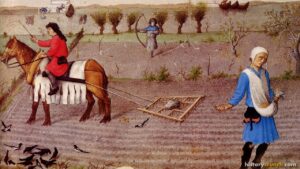
The Middle Ages, also known as the Medieval Period, refers to the period of European history that stretched from the 5th century to the 15th century. More specifically, historians generally place the beginning of the Middle Ages at 476 CE, with the fall of the Western Roman Empire, and its end at approximately 1500 CE, with the start of the Renaissance. Due to its length, the Middle Ages is divided into three smaller periods, including: the Early Middle Ages, the High Middle Ages and the Late Middle Ages. The Great Schism of 1054 CE took place during the High Middle Ages and was one of the most important religious events of the entire medieval period.
What Was the Great Schism?
The Great Schism refers to the formal split between the Roman Catholic Church and the Eastern Orthodox Church that occurred in 1054 CE. The term schism comes from the Greek word for division or separation, and the Great Schism is so named because it represented the greatest division in the history of the Christian Church up to that point. Before the Great Schism, Christianity in Europe was in theory a single unified Church, though in practice the western and eastern branches of the Church had been developing in different directions for several centuries. The Great Schism made this division official and permanent, creating two distinct branches of Christianity that have remained separate to the present day.
It is important to note that historians sometimes use the term Great Schism to refer to a second major division within the Catholic Church that occurred in the late 14th century, known as the Western Schism or Papal Schism, in which two rival popes simultaneously claimed authority over the Catholic Church. With that said, the term Great Schism most commonly refers to the split of 1054 CE between the Roman Catholic Church and the Eastern Orthodox Church, which is the focus of this article.
FactsthatCrunchWhy did the eastern and western churches drift apart before the Great Schism of 1054 CE?
Background to the Great Schism
The division between the western and eastern branches of Christianity had its roots in the political division of the Roman Empire. In 395 CE, the Roman Empire was formally divided into a Western Roman Empire, centered in Rome, and an Eastern Roman Empire, centered in Constantinople. This political division had important consequences for the Christian Church, as the western Church became increasingly centered on the Pope in Rome, while the eastern Church developed under the authority of the PatriarchA senior church leader with authority over a large region, similar in rank to the Pope but in the eastern Church. of Constantinople and other eastern church leaders.
Following the fall of the Western Roman Empire in 476 CE, the eastern and western branches of the Church continued to develop in different directions. For instance, the western Church, which became known as the Roman Catholic Church, used Latin as its language of worship and administration, while the eastern Church used Greek. As well, the two branches of the Church developed different traditions of worship, art and theology over the centuries following the fall of Rome. With that said, the most significant source of tension between the two churches was the question of authority, and in particular the question of whether the Pope in Rome had supreme authority over all Christians, including those in the eastern Church. The eastern Church rejected this claim and argued that the major church leaders, known as patriarchs, should have equal authority within their own territories. As such, the growing tension between the eastern and western branches of Christianity was rooted in deep disagreements about power, authority and the nature of the Church itself.
FactsthatCrunchIn 395 CE, the Roman Empire was formally divided into a Western Roman Empire centered in Rome and an Eastern Roman Empire centered in Constantinople, splitting political authority across two separate capitals.
This political split did not immediately break the Church apart, but it set the two branches on different paths for more than six hundred years before the formal division of 1054 CE. The disagreements that grew from this separation, especially over the Pope's authority, eventually made the split permanent.
Causes of the Great Schism
There were several main causes of the Great Schism, which combined to make the split between the Roman Catholic Church and the Eastern Orthodox Church inevitable by the 11th century.
The first and most important cause was the dispute over the authority of the Pope. The Roman Catholic Church taught that the Pope, as the Bishop of Rome and the successor of Saint Peter, had supreme authority over all Christians everywhere. The eastern Church disagreed with this claim and argued that the Pope was simply the first among equals, with no more authority over the eastern Church than the Patriarch of Constantinople had over the western Church. This fundamental disagreement over the nature of papal authorityThe claim that the Pope holds supreme power over all Christians everywhere in the world. was the most important theological and political issue dividing the two churches.
A second important cause of the Great Schism was a theological dispute known as the FilioqueA Latin phrase meaning ‘and from the Son,’ added by the western Church to a key statement of Christian belief. controversy. The Filioque was a Latin term meaning “and from the Son” that had been added to the Nicene CreedA statement of Christian belief that both churches accepted, until the western Church added words the eastern Church rejected., which was a statement of Christian belief, by the western Church. The addition stated that the Holy Spirit proceeded from both God the Father and God the Son. The eastern Church strongly objected to this addition, arguing that it had been made without the agreement of the whole Church and that it contradicted the original text of the Creed. This theological dispute became one of the most significant points of disagreement between the two churches.
A third cause of the Great Schism was the dispute over the use of unleavened bread in the celebration of the Eucharist, which is the central act of Christian worship involving bread and wine. The western Church used unleavened bread, while the eastern Church used leavenedBread made with yeast so it rises, as opposed to unleavened bread, which contains no yeast and stays flat. bread. While this may seem like a minor difference, it was seen as a significant theological issue by both sides and contributed to the growing tension between the two churches. As such, the Great Schism was caused by a combination of theological, political and cultural disagreements that had been building for centuries before the formal split of 1054 CE.
FactsthatCrunchWhat really caused the Great Schism between the Catholic and Eastern Orthodox Churches in 1054 CE?
Events of the Great Schism
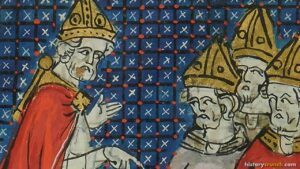
The immediate events that led to the Great Schism of 1054 CE centered on a dispute between the Pope in Rome and the Patriarch of Constantinople. At the time, the Pope was Leo IX and the Patriarch of Constantinople was Michael Cerularius. The two leaders had been in conflict over a range of theological and political issues, and the situation came to a head in 1054 CE when Pope Leo IX sent a delegation to Constantinople to negotiate with Cerularius. The leader of the delegation was Cardinal Humbert, who was known for his strong views on papal authority and his hostility toward the eastern Church.
The negotiations between Cardinal Humbert and Patriarch Cerularius broke down quickly, and on July 16th, 1054 CE, Cardinal Humbert placed a document known as a bull of excommunicationAn official act that cuts a person off from membership and the sacraments of the Church. on the altar of the Hagia Sophia cathedral in Constantinople. This document formally excommunicated Patriarch Cerularius and his supporters from the Catholic Church. Cerularius responded by convening a church council that issued its own excommunication of Cardinal Humbert and his delegation. With that said, it is important to note that the excommunications of 1054 CE were directed at specific individuals rather than at entire churches, and the formal split between the two churches developed gradually over the centuries that followed rather than occurring in a single dramatic moment. As such, 1054 CE is used by historians as the conventional date of the Great Schism, though the division between the two churches was in reality a gradual process.
FactsthatCrunchThe Great Schism began with a document left on an altar. On July 16th, 1054 CE, Cardinal Humbert placed a bull of excommunication on the altar of the Hagia Sophia in Constantinople.
The document cut off Patriarch Michael Cerularius and his supporters. Cerularius answered with a church council that excommunicated Humbert and his delegation. These excommunications targeted individuals, not whole churches, but historians use 1054 CE as the date of the split.
Impact of the Great Schism
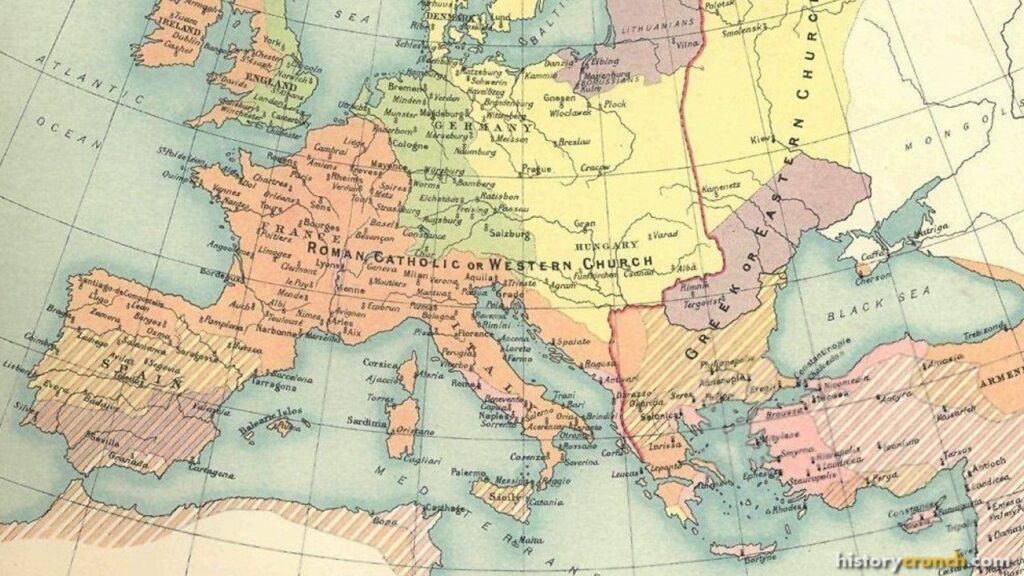
The Great Schism had a profound and lasting impact on the history of Christianity and on the political and cultural life of medieval Europe. The most immediate impact was the creation of two distinct and separate branches of Christianity that have remained divided to the present day. The Roman Catholic Church continued to be centered in Rome under the authority of the Pope and remained the dominant form of Christianity in western Europe throughout the Middle Ages. The Eastern Orthodox Church, centered in Constantinople, remained the dominant form of Christianity in eastern Europe, including in the Byzantine Empire, Russia and the Balkans.
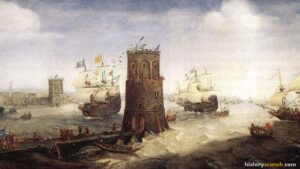
The Great Schism also had important political consequences for medieval Europe. For instance, the division between the Catholic and Orthodox churches deepened the cultural and political differences between western and eastern Europe and made cooperation between the two regions more difficult. This was particularly evident during the Crusades, which were a series of religious wars carried out by Christian crusaders from Europe beginning in 1095 CE. The relationship between the Catholic crusaders from western Europe and the Orthodox Christians of the Byzantine Empire was often tense and sometimes openly hostile. For instance, the Fourth Crusade of 1204 CE ended in disaster for the Byzantine Empire when Catholic crusaders attacked and sacked Constantinople, which caused enormous damage to the relationship between the two churches and deepened the divisions that the Great Schism had created.
As well, the Great Schism helped spread Eastern Orthodox Christianity throughout Russia and eastern Europe, as Byzantine missionaries had already spread the faith to these regions in the centuries before the split. For instance, Russia adopted Eastern Orthodox Christianity in 988 CE, and the Russian Orthodox Church eventually became one of the most important branches of the Eastern Orthodox tradition. As such, the Great Schism helped shape the religious and cultural identity of a large part of the world and its effects continue to be felt in the distinct religious traditions of western and eastern Europe to the present day.
FactsthatCrunchMany crusaders saw Constantinople as a wealthy city that had failed to support the crusading cause and whose people followed a form of Christianity they considered schismatic and defiant of the Pope. They justified the attack partly on the grounds that the Byzantine Empire had obstructed earlier crusades and owed submission to Rome. Looting the city's churches, palaces, and treasuries was treated by some leaders as a legitimate seizure of resources from a people who had refused papal authority.
Byzantine Christians experienced the sack as a brutal betrayal by fellow Christians who had sworn to fight for the faith. Crusaders plundered the Hagia Sophia and other sacred sites, carrying off relics, gold, and manuscripts that had been held in Constantinople for centuries. The attack confirmed deep fears that the western Church viewed Orthodox Christians as enemies rather than allies, and it permanently damaged relations between the two churches.
The Western Schism
As mentioned above, there was a second major schism within the Catholic Church during the Middle Ages, known as the Western Schism or Papal Schism, which took place from 1378 to 1417 CE. The Western Schism occurred when a dispute over the election of the Pope led to a situation in which two and eventually three rival claimants simultaneously claimed to be the rightful Pope. For instance, one claimant was based in Rome and another was based in Avignon in France, and each had the support of different European kingdoms and rulers. This division within the Catholic Church caused enormous damage to the authority and credibility of the papacy and contributed to the growing questioning of the Church’s authority that characterized the Late Middle Ages.
The Western Schism was eventually resolved by the Council of Constance, which met from 1414 to 1418 CE and agreed to remove all three rival claimants and elect a new Pope, Martin V, who was accepted by all parties. With that said, the damage done to the authority of the papacy by the Western Schism was significant and contributed to the broader decline of Church power at the end of the Middle Ages that eventually led to the Protestant Reformation in the 16th century. As such, the Western Schism was an important event in the history of government and religion in the Middle Ages, even though it is less well known than the Great Schism of 1054 CE.
Can you put these steps in the right order to show how the Western Schism was resolved?
Significance of the Great Schism
In conclusion, the Great Schism was one of the most significant events in the history of Christianity and the Middle Ages. The formal split between the Roman Catholic Church and the Eastern Orthodox Church in 1054 CE created a division in the Christian world that has lasted to the present day and had profound consequences for the political and cultural history of Europe. As such, understanding the Great Schism is important for gaining a complete picture of the religious life of the Middle Ages and for understanding the major divisions and developments in the history of Christianity.
FactsthatCrunchIn 1054 CE, Christianity formally split into two separate churches: the Roman Catholic Church, centered in Rome, and the Eastern Orthodox Church, centered in Constantinople. The Roman Catholic Church used Latin in worship and held that the Pope had supreme authority over all Christians. The Eastern Orthodox Church used Greek, rejected that claim of papal supremacy, and taught that regional church leaders called patriarchs held equal authority within their own territories.
Both churches still exist today and remain separate. The Roman Catholic Church, led by the Pope in Rome, has over a billion members worldwide and is the largest Christian denomination. The Eastern Orthodox Church includes major branches such as the Greek Orthodox and Russian Orthodox churches, which together serve hundreds of millions of Christians across eastern Europe, Russia, the Middle East, and beyond.
A disagreement over authority and doctrine that became official nearly a thousand years ago still shapes the religious identity of hundreds of millions of people across two broad regions of the world.
Explore Middle Ages · 476 – 1500 CE
Keep exploring Middle Ages with these History Crunch resources.
Key Vocabulary
Schism
Filioque
Nicene Creed
Excommunication
Patriarch
Papal authority
Leavened
Frequently Asked Questions
When did the Great Schism happen?
The Great Schism became official in 1054 CE, during the High Middle Ages. Historians use this date for convenience, but the real split grew over many centuries. Tension between the western and eastern churches had been building since the Roman Empire divided in 395 CE.
What was the main cause of the Great Schism?
The main cause was a dispute over the authority of the Pope. The Roman Catholic Church taught that the Pope held supreme power over all Christians everywhere. The eastern Church disagreed and said the Pope was only the first among equals, with no power over the east.
What was the Filioque controversy?
The Filioque controversy was a dispute over words added to the Nicene Creed by the western Church. Filioque is a Latin term meaning “and from the Son.” The addition said the Holy Spirit came from both the Father and the Son, and the eastern Church strongly rejected it.
Who was involved in the events of 1054 CE?
The main figures were Pope Leo IX in Rome and Patriarch Michael Cerularius in Constantinople. Pope Leo IX sent a delegation led by Cardinal Humbert to settle their disputes. When talks failed, Humbert placed a document of excommunication on the altar of the Hagia Sophia on July 16th, 1054 CE.
How is the Great Schism different from the Western Schism?
The Great Schism of 1054 CE split Christianity into the Roman Catholic and Eastern Orthodox churches. The Western Schism, from 1378 to 1417 CE, was a crisis inside the Catholic Church with rival popes. The Council of Constance ended it by electing one agreed Pope, Martin V.
What was the impact of the Great Schism?
The Great Schism created two lasting branches of Christianity that are still separate today. It deepened the split between western and eastern Europe and strained ties during the Crusades. The sack of Constantinople in the Fourth Crusade of 1204 CE badly damaged relations between the two churches.
Cite This Article
To cite this article as a source, use one of the formats below.
MLA: Millar, B. “Great Schism: A Detailed Summary.” HistoryCrunch, 17 October 2026, https://historycrunch.com/great-schism/.
APA: Millar, B. (2026). Great Schism: A Detailed Summary. HistoryCrunch. https://historycrunch.com/great-schism/
Chicago: Millar, B. “Great Schism: A Detailed Summary.” HistoryCrunch. October 17, 2026. https://historycrunch.com/great-schism/
Sources
- The Met (Heilbrunn Timeline): medieval art
- Chris Wickham, Medieval Europe.
- Barbara Rosenwein, A Short History of the Middle Ages.
- Fordham Medieval Sourcebook