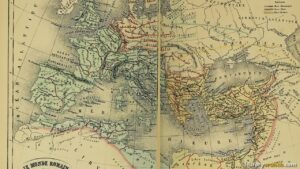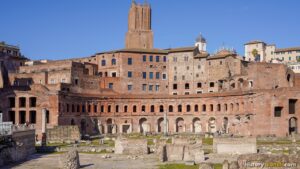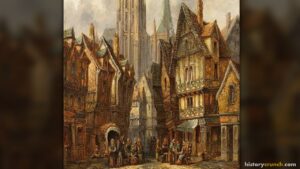
The Byzantine Empire was the eastern half of the Roman Empire that survived for nearly one thousand years after the western half collapsed in 476 CE. Based in the city of Constantinople, the Byzantine Empire lasted from 330 CE until 1453 CE, when it was finally conquered by the Ottoman Turks. During that time it was one of the most powerful civilizations in the world and played a major role in preserving the knowledge and culture of ancient Greece and Rome.
 FactsthatCrunch
 Evidence Photo
Creation of the Byzantine Empire
The Byzantine Empire is also known as the Eastern Roman Empire, and it grew directly out of the Roman Empire that had ruled much of Europe, North Africa, and the Middle East for centuries. When the Roman Empire began to struggle under the pressure of invasion and economic decline, Emperor Constantine I made a major decision that would shape the future of the empire. In 330 CE, Constantine moved the capital of the Roman Empire from Rome to the ancient Greek city of Byzantium, which he renamed Constantinople after himself. The city was located on a narrow strip of land between Europe and Asia, which made it an ideal location for trade and defence.
The Roman Empire was formally divided into two halves in 395 CE following the death of Emperor Theodosius I. The Western Roman Empire continued to be ruled from Rome but struggled to survive against invasions from various groups and eventually collapsed in 476 CE. The Eastern Roman Empire, ruled from Constantinople, survived and continued to grow. Although the people of the Byzantine Empire called themselves Romans and continued many Roman traditions, their culture was shaped heavily by Greek language, Orthodox Christianity, and the unique position of Constantinople at the crossroads of Europe and Asia. The name Byzantine Empire was not actually used by the people who lived in it. It was a term later invented by historians to describe the eastern empire after it had developed its own distinct identity.
FactsthatCrunchDuring the Middle Ages, Constantinople stood at the narrow crossing point between Europe and Asia, making it the busiest trading city in the medieval world. Merchants from Europe, the Middle East, Russia, and Central Asia all passed through the city to buy and sell goods such as silk, spices, and grain. The Byzantine government collected taxes on both imports and exports, and the city grew into the wealthiest commercial center of its era.
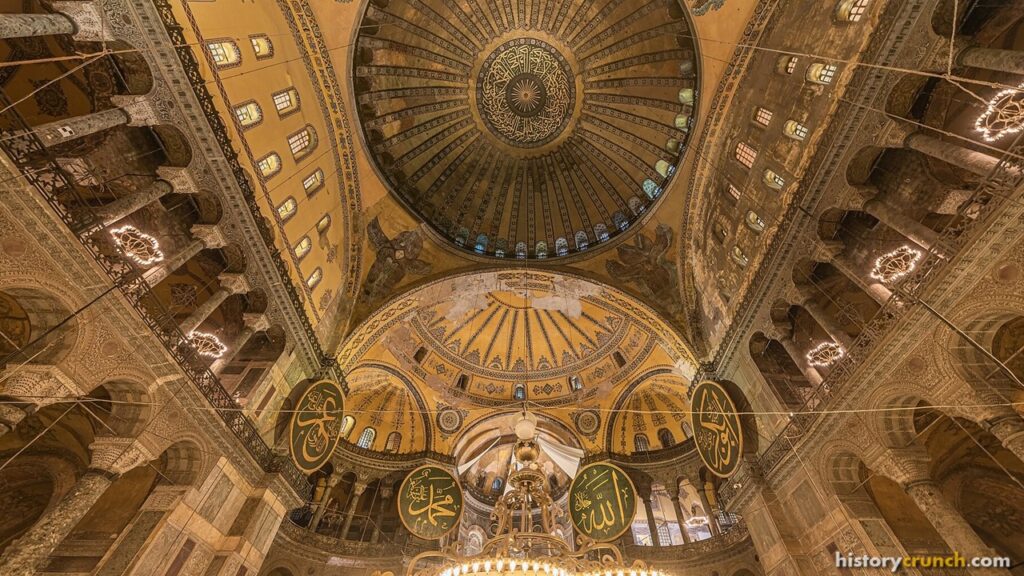
Today the same city is called Istanbul, located in modern Turkey, and it still straddles two continents, with part of the city in Europe and part in Asia. The Hagia Sophia, completed in 537 CE as a Christian church and later converted into a mosque after 1453 CE, still stands and remains a major landmark visited by millions of people each year. Istanbul is now one of the most populated cities in Europe and continues to serve as a meeting point between Eastern and Western cultures.
The geography that made Constantinople so powerful in the Middle Ages still shapes Istanbul's role as a global crossroads today.
Government and Society in the Byzantine Empire
The Byzantine Empire was ruled by an emperor who held absolute powerComplete control over all parts of government with no checks or limits on authority. over the government, the military, and the Church. The emperor was seen as chosen by God to lead the empire, and this gave the position an enormous amount of authority and respect. The emperor lived in the Great Palace of Constantinople and was supported by a large and highly organized government made up of officials, advisors, and administrators who helped run the affairs of such a large empire. While the emperor held ultimate authority, he was also expected to rule wisely and justly, and emperors who failed militarily or caused economic hardship could find themselves removed from power by generals or rival factions within the government.
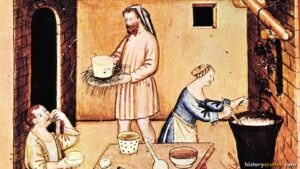
Byzantine society was made up of several different groups. At the top were the emperor and the nobility, which included powerful landowners, military commanders, and senior government officials. Below them were merchants, craftsmen, and skilled workers who lived mainly in the cities. At the bottom of society were the farmers and peasants who worked the land in the countryside and made up the majority of the population. The Greek language was spoken by most people in the empire, replacing Latin over time as the main language of government and everyday life. The Christian Church was central to daily life for all people in the Byzantine Empire, and religious practice shaped everything from the laws of the empire to the art and architecture that decorated its cities and churches.
FactsthatCrunchHow much power did a Byzantine emperor have?
The emperor held absolute power over the government, the military and the Church, and people believed God had chosen him to rule. He was still expected to rule wisely, and emperors who lost wars or caused hard times could be removed from power by generals or rival groups inside the government.
Trade and Economy in the Byzantine Empire
One of the most important reasons the Byzantine Empire survived for so long was its strong economy, which was built on a combination of agriculture and trade. Constantinople’s location between Europe and Asia made it one of the greatest trading cities in the medieval world. Merchants from across Europe, the Middle East, Russia, and Asia came to Constantinople to buy and sell goods, and the city grew into a massive and wealthy center of commerce. For much of the Middle Ages, Constantinople was the largest and most important trading city in the world. This was particularly related to the history and expanse of the Silk Road.
The Byzantine government kept tight control over trade, taxing both imports and exports at a rate of around ten percent. The most important goods traded through the empire included silk, spices, grain, and a wide variety of luxury items. Silk was especially valuable, and for a long period the Byzantines were the only people in Europe who knew how to produce it, which gave them a significant advantage in trade. The government also controlled the production of silk directly, making it a source of both wealth and diplomatic power. Agriculture was the foundation of the economy, with most of the population working the land and producing food for the empire’s cities and armies. When Arab conquests in the 7th century took away important grain-producing regions such as Egypt and Syria, the empire’s economy was seriously weakened. Over time, Italian merchants from cities such as Venice and Genoa gradually took over much of the trade that had once been controlled by the Byzantines, which contributed to the long-term decline of the empire.
FactsthatCrunchThe Byzantine government turned silk into a weapon, using strict rules and royal workshops to control the most valuable cloth in the medieval world.
Reign of Justinian I
One of the most important rulers in the history of the Byzantine Empire was Emperor Justinian I, who ruled from 527 CE to 565 CE. Justinian is remembered for several major achievements that helped define the empire at its height. One of his greatest accomplishments was the reorganization of Roman law into a single organized legal code known as the Corpus Juris CivilisA single organized legal code created under Justinian I that shaped European law for centuries., which is sometimes called the Justinian Code. This code of laws had a major influence on legal systems in Europe for centuries and helped shape the modern concept of law and government.
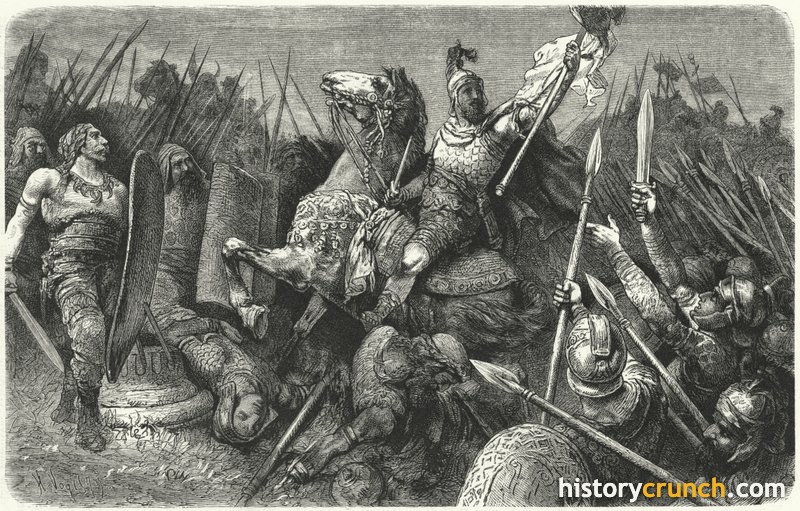
Justinian also launched a series of military campaigns with the goal of recapturing the western territories that had been lost when the Roman Empire collapsed. His armies, led by the brilliant general Belisarius, succeeded in retaking parts of North Africa, Italy, and southern Spain, briefly expanding the empire to its greatest size. As well, Justinian ordered the construction of one of the most famous buildings in history, the Hagia Sophia, a magnificent Christian church in Constantinople completed in 537 CE. The Hagia Sophia was a remarkable feat of architecture for its time and remained one of the largest churches in the world for nearly a thousand years. Despite these achievements, the wars fought under Justinian were expensive and left the empire in a weakened financial state by the time of his death.
FactsthatCrunchBelisarius led the Byzantine armies that recaptured large parts of North Africa, Italy, and southern Spain for Emperor Justinian I, temporarily rebuilding much of the old Roman Empire in the west. He is remembered as a highly skilled military commander of the early Middle Ages, winning major campaigns with relatively small forces through careful tactics and discipline.
Religion in the Byzantine Empire
Religion was one of the most important aspects of life in the Byzantine Empire. Christianity was the official religion of the empire, and the emperor was seen as both the political and spiritual leader of his people. The form of Christianity practiced in the Byzantine Empire became known as Eastern Orthodox ChristianityThe form of Christianity practiced in the Byzantine Empire, differing from the Roman Catholic Church on the Pope’s authority and certain practices., which differed in several important ways from the Roman Catholic Church in western Europe. These differences caused growing tension between the two branches of Christianity over many centuries.
The split between the Eastern Orthodox Church and the Roman Catholic Church became official in 1054 CE in an event known as the Great SchismThe official split in 1054 CE between the Eastern Orthodox Church and the Roman Catholic Church.. The two churches disagreed on several issues, including the authority of the Pope in Rome and differences in religious practices and beliefs. After the Great Schism, the Eastern Orthodox Church centered in Constantinople became the dominant form of Christianity in the Byzantine Empire, as well as in Russia and much of Eastern Europe, where Byzantine missionaries had spread the faith in earlier centuries. Religion shaped nearly every aspect of Byzantine life, from the arts and architecture to the laws and politics of the empire.
The Great Schism of 1054 CE happened partly because the Eastern Orthodox Church and the Roman Catholic Church disagreed over the authority of the Pope in Rome.
Decline and Fall of the Byzantine Empire
After the reign of Justinian I, the Byzantine Empire faced growing challenges from many directions. Arab armies expanding out of the Middle East in the 7th century captured large territories that had belonged to the empire, including Egypt, Syria, and parts of North Africa. In 1071 CE, the Seljuk Turks defeated a Byzantine army at the Battle of Manzikert in a major blow that opened up much of Asia Minor to Turkish settlement. This loss significantly weakened the empire and contributed to the decision by Emperor Alexius I to appeal to western Europe for military help, which was one of the events that led to the First Crusade in 1096 CE.
The relationship between the Byzantine Empire and the Crusaders from western Europe was complicated and often damaging. Rather than helping the empire, the Fourth Crusade in 1204 CE ended in disaster for the Byzantines when Crusader forces attacked and sacked Constantinople itself, dividing the empire into several smaller states. Although the Byzantine emperors eventually recaptured Constantinople in 1261 CE, the empire was greatly weakened and never fully recovered. For the next two centuries, the Ottomans steadily captured the remaining Byzantine territories until only Constantinople itself remained.
The final end of the Byzantine Empire came in 1453 CE when the Ottoman Sultan Mehmed II launched a major siege of Constantinople. The city had survived many siegesA military operation where an army surrounds a city and attacks it to force a surrender. over the centuries due to its strong defensive walls, but the Ottomans used powerful cannons to break through the defences. The last Byzantine emperor, Constantine XI, died fighting in the city as Ottoman forces broke through the walls on May 29th, 1453 CE. With his death, the Byzantine Empire officially came to an end after more than one thousand years of history. Constantinople became the new capital of the Ottoman Empire and was later renamed Istanbul, which remains its name today.
Can you put these key events in the decline of the Byzantine Empire in the right order?
Significance of the Byzantine Empire
The Byzantine Empire played an enormously important role in the history of Europe and the Middle East. By surviving for so long after the fall of the Western Roman Empire, it preserved much of the knowledge, law, and culture of the ancient world through the difficult centuries of the early Middle Ages. Byzantine scholars kept alive the works of ancient Greek and Roman writers, philosophers, and scientists, and this knowledge eventually made its way back into western Europe and helped spark the RenaissanceA period of renewed interest in ancient Greek and Roman knowledge and culture that emerged in western Europe.. The Justinian Code shaped legal traditions across Europe. Eastern Orthodox Christianity spread throughout Russia and Eastern Europe largely because of Byzantine influence, shaping the religious and cultural identity of those regions for centuries.
FactsthatCrunchHow did the Byzantine Empire keep ancient Greek and Roman knowledge alive through the Middle Ages?
Explore Middle Ages · 476 – 1500 CE
Keep exploring Middle Ages with these History Crunch resources.
Key Vocabulary
Absolute power
Corpus Juris Civilis
Great Schism
Eastern Orthodox Christianity
Siege
Renaissance
Silk Road
Frequently Asked Questions
When did the Byzantine Empire begin and end?
The Byzantine Empire lasted from 330 CE until 1453 CE, nearly 1,000 years. It began when Emperor Constantine I moved the Roman capital to Constantinople. It ended when the Ottoman Turks conquered that city.
Why is it called the Byzantine Empire?
The name comes from Byzantium, the old Greek city that became Constantinople. The people who lived there never used the word Byzantine and simply called themselves Romans. Historians invented the term much later to describe the eastern empire.
What did Emperor Justinian I accomplish?
Justinian I reorganized Roman law into the Corpus Juris Civilis, often called the Justinian Code. He also ordered the building of the Hagia Sophia, finished in 537 CE. His armies briefly retook parts of North Africa, Italy, and southern Spain.
What religion did the Byzantine Empire follow?
The Byzantine Empire followed Eastern Orthodox Christianity, which became its official faith. This branch split from the Roman Catholic Church in 1054 CE in the Great Schism. The two churches disagreed over the Pope’s authority and certain practices.
How did the Byzantine Empire fall?
The Byzantine Empire fell in 1453 CE when Sultan Mehmed II captured Constantinople. The Ottomans used powerful cannons to break through the city’s famous walls. The last emperor, Constantine XI, died fighting on May 29th, 1453 CE.
Why was the Byzantine Empire important?
The Byzantine Empire preserved the knowledge and culture of ancient Greece and Rome for centuries. Its scholars kept old Greek and Roman writings alive, which later helped spark the Renaissance. It also spread Orthodox Christianity across Russia and Eastern Europe.
Cite This Article
To cite this article as a source, use one of the formats below.
MLA: Millar, B. “Byzantine Empire: A Detailed Summary.” HistoryCrunch, 15 October 2026, https://historycrunch.com/byzantine-empire/.
APA: Millar, B. (2026). Byzantine Empire: A Detailed Summary. HistoryCrunch. https://historycrunch.com/byzantine-empire/
Chicago: Millar, B. “Byzantine Empire: A Detailed Summary.” HistoryCrunch. October 15, 2026. https://historycrunch.com/byzantine-empire/
Sources
- The Met (Heilbrunn Timeline): medieval art
- Fordham Medieval Sourcebook