The Crusades were one of the most significant events in the history of the Middle Ages. Spanning nearly two centuries from 1096 to 1272 CE, they were a series of religious wars carried out by European Christian crusaders who traveled to the Middle East in an attempt to capture the Holy Land from Muslim control. There were nine major Crusades in total, each with its own causes, routes and outcomes. Together they transformed Europe and the Middle East and left a lasting legacy that continues to shape the relationship between these regions today. This infographic was designed for students to visually summarize the key aspects of the Crusades and is based on the History Crunch article titled Crusades Overview.
Crusades – Infographic
About This Infographic
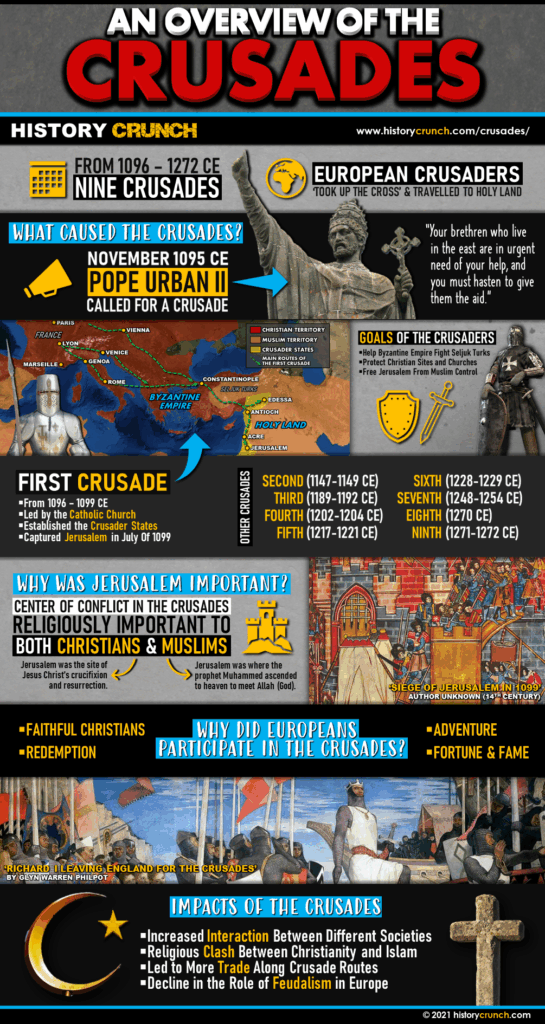
This Crusades infographic was created by the History Crunch team to help students and teachers quickly understand the causes, major events and significance of one of the defining episodes of the Middle Ages. It is designed as a visual learning and study tool, summarizing the essential information covered in our full article on the Crusades Overview. Teachers may use it as a classroom display, a discussion prompt, or a study aid for students preparing for assessments.
What This Infographic Covers
The infographic begins with the causes of the Crusades. There were several key reasons why Pope Urban II called for the First Crusade in his famous Council of Clermont speech on November 27th, 1095 CE. First, the Byzantine Empire was under attack from Muslim civilizations to the east and needed military assistance. Second, the Roman Catholic Church wanted to secure and protect Christian churches and holy sites in the Holy Land. Third, the spread of Islam since the 7th century had caused concern among church leaders who feared Christianity was under threat. Fourth, Jerusalem, which held deep religious significance for Christians, Muslims and Jewish people alike, was under Muslim control. Fifth, calling the crusades gave the Pope an opportunity to unite European kingdoms and direct existing aggression outward rather than inward. Beyond religious duty, many crusaders also joined believing they would be forgiven for their past sins, while others were attracted by the promise of adventure and escape from the hardships of life under feudalism.
The infographic covers the nine major Crusades, which took place over a period of nearly two centuries. The First Crusade (1096 to 1099 CE) was the most successful, ending with the capture of Jerusalem and the establishment of the four Crusader States: the Kingdom of Jerusalem, the County of Edessa, the Principality of Antioch and the County of Tripoli. The Second Crusade (1147 to 1149 CE) was launched after the fall of Edessa and ended in failure at the siege of Damascus. The Third Crusade (1189 to 1192 CE), led by Richard I of England, Philip II of France and Frederick Barbarossa, achieved military victories but failed to retake Jerusalem. The Fourth Crusade (1202 to 1204 CE) was dramatically diverted from its intended destination and ended with the sack of Constantinople. The Fifth Crusade (1217 to 1221 CE) targeted Egypt but ended in defeat on the Nile Delta. The Sixth Crusade (1228 to 1229 CE) uniquely achieved its goals through diplomacy, with Frederick II negotiating the return of Jerusalem. The Seventh Crusade (1248 to 1254 CE) and Eighth Crusade (1270 CE) were both led by King Louis IX of France and both failed. The Ninth Crusade (1271 to 1272 CE), led by Lord Edward of England, was the last major crusading effort in the Holy Land.
The infographic also covers the lasting impacts of the Crusades. The campaigns dramatically increased interaction between European and Middle Eastern civilizations, spreading scientific knowledge, mathematical ideas and philosophical thought from the advanced scholarly centers of the Middle East back into Europe. This exchange of knowledge contributed to the intellectual developments that eventually led to the Renaissance. The Crusades also stimulated trade by creating new demand for routes and supply networks, causing Italian port cities such as Venice and Genoa to grow in wealth and power. They weakened the feudal system by drawing nobles away from their estates and transferring power toward kings, and they deepened the religious divide between Christianity and Islam in ways that shaped the history of the region for centuries.
How to Use This Infographic in the Classroom
This infographic works well as a visual introduction to the Crusades before students read the full overview article, or as a review tool before an assessment. It can also be used as a discussion prompt asking students to consider which cause of the Crusades they think was most significant, or which crusade they believe had the greatest long-term impact on world history. Teachers may also use it alongside the individual Crusade maps to help students connect the chronological overview provided in the infographic with the geographic dimensions of each campaign.
H2: Related Articles
To learn more about the topics covered in this infographic, visit the following History Crunch articles: