Laissez-faireA French phrase meaning ‘leave us alone,’ used to describe an economic system where the government stays out of business and individual economic decisions. capitalism is an economic system that supports the idea of minimal government intervention in the economy. In short, it argues that individuals and businesses should be free to make their own economic choices, which economists refer to as ‘economic individualism‘. This idea became one of the main aspects of modern capitalism. As such, understanding laissez-faire capitalism remains important today.
 FactsthatCrunch
Economic individualism is the idea that individuals and businesses should be free to make their own economic choices without government control. It holds that personal freedom in buying, selling, and producing leads to better outcomes for society than government direction. This concept became a foundation of modern capitalism, especially during the Industrial Revolution.
"Because of economic individualism, factory owners during the Industrial Revolution could decide what to produce, how to produce it, and whom to hire, without needing government approval."
Laissez-Faire Capitalism – History
Often, laissez-faire capitalism is also referred to as free market capitalism or market capitalism. Simply put, laissez-faire translates to “leave us alone” meaning that the government should remain out of the economy and instead allow individuals to freely carry out their own economic affairs. Historically, laissez-faire capitalism was most common during the 18th and 19th centuries in the timeframe of the Industrial Revolution. At the time, it was a revolutionary idea, because in the previous centuries, mercantilismAn older economic system in which the government heavily controlled and regulated trade and production, often under absolute monarchs. had been the dominant economic system. In general, mercantilism is viewed as an economic system that favored heavy government control and regulation. At the time, absolute monarchs ruled over vast empires and controlled almost all aspects of the economy. However, prominent thinkers, including Adam Smith, began to argue against mercantilism in favor of an economic system with more freedom for individuals. The development of capitalism as an economic system sought to reject the idea of government control of the economy and instead put the focus on individuals.
The concept of laissez-faire capitalism first appeared as a reaction against heavy government regulation. In fact, French economists known as the PhysiocratsA group of French economists in the 1700s who believed economies work best when natural laws are allowed to operate without government interference., such as François Quesnay, believed that economies work best when natural laws are allowed to operate freely.
However, the ideas of laissez-faire capitalism gained global attention with Adam Smith’s famous book, ‘The Wealth of Nations’, which he published in 1776. Smith argued that when individuals pursue their own self-interest, they unintentionally promote the good of society through the “invisible handAdam Smith’s term for the way market forces of supply and demand guide the economy on their own, without government direction.” of the market. He believed that government intervention should be limited to protecting property rights, enforcing contracts, and ensuring national defense. His ideas were extensions of those first expressed by the Physiocrats of France.
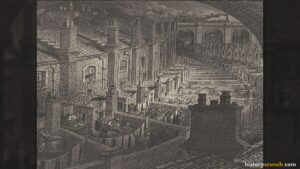
Finally, laissez-faire capitalism became the dominant economic system during the Industrial Revolution in Britain and the United States. Businesses thrived with little regulation, and industries like textiles, steel, and railroads expanded rapidly during this period of industrialization. This period was also marked by the policies of classical liberalism, which is when economic freedom was seen as essential to progress.
FactsthatCrunchLaissez-Faire Capitalism – Main Principles
On the economic spectrum, laissez-faire capitalism is a right-wing ideology that is fundamentally based on: private ownership, competition, free trade, self-reliance, self-interest, and the principles of supply and demand.
Private ownership is a central principle of laissez-faire capitalism. It is the idea that individuals should have the ability to own property, which could include: land, businesses, products, ideas, etc. For example, during the Industrial Revolution, entrepreneurs began to use their wealth to establish privately owned factories, mines and mills. This allowed individuals to control what they produced, how it was produced and for whom they were producing it. Before the development of capitalism, these decisions would have been controlled by the government. Thus, private ownership shifted the economic decision-making from the government to the people.
Competition is another central principle of laissez-faire capitalism. Under mercantilism, the government controlled the means of production and therefore there was little to no competition. Laissez-faire capitalism introduced the idea that individuals and businesses should compete against each other and their success should be determined by the market forces of supply and demand. Therefore, consumers had the ability to decide the success of a business based upon whether they purchased the good or service. Laissez-faire capitalists argued that competition benefited society in a number of ways, including: it lowered the price of goods and services as producers competed for the business of consumers, and it fostered innovation of goods and services as companies competed to outdo each other. For example, modern companies such as Apple and Samsung compete for consumers’ business which causes them to innovate their phones with new features, while still trying to keep costs as low as possible.
Free trade is also a central principle of laissez-faire capitalism. It is the idea that companies and individuals should be allowed to carry out their business without interference from the government. In general, the government intervenes in the economy through taxation, which it collects from both individual citizens and companies. For example, governments collect several forms of taxes including: income tax on individuals, sales tax on purchases, corporate tax on companies and tariffsTaxes placed on goods and services traded between countries, which laissez-faire capitalists argued should be abolished or limited. on goods and services traded between countries. The principle of free trade holds that taxes on trade, such as tariffs, should be abolished or limited to allow the economy to operate on its own without interference. Laissez-faire capitalists argued that it would create more economic activity in the form of trade and thus would create more wealth within a given country.
Self-reliance is another important principle of laissez-faire capitalism. It is the idea that individuals should be responsible for their own well-being and should not rely on the government for assistance. For example, in modern welfare capitalist states, the government provides many social programs to assist citizens. A social program is a government-funded program that is, in general, universally provided to all citizens of the country. There are many examples of social programs in modern democratic nations, including: old age pensions, some form of government funded healthcare, public education, welfare, etc. However, as stated previously, laissez-faire capitalism is in favor of people being responsible for themselves and therefore the government should not intervene in the economy in order to provide assistance. It was argued that self-reliance would push individuals to work harder and would therefore benefit the society more as a whole.
Self-interest is another important aspect of laissez-faire capitalism. Similar to self-reliance, self-interest is the idea that individuals should act, economically, in their own best interest. Further to this idea, laissez-faire capitalists supported the idea that individuals should constantly seek to improve their own well-being over that of the collective society. For example, self-interest is apparent in the decision-making process of most business owners during the Industrial Revolution. They generally made decisions to increase their own wealth over the economic or personal well-being of their workers. Regardless, laissez-faire capitalists argued that self-interest was positive for society as a whole through its indirect impacts. For instance, when wealthy business owners acted based on self-interest they were working to improve the economic standing of their overall company. If the company gained more income it could then use that income to hire more workers and provide more goods or services. Therefore, the belief was that everyone acting in their own self-interest would in the end create more jobs and economic activity to improve the overall economy of a society.
The final main principle of laissez-faire capitalism is the market forces of supply and demand. In any economy there are producers and consumers. Producers are the individuals and companies who supply goods and services for others to purchase. Consumers are the individuals and companies who purchase those goods and services. In a government-controlled economy the actions of producers and consumers are heavily regulated and controlled. However, laissez-faire capitalism holds that the government should leave producers and consumers alone and instead allow the forces of supply and demand to control the economy. For instance, in his book ‘Wealth of Nations’ Adam Smith introduced the idea of the ‘invisible hand’. Simply put, the ‘invisible hand’ is the idea that the market forces of supply and demand should drive the economy of a country. Producers should be free to produce any good or service they want and consumers should be allowed to purchase any good or service. The success of a particular good or service would therefore be conditional on its ability to appeal to a large base of consumers. In turn, supply and demand would also be responsible for setting the price of any given good or service. For example, if a product was in short supply, but was in heavy demand, the price of the product would be at its highest. The reverse situation would see the price of the product plummet to its lowest possible price. As well, supply and demand would also be responsible for setting the wages of workers. If there are many people with the same skillset and only a few jobs, then the wage that a worker could demand would be quite low. Whereas, if the worker has a specialized skillset that not many others possess, then he or she could demand a higher wage. Therefore, laissez-faire capitalists argue that limiting the government and allowing the forces of supply and demand to control the economy is the best means of setting appropriate prices and wages for the producers and consumers in society.
FactsthatCrunchThe phrase laissez-faire is often traced to a French merchant who reportedly told a royal minister, "Laissez-nous faire," or "Leave us alone."
According to the story, around 1681 the finance minister Jean-Baptiste Colbert asked a merchant named Legendre how the government could help business, and the merchant replied that it should simply leave them alone. French economists later turned the idea into a slogan against government control of trade.
Laissez-Faire Capitalism – Positives
As stated above, laissez-faire capitalism was one of the most significant economic theories of the 18th and 19th centuries. It played a vital role in the development of several nations (Britain and the United States) during the events of the Industrial Revolution. For instance, laissez-faire policies encouraged rapid industrialization and innovation. By allowing entrepreneurs freedom, it led to the creation of new technologies, industries, and markets. These changes allowed both Britain and the United States to strengthen their economies and build vast amounts of wealth. As such, laissez-faire ideas laid the foundation for modern free market economies. For this reason, historians and economists consider the history and principles of laissez-faire capitalism to be significant in understanding the current global economy.
Adam Smith believed the government should play no role at all in the economy.
Laissez-Faire Capitalism – Negatives
While laissez-faire capitalism created vast amounts of wealth and developed the economies of many nations, it also had its shortcomings. For instance, the freedom under laissez-faire capitalism also led to harsh conditions for people in the poor and working classes. In fact, many have argued that the unregulated periods of laissez-faire capitalism created inequality, poor working conditions, and environmental problems. These issues led to the development of mixed economiesEconomic systems where governments regulate markets to protect workers and the public while still allowing some individual economic freedom., where governments regulate markets to protect workers and the public while still encouraging freedom and innovation. As such, some people have argued against pure laissez-faire capitalism and instead support some degree of government intervention to combat the shortcomings of economic individualismThe principle that individuals and businesses should be free to make their own economic choices without government control..
FactsthatCrunchKey Vocabulary
Economic individualism
Mercantilism
Physiocrats
Invisible hand
Classical liberalism
Tariffs
Mixed economies
Frequently Asked Questions
What does laissez-faire mean?
Laissez-faire is a French phrase that roughly means “leave us alone.” In economics, it means the government should stay out of business affairs. Instead, individuals and companies make their own economic choices. This idea is a core part of free market capitalism.
Who created the idea of laissez-faire capitalism?
French economists called the Physiocrats, including François Quesnay, first shaped the idea in the 1700s. They believed economies work best when natural laws operate freely. Adam Smith later expanded these ideas in his 1776 book, “The Wealth of Nations.” His work made laissez-faire capitalism known around the world.
What is the “invisible hand”?
The “invisible hand” is a term Adam Smith used to describe how markets guide themselves. He argued that people who pursue their own self-interest end up helping society as a whole. Supply and demand set prices and wages without government control. In this view, the market steers the economy on its own.
How is laissez-faire capitalism different from mercantilism?
Mercantilism relied on heavy government control of the economy, while laissez-faire capitalism favored freedom for individuals. Under mercantilism, absolute monarchs regulated trade and production across their empires. Laissez-faire capitalism rejected this control and gave choices back to people and businesses. It became popular during the Industrial Revolution of the 18th and 19th centuries.
What were the downsides of laissez-faire capitalism?
The lack of rules often led to harsh conditions for poor and working class people. Critics point to inequality, unsafe workplaces, and environmental damage during unregulated periods. These problems led many nations to adopt mixed economies instead. In a mixed economy, the government regulates markets while still allowing some economic freedom.
Cite This Article
To cite this article as a source, use one of the formats below.
MLA: Beck, Elias. “Laissez-faire Capitalism: A Detailed Summary.” HistoryCrunch, 27 September 2026, https://historycrunch.com/laissez-faire-capitalism/.
APA: Beck, E. (2026). Laissez-faire Capitalism: A Detailed Summary. HistoryCrunch. https://historycrunch.com/laissez-faire-capitalism/
Chicago: Beck, Elias. “Laissez-faire Capitalism: A Detailed Summary.” HistoryCrunch. September 27, 2026. https://historycrunch.com/laissez-faire-capitalism/
Sources
- The Science Museum Group
- Emma Griffin, A Short History of the British Industrial Revolution.
- Fordham Modern History Sourcebook