Eli Whitney was an American inventor during the timeframe of the Industrial Revolution and is best remembered today for his invention of the cotton gin and the innovation of interchangeable parts. As such, he had a profound impact on cotton production and manufacturing in the United States during the Industrial Revolution.
 FactsthatCrunch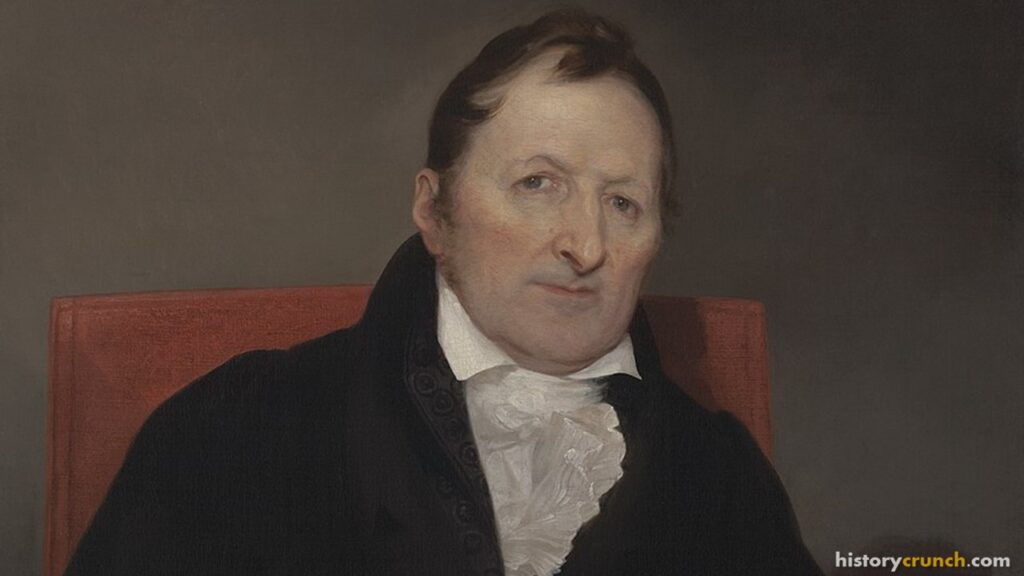
Eli Whitney – Early Life
He was born on December 8th, 1765 in Massachusetts. His father was a successful farmer and his mother helped on the farm too, until she died in 1777 when Whitney was just 11 years old. After his mother’s death, Whitney was put in charge of a nail manufacturing operation, which allowed him to learn early industrial processes. During this time, the American Revolutionary War was occurring. Whitney was also hard working at school and attended college with the hope of pursuing a law degree at Yale University. However, short on money to fund his education, he instead traveled and worked throughout the former American colonies as a farm laborer and school teacher. While en route to South Carolina to work as a private tutor, he was convinced to instead go to Georgia and take work on a plantation there. On the way there, he met Phineas Miller, a plantation manager. The two eventually became business partners. Within months of arriving at the plantation in 1793, Whitney developed the invention for which he became famous.
FactsthatCrunchAs a teenager during the Revolutionary War, Whitney set up a forge in his father's workshop and made nails to sell.
Nails from Britain were hard to get during the war, so homemade nails sold well. Running the forge taught Whitney how to handle tools, materials, and steady production. That hands-on experience shaped the mechanical skills he later used to build the cotton gin and to make muskets.
Eli Whitney – Invention of the Cotton Gin
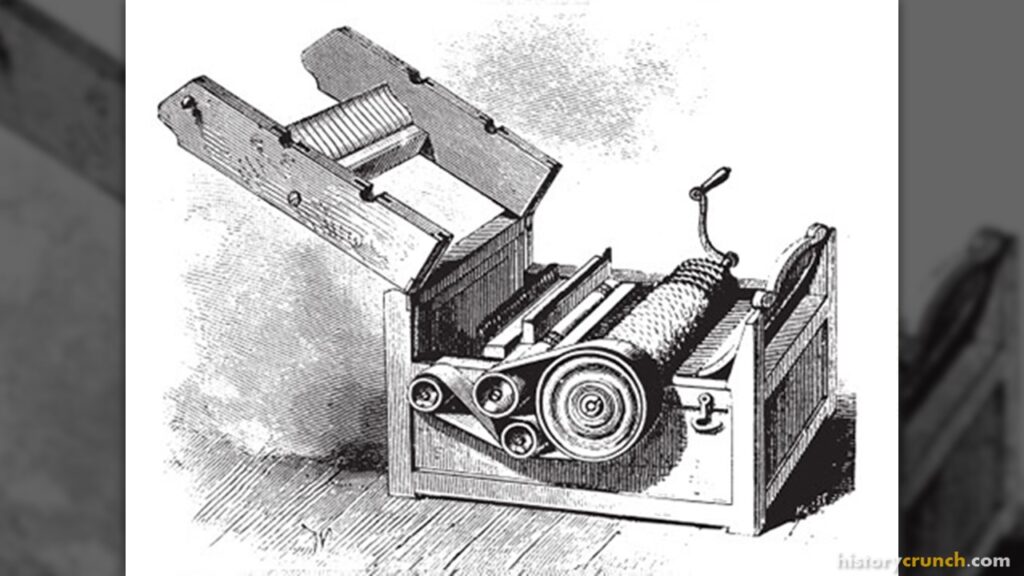
Whitney was an inventor at heart, and when he visited the cotton plantations he realized the need for an improved machine for processing cotton. He developed the cotton ginA machine that quickly separates cotton fibers from seeds, replacing slow manual work.. The cotton gin was a machine that could quickly separate cotton fibers from seeds in order to create cotton items such as clothing and linens. Before the invention of the cotton gin, cotton production and processing were a very slow process, requiring lots of hard manual work. However, the cotton gin led to several main innovations. First, the machine helped to boost productivity and increased cotton usage. Second, the cotton gin helped to increase production of cotton in the United States, and made cotton into a profitable crop. Third, the machine helped to strengthen the United States’ economy and helped expand slavery and the slave trade. As such, Eli Whitney is often viewed as one of the main inventors of the Industrial Revolution and was of particular importance to industrialization in the United States. In fact, the invention of the cotton gin was vitally important to the textile industry, which was booming during the timeframe of the Industrial Revolution.
 FactsthatCrunch
The cotton gin made cotton so profitable that Southern plantation owners rapidly expanded their fields to grow as much cotton as possible.
Eli Whitney patented the cotton gin in 1794. Rather than reducing the need for labor, the machine increased the scale of cotton farming so dramatically that it strengthened and expanded the institution of slavery across the South.
Eli Whitney – Invention of Interchangeable Parts
Although the cotton gin was very profitable and was a key invention of the Industrial Revolution, Whitney did not see much in the way of profit from his invention. This is because of patentA legal right that protects an inventor’s design from being copied by others without permission. battles that took place. Despite this, Whitney continued to invent. He manufactured arms and developed a relationship with the United States Army. For instance, in 1798 he was granted a contract to develop firearms for the United States Army. This led to his company pioneering the innovation of the interchangeable parts systems of production which was important for a number of processes. Essentially, interchangeable partsMatching components made to be easily swapped out so only a broken piece needs replacing, not the whole product. is the idea that a product should be made of easily replaceable parts. As such, when a single part of the product breaks or needs repair, the single part could be easily replaced instead of the entire item. Whitney’s company developed firearms with this system in mind, making Whitney an early pioneer in the process of interchangeable parts, which has come to dominate the world of mass productionMaking large quantities of a product efficiently, often using systems like interchangeable parts..
 FactsthatCrunch
What did Eli Whitney promise the U.S. government in 1798?
In 1798 Whitney signed a contract to make 10,000 muskets for the U.S. government in just two years. He planned to use machines to make matching parts that could fit any musket. The job took far longer than promised, and the last muskets were delivered in 1809. Historians note his parts were not fully interchangeable, but he helped spread the idea that later drove mass production.
Eli Whitney – Death and Legacy
Eli Whitney developed cancer, and died on January 8th, 1825 in Connecticut. He was just 59 years old. During his illness he continued to invent. Today, he is remembered as a significant figure in the Industrial Revolution and American History.
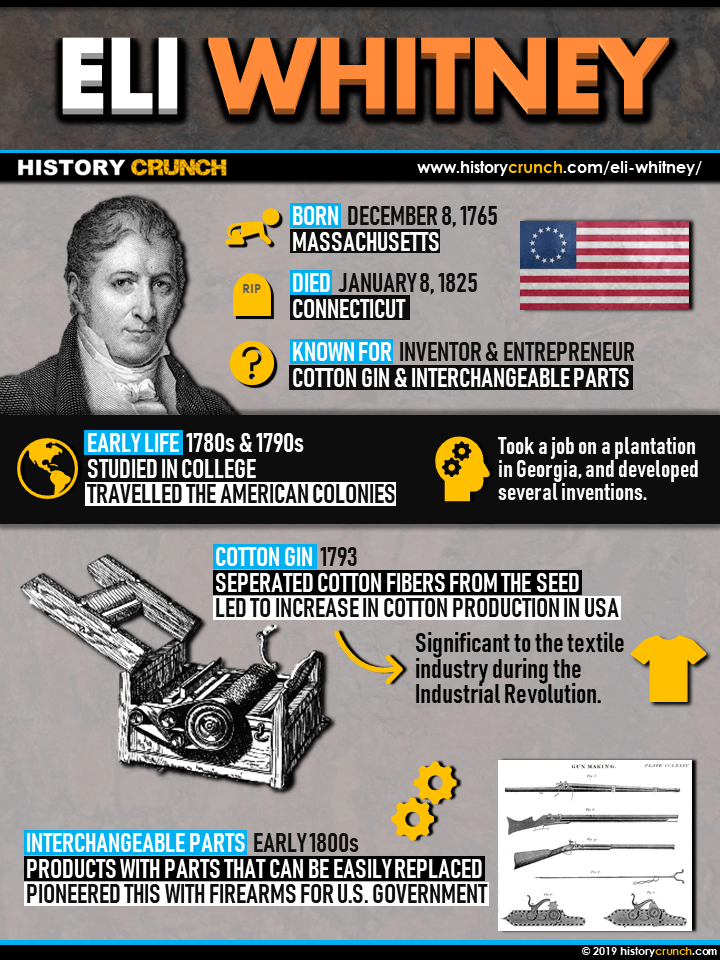
Eli Whitney – Infographic
Key Vocabulary
Cotton gin
Interchangeable parts
Patent
Textile industry
Mass production
Frequently Asked Questions
What did Eli Whitney invent?
Eli Whitney is best known for inventing the cotton gin, a machine that separated cotton fibers from seeds. He also pioneered the use of interchangeable parts in gun manufacturing. Both ideas helped shape mass production during the Industrial Revolution.
How did the cotton gin work?
The cotton gin quickly pulled cotton fibers away from their seeds using a machine instead of slow hand labor. This let workers process much more cotton in far less time. As a result, cotton became a very profitable crop in the United States.
Why did the cotton gin increase slavery?
The cotton gin made cotton so profitable that plantation owners wanted to grow much more of it. Growing and picking more cotton required more enslaved workers in the fields. In this way the machine helped expand slavery and the slave trade in the South.
What are interchangeable parts?
Interchangeable parts are matching pieces that can be swapped in and out of a product. When one part breaks, only that piece needs replacing instead of the whole item. Whitney promoted this idea after winning a 1798 government contract to make muskets.
Did Eli Whitney get rich from the cotton gin?
No, Whitney earned little money from the cotton gin despite how important it became. Long patent battles kept him from collecting profits as others copied his design. He turned to making firearms to earn a steady income instead.
When did Eli Whitney live?
Eli Whitney was born on December 8th, 1765 in Massachusetts and died on January 8th, 1825 in Connecticut. He was 59 years old when he passed away from cancer. He kept inventing even during his final illness.
Cite This Article
To cite this article as a source, use one of the formats below.
MLA: Beck, Elias. “Eli Whitney: A Detailed Biography.” HistoryCrunch, 26 September 2026, https://historycrunch.com/eli-whitney/.
APA: Beck, E. (2026). Eli Whitney: A Detailed Biography. HistoryCrunch. https://historycrunch.com/eli-whitney/
Chicago: Beck, Elias. “Eli Whitney: A Detailed Biography.” HistoryCrunch. September 26, 2026. https://historycrunch.com/eli-whitney/
Sources
- Robert C. Allen, The Industrial Revolution: A Very Short Introduction.
- Joel Mokyr, The Enlightened Economy.