Elie Wiesel was one of the most important Holocaust survivors of the 20th century. He was a writer, teacher and public voice who became widely known for bearing witnessPublicly telling what you personally saw or experienced so others will know the truth. to the Holocaust and for urging later generations not to forget it. However, Elie Wiesel is best known for his memoirA book in which a real person writes about their own life and experiences. ‘Night’, which was based on his experiences in the Nazi concentration camp system during the later years of the Holocaust. As well, he later became an important public figure in Holocaust remembrance, human rights advocacy and education.
 FactsthatCrunch
Elie Wiesel survived Auschwitz-Birkenau and Buchenwald concentration camps during World War II and later wrote 'Night,' a memoir published in French in 1958 that became a central text for understanding the Holocaust. After the war, he spent decades speaking to governments and the public about the dangers of silence in the face of persecution, and he received the Nobel Peace Prize in 1986 for that work.
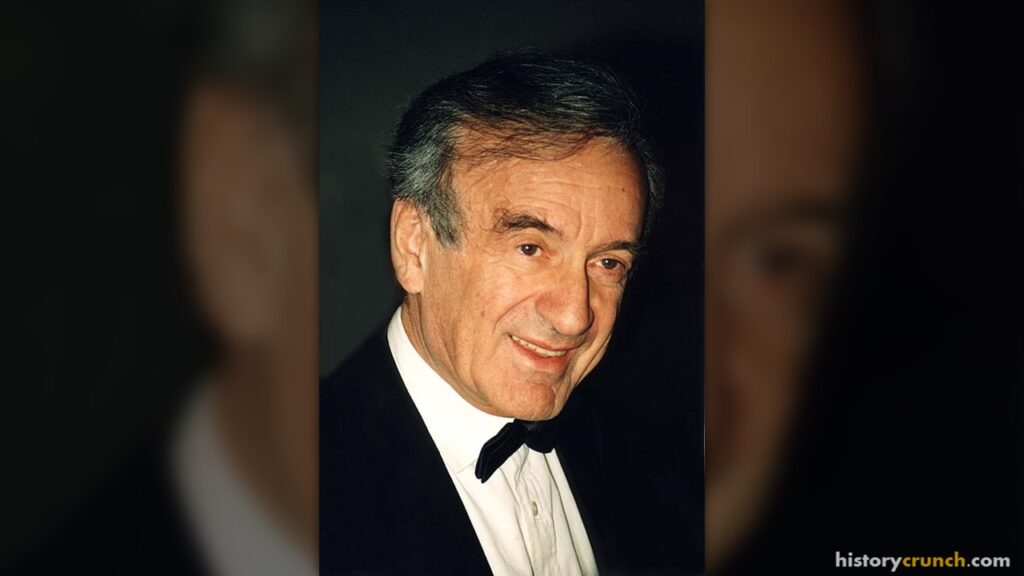
Elie Wiesel – Early Life
Elie Wiesel was born as Eliezer Wiesel into a Jewish family in Sighet, Romania on September 30th, 1928. He grew up in a religious community and was strongly shaped by Jewish learning and tradition while he was still young. This early background remained important throughout his life, because questions of faith, memory, and morality later became central themes in his writing.
His youth was ultimately disrupted by the expansion of Nazi power during World War II. In March of 1944, Germany occupied the nation of Hungary, which then controlled the region where Wiesel lived. This resulted in the rapid extension of anti-Jewish persecution into his hometown and set the stage for his experiences in the Holocaust.
FactsthatCrunchIn March of 1944, Germany occupied Hungary, bringing Nazi anti-Jewish persecution directly to the region where Elie Wiesel lived.
Elie Wiesel – the Holocaust
In May of 1944, Elie Wiesel, his parents, and his sisters were deportedForcibly removed from your home and sent somewhere else, usually by a government. from Sighet to Auschwitz-Birkenau, which was the most notorious of all of the Nazi concentration camps. Upon arrival, his mother Sarah and his younger sister Tzipora were murdered. This is because Auschwitz-Birkenau was both a concentration camp and a death camp. As such, generally only working age men were kept alive to work in the concentration camps. For instance, Elie Wiesel and his father Shlomo were selected for forced labor, which meant that they remained alive only as long as the Nazis considered them useful for work.
Later, as the war turned against Nazi Germany, Wiesel and his father were forced on a death marchA forced journey on foot under brutal conditions, ordered by guards, that killed many prisoners. and then taken to Buchenwald, which was another Nazi German concentration camp. His father died there on January 29th, 1945, only a short time before the camp was liberated on April 11th, 1945. These events became the core of Elie Wiesel’s later writing, and more specifically they shaped the deeply personal witness that appears in his famous memoir ‘Night’.
FactsthatCrunchElie Wiesel – Writer
After World War II, Elie Wiesel was sent to France, where he rebuilt his life and later studied in Paris. Furthermore, by the late 1940s he had begun working as a journalist, and over time he moved toward writing about what he had lived through in the Holocaust.
As stated above, his most famous work was ‘Night’. The book first grew out of a longer Yiddish manuscript, then appeared in French as ‘La Nuit’ in 1958, and in English as ‘Night’ in 1960. In fact, the book became one of the best known Holocaust memoirs in the world because it presented the Holocaust through the experience of one teenager and his father inside Auschwitz and Buchenwald.
Elie Wiesel did not only write about his own hardships. Over the years, he published dozens of books and became known for discussing memory, faith, silence, and human responsibility after catastrophe. As such, his writing was important not simply as autobiography, but as a larger moral response to genocideThe deliberate killing of a large group of people because of their race, religion, or ethnicity. and indifferenceA refusal to care about the suffering of others, treated here as a moral failure..
For instance, in the decades after World War II, Elie Wiesel became one of the most prominent public voices connected to Holocaust remembrance. More specifically, from 1978 he chaired the President’s Commission on the Holocaust, and then the United States Holocaust Memorial Council until 1986, and he helped lead the effort that resulted in the creation of the United States Holocaust Memorial Museum. He received the Nobel Peace Prize in 1986. By that point, he was widely recognized not only as a survivor and writer, but also as an international moral voice who spoke against hatred, repression and indifference.
FactsthatCrunchElie Wiesel's memoir Night appeared in three published forms, each differing in language and audience.
Elie Wiesel – Death
Elie Wiesel died on July 2nd, 2016, at his home in New York City following a long illness. By the time of his death, he had become one of the most recognizable Holocaust survivors in the world and one of the most influential witnesses to Nazi persecution. His death marked the passing of a figure whose life had long stood at the center of Holocaust memory and education.
Elie Wiesel – Significance
Elie Wiesel was significant because he gave millions of readers a direct and personal way to understand the human experience of the Holocaust, while his later public work helped build institutions and conversations devoted to remembrance. For that reason, Elie Wiesel remains one of the most important voices in the history of Holocaust education.
We must take sides. Neutrality helps the oppressor, never the victim. Silence encourages the tormentor, never the tormented.
Key Vocabulary
Bearing witness
Memoir
Deported
Death march
Indifference
Genocide
Frequently Asked Questions
Why did Elie Wiesel write ‘Night’?
Elie Wiesel wrote ‘Night’ to bear witness to what he saw and suffered during the Holocaust. The book began as a longer Yiddish manuscript before it appeared in French in 1958 and in English in 1960. He wanted readers to understand the Holocaust through one teenager’s real experience inside the camps.
What concentration camps was Elie Wiesel held in?
Elie Wiesel was held in Auschwitz-Birkenau and later Buchenwald, both Nazi German concentration camps. He and his father were deported to Auschwitz in May of 1944 and chosen for forced labor. As the war ended, they were forced on a death march to Buchenwald, where his father died.
Did Elie Wiesel win the Nobel Peace Prize?
Elie Wiesel won the Nobel Peace Prize in 1986 for his work against hatred and indifference. By then he was known as a survivor, writer, and international moral voice. The award recognized decades of speaking out for human rights and Holocaust remembrance.
What happened to Elie Wiesel’s family during the Holocaust?
Elie Wiesel’s mother Sarah and younger sister Tzipora were murdered soon after the family arrived at Auschwitz-Birkenau. His father Shlomo was kept alive for forced labor but died at Buchenwald on January 29th, 1945. This was only a short time before the camp was liberated in April.
How did Elie Wiesel help with Holocaust remembrance?
Elie Wiesel helped lead the effort that created the United States Holocaust Memorial Museum. From 1978 he chaired the President’s Commission on the Holocaust and later the United States Holocaust Memorial Council. His work helped build lasting institutions devoted to memory and education.
Cite This Article
To cite this article as a source, use one of the formats below.
MLA: Millar, B. “Elie Wiesel: A Detailed Biography.” HistoryCrunch, 16 September 2026, https://historycrunch.com/elie-wiesel/.
APA: Millar, B. (2026). Elie Wiesel: A Detailed Biography. HistoryCrunch. https://historycrunch.com/elie-wiesel/
Chicago: Millar, B. “Elie Wiesel: A Detailed Biography.” HistoryCrunch. September 16, 2026. https://historycrunch.com/elie-wiesel/
Sources
- Jerry Bentley & Herbert Ziegler, Traditions & Encounters: A Global Perspective on the Past.
- J.M. Roberts & Odd Arne Westad, The Penguin History of the World.