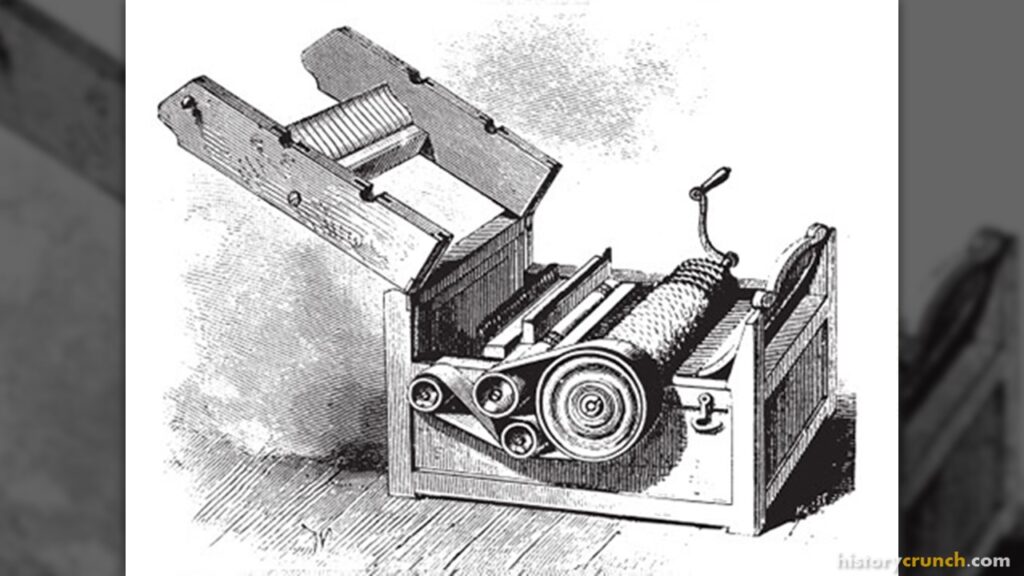
The invention of the cotton ginA machine invented in 1793 that quickly separated cotton fibers from their seeds. by Eli Whitney in 1793 revolutionized the cotton industry during the Industrial Revolution. This device efficiently separated cotton fibers from their seeds, drastically reducing the labor required for this process. As a result, cotton production soared, transforming it into a highly profitable commodityA raw material or agricultural product that can be bought and sold for profit. and fueling the growth of the textile industry. However, the cotton gin also had a profound social impact, inadvertently strengthening the institution of slavery in the Southern United States by increasing the demand for cotton plantation labor.
 FactsthatCrunch
Innovations in the Industrial Revolution
The Industrial Revolution is one of the most significant events in all of world history and had a profound impact on the modern world. It began first in Britain in the 1700s but soon expanded to the rest of Europe and North America. Before the innovations of the Industrial Revolution, most production depended on water, wind or human energy. The businesses that existed at this time were called cottage industriesEarly home-based businesses where workers made a limited amount of goods before factory production existed.. Cottage industries were an early stage of economic development in society in which workers produce a limited amount of goods in home-based businesses. However, by the mid-1700’s, new methods of production were being developed across Europe, especially in Great Britain. This transition led to the factory system, which was the creation of factories in centralized locations such as industrial towns and cities. This period of innovation continued throughout the 19th century and led to many new inventions by now famous inventors. In fact, one of the key features of the Industrial Revolution is the development of new inventions that led to more automationUsing machines to do work that people previously had to do by hand. by machines. Significant inventions or innovations of the Industrial Revolution included: flying shuttle, spinning jenny, power loom, water frame, cotton gin, steam engine, telephone, light bulb, automobile, assembly line production and interchangeable parts.
 FactsthatCrunch
Eli Whitney secured his cotton gin patent in 1794, but the patent brought him little financial reward because copies of his machine spread across the South before he could enforce his rights.
Whitney and his business partner Phineas Miller spent years filing lawsuits against planters and manufacturers who built unauthorized copies of the gin. The legal fees drained their finances, and courts in Southern states were slow to rule in their favor. Whitney earned very little from the invention that helped transform American cotton production, and he eventually turned to making muskets for the U.S. government to recover his losses.
Eli Whitney and the Cotton Gin
A significant invention of the Industrial Revolution was the cotton gin, which was invented by Eli Whitney in 1793. Eli Whitney was an American inventor and is remembered today for inventing the cotton gin, which was an important development to the textile industry. The textile industryThe business sector focused on making cloth and clothing from raw materials like cotton. was based on the development of cloth and clothing. He is also considered to be the pioneer of the system of interchangeable parts, which made items more easily repairable.
Whitney was an inventor at heart, and when he visited the cotton plantations he realised the need for an improved machine for processing cotton. He developed the cotton gin. The cotton gin was a machine that could quickly separate cotton fibers from seeds in order to create cotton items such as clothing and linens. Before the invention of the cotton gin, cotton production and processing was a very slow process, requiring lots of hard manual work.
 FactsthatCrunch
Can you name this mystery person before the photo develops? Click through the hints and lock in your guess.
What Innovations Did the Cotton Gin Lead To?
However, the cotton gin led to several main innovations. First, the machine helped to boost productivity and increased cotton usage. Second, the cotton gin helped to increase production of cotton in the United States, and made cotton into a profitable crop. Third, the machine helped to strengthen the United States’ economy and greatly expanded slavery and the slave trade within the United States. As such, Eli Whitney is often viewed as one of the main inventors of the Industrial Revolution and was of particular importance to industrialization in the United States. In fact, the invention of the cotton gin was vitally important to the textile industry, which was booming during the timeframe of the Industrial Revolution. With that said, the invention of the cotton gin was also significant to slavery in the United States, since cotton production was a central component of the slavery economy at the time.
 FactsthatCrunch
The cotton gin made cleaning cotton much faster. What happened to cotton output in the United States as a direct result?
Industrial Revolution timeline · 1760 – 1840
Key Vocabulary
Cottage industries
Factory system
Automation
Cotton gin
Interchangeable parts
Textile industry
Commodity
Frequently Asked Questions
Who invented the cotton gin and when?
Eli Whitney invented the cotton gin in 1793. Whitney was an American inventor who saw the need for a faster way to process cotton. He is also known as a pioneer of interchangeable parts, which made machines easier to repair.
What did the cotton gin do?
The cotton gin quickly separated cotton fibers from their seeds. Before this machine, that task took slow and hard manual work by hand. The gin sped up the process and let workers clean far more cotton in less time.
How did the cotton gin affect the textile industry?
The cotton gin boosted productivity and made cotton a profitable crop in the United States. More cleaned cotton meant more raw material for making cloth and clothing. This helped the textile industry grow quickly during the Industrial Revolution.
Why did the cotton gin increase slavery?
The cotton gin raised the demand for cotton, which meant more workers were needed on plantations. Cleaning cotton became fast, but growing and picking it still took heavy labor. This increased the demand for enslaved people in the Southern United States.
Why is the cotton gin important in the Industrial Revolution?
The cotton gin was a key invention that pushed the United States toward industrial production. It strengthened the economy and supported the growing textile industry. For these reasons, Eli Whitney is seen as one of the main inventors of the Industrial Revolution.
Cite This Article
To cite this article as a source, use one of the formats below.
MLA: Beck, Elias. “Cotton Gin Invention in the Industrial Revolution: A Detailed Summary.” HistoryCrunch, 25 September 2026, https://historycrunch.com/cotton-gin-invention-in-the-industrial-revolution/.
APA: Beck, E. (2026). Cotton Gin Invention in the Industrial Revolution: A Detailed Summary. HistoryCrunch. https://historycrunch.com/cotton-gin-invention-in-the-industrial-revolution/
Chicago: Beck, Elias. “Cotton Gin Invention in the Industrial Revolution: A Detailed Summary.” HistoryCrunch. September 25, 2026. https://historycrunch.com/cotton-gin-invention-in-the-industrial-revolution/
Sources
- Library of Congress
- Joel Mokyr, The Enlightened Economy.