
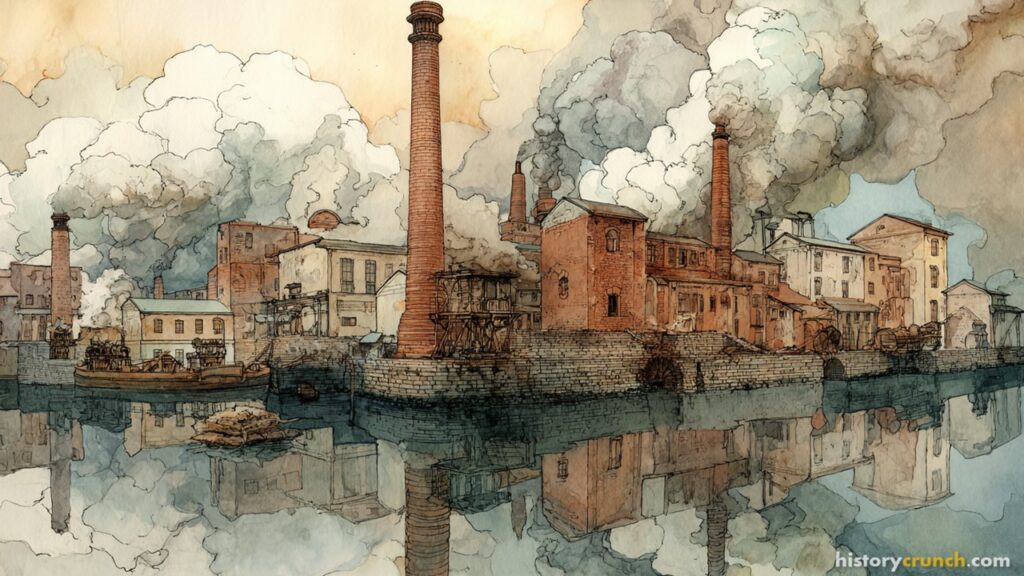
The Industrial Revolution is the two hundred years in which human beings stopped making things by hand in their own homes and started making them by machine in somebody else's building. It began with British farming and British coal, produced the factory, the railway, the city, the union and the middle class, and ended with a world where almost everything anyone owns was made by a machine that a stranger operates.
The Industrial Revolution ran from about 1760 to 1914. This timeline covers 1700 to 1947, from the seed drill to the death of Henry Ford.
The Industrial Revolution is the largest change in how human beings live since farming was invented, and it happened in about two hundred years. The events below run from a horse-drawn seed drill in an English field to the death of the man who built fifteen million identical cars. Most of them are the result of something earlier on the list: a machine that made thread faster than anyone could weave it, a mill that needed a river, an engine that freed the mill from the river, and a law passed because somebody printed what was happening inside the building.
The question every course asks first is why this happened in one damp island off the coast of Europe rather than in France, China or anywhere else. This view is the answer: farming that fed more people with fewer farmers, laws that fenced the commons and emptied the villages, coal and iron in the same valleys, rivers and canals to move them, colonies to supply the cotton and buy the cloth, banks that would lend and patents that made inventing pay.
The Industrial Revolution began in cloth, and it began as an argument between spinning and weaving. John Kay's flying shuttle of 1733 let one weaver do the work of two and used thread faster than spinners could make it; Hargreaves' spinning jenny answered that, Arkwright's water frame answered the jenny, and Cartwright's power loom finished the argument. In sixty years the making of cloth went from a family in a kitchen to a five-storey mill, and every machine on this view was invented by somebody solving the problem the machine before it had caused.
A revolution in making things is a revolution in power and materials. This view follows both: the engine built to pump water out of a coal mine, the improvement that let it turn a shaft and free the factory from the river, the rails that carried what the factories made, the process that turned steel from a luxury into a building material, and the moving line that put the whole idea together in Detroit in 1913.
This view is about what industry did to the people inside it. The bell that started the shift, the children who crawled under running machines, the back-to-back houses with a shared privy and a pump beside the cesspit, the cholera that killed rich and poor alike and so got something done, the schools that finally ended child labor in Britain, and the locked doors in New York that killed 146 people in twenty minutes.
Every economic idea we still argue about was formed by people looking at a factory. Adam Smith explained why a free market makes a country rich; Malthus explained why helping the poor was pointless; Owen and Fourier tried to build something better and Owen made it pay; Dickens made the middle class look; Marx built a theory of history on Manchester and it governed a third of the world. This view follows the argument, from 1776 to the stopwatch on the factory floor.
In 1799 it was a crime in Britain for workmen to meet about their wages. In 1938 the United States set a minimum wage, a forty-hour week and a minimum working age by federal law. This view is the hundred and forty years in between: machines broken at night, petitions rejected three times, evidence printed, unions founded and destroyed, detectives on barges, troops on the railways, and at the end two American laws that gave working people the thing they had been asking for since the beginning.
American industry began as theft: an apprentice memorized Arkwright's machines and sailed for Rhode Island in 1789. A century later the United States was making more than Britain. This view follows it: the cotton gin that made slavery profitable, the railroad that made one market of a continent, the immigrants who worked the mills, the men who owned them, the reformers who regulated them, and the farm boy in Detroit who built a car that everybody could afford.
Almost none of them were scientists. A clockmaker, a carpenter, a barber, an instrument maker, a clergyman who had never seen a loom, a teacher of the deaf, a telegraph operator and two men who made bicycles: this view follows the people who built the machines, most of whom solved a practical problem in front of them and had no idea what they were starting.
France had more people, China had better technology for centuries and the Dutch had better banks. Why did this happen in Britain?
The causes run from the farms of 1700 to the first factory in 1771, and no single one of them is the answer.
A factory needs hundreds of people who have nowhere else to be. In 1700 almost everybody in Britain had somewhere else to be. What changed?
Before anyone could build a mill, somebody had to empty the villages.
Britain's first great industry spun cotton. Britain grows no cotton. So who grew it, and under what conditions?
The machines that made Lancashire rich were fed by fields worked by enslaved people.
Six machines in sixty years turned cloth-making from a cottage trade into an industry. Why did they come one after another instead of all at once?
The textile machines run from the flying shuttle of 1733 to the cotton gin of 1793, and each one was built to fix the shortage the machine before it caused.
An engine built in 1712 to pump water out of a Staffordshire mine ended up building cars in Detroit. How?
The power story runs from Newcomen's engine to Ford's moving line, through Watt, the railway, interchangeable parts and cheap steel.
Every time one half of cloth-making got faster, the other half became the problem. Why does one invention force the next?
Four machines in fifty years, each one built to fix the bottleneck the machine before it created.
Steel existed for centuries before 1856 and was used for swords and springs, not buildings. What changed when it got cheap?
One process dropped the price of steel by about eighty percent, and the shape of cities changed.
In 1750 news moved at the speed of a horse or a ship. By 1876 it moved at the speed of electricity. What does that do to a society?
Canal, rail, cable and telephone, and each one cut the time between two places.
Why would anyone leave a cottage where they set their own hours to work thirteen hours a day to somebody else's bell?
This path runs from the cottage system to the first federal law that ended child labor in America, through the evidence people gave at the time.
Manchester went from 25,000 people to over 300,000 in eighty years. Where did they all live?
This path follows urbanization from the emptying of the villages to the laws that finally made the towns habitable.
Children worked in British mills for decades before anyone made it illegal. Why did it take so long, and what finally worked?
From the first evidence in 1819 to the last law in 1938, a slow argument about what a childhood is for.
People moved to the towns for work and then died younger than their parents had in the countryside. What was killing them?
Cholera arrived in 1832 and forced Britain to look at what its towns were drinking.
A farm worker works until the job is done. A factory worker works until the bell. When did the clock take over, and what did people lose?
Work used to be measured in tasks. The factory measured it in minutes, and then in seconds.
Within seventy years of the first factory, four men had produced four completely different explanations of what it meant. Which of them was right?
This path follows the economic argument from the Wealth of Nations in 1776 to the Communist Manifesto in 1848 and the trusts that followed.
Britain got much richer. Did the people who made it richer get better off, and if so, when?
The oldest argument in economic history, and the evidence genuinely points both ways.
In 1798 Malthus argued that population always outruns food. Britain's population then grew enormously and nobody starved. What did he miss?
A prediction that had been right for most of human history, made just as it stopped being right.
Standard Oil made oil cheaper and more reliable and destroyed everyone who competed with it. Should that be allowed?
The first modern monopoly, and the first modern attempt to stop one.
In 1799 it was a crime in Britain for workers to meet about their wages. In 1938 America set a minimum wage by federal law. What happened in between?
The labor story runs from the Combination Acts to the Fair Labor Standards Act, a hundred and forty years, mostly of losing.
The Luddites broke machines and are remembered as fools who tried to stop progress. They were skilled workers with families. What were they actually saying?
Not a protest against machinery, but against what was being done with it.
Britain argued its way to factory law through committees. America did it through strikes that turned into gun battles. Why the difference?
Four confrontations in twenty years, and a union movement shaped by losing them.
Again and again the rule changes only after people die in a way the public can see. Is that how reform actually works?
Cholera, a committee, a novel and a fire, and a law after each one.
The United States had no factories in 1789 and was outproducing Britain by the 1890s. How?
This path runs from a stolen machine design in 1789 to the moving assembly line in 1913.
American industry grew faster than any before it. The people who did the building were mostly not born there. Who were they?
From Ellis Island to the steel town, the workforce that made the United States an industrial power.
Ford made a car a worker could buy and paid wages a worker could live on. Is that the birth of modern prosperity, or a story Ford told well?
One company, one decade, and an argument about who deserves the credit for mass prosperity.
A clockmaker, a carpenter, a barber, a clergyman, a teacher of the deaf and two bicycle makers. Why were almost none of the great inventors scientists?
This path follows the inventors themselves, from Newcomen in 1712 to the Wright brothers in 1903.
Britain made it illegal to export its textile machines or the people who knew how to build them. It did not work. Why not?
Samuel Slater left England with the plans in his memory, and American industry started.
Bell, Edison, Benz and the Wrights all built things that changed the world. Plenty of equally clever people built things nobody remembers. What is the difference?
Four inventions that stuck, and the question of what made them stick.
Two hundred years on, which parts of ordinary life come from this, and what did it cost?
This path takes the whole timeline and asks what is different, from the first factory to the last federal law.
The Industrial Revolution is measured in output, wages and inventions. What happens to the account if you measure it in smoke and rivers?
The first economy to run on fossil fuel, and the first to find out what that costs.
Women had always worked. The factory changed where they worked, who paid them and who saw it. Did that make them freer?
From the family kitchen to the mill, the mine, the shirtwaist factory and eventually the vote.
In 1700 Britain held about five and a half million people and four out of five of them worked the land. Cloth was made at home by whole families at their own pace, power came from muscle, wind and water, and most people lived and died within a few miles of where they were born. Then farming changed: a seed drill, a four-crop rotation and five thousand acts of Parliament that fenced the common land produced more food with fewer farmers and a great many villagers with nowhere to go. A Devon ironmonger built an engine that pumped water out of a coal mine with steam, and a duke cut a canal that halved the price of coal in Manchester. Nothing about this looked like a revolution at the time.
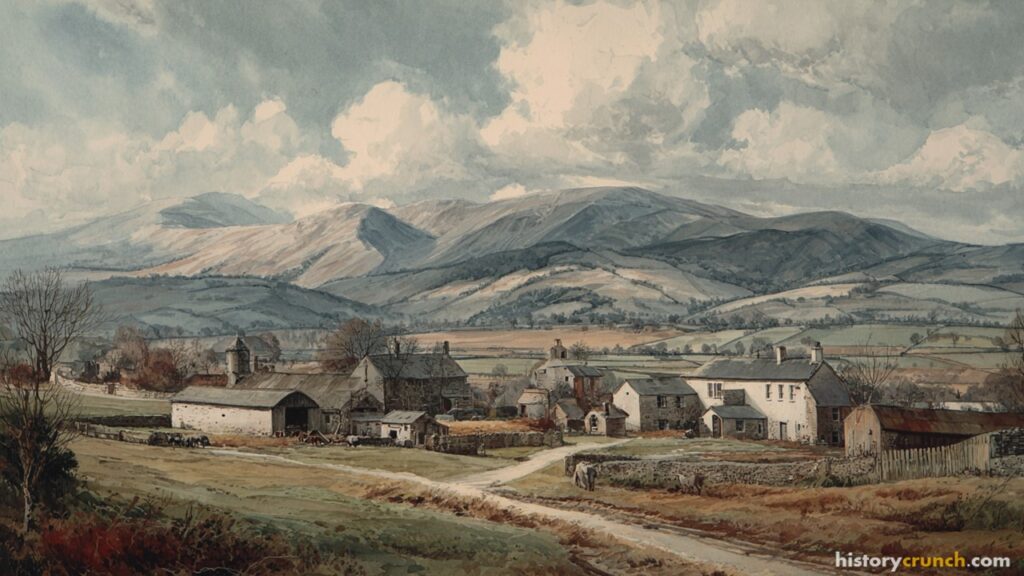
In 1700 about 5.5 million people lived in Britain, and around 80 percent of them worked the land. Most cloth was made at home under the putting out system, in which a merchant supplied the raw wool and collected the yarn, most power came from muscle, wind or water, and most people died within a few miles of where they were born. A hundred years later the population was over 9 million and by 1840 it was nearly 16 million, because better farming meant fewer people starved.
LEARN MORESHOW LESSwhy it matters · key numbersSOCIALEvery card that follows depends on this one. A country cannot put people in factories until its farms can feed them without them, and Britain's farms learned how in the fifty years before the machines arrived.
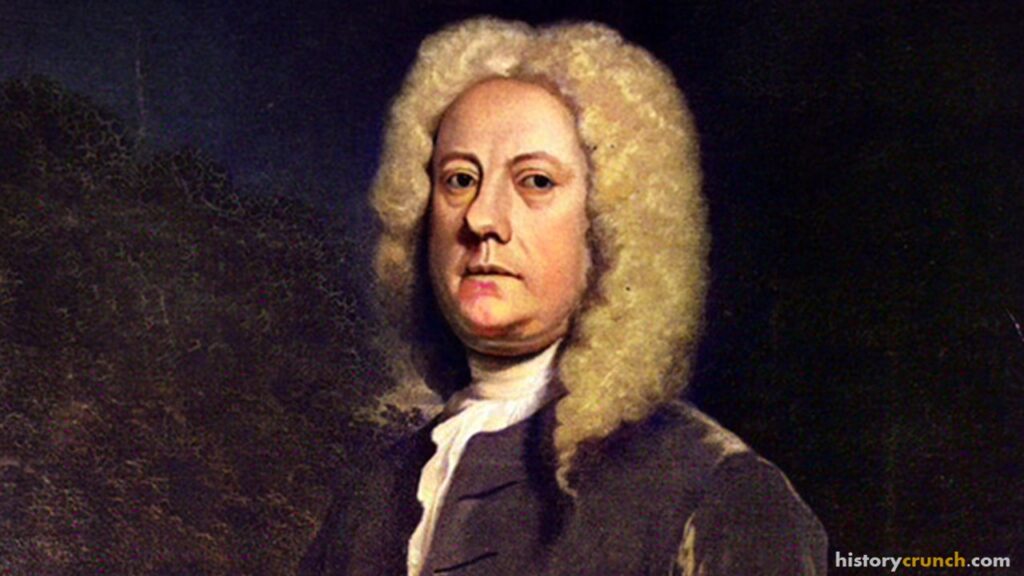
Seed had always been scattered by hand, and most of it was eaten by birds or fell where nothing could grow. In 1701 an English farmer named Jethro Tull built a machine, pulled by a horse, that cut a furrow, dropped the seed into it at a set depth and covered it over. He published a book about his methods in 1731. In the same years Charles Townshend was arguing for a four-crop rotation with turnips and clover, so that no field ever had to lie empty.
LEARN MORESHOW LESSwhy it matters · key numbers · 2 key figuresSCIENCEBetter farming is where the Industrial Revolution starts. More food from the same land meant a bigger population, fewer hands needed on the farm, and money in the pockets of landowners who then had something to invest.
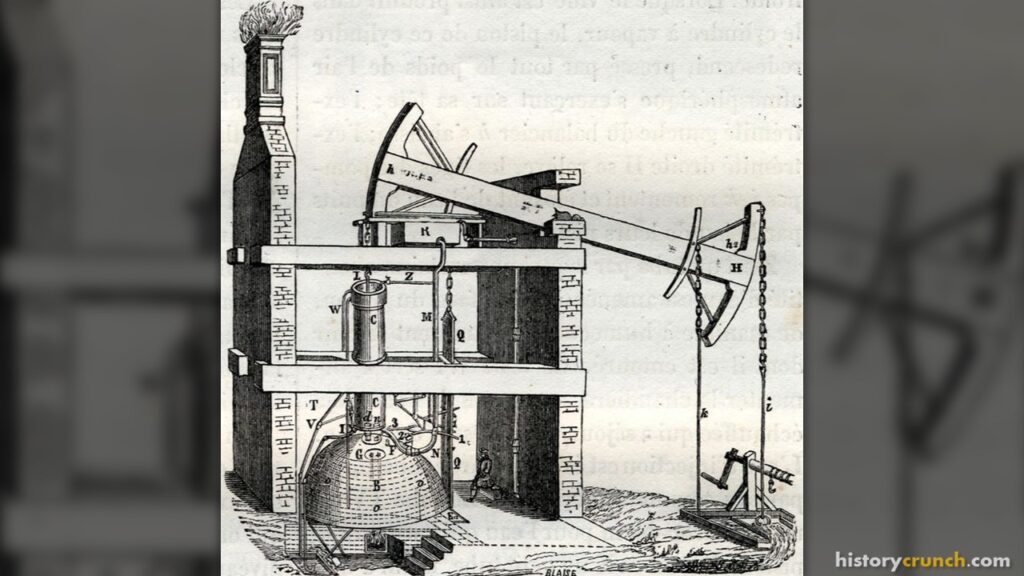
Coal mines flooded, and once a mine was below the water table no number of horses could keep it dry. In 1712 Thomas Newcomen, an ironmonger from Devon, built an engine at a colliery near Dudley in which steam filled a cylinder, was cooled to make a vacuum, and pulled a piston down to work a pump. It was enormous, it burned coal by the ton, and it worked. By 1729, the year he died, more than a hundred were at work.
LEARN MORESHOW LESSwhy it matters · key numbers · 1 key figureSCIENCEThis is the first machine in history to turn heat into useful motion, and it was invented to solve one problem in one industry. Everything after it, the mills, the railways, the factories, is an argument about how to make it smaller, cheaper and more useful.
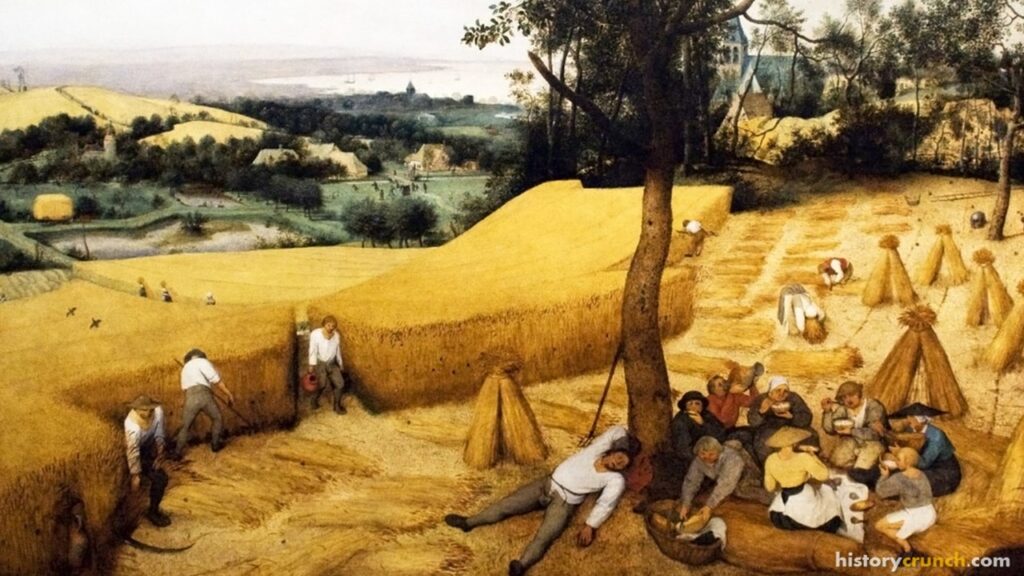
For centuries English villages had farmed in open strips and grazed animals on common land that belonged to everybody. From the middle of the eighteenth century landowners went to Parliament for private acts that let them fence those fields into single holdings they owned outright. About 5,000 enclosure acts were passed between 1750 and 1860, covering roughly a fifth of England. Enclosed farms produced more; the families who had grazed a cow on the common produced nothing.
LEARN MORESHOW LESSwhy it matters · key numbersECONOMICEnclosure is the uncomfortable answer to where the factory workers came from. The same laws that made British farming the most productive in Europe took away the living of hundreds of thousands of villagers, and the towns are where they went.

Before the factory, cloth was made under the putting-out system. A merchant brought raw wool or cotton to a village, families spun and wove it in their own kitchens on their own wheels and looms, and the merchant came back, collected the cloth and paid by the piece. Everybody in the house worked, children included, but they chose the hours, kept a garden and stopped when they wanted to.
LEARN MORESHOW LESSwhy it matters · key numbersECONOMICThis is the world the factory replaced, and it is why the first factory workers hated the factory. The work itself was not new; what was new was somebody else owning the machine, setting the hours and locking the door.

Britain had coal and iron ore close together and close to the sea. It had rivers and, soon, canals. It had an agricultural revolution that fed a growing population with fewer farmers, and enclosure that pushed the spare ones into towns. It had colonies that supplied raw cotton and bought finished cloth, a navy to protect the trade, a banking system that would lend, laws that protected an invention, and no internal customs barriers or wars on its own soil.
LEARN MORESHOW LESSwhy it matters · key numbers · a debateECONOMICNo single one of these explains it. France had more people, China had better technology for centuries, the Dutch had more banking. Britain had all of them at once, and that is the answer every exam question is looking for.
Why Britain and not France or China?
Resources and geography: coal near iron near water, and colonies to supply and to sell to. Nowhere else had that combination.
Institutions: patents that made inventing pay, banks that would lend to strangers, and a parliament run by men who profited from trade rather than by a court that taxed it.
The Duke of Bridgewater had coal at Worsley and a market ten miles away in Manchester, and no road that could carry it cheaply. In 1759 he got an act of Parliament and hired an illiterate millwright named James Brindley to cut a canal, carried over a river on an aqueduct that people came from all over Europe to see. It opened in 1761 and the price of coal in Manchester fell by half. Sixty years of canal building followed.
LEARN MORESHOW LESSwhy it matters · key numbersECONOMICA factory is worth nothing if raw material cannot reach it and cloth cannot leave. Canals were the first transport system built for industry rather than for people, and they made it possible to put a mill somewhere that was not a port.
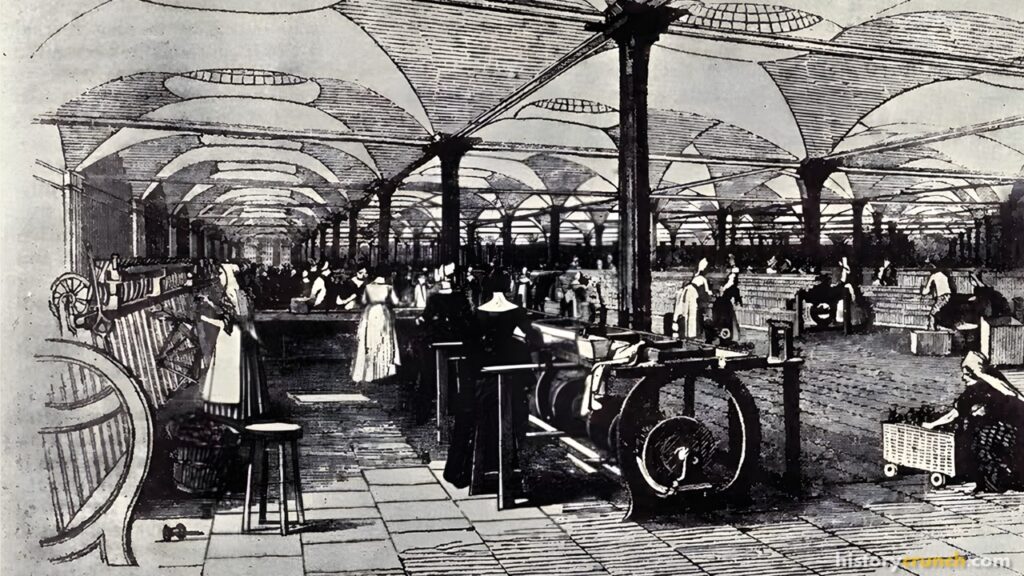
In fifty years the making of cloth moved out of the cottage and into the mill. A flying shuttle doubled how fast a weaver could work and created a shortage of thread; a spinning jenny, a water frame and a mule answered it; a power loom finished the job. The water frame was too heavy for a kitchen, so in 1771 Richard Arkwright built a five-storey mill beside a stream, filled it with machines and rang a bell to start the shift, and the factory existed. James Watt made steam efficient enough to drive anything that turned, Adam Smith explained why none of it should be interfered with, and an English apprentice carried the designs to Rhode Island in his head.
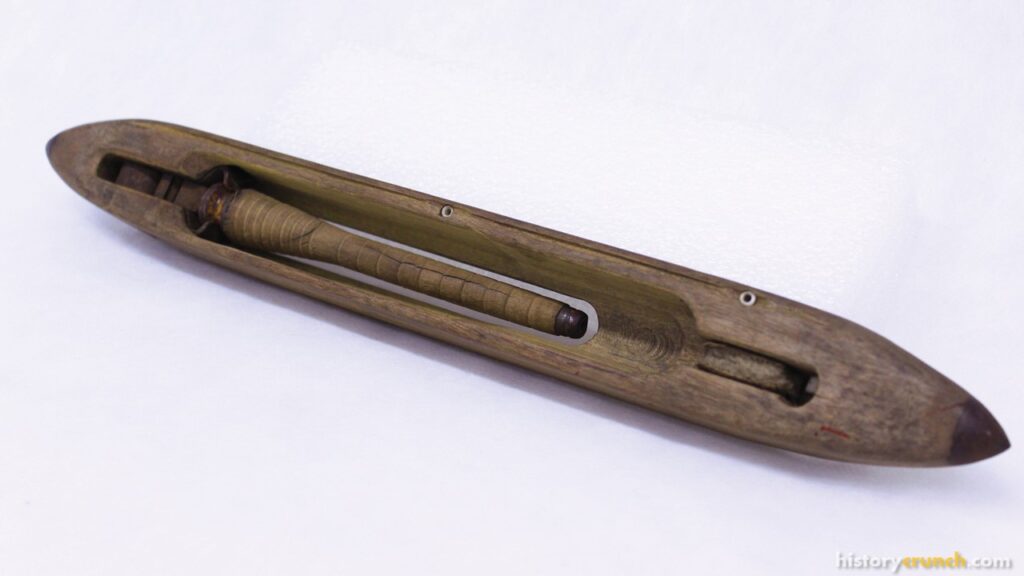
A weaver working a broad cloth had to throw the shuttle by hand and needed a second weaver at the far edge of the cloth to throw it back. In 1733 John Kay, a clockmaker's son from Lancashire, put the shuttle on wheels in a track with a cord and a handle, so one weaver could flick it across and back alone. Weavers used it and refused to pay him for it; his house was attacked and he left for France in 1747.
LEARN MORESHOW LESSwhy it matters · key numbers · 1 key figureSCIENCEThe flying shuttle doubled how fast cloth could be woven, and created the problem that drove the next thirty years: one weaver could now use thread faster than ten spinners could make it. Every machine on this view for the next fifty years is an answer to that shortage.
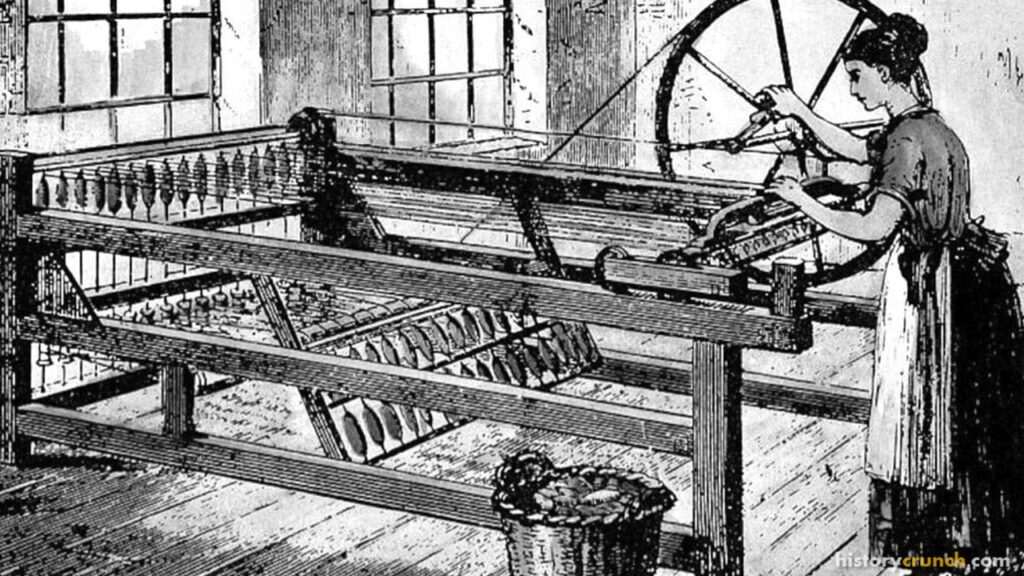
James Hargreaves was a carpenter and weaver in Lancashire who had never been to school. In 1764 he built a frame carrying eight spindles turned by one wheel, so that a single spinner could make eight threads at once; later versions carried eighty. It was small enough to stand in a cottage. Spinners who saw their wages fall broke into his house and smashed his machines, and he moved to Nottingham.
LEARN MORESHOW LESSwhy it matters · key numbers · 1 key figureSCIENCEThe jenny solved the thread shortage the flying shuttle had created, and it was the last of the great machines that a family could still own and work at home. After it the machines got too big for a kitchen, and the kitchen stopped being where cloth was made.
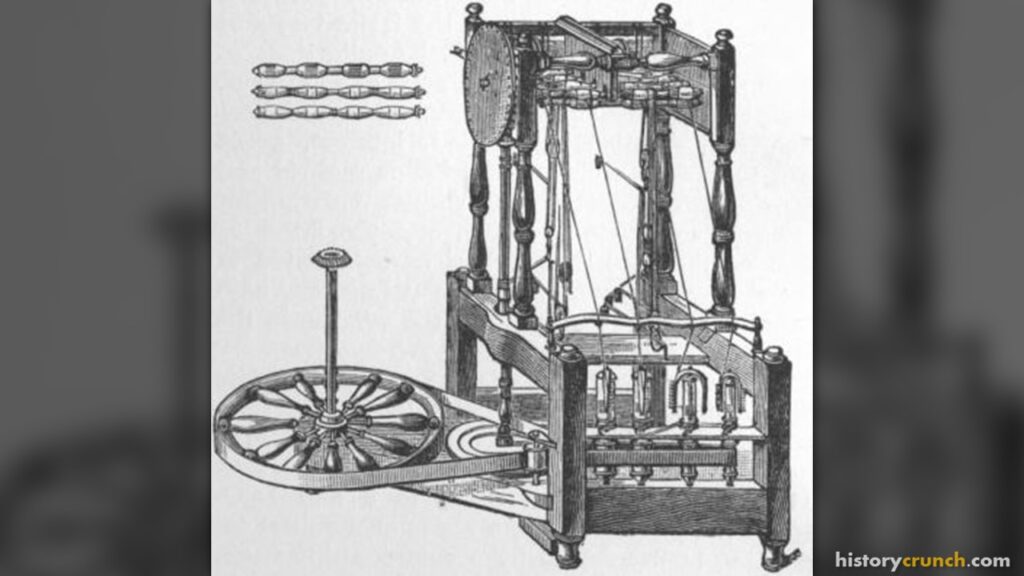
In 1769 Richard Arkwright, a barber and wigmaker who had never made a machine before, patented a spinning frame that drew the cotton through rollers and twisted it, producing thread strong enough to be used for the warp as well as the weft. It could hold up to a hundred spindles and it was too heavy for a person to turn, so it was driven by a waterwheel. Ten years later Samuel Crompton combined it with the jenny in the spinning mule, which made thread that was both strong and fine.
LEARN MORESHOW LESSwhy it matters · key numbersSCIENCEThe water frame is the machine that made the factory necessary. A jenny fits in a cottage; a water frame needs a river, a building and somebody to own both, and from 1769 the people who worked the machines no longer owned them.
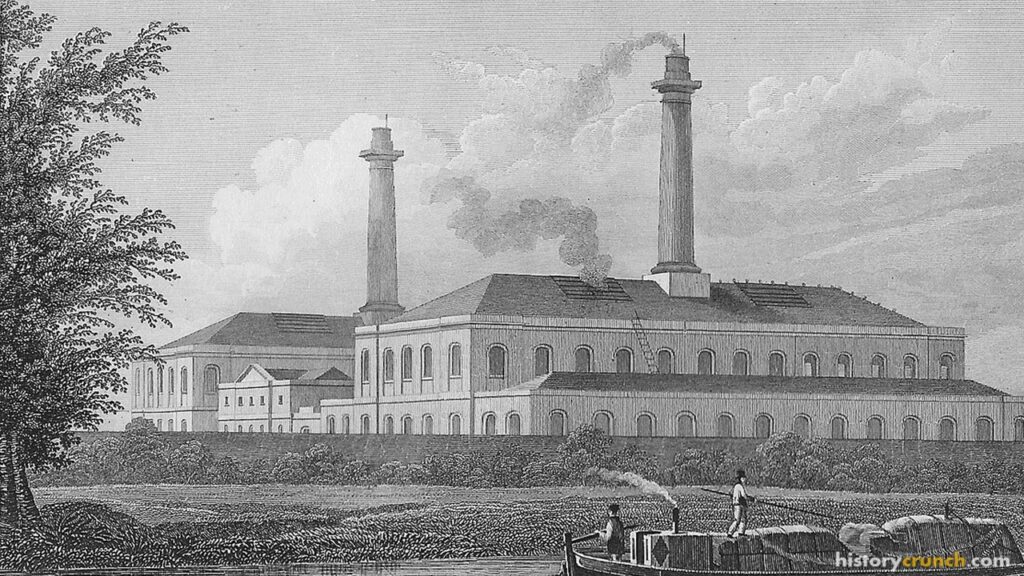
In 1771 Richard Arkwright built a five-storey mill beside a stream at Cromford in Derbyshire and filled it with water frames. It ran day and night in two twelve-hour shifts and employed about two hundred people, most of them women and children, because children had small fingers and cost less. He built cottages, a chapel and an inn to attract families, and rang a bell to start and stop the work.
LEARN MORESHOW LESSwhy it matters · key numbers · a debateECONOMICCromford is where work stops being something you do and becomes somewhere you go. The factory brought the workers to the machine instead of the machine to the workers, and it brought the clock with it.
Was the factory an improvement on the cottage?
It paid a regular wage, it was warmer and drier than most cottages, and it produced cloth cheap enough that ordinary people could own more than one set of clothes.
It took away every choice a worker had: when to start, when to stop, when to eat, when to see daylight. Cottage families were poor, and they were not owned.
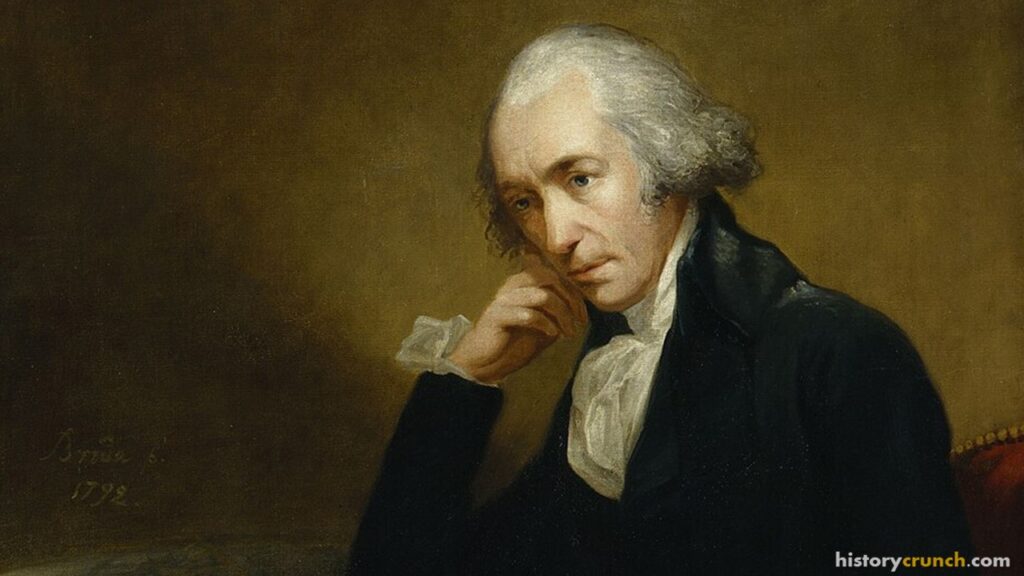
In 1764 James Watt, an instrument maker at Glasgow University, was given a model Newcomen engine to repair and saw why it wasted so much fuel: the same cylinder was heated and cooled on every stroke. His answer, patented in 1769, was a separate condenser, which cut coal use by about three quarters. He found a manufacturer in Matthew Boulton in 1775, sold the first engines the next year, and later added gearing that turned the up-and-down motion into a turning shaft.
LEARN MORESHOW LESSwhy it matters · key numbers · 1 key figureSCIENCENewcomen's engine could only pump. Watt's could drive anything that turned, which meant a mill no longer had to sit on a river. From about 1800 a factory could be built wherever the coal and the workers were, and that is why the industrial towns grew where they did.
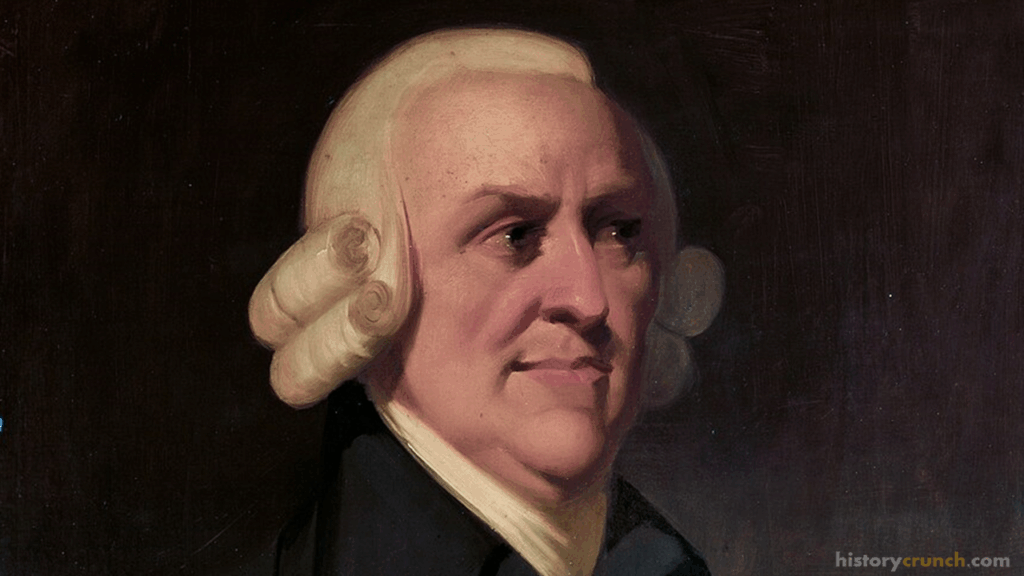
Adam Smith was a Scottish professor of moral philosophy who spent ten years writing one book. The Wealth of Nations, published in 1776, argued that a nation's wealth is what it produces rather than the gold in its vaults, that dividing labor into small repeated tasks multiplies output, and that people pursuing their own interest in a free market are led as if by an invisible hand to serve everybody else's. He opened it with a pin factory where ten men doing one step each made 48,000 pins a day.
LEARN MORESHOW LESSwhy it matters · key numbers · a sourceIDEASSmith gave the factory owners their laissez-faire argument, and they used it against every proposal to limit hours or ages for the next sixty years. He would not have recognized some of it: the same book warns that employers always combine to keep wages down and that a man who does one task all day becomes as stupid as it is possible to become.
IN THEIR OWN WORDS“It is not from the benevolence of the butcher, the brewer, or the baker that we expect our dinner, but from their regard to their own interest.”
Adam Smith, The Wealth of Nations, 1776
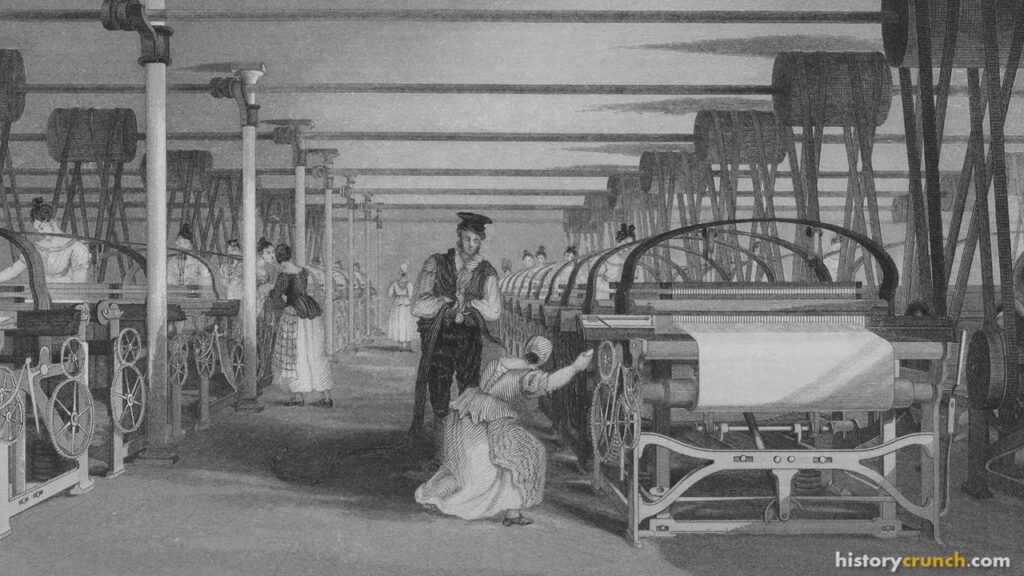
Edmund Cartwright was a clergyman who had never seen a loom when he heard people arguing that weaving could not be mechanized. He designed one in 1784 and built it in 1785. The first versions were bad and his own mill was burned down, but the machine improved, and where there were 2,400 power looms in Britain in 1803 there were about 100,000 by 1833. Parliament gave him 10,000 pounds in 1809 for what it had done for the country.
LEARN MORESHOW LESSwhy it matters · key numbers · 1 key figureSCIENCEWith the power loom the whole business of making cloth was inside the factory, and hand weaving, the best-paid trade in the north of England, was finished. Handloom weavers took about thirty years to starve out, and they are the men who broke the machines in 1811.
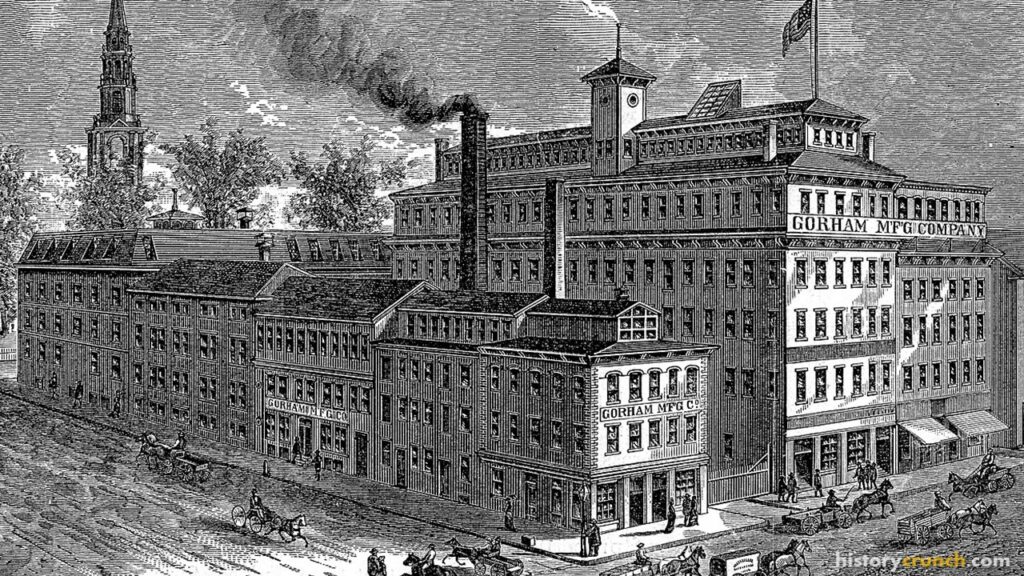
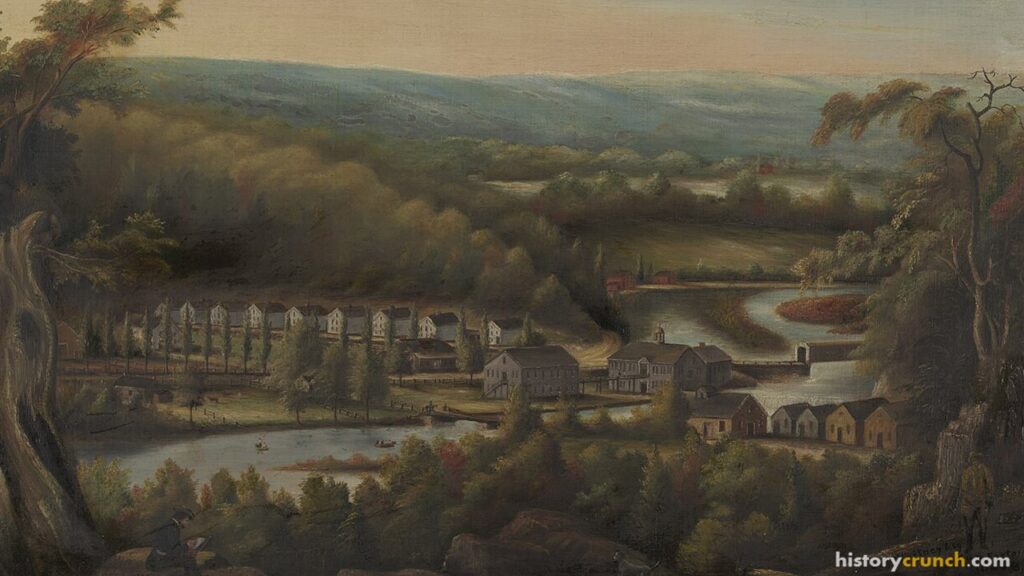
Britain banned the export of textile machinery and forbade skilled workers to emigrate, so Samuel Slater, who had served an apprenticeship in an Arkwright mill, memorized the designs, told nobody where he was going, and sailed for New York in 1789. In 1793 he built America's first water-powered spinning mill at Pawtucket, Rhode Island. Twenty years later Francis Cabot Lowell, who had toured British mills taking notes, set up the Boston Manufacturing Company in 1813 with spinning and weaving under one roof.
LEARN MORESHOW LESSwhy it matters · key numbersECONOMICAmerican industry began as industrial espionage. Slater is called the father of the American factory in the United States and Slater the Traitor in England, and both are accurate.
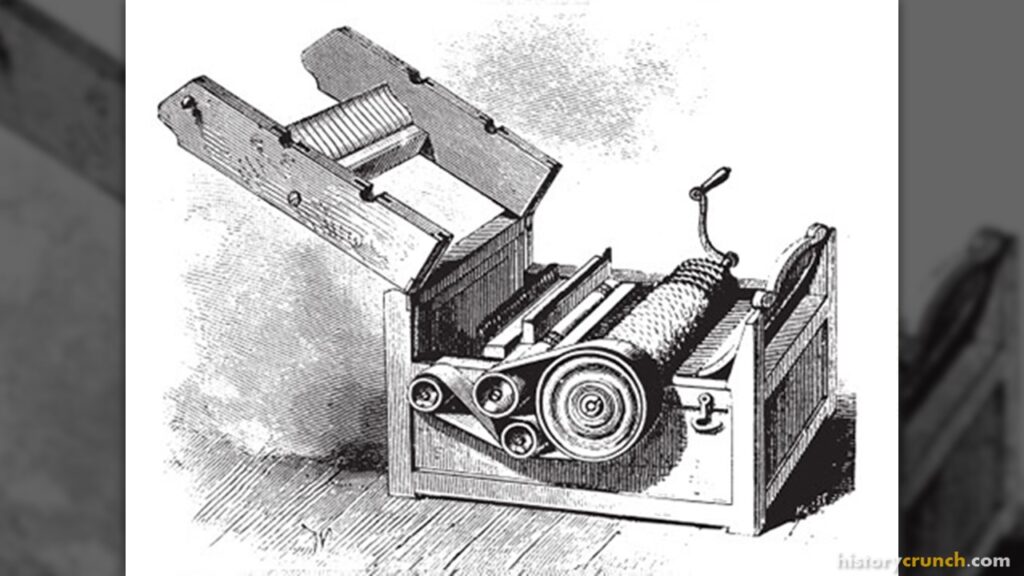
Short-staple cotton grew well across the American South but its sticky seeds had to be picked out by hand, about a pound a day per worker. In 1793 Eli Whitney, a Massachusetts graduate visiting Georgia, built a box with a wire screen and a rotating drum of hooks that pulled the fibre through and left the seed behind, cleaning fifty pounds a day. Cotton exports rose from about 500,000 pounds in 1793 to 93 million by 1810.
LEARN MORESHOW LESSwhy it matters · key numbers · a debateSCIENCEThe gin is the clearest case in history of a machine making things worse. Slavery had been thought to be dying in America; cheap cotton made it enormously profitable, and the enslaved population grew from about 700,000 in 1790 to nearly four million by 1860. The mills of Lancashire ran on that cotton.
The American Civil War hub carries where this leads; this card is the machine and what it did.
Can an inventor be blamed for what an invention does?
Whitney was an opponent of slavery who made a machine to save labor, and he barely made a penny from it because it was so easy to copy.
He knew exactly whose labor it would be applied to, sold gins to planters, and spent years in court trying to profit from it.
Employers could and did meet to agree on wages. Workers could not: the Combination Acts of 1799 and 1800, passed while Britain was at war with revolutionary France and afraid of anything that looked like a club, made it a crime for workmen to combine to raise wages or shorten hours, punishable by three months in prison. The acts were repealed in 1824 after a long campaign, and unions were legal but barely tolerated for another fifty years.
LEARN MORESHOW LESSwhy it matters · key numbersPOLITICALThis is where the labor movement starts, from a standing start of being illegal, and collective bargaining was the thing the law existed to prevent. Everything on this view, the Luddites, the Chartists, the Knights of Labor, the Wagner Act, is the long argument about whether working people may act together, and for the first twenty-five years of the factory age the answer was no.
The first half of the nineteenth century is the argument about what the factory had done. Handloom weavers broke the machines and were hanged for it; a committee of Parliament printed the evidence of children beaten to stay awake; cholera arrived and killed thirty-two thousand people in towns that had grown faster than anyone could build sewers. Parliament answered in steps: children under nine out of the mills in 1833 with four inspectors to check, women and boys out of the pits in 1842, ten hours in 1847. Robert Owen ran a mill decently and stayed profitable, Dickens made the middle class look, Marx built a theory on it, and in 1851 Britain filled a palace of glass with what it had made.
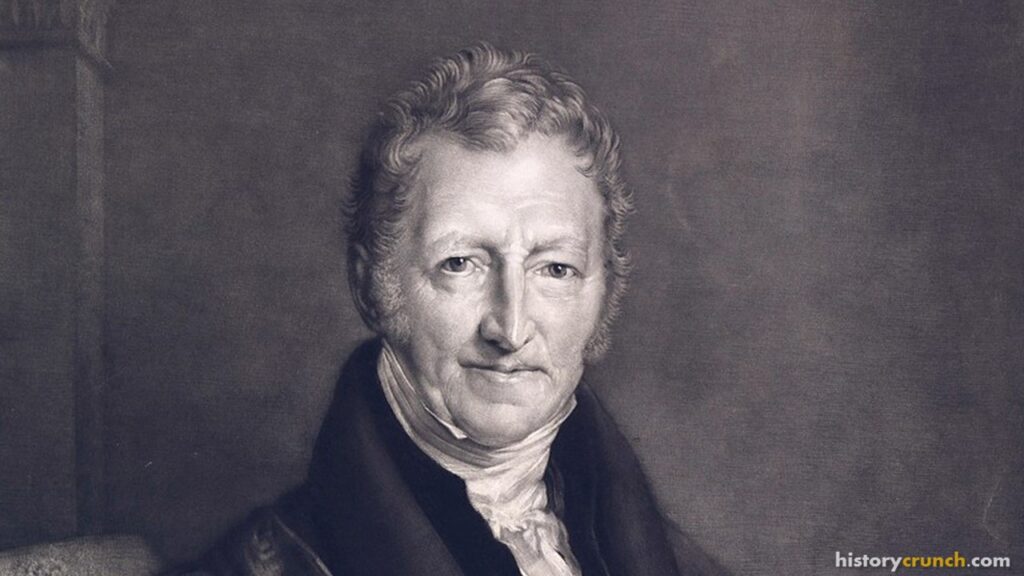
In 1798 an English clergyman named Thomas Malthus published an essay arguing that population grows by multiplying while food grows only by adding, so that any gain in living standards will be eaten up by more mouths, and that famine, disease and war are the checks that keep the two in balance. He opposed poor relief on the grounds that it encouraged the poor to have more children.
LEARN MORESHOW LESSwhy it matters · key numbers · 1 key figureIDEASMalthus gave the nineteenth century a reason not to help anybody, and it was quoted in Parliament for fifty years against factory reform and poor relief. He was also wrong about the thing he was most confident about: industrial farming and industrial transport fed a population that grew six times over.
The Health and Morals of Apprentices Act of 1802 was the first factory law in Britain. It limited pauper apprentices in cotton mills to twelve hours a day, banned night work for them, and required some schooling and whitewashed walls. It applied only to children sent from workhouses, only in cotton mills, and it appointed no inspectors, so it was enforced by local magistrates who were often the mill owners.
LEARN MORESHOW LESSwhy it matters · key numbersPOLITICALThe first Factory Act matters because it established the principle, that Parliament may tell an employer what to do inside his own building, and because it shows what a law without inspectors is worth. Every reform for the next forty years was an argument about enforcement rather than principle.
The Royal Navy needed about 100,000 wooden pulley blocks a year and bought them from craftsmen who made each one by hand. From 1803 a set of 45 machines at the Portsmouth Block Mills, designed by Marc Brunel and built by Henry Maudslay, made blocks in identical parts from identical patterns. Ten unskilled men produced what 110 skilled ones had, and the machines ran for 145 years.
LEARN MORESHOW LESSwhy it matters · key numbers · 1 key figureECONOMICInterchangeable parts are the idea that makes mass production possible: if every part is the same, an unskilled worker can assemble them and a broken one can be replaced rather than refitted. Eli Whitney promised the same thing for muskets in America, and Ford finished the argument in 1913.
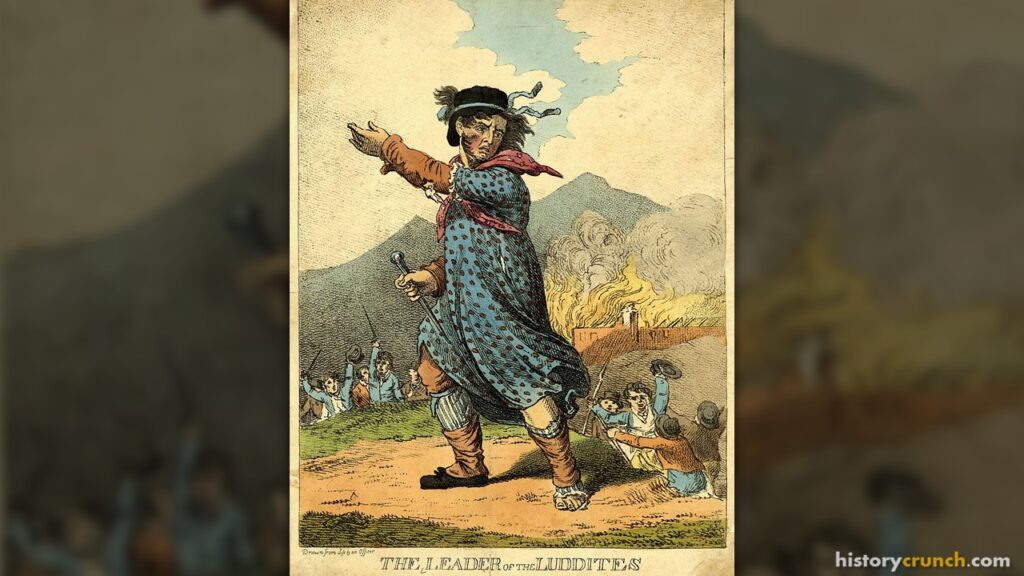
On March 11th, 1811 a crowd of stocking knitters at Nottingham broke into a workshop and smashed the wide frames that were producing cheap cut-up stockings and putting skilled men out of work. Over the next five years bands of croppers and weavers across the Midlands and Yorkshire destroyed machines at night, signing their letters Ned Ludd after a boy said to have smashed two frames in a temper in 1779. At its height Parliament had more soldiers fighting Luddites in England than it had under Wellington in Spain.
LEARN MORESHOW LESSwhy it matters · key numbers · a debateSOCIALThe Luddites were not against machines as such; they were skilled men whose trade was being destroyed and who had no vote, no union and no other way to be heard. Parliament's answer in 1812 was to make machine breaking a capital crime, and seventeen men were executed at York in one day in 1813.
Were the Luddites backward or were they right?
They were trying to stop the future with hammers, and the machines they broke made cloth that the poor could afford for the first time.
They were right about what would happen to them. Handloom weavers' wages fell by about three quarters in thirty years, and no one offered them anything else.
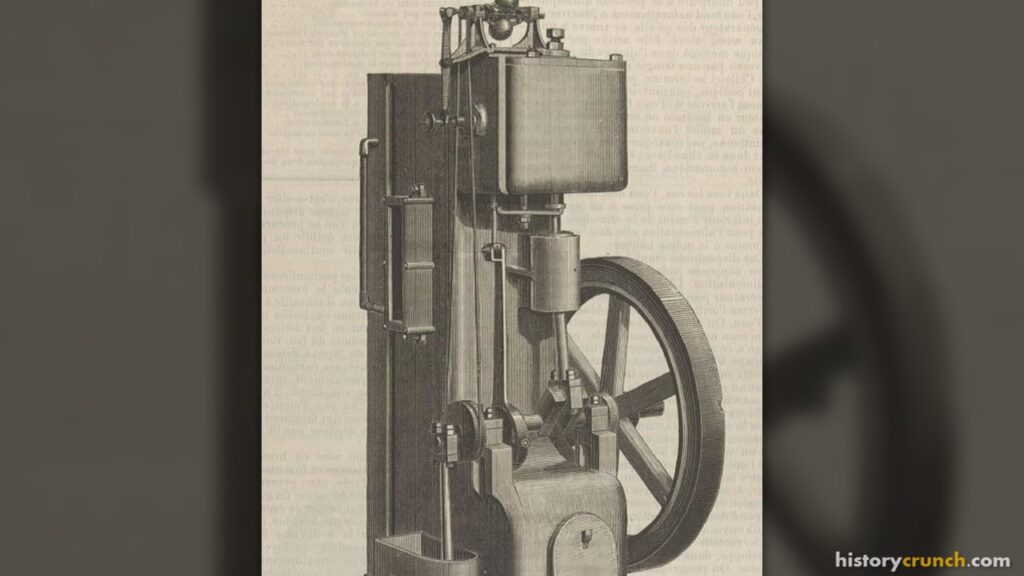
Robert Fulton had already put a steam engine in a boat in 1807. In 1814 George Stephenson, a colliery engineman who had taught himself to read at eighteen, built a locomotive to pull coal wagons at Killingworth. In 1825 his Stockton and Darlington Railway carried the first fare-paying passengers behind a steam engine, and in 1829 his Rocket won the Rainhill Trials at about thirty miles an hour, faster than any human being had ever travelled on land.
LEARN MORESHOW LESSwhy it matters · key numbersSCIENCEThe railway is what made the Industrial Revolution national instead of local. It moved coal, cotton, food and people at a speed nobody had experienced, it forced Britain to agree on a single time, and within twenty years of Rocket there were 6,000 miles of track.
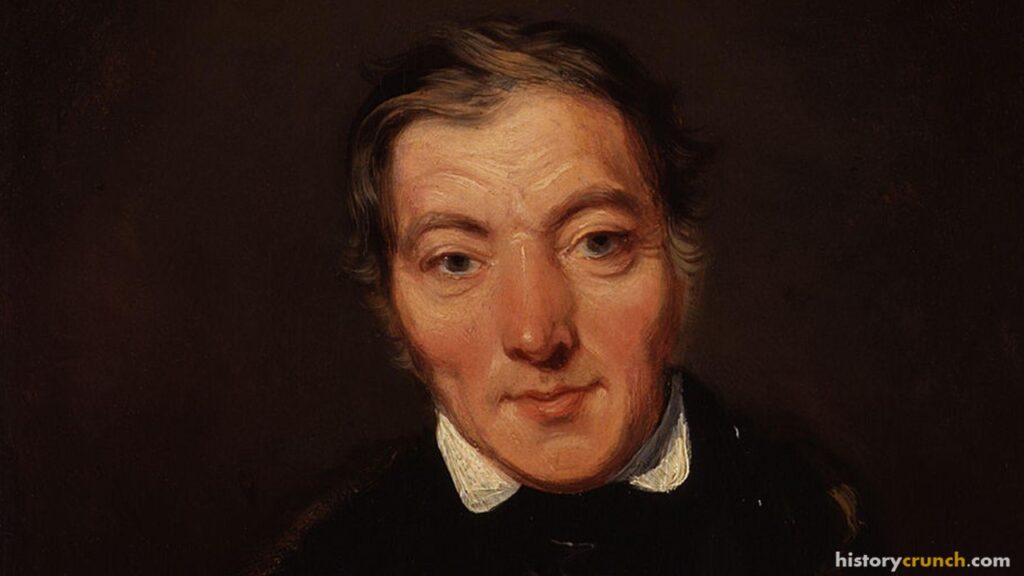
Robert Owen took over the New Lanark cotton mills in Scotland in 1800 and ran them as an argument. He stopped employing children under ten, cut the working day, built decent housing instead of the tenements most mill hands lived in, opened a shop that sold at cost, and in 1816 opened a school for the mill's children, the first infant school in Britain, with no punishment and no religious instruction. The mill remained profitable and thousands of visitors came to see it. In 1833 he said that eight hours' daily labor is enough for any human being.
LEARN MORESHOW LESSwhy it matters · key numbers · 2 key figuresSOCIALOwen is the answer to anyone who says the conditions of the factory age were unavoidable. One man proved otherwise in one mill for thirty years, and almost nobody copied him. His later communities failed, but the eight-hour day and the cooperative movement both start here.
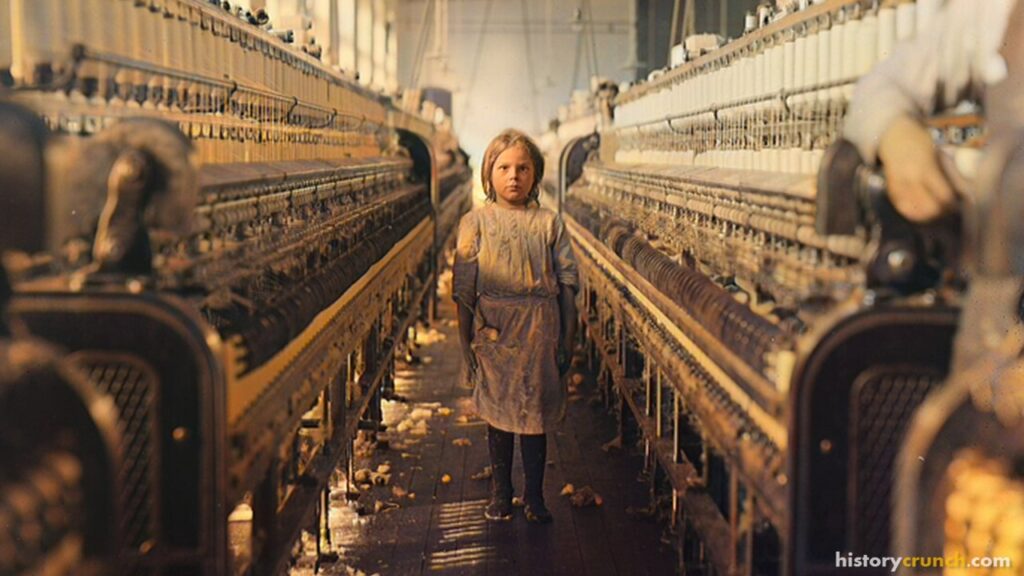
Children were cheap, obedient and small enough to crawl under running machinery to clear the waste. A Manchester doctor interviewed in 1819 described the deformities of children who stood at the same machine for thirteen hours. A witness named John Fairbrother described a master waiting outside with a horse whip for children who came late. William Cobbett visited a mill in 1824. A House of Commons report of 1832 found that dangerous machinery was left unfenced and that injured workers were abandoned with their wages stopped and no medical help.
LEARN MORESHOW LESSwhy it matters · key numbers · a sourceSOCIALThese are the accounts that got the Factory Acts passed, and they are why this timeline can say what conditions were like without guessing. They were collected by people who wanted the laws changed, which is worth knowing, and they were not contradicted by the mill owners at the time.
IN THEIR OWN WORDS“There are factories, no means few in number, in which serious accidents are continually occurring, and in which, notwithstanding, dangerous parts of the machinery are allowed to remain unfenced.”
Report of the British House of Commons, 1832
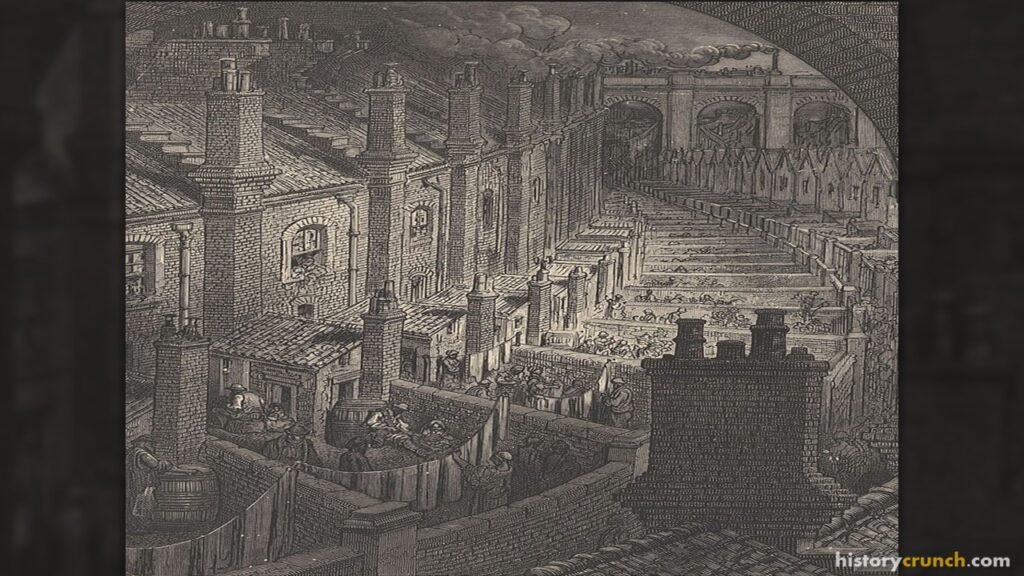
The industrial towns had grown faster than anyone could build for. Families lived in back-to-back houses with no windows at the rear, sometimes a family to a cellar, sharing one privy between dozens and drawing water from a pump beside the cesspit. Cholera arrived in Britain in 1831 and killed about 32,000 people in the epidemic that followed, and it came back in 1848 and 1854. It killed the rich as well as the poor, which is why anything was done.
LEARN MORESHOW LESSwhy it matters · key numbersSCIENCECholera is what turned living conditions from a complaint into a law. The investigations it forced produced the first public health acts, the sewers and the clean water supplies, and the recognition, thirty years later, that a town is something that has to be built rather than something that just happens.
In 1832 a select committee chaired by Michael Sadler took sworn evidence from mill workers about what the work had done to them. Witnesses described being beaten to stay awake, working from five in the morning until nine at night in busy seasons, and being crippled by standing. The evidence was printed and sold, mill owners said it was one-sided and got a royal commission of their own, and that commission confirmed most of it.
LEARN MORESHOW LESSwhy it matters · key numbersPOLITICALThe Sadler Committee is the reason the Factory Act of 1833 passed. Printed evidence in the words of the people it happened to changed what the middle classes believed was going on inside the buildings they owned shares in, and that is a pattern that repeats with Lewis Hine's photographs eighty years later.
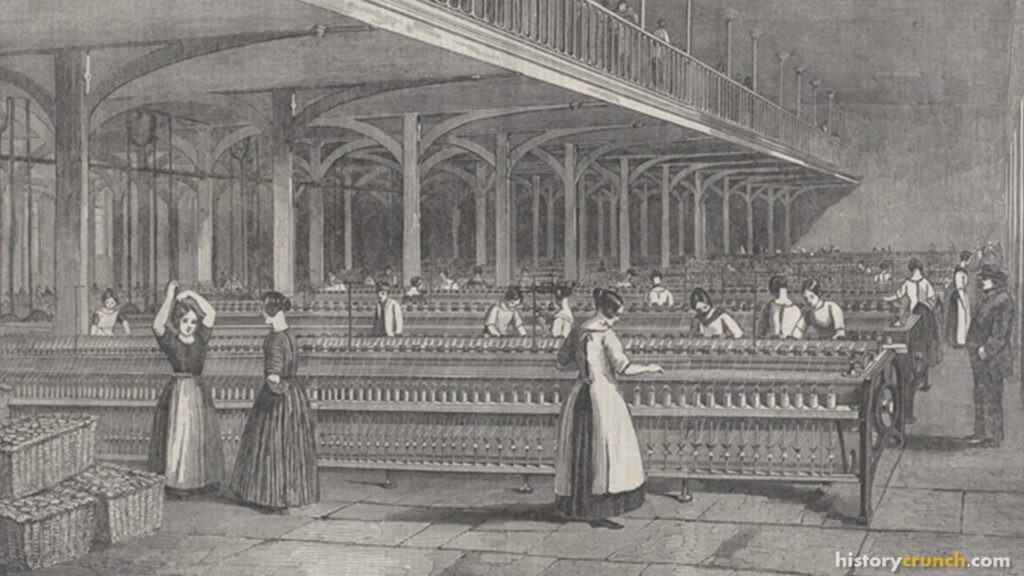
The act of 1833 forbade the employment of children under nine in textile mills, limited children aged nine to thirteen to nine hours a day and young people aged thirteen to eighteen to twelve, banned night work for anyone under eighteen, required two hours of schooling a day for the youngest, and, for the first time, appointed factory inspectors with the power to enter a mill and prosecute. There were four of them for the whole country.
LEARN MORESHOW LESSwhy it matters · key numbersPOLITICALThis is the law that made all the others possible, because it created someone whose job was to check. What followed came in steps: the Mines Act of 1842 took women and boys under ten out of the pits, and the Ten Hours Act of 1847 limited women and young people to ten hours, which in practice stopped the machines for everybody.
A royal commission on the mines reported in 1842 and had its findings printed with engravings: women crawling on all fours dragging coal carts by a chain between their legs, children of five sitting alone in the dark for twelve hours opening and closing ventilation doors. The Mines and Collieries Act passed within months, banning all women and girls and all boys under ten from working underground.
LEARN MORESHOW LESSwhy it matters · key numbersPOLITICALThe pictures did it. The commission's engravings were reprinted in newspapers and shocked a public that had accepted the same conditions in words for years, and the act went through a Parliament full of mine owners in a single session.
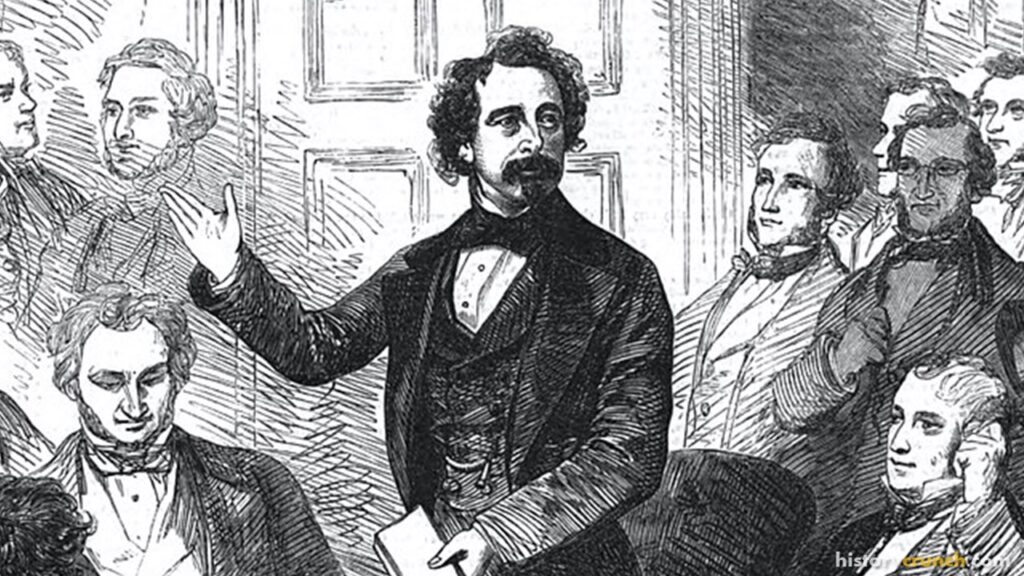
Charles Dickens had been a twelve-year-old pasting labels in a blacking factory while his father was in a debtors' prison, and he never got over it. He became a parliamentary reporter in 1833 and a famous novelist in 1836, and in 1843, after visiting a ragged school and a tin mine, he wrote A Christmas Carol in six weeks. Scrooge, asked to give to the poor, asks whether there are no prisons and no workhouses, and says that those who would rather die had better do it and decrease the surplus population, which is Malthus in one sentence.
LEARN MORESHOW LESSwhy it matters · key numbers · a sourceCULTUREDickens did more than any reformer to make the Victorian middle class look at what industry cost, because he made it a story rather than a statistic. Every one of his novels has a factory, a workhouse, a court or a school in it, and people who would not read a select committee report read him.
IN THEIR OWN WORDS“If they would rather die, they had better do it, and decrease the surplus population.”
Ebenezer Scrooge, in Charles Dickens' A Christmas Carol, 1843
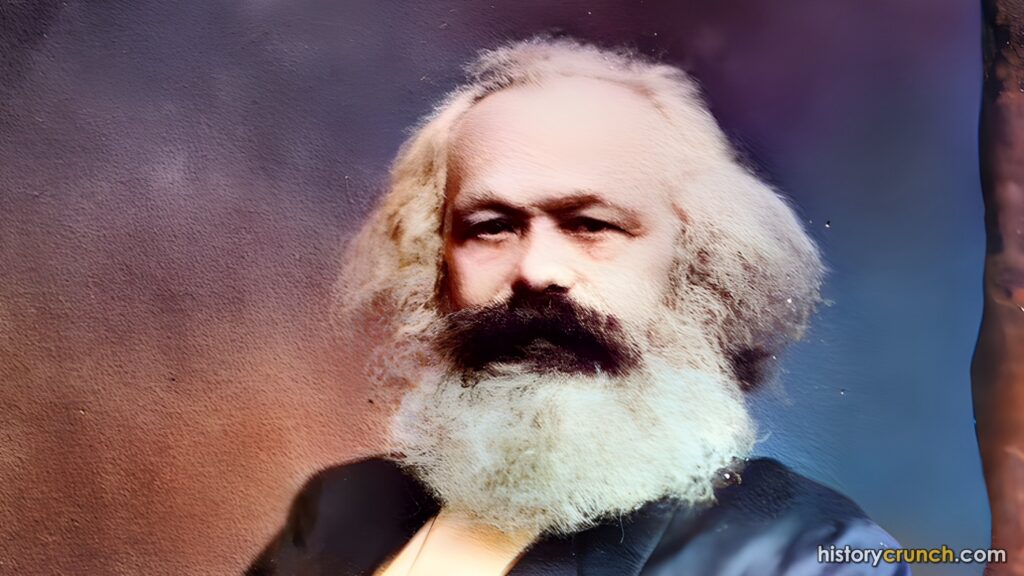
Karl Marx was a German philosopher expelled from one country after another for what he wrote. Friedrich Engels was the son of a mill owner who had managed the family's cotton works in Manchester and published a book about what he saw there. They met in Paris in 1844 and, at the end of 1847, wrote a pamphlet for a small group of German workers. The Communist Manifesto appeared in 1848, the year revolutions broke out across Europe, and argued that all history is a struggle between classes and that the workers would end it.
LEARN MORESHOW LESSwhy it matters · key numbers · a sourceIDEASMarx took the factory system as his evidence and built socialism into a theory of history on it, and that theory governed a third of the world within a century. Whether he was right about what would happen, he was describing something real: in 1848 a Manchester mill hand had no vote, no union, no safety law worth the name and no other way out.
IN THEIR OWN WORDS“The proletarians have nothing to lose but their chains. They have a world to win.”
Karl Marx and Friedrich Engels, The Communist Manifesto, 1848
The Chartists wanted six things: the vote for every man, a secret ballot, no property requirement to sit in Parliament, pay for members so that a working man could serve, equal constituencies and annual elections. They gathered petitions with millions of signatures and presented them in 1839, 1842 and 1848, and Parliament rejected each one. The movement faded after 1848 with nothing to show for it.
LEARN MORESHOW LESSwhy it matters · key numbersPOLITICALFive of the six points are law today. Chartism failed in its own lifetime and won everything afterwards, and it is where British working people learned to organize nationally, which is what the trade unions of the 1860s were built on.
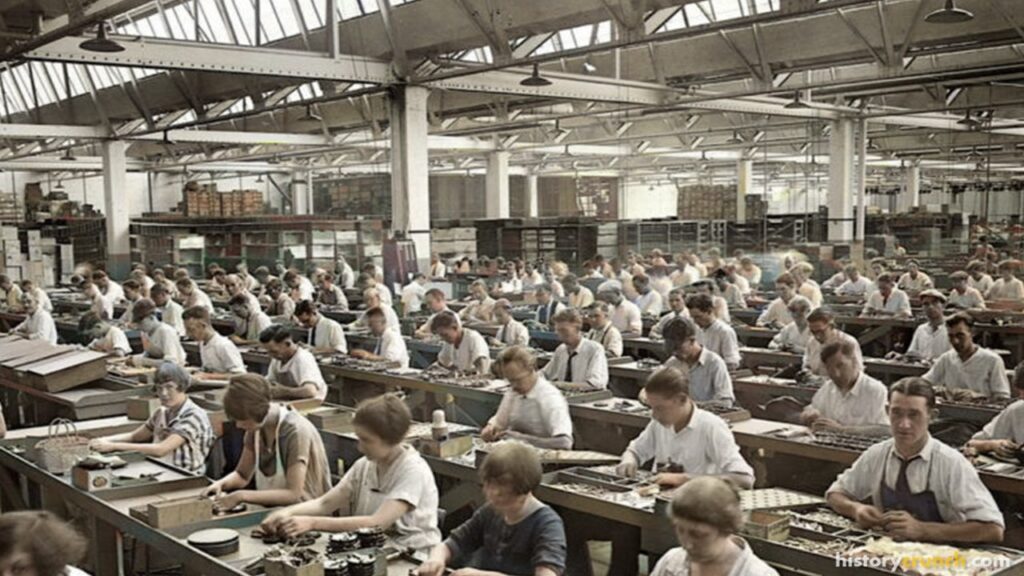
In 1750 about 80 percent of the British population lived on the land. By 1850 only about half did, and Britain became the first country in the world where more people lived in towns than in the countryside. Manchester went from about 25,000 people in 1772 to over 300,000 by 1851. Life expectancy in the worst districts of those towns was under thirty, about half what it was in the surrounding countryside.
LEARN MORESHOW LESSwhy it matters · key numbersSOCIALUrbanization is the single biggest change the Industrial Revolution made, bigger than any machine: where human beings live and what their day looks like. Every country that industrialized afterwards went through the same shift, and most of the world went through it in the twentieth century.
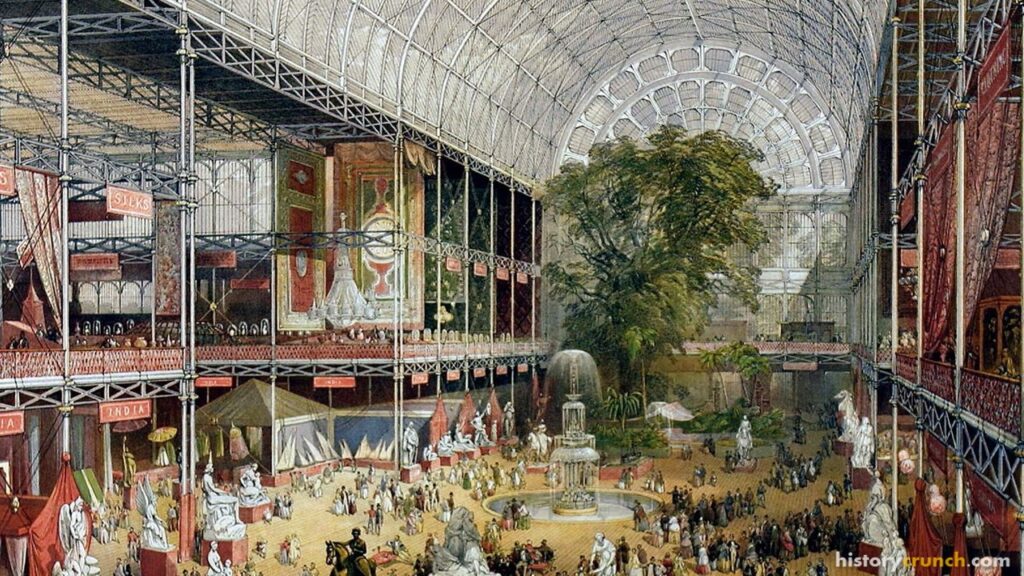
On May 1st, 1851 the Great Exhibition of the Works of Industry of All Nations opened in Hyde Park in a building of iron and glass nine hundred feet long, put up in nine months and nicknamed the Crystal Palace. It held about 100,000 objects from around the world, half of them British: locomotives, looms, hydraulic presses, the Koh-i-Noor diamond. Six million people came in five months, many on excursion trains at prices working families could afford.
LEARN MORESHOW LESSwhy it matters · key numbersCULTUREThis is the high point of the first industrial revolution and the best single picture of it: a country so confident it invited everyone to come and compare. Within thirty years the comparison had stopped flattering Britain, because Germany and the United States had caught up and passed it.
From about 1850 the leading edge moved from cloth and steam to steel, electricity, chemicals and oil, and from Britain to Germany and the United States. Bessemer made steel cheap enough for rails, ships and tall buildings; a cable under the Atlantic made the world's markets one market; a railroad crossed America and made it a single economy. Edison built the first industrial research laboratory and produced the phonograph and the light bulb; Bell sent a voice down a wire. Millions arrived through Ellis Island to work in the mills, a few hundred families built palaces on the profits, and American workers who organized were met with detectives, militia and federal troops.
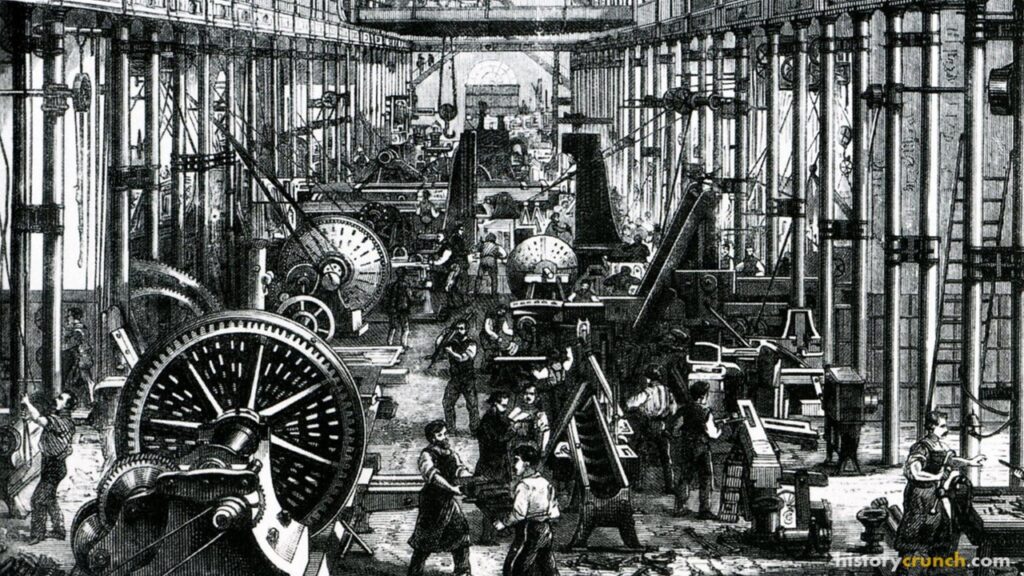
Iron was either cast, which is brittle, or wrought, which is soft; steel was both strong and tough but had to be made a few pounds at a time and cost as much as silver. In 1856 Henry Bessemer announced a converter that blew air through molten iron, burning out the carbon in twenty minutes and making tons of steel at a time. The price fell by about eighty percent within twenty years.
LEARN MORESHOW LESSwhy it matters · key numbersSCIENCEThe Bessemer process is the difference between the first industrial revolution and the second. Rails that did not wear out, ships, bridges, boilers that could take high pressure, and the steel frame that let a building go higher than six storeys all come from this, and so does Andrew Carnegie's fortune.
Two earlier attempts had failed and one cable had worked for three weeks in 1858 before dying. In 1866 the Great Eastern, the largest ship in the world, laid a cable from Ireland to Newfoundland that held. A message that had taken ten days by fast steamer now took minutes. Within thirty years cables reached India, Australia, South America and across the Pacific.
LEARN MORESHOW LESSwhy it matters · key numbersSCIENCEThe telegraph cable is when the world's markets became one market. A price in Liverpool and a price in New York could now be the same price on the same morning, and businesses, newspapers and governments all had to learn to work at the speed of a wire.
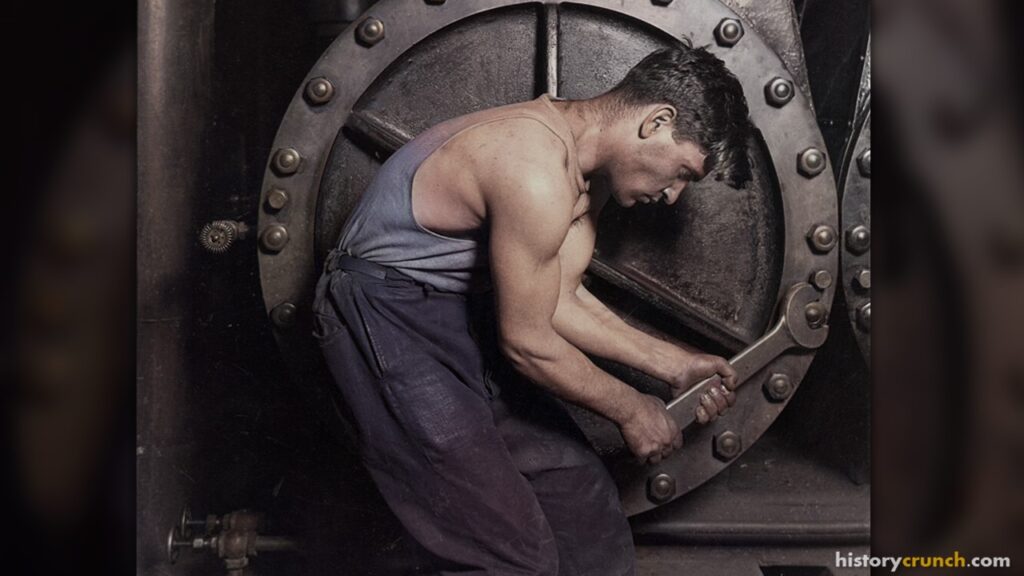
American workers had organized before, the shoemakers of Philadelphia in 1794 and the Mechanics' Union in the 1820s, but always by trade and always locally. The Knights of Labor, founded in Philadelphia in 1869, took skilled and unskilled, black and white, men and women, and asked for an eight-hour day, an end to child labor and cooperatives instead of wage work. By 1886 it had about 700,000 members.
LEARN MORESHOW LESSwhy it matters · key numbersSOCIALThe Knights are the first attempt at one union for everybody in America, and the last for fifty years. They were destroyed by the Haymarket bomb of 1886, which let newspapers call every union member a bomb-thrower, and what replaced them organized only the skilled.
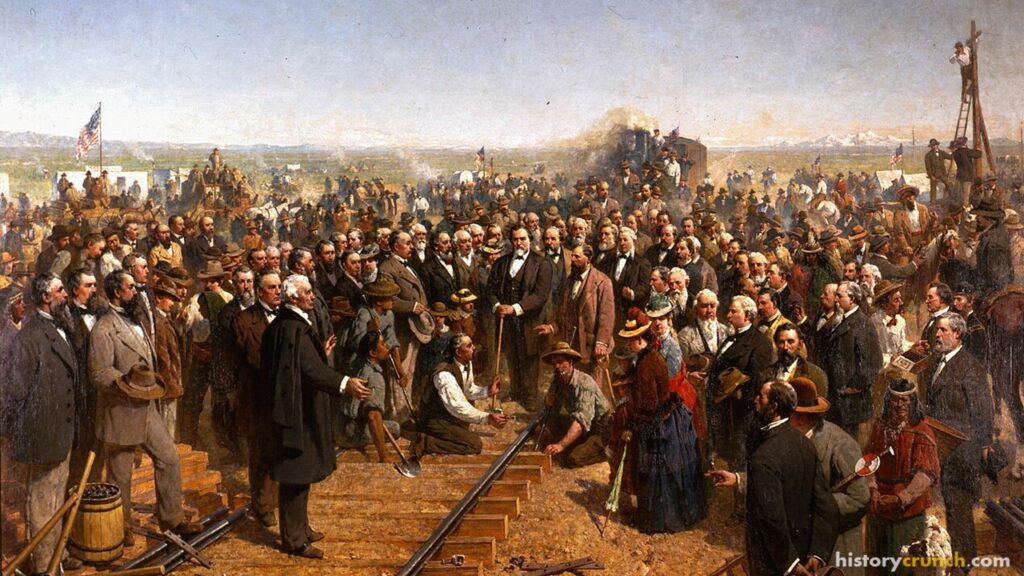
The Gold Rush of 1849 had put a hundred thousand Americans on the far side of a continent that took six months to cross. Abraham Lincoln signed the Pacific Railway Act in 1862, and two companies built toward each other: the Central Pacific east from Sacramento, cutting through the Sierra Nevada largely with Chinese labor, and the Union Pacific west from Omaha, largely with Irish immigrants and Civil War veterans. They met at Promontory Summit, Utah on May 10th, 1869. The journey fell to under a week.
LEARN MORESHOW LESSwhy it matters · key numbersECONOMICThe railroad made the United States a single market and finished the Plains nations whose land it crossed. It also created the first giant American corporations, with more employees and more capital than most state governments, and the politics of the next forty years is largely about what to do with them.
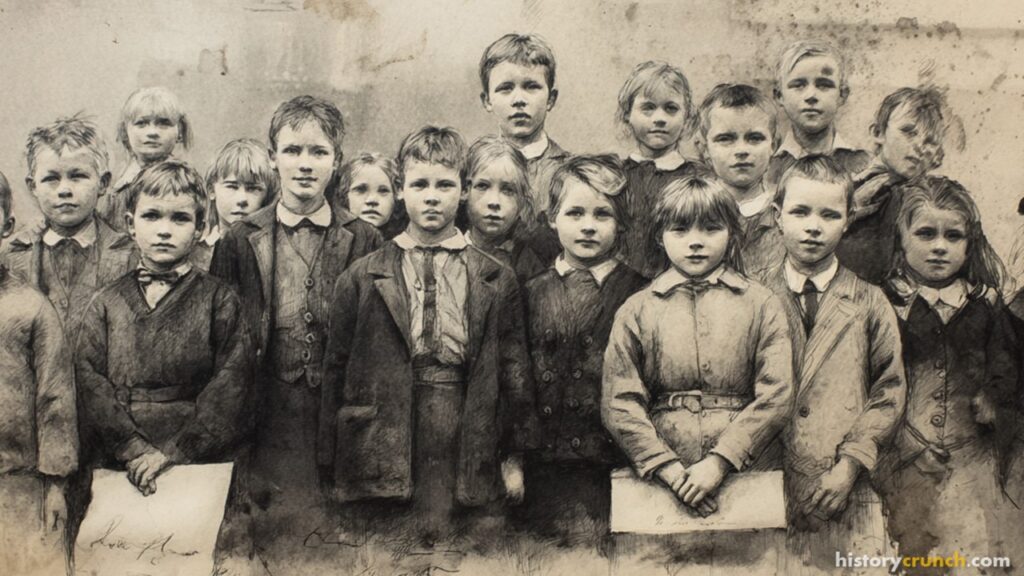
The Factory Act of 1833 had required two hours of schooling a day for the youngest mill children, and mill owners had complied by seating them in a corner with whoever was available. The Elementary Education Act of 1870, the Forster Act, set up elected school boards to build schools wherever the churches had not, and made elementary education compulsory for children aged five to thirteen. It was made free in 1891.
LEARN MORESHOW LESSwhy it matters · key numbersSOCIALCompulsory school is what finally ended child labor in Britain, more than any factory act, because a child who has to be in a classroom cannot be in a mill. It also created something new: a working population that could all read, which changed newspapers, politics and unions within a generation.
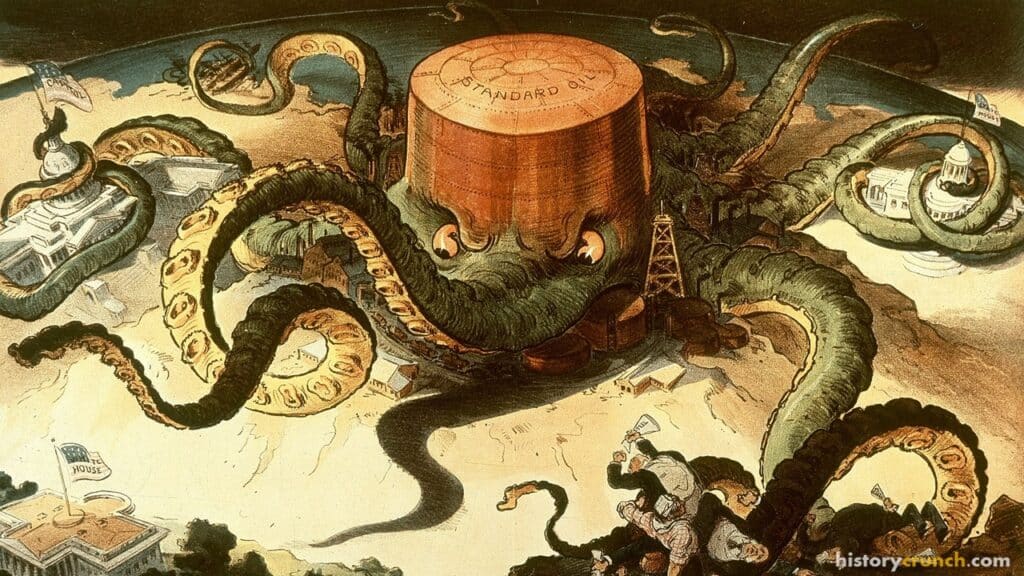
John D. Rockefeller founded Standard Oil in Ohio in 1870 and set out to control not one refinery but all of them. He negotiated secret rebates from the railroads, undercut rivals until they sold to him, and bought the barrel makers and the pipelines. By 1880 he controlled about 90 percent of American refining. Andrew Carnegie did the same in steel from 1875, buying the ore, the ships, the rails and the mills, and sold out in 1901 for $480 million.
LEARN MORESHOW LESSwhy it matters · key numbers · a debateECONOMICThese men built the modern corporation and were called both captains of industry and robber barons in their own lifetimes, which is the argument still. Both gave away most of their fortunes at the end, and both were broken up or bought out by the state or its rules: the Supreme Court dissolved Standard Oil in 1911.
Captains of industry or robber barons?
They built the steel, oil and rail networks that made America the largest economy in the world, drove prices down and gave away most of their money in libraries, universities and foundations.
They did it by rigging freight rates, crushing competitors, breaking strikes with private armies and buying legislatures, and the wealth came from workers paid as little as the market would allow.
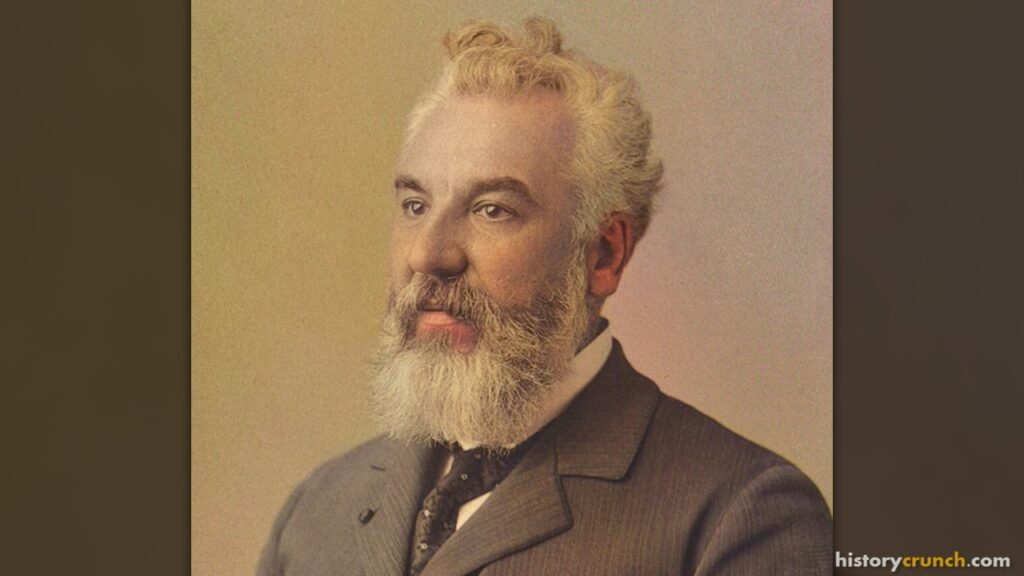
Bell was a teacher of the deaf in Boston whose mother and wife were both deaf, and who was trying to send several telegraph messages down one wire at once when he realized the same principle could carry a voice. He filed his patent on February 14th, 1876, hours before Elisha Gray filed a caveat for something similar, and on March 10th, three days after it was granted, he spoke to his assistant in the next room. The Bell Telephone Company followed in 1877 and became AT&T in 1885.
LEARN MORESHOW LESSwhy it matters · key numbers · 1 key figureSCIENCEThe telephone changed what a business day was: an order, a price or an instruction could now be given anywhere instantly, without writing. Bell thought of it as a sideline to his work with the deaf, refused to have one in his study, and made the first transcontinental call in January 1915, to the same assistant.
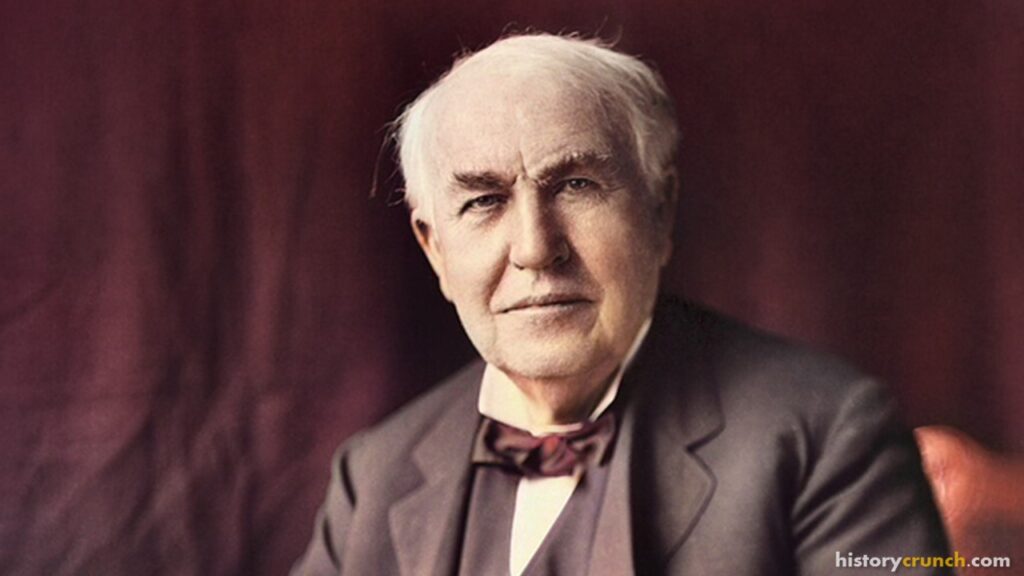
Thomas Edison had been a telegraph operator, was deaf in one ear and hard of hearing in the other, and in 1876 opened a laboratory at Menlo Park in New Jersey with the stated aim of producing a minor invention every ten days and a big one every six months. In 1877 he wrapped tinfoil round a cylinder, spoke into a diaphragm with a needle on it, and played back Mary Had a Little Lamb. Nobody had ever heard a recorded sound before.
LEARN MORESHOW LESSwhy it matters · key numbers · 1 key figureSCIENCEMenlo Park is as important as anything made in it: the first industrial research laboratory, where invention became an organized job with a payroll rather than a lone genius in a shed. Every corporate research department since is descended from it.
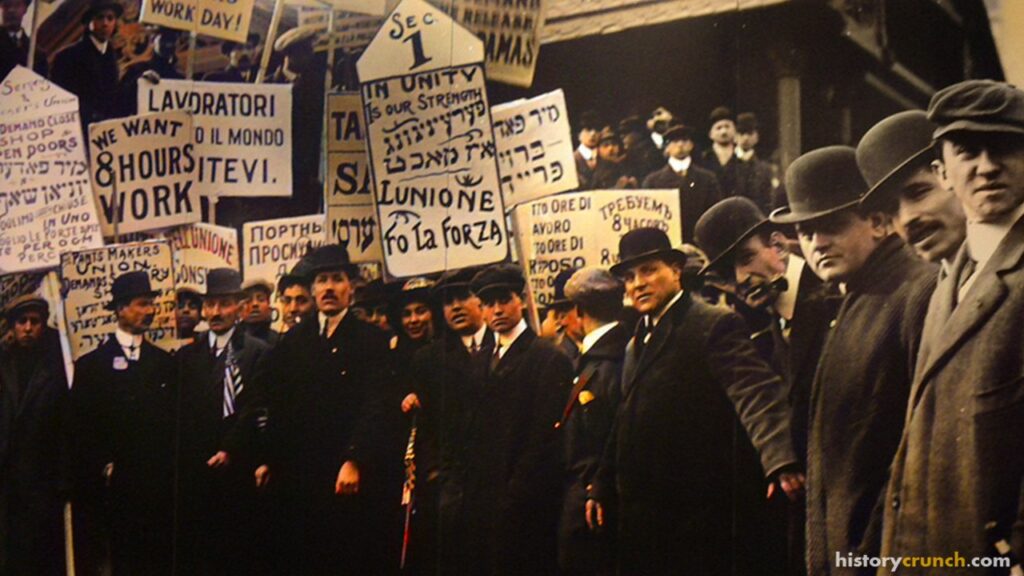
In the depression that followed 1873 the railroads cut wages for the third time in four years. In July 1877 firemen and brakemen in West Virginia refused to move the trains, and the strike spread along the lines to Baltimore, Pittsburgh, Chicago and St Louis. State militias and then federal troops were sent in; about a hundred people were killed and the Pittsburgh roundhouse was burned.
LEARN MORESHOW LESSwhy it matters · key numbersSOCIALThis was the first national strike in American history and the first time federal troops were used to break one, which set the pattern for the next sixty years. It also frightened the middle class into building armories in the middle of American cities, some of which are still there.
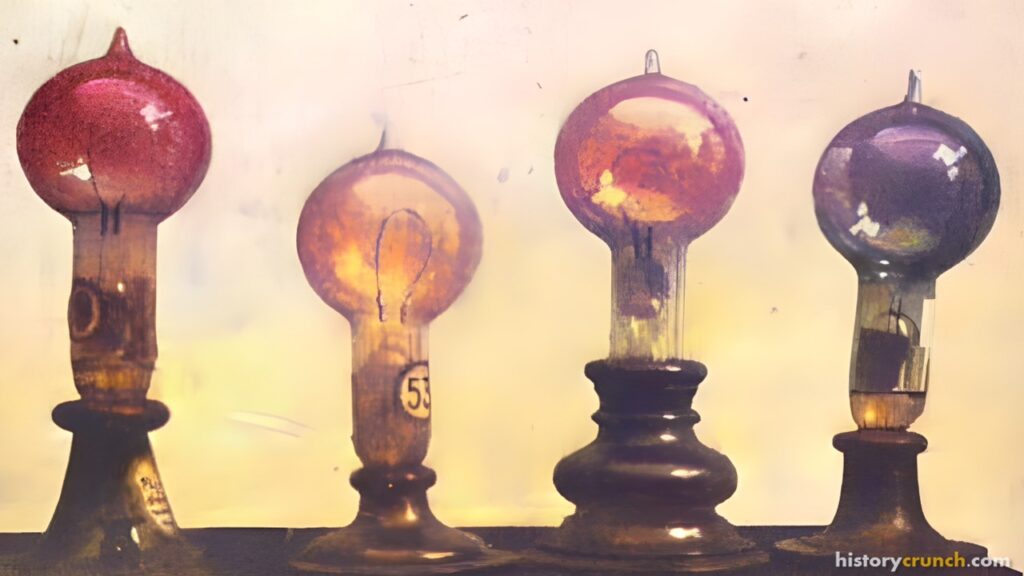
Electric arc lights already existed and were far too bright for a room. From 1878 Edison's laboratory tested thousands of materials for a filament that would glow without burning out, and settled on carbonized cotton thread and later bamboo. On December 31st, 1879 he lit the laboratory and the street outside for a crowd brought in by special train, and he patented the carbon filament lamp on January 27th, 1880. The Edison Illuminating Company began selling electricity in New York in 1882.
LEARN MORESHOW LESSwhy it matters · key numbers · 1 key figureSCIENCEThe bulb is only half of it: Edison had to invent the generators, the meters, the sockets and the wiring, because he was selling a system rather than a lamp. Electric light untied the factory and the home from daylight, and it is why a shift can begin at any hour.
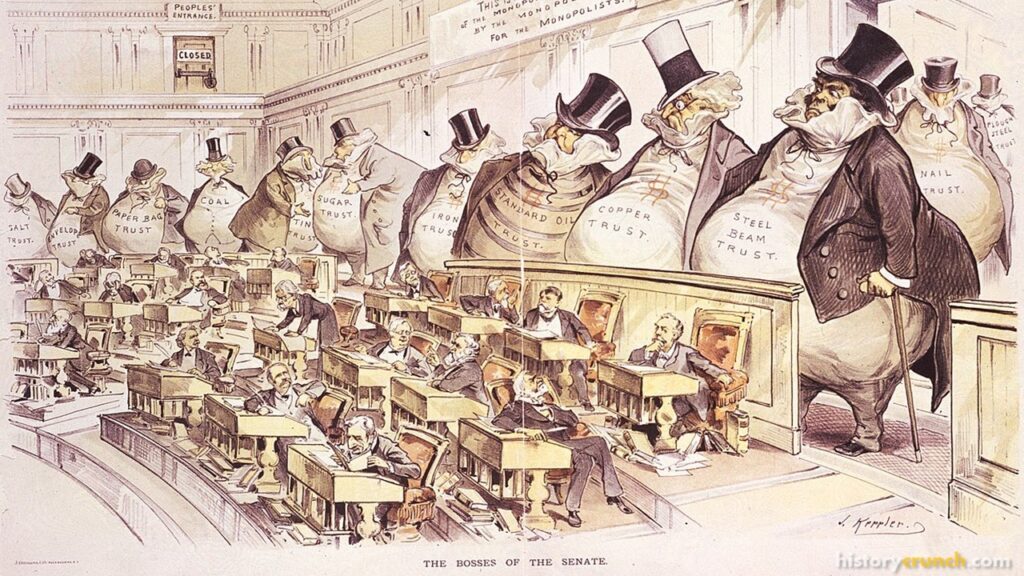
Mark Twain gave the age its name in 1873: gilded, not golden, meaning a thin layer of something bright over something cheap. Between the 1870s and 1900 American industrial output passed Britain's, immigrants arrived in millions, and a few hundred families built houses modelled on French chateaux while the people who worked for them lived six to a room. Political jobs were bought and sold until the Pendleton Act of 1883 required examinations for federal posts.
LEARN MORESHOW LESSwhy it matters · key numbersSOCIALThe Gilded Age is the argument about whether inequality is the price of growth, and it was fought out in strikes, courts and elections for thirty years. The Progressive Era is the answer America eventually gave.
Nicolaus Otto had built a working four-stroke internal combustion engine in 1861 and improved it through the 1870s. In 1885 Karl Benz put a small one on a three-wheeled frame in Mannheim and drove it; Gottlieb Daimler fitted another to a carriage the following year. In 1888 Benz's wife Bertha took the car and their two sons on a sixty-mile drive to her mother's without telling him, fixed it twice on the road, and proved to Germany that it worked.
LEARN MORESHOW LESSwhy it matters · key numbersSCIENCEThe car existed for twenty years as a rich man's toy made one at a time by hand. What changed it was not a better engine but a different way of making it, which is the next card but one.
Samuel Gompers was a cigar maker who had listened to socialist arguments all day at the bench and concluded that American workers were not interested in remaking society. The American Federation of Labor, founded in 1886, organized skilled workers by craft, kept out of politics as a movement, and asked for higher wages, shorter hours and better conditions. Asked what labor wanted, Gompers said: more.
LEARN MORESHOW LESSwhy it matters · key numbersSOCIALThe AFL survived where the Knights did not, and it decided the shape of American unionism for half a century: bargaining rather than politics, and skilled trades rather than everybody. The unskilled, the immigrants, women and black workers were mostly left outside until the 1930s.
On May 1st, 1886 about 300,000 American workers struck for an eight-hour day. Three days later, at a rally in Haymarket Square in Chicago, somebody threw a bomb at the police; seven officers and at least four workers died, most of them shot in the confusion that followed. Eight anarchists were tried for the bombing on the evidence of their speeches rather than their acts, and four were hanged. Nobody ever found out who threw it.
LEARN MORESHOW LESSwhy it matters · key numbersSOCIALHaymarket ruined the Knights of Labor, gave employers a word for every union organizer, and made May 1st the international workers' day everywhere except the United States, where it was replaced with a September holiday to avoid the association.
The Sherman Antitrust Act of 1890 declared every combination in restraint of trade illegal, in language so broad that nobody was sure what it covered. In its first decade it was used mostly against trade unions, on the argument that a strike restrained trade, and hardly at all against the trusts it was written for. That changed under Theodore Roosevelt after 1901, and in 1911 the Supreme Court used it to break Standard Oil into thirty-four companies.
LEARN MORESHOW LESSwhy it matters · key numbersPOLITICALThe Sherman Act is the moment Congress accepted that a market can be too concentrated to be a market. It took twenty years to mean anything, and it is still the law that antitrust cases are brought under today.
In 1892, with Andrew Carnegie in Scotland, his manager Henry Clay Frick cut wages at the Homestead steel works near Pittsburgh, locked out the union and brought 300 armed Pinkertons, private detectives hired to break strikes, up the river on barges. The workers met them at the landing and fought all day; about ten men died. The state militia took the plant, the union was destroyed, and there was no union in American steel for forty-five years. Two years later the Pullman Strike of 1894 was broken by federal troops sent to protect the mail.
LEARN MORESHOW LESSwhy it matters · key numbersSOCIALHomestead and Pullman settled the question of who the state would side with, and the answer for the rest of the century was the employer. It is why American union membership stayed low until the law changed in 1935.
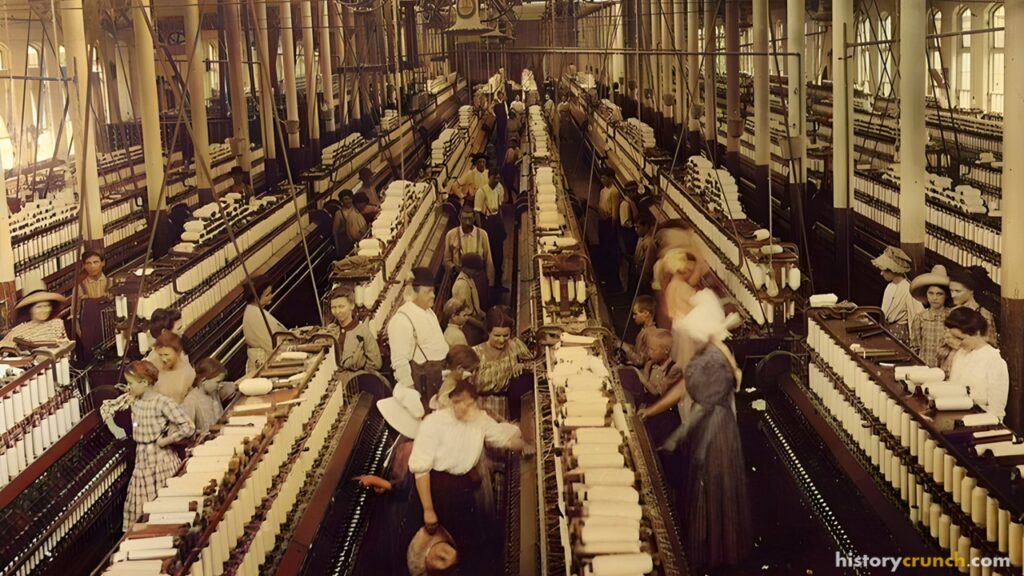
American industry grew faster than the American birth rate could supply, and the difference came by ship. Ellis Island opened in New York harbour on January 1st, 1892 and about 12 million people passed through it before it closed in 1954, most of them in the twenty years before the First World War, from Italy, Poland, Russia, Hungary and Greece. They took the jobs in the steel mills, the packing houses and the garment shops that nobody else wanted.
LEARN MORESHOW LESSwhy it matters · key numbersSOCIALThe Gilded Age was built by people who had arrived within the previous ten years, and its politics is largely an argument about them. Congress ended the open door in 1921 and 1924 with quotas designed to keep the numbers from southern and eastern Europe down.
Wilbur and Orville Wright ran a bicycle shop in Dayton, Ohio, and taught themselves aeronautics from library books and a wind tunnel they built out of a box. On December 17th, 1903 at Kitty Hawk, North Carolina, Orville flew 120 feet in twelve seconds; the fourth flight that day covered 852 feet in 59 seconds. Five people watched. Most newspapers did not believe it for five years.
LEARN MORESHOW LESSwhy it matters · key numbersSCIENCEThe Wrights solved the problem everyone else had missed, which was not lift or power but control in three axes, and they did it with bicycle-shop engineering and an industrial-age light engine. It is the last invention of the second industrial revolution and the first of the twentieth century.
The last act belongs to a Michigan farm boy who decided to build one cheap car for people who were not rich. The Model T went on sale in 1908; in 1913 Ford's engineers moved the chassis past the men instead of the men around the chassis and cut assembly from twelve hours to ninety minutes; in 1914 he doubled the wage to stop everyone leaving, and discovered that a worker paid enough to buy the product is a customer. Around it the century settled its accounts with the factory: Lewis Hine photographed the children, 146 garment workers died behind locked doors in New York, and between 1935 and 1938 American law finally granted the union, the minimum wage and the end of child labor.
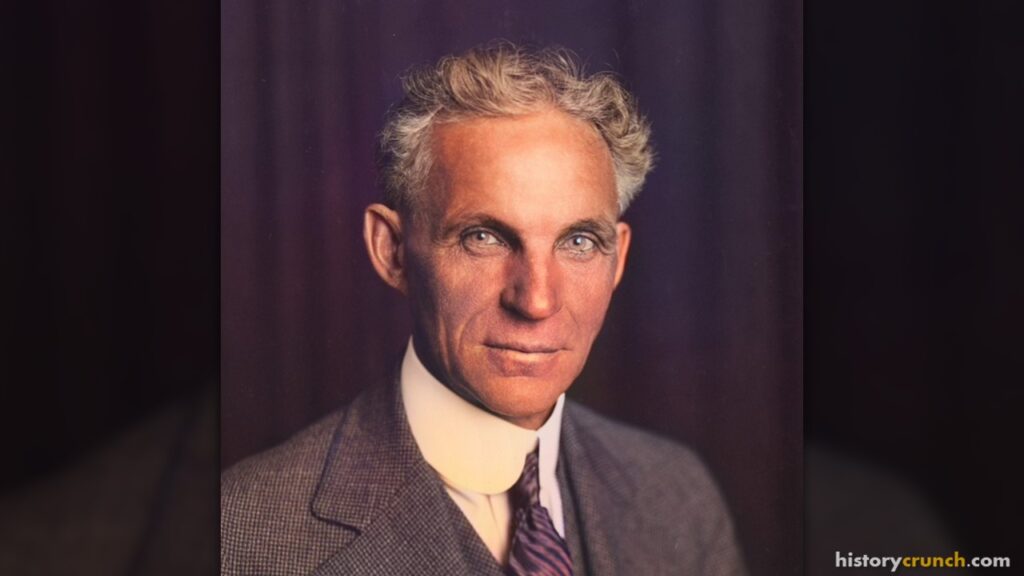
Henry Ford was born on a Michigan farm in 1863, left it at sixteen for a machinist's apprenticeship in Detroit, and spent the 1890s as an engineer at the Edison Illuminating Company building a car in his spare time. He completed the Quadricycle in 1896. Two earlier companies failed. The Ford Motor Company, founded in 1903 with eleven investors and $28,000, was the third attempt.
LEARN MORESHOW LESSwhy it matters · key numbers · 1 key figureECONOMICFord's idea was not the car, which existed, but who it was for. Everyone else was building expensive cars for rich people; he set out to build one car, cheap, for the farmer and the mechanic, and refused to make anything else for nineteen years.
Upton Sinclair spent seven weeks undercover in the Chicago meat-packing plants and published The Jungle in 1906 as a novel about the immigrant families destroyed by the work. Readers were not moved by the workers; they were horrified by the descriptions of what went into the sausage. Theodore Roosevelt sent inspectors, and the Pure Food and Drug Act and the Meat Inspection Act were law within six months. Sinclair said he had aimed at the public's heart and by accident hit it in the stomach.
LEARN MORESHOW LESSwhy it matters · key numbers · a sourceCULTUREThe Jungle is the clearest case of a book producing a law, and it is also the clearest case of the muckraker at work, the Progressive method: find out what is happening inside the building, print it, and let the public do the rest.
IN THEIR OWN WORDS“I aimed at the public's heart, and by accident I hit it in the stomach.”
Upton Sinclair, on The Jungle, 1906
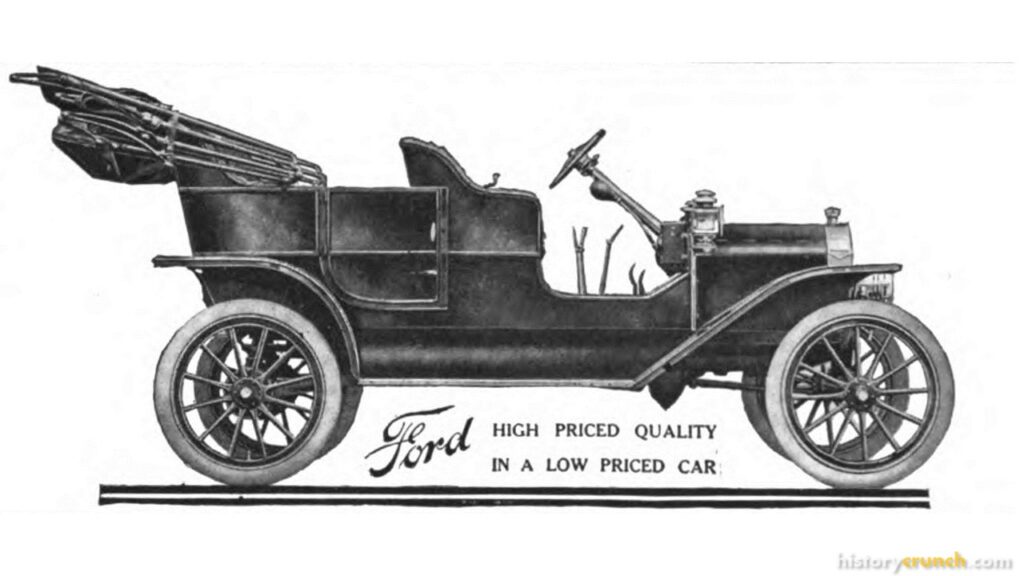
The Model T went on sale in 1908 at $825, built high for rutted country roads, simple enough that a farmer could repair it with the tools that came with it. By 1914 more than 250,000 had been sold; in 1916, after the price was cut to $360, sales passed 472,000; by 1918 half the cars in the United States were Model Ts. It was made without serious change until 1927.
LEARN MORESHOW LESSwhy it matters · key numbers · 1 key figureECONOMICThe Model T is the first thing in history that was both a serious machine and something an ordinary wage could buy, and it rearranged the country: paved roads, suburbs, motels, the whole geography of American life follows from it. Ford said customers could have any color so long as it was black, because black paint dried fastest.
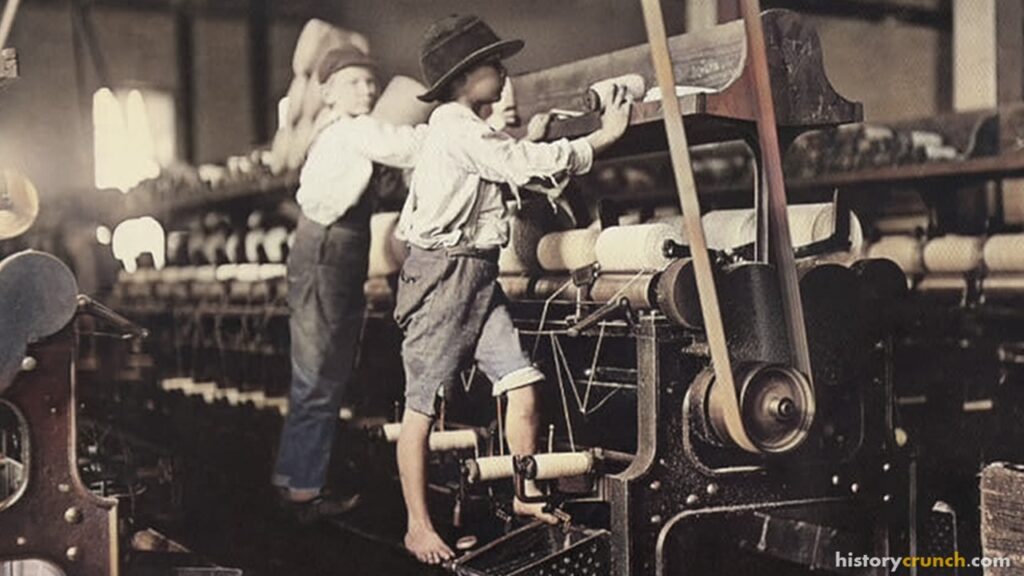
In 1908 the National Child Labor Committee hired a schoolteacher named Lewis Hine to photograph child labor across the United States. He talked his way into mills, mines and canneries pretending to be an insurance inspector or a bible salesman, measured the children against his own coat buttons to record their heights, and wrote down their names and ages. He produced thousands of photographs over ten years.
LEARN MORESHOW LESSwhy it matters · key numbersCULTUREHine did for America what the Sadler Committee's evidence and the Mines Commission's engravings had done for Britain: he made it impossible to say you did not know. Federal child labor laws were struck down by the Supreme Court twice before they finally stood in 1938.
Frederick Winslow Taylor was an engineer who believed that for every job there was one best way to do it, discoverable with a stopwatch. He broke tasks into their smallest movements, timed each one, eliminated the rest, and published The Principles of Scientific Management in 1911. Managers loved it. Workers found that the knowledge of how to do the job had been taken away from them and written down by somebody else.
LEARN MORESHOW LESSwhy it matters · key numbersIDEASScientific management took the division of labor Adam Smith had described and pushed it to its limit. It is the other half of mass production, and the half nobody remembers. Ford's moving line is Taylor's stopwatch with a conveyor attached, and the modern argument about monitored work, from the factory floor to the warehouse scanner, starts here.
On the afternoon of Saturday March 25th, 1911 a fire started in a rag bin on the eighth floor of the Triangle Shirtwaist factory in Manhattan. The doors to the stairwell had been locked to stop workers taking breaks or stealing. The fire escape collapsed, the ladders of the fire brigade reached the sixth floor, and 146 people died, most of them immigrant girls aged sixteen to twenty-three. Sixty-two jumped.
LEARN MORESHOW LESSwhy it matters · key numbersSOCIALTwenty thousand people had struck at the same factory in 1909 for exactly the conditions that killed them. The fire produced thirty-six new state laws in New York within three years and made the careers of the reformers who wrote the New Deal labor law twenty years later, Frances Perkins among them, who watched it happen from the street.
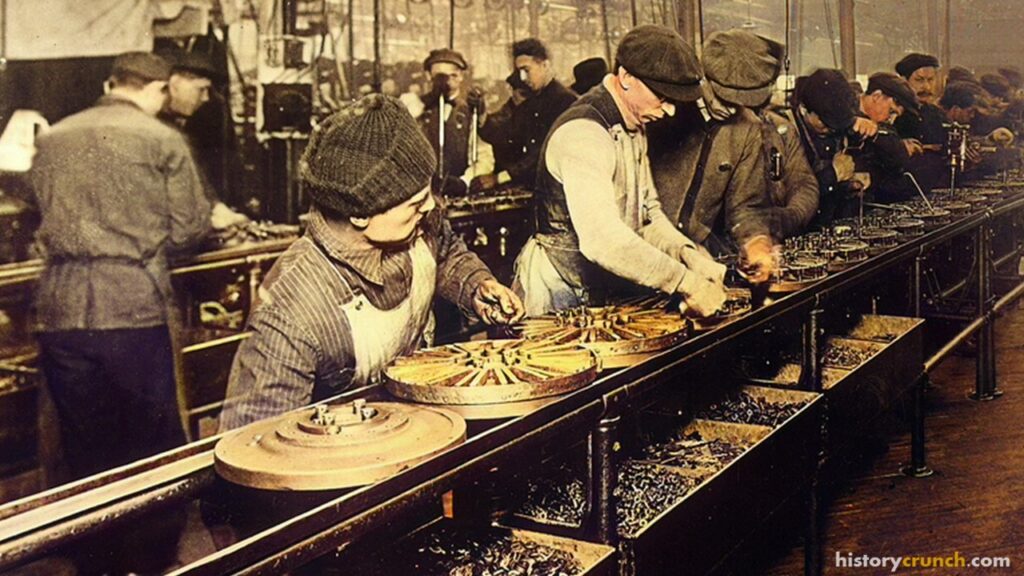
Ford's engineers at Highland Park had watched the overhead trolleys in Chicago's meat-packing plants, where a carcass moved past men who each made one cut. In 1913 they reversed it: instead of a team walking to a stationary car, the chassis moved on a rope and then a chain past men who each fitted one part. Assembly time for a Model T fell from about twelve and a half hours to about ninety minutes.
LEARN MORESHOW LESSwhy it matters · key numbers · 1 key figureECONOMICThis is the moment the twentieth century starts. Everything cheap enough for everybody, from cars to radios to refrigerators, comes from the moving line, and so does the complaint that follows it: the work is repetitive, it is paced by the machine, and it needs no skill, so nobody stays.
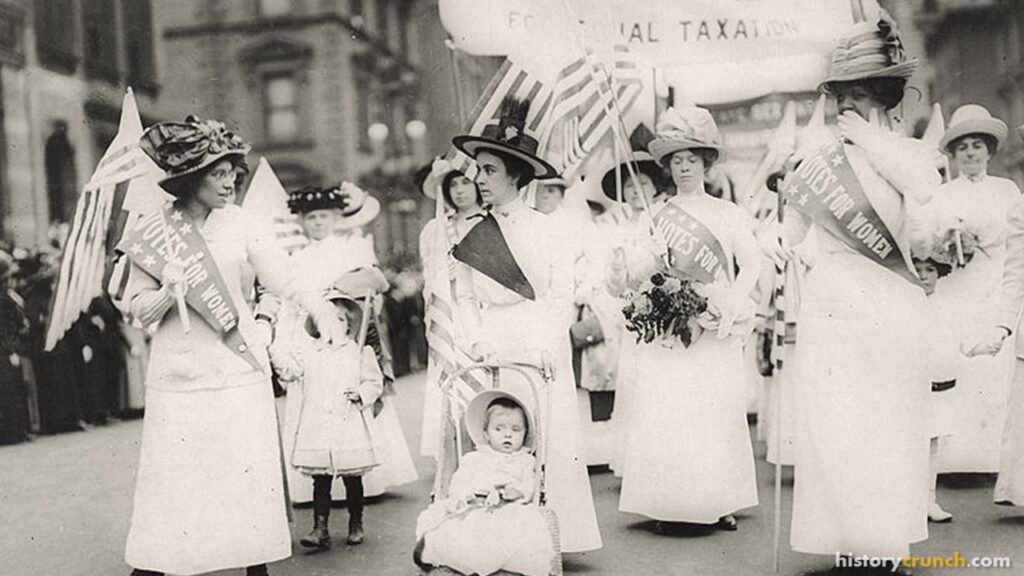
The Progressive Era ran from about 1896 to 1917 and was the American answer to the Gilded Age. The Clayton Antitrust Act of 1914 named the practices the Sherman Act had left vague and said explicitly that unions were not conspiracies in restraint of trade; the Federal Trade Commission, created the same year, was given the job of watching business between court cases. The 17th Amendment of 1913 took the election of senators away from state legislatures and gave it to voters.
LEARN MORESHOW LESSwhy it matters · key numbersPOLITICALThe Progressives did not want to end capitalism; they wanted an umpire. Almost every American federal agency that regulates a business, a drug, a food or a workplace dates from this period or from the New Deal that borrowed its methods.
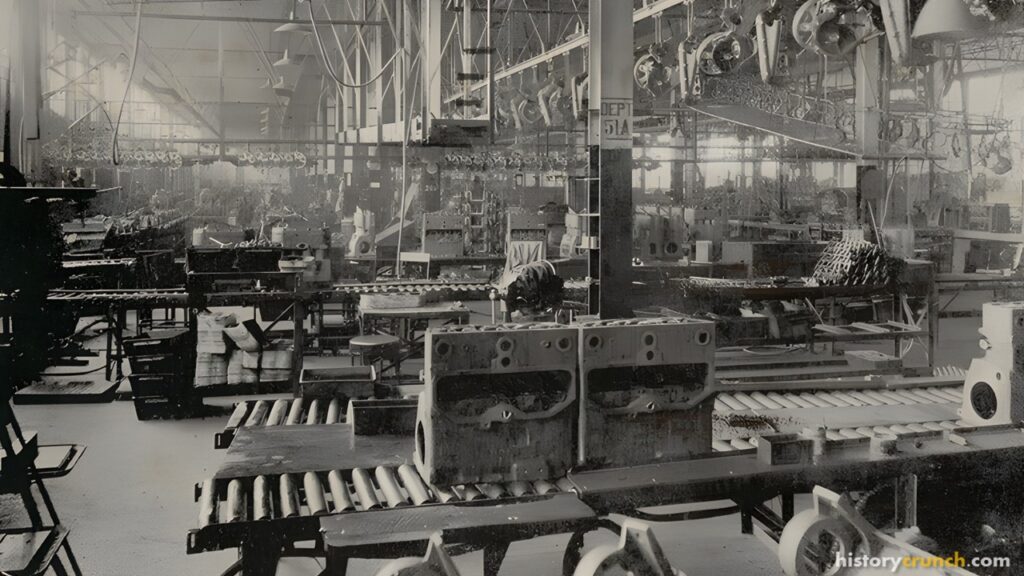
The moving line worked and the workers would not stay: Ford had to hire 963 men in 1913 to keep 100. On January 5th, 1914 the company announced that it would pay five dollars for an eight-hour day, roughly double the going rate, to men who passed the inspection of its Sociological Department, which visited homes to check on drinking, saving and family life. Ten thousand men queued outside the plant in the snow the next morning.
LEARN MORESHOW LESSwhy it matters · key numbers · a debateECONOMICFord was not being generous; he was buying an end to turnover, and it worked. He also understood something other employers did not, that a workman paid enough to buy a Model T is a customer, and that idea, high wages to create the market for what you make, is the one that built the twentieth-century middle class.
Was the five-dollar day generosity or control?
It doubled working-class wages in Detroit overnight, cut turnover to almost nothing, and proved that paying workers more could be good business rather than charity.
It came with inspectors in your house checking whether you drank, saved and spoke English, and it was aimed at a turnover problem the assembly line had created in the first place.
The Second Industrial Revolution, the age of steel, electricity, chemicals and the internal combustion engine, ran from about 1850 until the First World War. The war began in 1914 and the United States entered it in 1917, and it turned every industrial economy in Europe and America into a war economy: mass production applied to shells, machine guns, aircraft and ships, and women into the factories in millions to replace the men.
LEARN MORESHOW LESSwhy it matters · key numbers · elsewhereMILITARYThe war proved what industry could do and what it now cost. The same assembly lines that made cars made artillery shells by the hundred million, and a generation that had thought machines meant progress came out of it thinking something more complicated.
The World War I timeline covers the war; this card is what it did to industry.
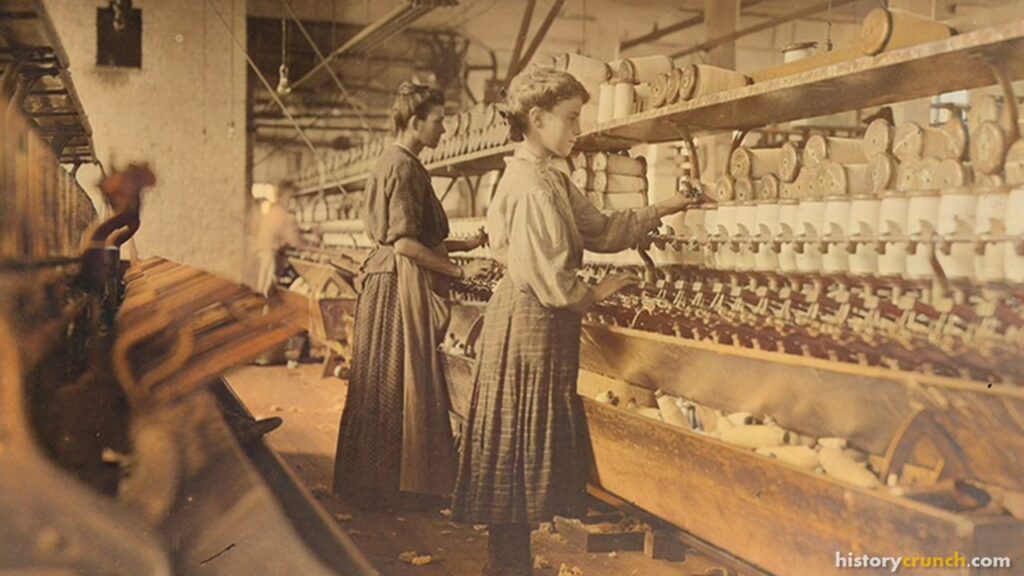
Women had worked in the mills from the first day: Arkwright's Cromford was mostly women and children, the Lowell mills of Massachusetts were staffed by farmers' daughters, and Lewis Hine's photographs of 1909 are full of them. They were paid between a third and a half of a man's wage for the same work. The 19th Amendment, ratified in 1920, gave American women the vote; British women over thirty got it in 1918 and on equal terms in 1928.
LEARN MORESHOW LESSwhy it matters · key numbersPOLITICALIndustrial work took women out of the household economy and into a wage, and the wage is what made the argument for the vote unanswerable. It did not make the pay equal: equal pay laws came in 1963 in the United States and 1970 in Britain, and the argument is not over.
For a century American workers who organized could be fired, blacklisted, sued or shot at, and the courts mostly agreed with the employer. The National Labor Relations Act, signed on July 5th, 1935 and known as the Wagner Act, guaranteed the right to form a union, required employers to bargain with one their workers had chosen, and created a board to run the elections and hear the complaints. The Social Security Act followed a month later.
LEARN MORESHOW LESSwhy it matters · key numbersPOLITICALUnion membership went from about three million in 1933 to about fifteen million by 1945, and with it came the eight-hour day, the weekend and employer health insurance for a large part of the American workforce. This is where the industrial working class finally got the law on its side, 136 years after the Combination Acts.
Signed on June 25th, 1938, the Fair Labor Standards Act set a federal minimum wage of 25 cents an hour, a maximum working week of 44 hours falling to 40, time and a half for overtime, and a ban on employing children under sixteen in most jobs and under eighteen in dangerous ones. The Supreme Court had struck down two earlier federal child labor laws; this one held.
LEARN MORESHOW LESSwhy it matters · key numbersPOLITICALThis is the end of the story that starts with Arkwright's mill in 1771. It took 167 years to get from children working twelve-hour shifts at a spinning frame to a federal law that said they could not, and the argument in between is most of this timeline.
Ford had fought the unions longer than anyone, with a private security force, until his own wife threatened to leave him if he did not sign with the United Auto Workers in 1941. He accepted a medal from Nazi Germany in July 1938 and published antisemitic material for years. He died on April 7th, 1947 at 83, at his house outside Detroit, during a flood that had knocked out the power, by the light of candles and an oil lamp. The same year the Taft-Hartley Act took back part of what the Wagner Act had given.
LEARN MORESHOW LESSwhy it matters · key numbers · elsewhereSOCIALFord is the whole of the Industrial Revolution in one life: a farm boy who mistrusted machines, a mechanic who made the century's machine, an employer who doubled wages and hired thugs, a man born into a world of horses who died in one of aircraft. He was buried in Detroit and the assembly lines stopped for one minute.
The Great Depression and World War II timelines carry what came next for these factories.

I'm a passionate history and geography teacher with over 15 years of experience working with students in the middle and high school years. I have an Education Degree with a focus in World History. I have been writing articles for History Crunch since 2015 and love the challenge of creating historical content for young learners!

K.L. is a content writer for History Crunch. She is a fantastic history and geography teacher that has been helping students learn about the past in new and meaningful ways since the mid-2000s. Her primary interest is Ancient History, but she is also driven by other topics, such as economics and political systems.

I'm the founder of History Crunch, which I first began in 2015 with a small team of like-minded professionals. I have an Education Degree with a focus in Social Studies education. I spent nearly 15 years teaching history, geography and economics in secondary classrooms to thousands of students. Now I use my time and passion researching, writing and thinking about history education for today's students and teachers.
To cite this timeline as a source, use one of the formats below.
MLA: Beck, E., et al. “Industrial Revolution Timeline.” HistoryCrunch, 12 September 2026, https://historycrunch.com/industrial-revolution-timeline/.
APA: Beck, E., Woida, K.L., & Millar, B. (2026). Industrial Revolution Timeline. HistoryCrunch. https://historycrunch.com/industrial-revolution-timeline/
Chicago: Beck, E., K.L Woida, and B. Millar. “Industrial Revolution Timeline.” HistoryCrunch. September 12, 2026. https://historycrunch.com/industrial-revolution-timeline/
© History Crunch
France had more people, China had better technology for centuries and the Dutch had better banks. Why did this happen in Britain?
Historians split between resources and institutions. One side points to coal, iron and colonies: Britain had cheap energy next to cheap ore and a captive market, and any country with that would have industrialized. The other points to law and habit: patents that made inventing pay, banks that lent to strangers, and a parliament of landowners who profited from trade rather than a court that taxed it. A third argument, harder to answer, is that Britain's advantage was partly the Atlantic slave economy that supplied the cotton and bought the cloth.
A factory needs hundreds of people who have nowhere else to be. In 1700 almost everybody in Britain had somewhere else to be. What changed?
Historians disagree about whether enclosure was a disaster or a necessary step. One side counts the families who lost their grazing and their fuel and had to sell their labor to survive. The other argues that output per acre rose, that Britain fed a growing population without famine, and that the alternative was not a happy village but a hungry one. The honest answer is that both happened to different people at the same time.
Britain's first great industry spun cotton. Britain grows no cotton. So who grew it, and under what conditions?
This is one of the sharpest arguments in economic history. One group of historians treats slavery as central: the cotton, the profits and the credit that built the mills all ran through it. Another group argues that industrialization was driven mainly by British coal, British institutions and British wages, and that cotton could have been bought elsewhere. A third position accepts the connection but questions how much of British growth it explains. Nobody serious now claims the two histories are unrelated.
Six machines in sixty years turned cloth-making from a cottage trade into an industry. Why did they come one after another instead of all at once?
Were the textile machines an improvement for the people who used them? Cloth became cheap enough that ordinary families could own more than one set of clothes, which had never been true before, and mill wages were more regular than cottage piecework. But the work was longer, it was paced by somebody else, and it destroyed the best-paid trade in northern England within thirty years. Both things happened to the same people.
An engine built in 1712 to pump water out of a Staffordshire mine ended up building cars in Detroit. How?
Did Watt's patent speed up the Industrial Revolution or slow it down? He could not have afforded the development without the protection, and his engine was a genuine leap. But the patent ran for thirty-one years, he sued rivals who tried to improve on it, and high-pressure engines, which made locomotives possible, only appeared after it expired in 1800.
Every time one half of cloth-making got faster, the other half became the problem. Why does one invention force the next?
Historians argue about whether these inventions were inevitable. Some describe a mechanical logic in which each bottleneck all but guarantees the next machine. Others point out that the bottleneck existed in France and India too and was not solved the same way, so the machines needed patent law, investors and a market as much as they needed the idea.
Steel existed for centuries before 1856 and was used for swords and springs, not buildings. What changed when it got cheap?
There is a long argument about whether Bessemer deserves the credit. William Kelly in the United States worked on a similar idea, and Robert Mushet's addition of manganese is what made the steel usable. Historians differ on whether we should name inventions after the person who first had the idea, the person who made it work, or the person who patented it.
In 1750 news moved at the speed of a horse or a ship. By 1876 it moved at the speed of electricity. What does that do to a society?
Historians disagree about whether transport caused industrial growth or simply followed it. One view treats canals and railways as the thing that made national markets possible. Another argues that they were built because demand already existed, and that they redistributed activity more than they created it.
Why would anyone leave a cottage where they set their own hours to work thirteen hours a day to somebody else's bell?
Was the factory age a fall or a rise in living standards? The pessimists point to the hours, the accidents, the cholera and life expectancy under thirty in the worst districts. The optimists point to wages, to cheap cloth and cheap coal, to a population that grew and lived longer overall, and argue that the misery was the countryside's, brought into view by being concentrated in towns. Recent work mostly finds real wages flat from 1780 to about 1830 and rising clearly afterwards, which is a long time to be told to wait.
Manchester went from 25,000 people to over 300,000 in eighty years. Where did they all live?
Were the slums the price of industry or the result of choices? They were built by private landlords for profit, in towns with no building rules, because nobody had the power or the will to impose any. Where rules existed, as in Owen's New Lanark or the Lowell boarding houses, workers were housed decently and the mills still made money, which suggests the conditions were a decision rather than a necessity.
Children worked in British mills for decades before anyone made it illegal. Why did it take so long, and what finally worked?
Historians argue about what ended child labor. One explanation credits reformers, evidence and the law. Another says machines grew too complex and too expensive for children to operate and that employers stopped wanting them. A third points to rising adult wages, which meant families no longer needed a child's income. Most now accept that the law mattered most where it came with inspectors.
People moved to the towns for work and then died younger than their parents had in the countryside. What was killing them?
Historians disagree about how much industrialization itself is to blame. One view is that the towns were lethal because they were industrial. Another points out that rural poverty was also lethal and less recorded, and that the towns look worse partly because someone was finally counting.
A farm worker works until the job is done. A factory worker works until the bell. When did the clock take over, and what did people lose?
There is a real argument about the five-dollar day. Ford presented it as sharing the profits. Historians have pointed out that it cut ruinous turnover, that it came with a Sociological Department which inspected workers' homes and private lives, and that it was conditional. Whether it was generosity, self-interest or control is still debated.
Within seventy years of the first factory, four men had produced four completely different explanations of what it meant. Which of them was right?
Two centuries on, the argument these men started is still the main axis of politics. Smith's descendants say industrial capitalism raised living standards further and faster than anything in history and that the evidence is the graph of world income since 1800. Marx's say that the graph hides who got it and when, and that everything decent about industrial work, the hours, the safety, the wage, was taken from owners by organized workers rather than given by the market. Both point at the same cards on this timeline.
Britain got much richer. Did the people who made it richer get better off, and if so, when?
This is the standard-of-living debate and it has run for over a century. Optimists point to real wages, consumption and the goods available by 1900. Pessimists point to the first two generations, who paid the cost and did not live to see the benefit, and to measures like height and life expectancy that fell while output rose. The current view is roughly that the gains were real but arrived late and were very unevenly shared.
In 1798 Malthus argued that population always outruns food. Britain's population then grew enormously and nobody starved. What did he miss?
Historians argue over whether Malthus was refuted or merely postponed. Some treat the escape from the Malthusian trap as the defining fact of modern history. Others note that it depended on fossil fuel, imported food and land taken from other people, and ask whether that counts as escaping the trap or exporting it.
Standard Oil made oil cheaper and more reliable and destroyed everyone who competed with it. Should that be allowed?
Economists and historians still divide over this. One side argues Standard Oil lowered prices and improved quality, so consumers gained and the breakup was politics. The other argues that it achieved that position through rebates and pressure that competitors could not survive, and that a market with one seller eventually stops being efficient whatever it did on the way up.
In 1799 it was a crime in Britain for workers to meet about their wages. In 1938 America set a minimum wage by federal law. What happened in between?
Did working people win these rights, or were they given them? One account is a fight: risings, strikes, petitions and unions, each one repressed and each one leaving something behind. Another is that reform came from above, from parliamentary committees, evangelical reformers and presidents who needed votes, often against the wishes of the workers' own leaders. The truth on this view is that the evidence was gathered by reformers and the pressure was applied by workers, and neither worked without the other.
The Luddites broke machines and are remembered as fools who tried to stop progress. They were skilled workers with families. What were they actually saying?
Historians have largely rewritten the Luddites. The older view treated them as irrational opponents of progress. Recent work reads them as skilled workers making a specific argument about wages, quality and who controls the pace of change, with rioting as their only available bargaining tool. The disagreement now is mainly about how organized they really were.
Britain argued its way to factory law through committees. America did it through strikes that turned into gun battles. Why the difference?
Historians offer several explanations for the difference: a federal system where a state governor could put militia on the street within a day, employers who could hire private armed agencies, a workforce divided by language and origin, and courts that treated unions as conspiracies for longer than British courts did. How much weight each deserves is still argued.
Again and again the rule changes only after people die in a way the public can see. Is that how reform actually works?
Historians disagree about whether disasters cause reform or merely give reformers their moment. One view holds that the campaigns, evidence and draft bills were usually already in place and the catastrophe simply removed the opposition. Another argues that public horror genuinely changes what a society is willing to pay for.
The United States had no factories in 1789 and was outproducing Britain by the 1890s. How?
Was American industrial success built on invention or on advantages? Americans invented the assembly line, interchangeable parts at scale, the research laboratory and the telephone. They also had a continent of coal, iron and farmland, a population arriving by the million, no neighbors who could invade, and, for the first seventy years, an export economy built on cotton grown by enslaved people. Both halves are in the cards on this view.
American industry grew faster than any before it. The people who did the building were mostly not born there. Who were they?
Historians argue about whether immigration raised or lowered wages for workers already there. Contemporary unions often insisted it lowered them and campaigned for restriction. Later economic work generally finds the effect smaller and more mixed than either side claimed, and emphasizes that immigrants also created demand.
Ford made a car a worker could buy and paid wages a worker could live on. Is that the birth of modern prosperity, or a story Ford told well?
Historians question the Ford story in two ways. First, mass production had many parents, including Taylor, the meatpacking disassembly lines and interchangeable parts from the armouries. Second, the claim that high wages created the consumer economy is disputed; most American workers did not work for Ford, and wages generally rose for overall economic reasons.
A clockmaker, a carpenter, a barber, a clergyman, a teacher of the deaf and two bicycle makers. Why were almost none of the great inventors scientists?
Does invention come from lone geniuses or from the moment being right? Almost every invention on this view was arrived at by two or more people within a few years: Bell and Gray filed on the same day, Swan had a light bulb before Edison, and several people built flying machines before the Wrights controlled one. That suggests the conditions produced the invention and the credit went to whoever patented, manufactured or publicized it first.
Britain made it illegal to export its textile machines or the people who knew how to build them. It did not work. Why not?
Historians disagree about how much Slater actually brought. Some treat him as carrying the decisive knowledge. Others argue that American mechanics were already capable and that what he really brought was the confidence that the system worked, plus the credibility to raise money for it.
Bell, Edison, Benz and the Wrights all built things that changed the world. Plenty of equally clever people built things nobody remembers. What is the difference?
Historians of technology generally reject the lone genius account and argue that inventions arrive when the surrounding conditions are ready, which is why so many were invented twice in different countries at once. Others reply that this underrates individual persistence, and that the notebooks show real problems solved by particular people.
Two hundred years on, which parts of ordinary life come from this, and what did it cost?
Was the Industrial Revolution worth it? It is the reason most people alive today were not born into subsistence farming, the reason life expectancy has doubled, and the reason almost anything can be owned by almost anyone. It also produced child labor on an industrial scale, the slum, the strike, the first mass pollution and, by way of the coal and oil it taught the world to burn, the climate problem that everyone alive now has to deal with. Most historians decline to answer the question and describe both, which is what this timeline does.
The Industrial Revolution is measured in output, wages and inventions. What happens to the account if you measure it in smoke and rivers?
Historians and economists argue about whether this was avoidable. One position is that nobody knew, and that the knowledge came much later. Another points out that the smoke and the stink were complained about at the time, laws were proposed and defeated, and that the cost was known locally and ignored because the people breathing it had no power.
Women had always worked. The factory changed where they worked, who paid them and who saw it. Did that make them freer?
Historians disagree about whether industrial work liberated women or exploited them. One argument is that a wage, however small, gave independence that domestic or farm work never did. Another is that women were paid a fraction of men's wages for the same hours and went home to a second unpaid shift. Protective legislation is argued about in the same way: real protection for some, and a way of excluding women from better-paid work for others.
No question matches that word.
Research question 1France had more people, China had better technology for centuries and the Dutch had better banks. Why did this happen in Britain?
Research question 2A factory needs hundreds of people who have nowhere else to be. In 1700 almost everybody in Britain had somewhere else to be. What changed?
Research question 3Britain's first great industry spun cotton. Britain grows no cotton. So who grew it, and under what conditions?
Research question 4Six machines in sixty years turned cloth-making from a cottage trade into an industry. Why did they come one after another instead of all at once?
Research question 5An engine built in 1712 to pump water out of a Staffordshire mine ended up building cars in Detroit. How?
Research question 6Every time one half of cloth-making got faster, the other half became the problem. Why does one invention force the next?
Research question 7Steel existed for centuries before 1856 and was used for swords and springs, not buildings. What changed when it got cheap?
Research question 8In 1750 news moved at the speed of a horse or a ship. By 1876 it moved at the speed of electricity. What does that do to a society?
Research question 9Why would anyone leave a cottage where they set their own hours to work thirteen hours a day to somebody else's bell?
Research question 10Manchester went from 25,000 people to over 300,000 in eighty years. Where did they all live?
Research question 11Children worked in British mills for decades before anyone made it illegal. Why did it take so long, and what finally worked?
Research question 12People moved to the towns for work and then died younger than their parents had in the countryside. What was killing them?
Research question 13A farm worker works until the job is done. A factory worker works until the bell. When did the clock take over, and what did people lose?
Research question 14Within seventy years of the first factory, four men had produced four completely different explanations of what it meant. Which of them was right?
Research question 15Britain got much richer. Did the people who made it richer get better off, and if so, when?
Research question 16In 1798 Malthus argued that population always outruns food. Britain's population then grew enormously and nobody starved. What did he miss?
Research question 17Standard Oil made oil cheaper and more reliable and destroyed everyone who competed with it. Should that be allowed?
Research question 18In 1799 it was a crime in Britain for workers to meet about their wages. In 1938 America set a minimum wage by federal law. What happened in between?
Research question 19The Luddites broke machines and are remembered as fools who tried to stop progress. They were skilled workers with families. What were they actually saying?
Research question 20Britain argued its way to factory law through committees. America did it through strikes that turned into gun battles. Why the difference?
Research question 21Again and again the rule changes only after people die in a way the public can see. Is that how reform actually works?
Research question 22The United States had no factories in 1789 and was outproducing Britain by the 1890s. How?
Research question 23American industry grew faster than any before it. The people who did the building were mostly not born there. Who were they?
Research question 24Ford made a car a worker could buy and paid wages a worker could live on. Is that the birth of modern prosperity, or a story Ford told well?
Research question 25A clockmaker, a carpenter, a barber, a clergyman, a teacher of the deaf and two bicycle makers. Why were almost none of the great inventors scientists?
Research question 26Britain made it illegal to export its textile machines or the people who knew how to build them. It did not work. Why not?
Research question 27Bell, Edison, Benz and the Wrights all built things that changed the world. Plenty of equally clever people built things nobody remembers. What is the difference?
Research question 28Two hundred years on, which parts of ordinary life come from this, and what did it cost?
Research question 29The Industrial Revolution is measured in output, wages and inventions. What happens to the account if you measure it in smoke and rivers?
Research question 30Women had always worked. The factory changed where they worked, who paid them and who saw it. Did that make them freer?