John Kay was a significant figure in the timeframe of the Industrial Revolution and is remembered today as a noted inventor. For example, he invented the flying shuttle, which had a profound impact on production in England and around the world during the time of the Industrial Revolution. John Kay’s flying shuttleA device attached to a hand-loom that allowed one operator to weave faster than was previously possible. transformed the textile industry by speeding up production.
 FactsthatCrunch
John Kay invented the flying shuttle in 1733, a device that allowed one person to operate a hand-loom faster than had ever been possible before, making it the first modern device to significantly improve textile productivity and efficiency. He later sold his patent to French manufacturers and settled in France, though he made little money from his invention because others copied his design without paying him.
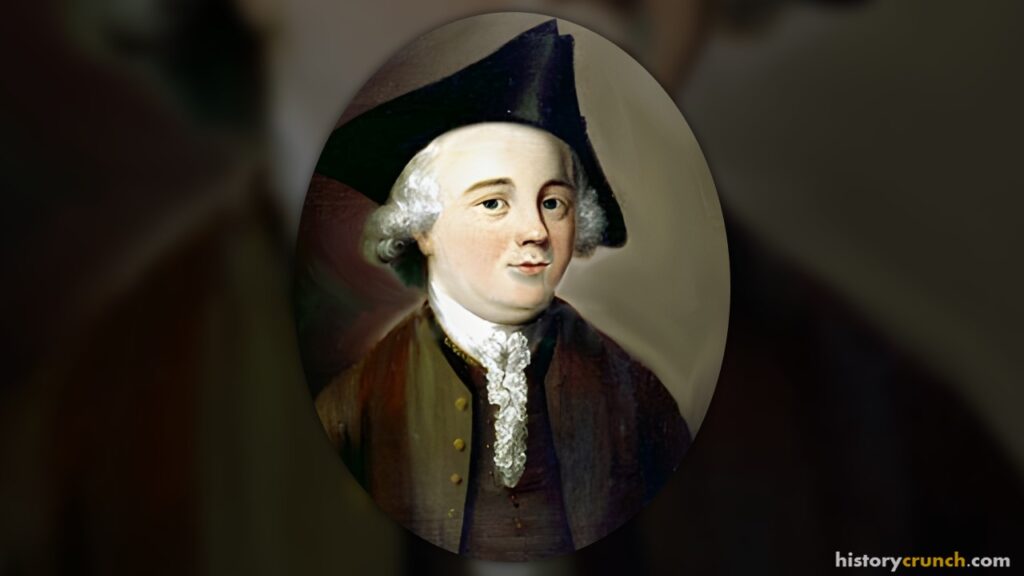
John Kay – Early Life
John Kay was born on June 17th, 1704 in Walmersley, England. His father was a yeomanA farmer who owned and worked their own land, considered a respectable but non-noble class in England. and owned an estate in Walmersley, but died before Kay was born. The estate went to Kay’s oldest brother, since John was the fifth son. As a child Kay attended school and became an apprenticeSomeone who learns a trade by working under a skilled person for a set period of time. hand-loom reed-maker at the age of fourteen. Kay left the apprenticeship after only one month after saying that he had mastered the craft. Once home he developed a metal reed that he sold across the country. On June 29th, 1725, John Kay married Anne Holte from Bury, England. The couple had several children together.
FactsthatCrunchA reed-maker was a craftsman who built reeds, the comb-like frames fitted inside a loom that held vertical warp threads apart at even distances so cloth came out smooth and uniform. Reed-makers served a skilled trade, and young people learned it through a formal apprenticeship. Without a well-made reed, weavers could not control thread spacing, and the finished fabric would be uneven.
"John Kay began training as a hand-loom reed-maker at age fourteen, though he left the apprenticeship after only one month, claiming he had already mastered the craft."
John Kay – Invention of the Flying Shuttle
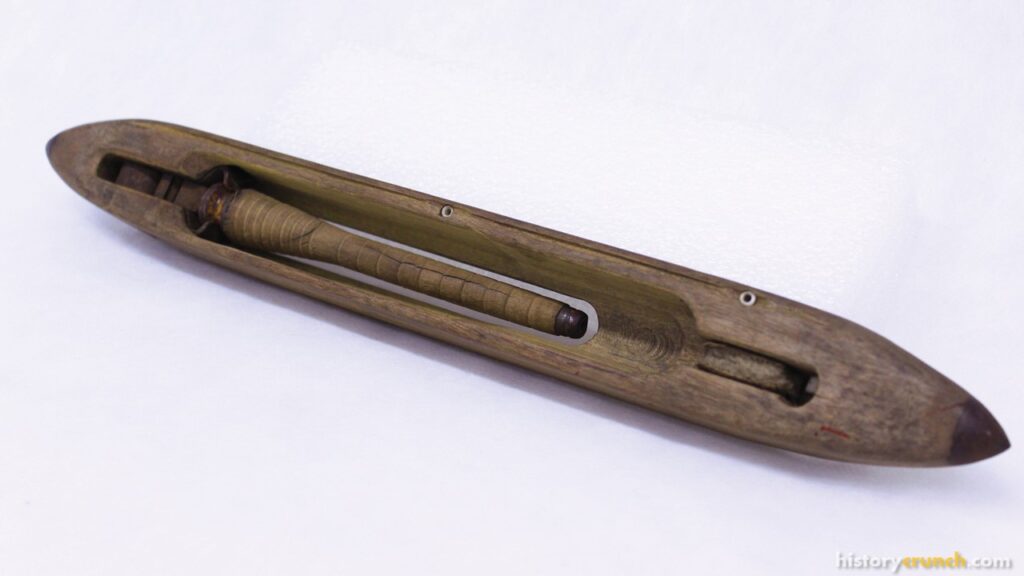
Kay continued to come up with ideas and improvements for textile machines, and in 1733 he developed a wheel shuttle, later known as a flying shuttle. The flying shuttle was used for the traditional hand-loom and helped improve weaving efficiency and reduced labor needs because it could be operated with only one operator. In fact, the flying shuttle was the first device in the modern era that significantly improved the productivity and efficiency of the textile process.
The flying shuttle was first manufactured in Essex, England. However, laborers did not like the machine, and petitionedFormally asked those in power to stop or change something, usually through a signed written request. to have it stopped, as it put their livelihoods at risk. This was an early example of the kind of protest that later became famous as the Luddite Movement that emerged in England during the timeframe of the Industrial Revolution. This movement opposed new technologies, which threatened the jobs of industrial workers. Kay improved his machine, and also developed other machines such as one for cloth ribbon weaving, and one for spinning. In reality, he made very little money from his invention and instead struggled due to patent infringementUsing someone’s patented invention without permission or payment. of his original design.
Kay left England in 1747 because France was known to support textile innovations. Kay sold his patent to the flying shuttle to French manufacturers and it allowed for the mechanizationThe process of replacing human labor with machines to produce goods faster and in larger quantities. in French textile production which allowed the French to make lots of fabric and textiles to clothe the population. In return, he was paid an ongoing pension. Kay adopted France as his country, although he did visit England a couple of times during the 1750s.
 FactsthatCrunch
What did John Kay do in 1747 when he struggled to profit from his flying shuttle in England?
John Kay – Death and Legacy
John Kay died in 1779. Today he is best remembered for his invention of the flying shuttle and the impact his innovation had on textile production during the Industrial Revolution.
FactsthatCrunchTap each impact to read what it led to.
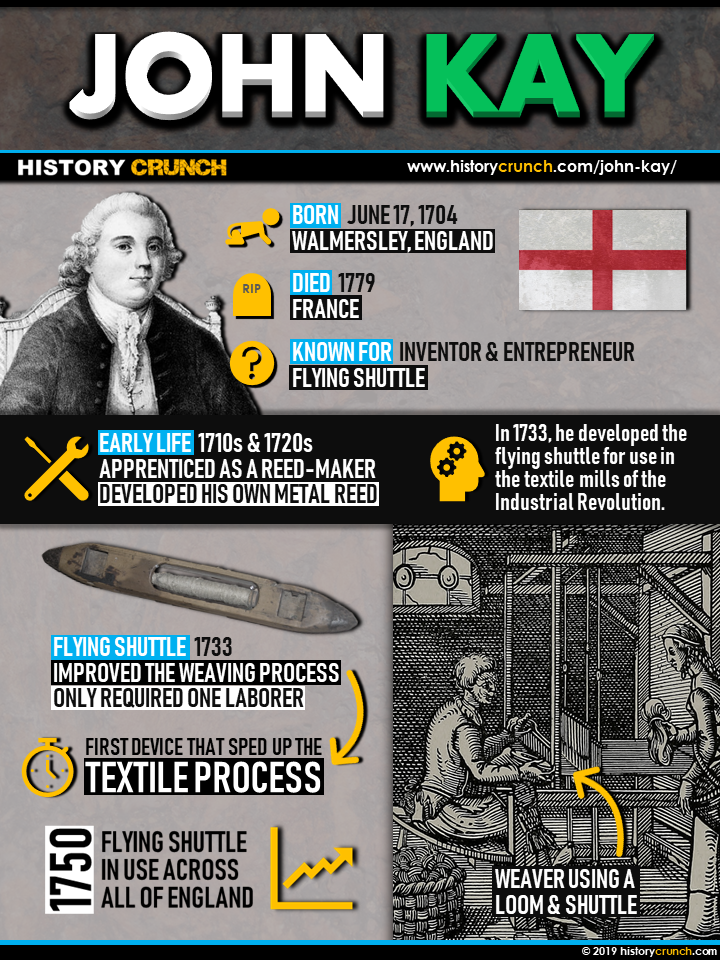
John Kay – Infographic
Key Vocabulary
Yeoman
Apprentice
Flying shuttle
Petitioned
Luddite Movement
Patent infringement
Mechanization
Frequently Asked Questions
What did John Kay invent?
John Kay invented the flying shuttle, a device that made weaving on a hand-loom much faster. He developed it in 1733, and it needed only one operator instead of two. He also created machines for cloth ribbon weaving and for spinning.
How did the flying shuttle change the textile industry?
The flying shuttle sped up weaving and cut the number of workers each loom needed. It was the first modern device that greatly improved textile productivity and efficiency. This change helped make cloth cheaper and faster to produce during the Industrial Revolution.
Why did workers oppose the flying shuttle?
Workers opposed the flying shuttle because it threatened their jobs by reducing the labor needed to weave. They even petitioned to have the machine stopped. This kind of protest was an early example of the resistance to new machines that the Luddites made famous decades later.
Why did John Kay move to France?
John Kay left England in 1747 because France was known to support textile innovations. He sold his flying shuttle patent to French manufacturers and received an ongoing pension in return. He adopted France as his home, though he visited England a few times during the 1750s.
Did John Kay become wealthy from his invention?
John Kay made very little money from the flying shuttle. Others copied his design without paying him, which left him struggling financially. His pension from France later gave him some steady income.
When and where was John Kay born?
John Kay was born on June 17th, 1704 in Walmersley, England. His father owned an estate but died before Kay was born, and the estate went to Kay’s oldest brother. As a teenager, Kay trained as a hand-loom reed-maker.
Cite This Article
To cite this article as a source, use one of the formats below.
MLA: Beck, Elias. “John Kay: A Detailed Biography.” HistoryCrunch, 26 September 2026, https://historycrunch.com/john-kay/.
APA: Beck, E. (2026). John Kay: A Detailed Biography. HistoryCrunch. https://historycrunch.com/john-kay/
Chicago: Beck, Elias. “John Kay: A Detailed Biography.” HistoryCrunch. September 26, 2026. https://historycrunch.com/john-kay/
Sources
- Emma Griffin, A Short History of the British Industrial Revolution.
- Fordham Modern History Sourcebook
- The Science Museum Group
- Joel Mokyr, The Enlightened Economy.