The invention of the telephone by Alexander Graham Bell in 1876 revolutionized communication by enabling real-time voice conversations over long distances. This groundbreaking device bridged geographic gaps, transforming personal and business interactions and fostering global connectivity. The telephone’s introduction led to the growth of telecommunications infrastructure, leading to the development of a vast network of telephone lines and exchanges. As a result, the telephone became an indispensable tool in everyday life, fundamentally changing how people connect.
 FactsthatCrunch
The U.S. government granted Alexander Graham Bell a patent for the telephone on March 7th, 1876, giving him exclusive legal rights to the invention and clearing the way for large-scale commercial development.
The patent system of the Industrial Revolution era gave inventors legal protection that encouraged private investment in new technology. In the case of the telephone, that protection directly shaped how quickly a national communications network was built.
Innovations of the Industrial Revolution
The Industrial Revolution is one of the most significant events in all of world history and had a profound impact on the modern world. It began first in Britain in the 1700s but soon expanded to the rest of Europe and North America. Before the innovations of the Industrial Revolution, most production depended on water, wind or human energy. The businesses that existed at this time were called cottage industriesHome-based businesses producing small amounts of goods, common before the factory system existed.. Cottage industries were an early stage of economic development in society in which workers produce a limited amount of goods in home-based businesses. However, by the mid-1700’s, new methods of production were being developed across Europe, especially in Great Britain. This transition led to the factory system, which was the creation of factories in centralized locations such as industrial towns and cities. This period of innovation continued throughout the 19th century and led to many new inventions by now famous inventors. In fact, one of the key features of the Industrial Revolution is the development of new inventions that led to more automation by machines. Significant inventions or innovations of the Industrial Revolution included: flying shuttle, spinning jenny, power loom, water frame, cotton gin, steam engine, telephone, light bulb, automobile, assembly line production and interchangeable parts.
 FactsthatCrunch
The Industrial Revolution unfolded in two distinct phases, each with its own focus, power sources, and key products.
Invention of the Telephone by Alexander Graham Bell
A significant invention of the late period of the Industrial Revolution was the telephone, which was invented by Alexander Graham Bell in 1876. Alexander Graham Bell was a Scottish inventor although he lived and worked in both Canada and the United States during the majority of his life and time inventing. The Industrial Revolution was one of the most important events in human history and dramatically transformed life for people throughout the world. While it first began in Britain, its effects later spread to other parts of Europe, the Americas and now parts of Asia. In general, the Industrial Revolution unfolded in a series of stages, which historians refer to as the First Industrial Revolution and the Second Industrial Revolution. The First Industrial Revolution began in the 18th century and focused primarily on textile manufacturing and steam power. The Second Industrial Revolution began in the mid-19th century and continued until World War I in 1914. The Second Industrial Revolution focused instead on steel production, the automobile and advances in electricity. Alexander Graham Bell’s invention of the telephone is one of the most significant inventions from the Second Industrial Revolution.
Throughout the 1860s and 1870s, Bell carried out numerous experiments all centered around human speech and the use of technology to carry human made sounds long distances. For instance, in 1875 he developed a receiver that could turn electricity into sound. Called ‘acoustic telegraphyAn early device that could send voice-like sounds across electrical wires, though not yet clear speech.’, the device allowed voice-like sounds to be heard across wires. While, not yet delivering clear voices across the wires, the device proved to Bell that the technology was viable. Bell quickly raced to get the acoustic telegraph patented in 1875. In the meantime, he continued to experiment and quickly worked to develop the first working telephone. At the time, there was intense competition with other inventors, who were working on similar technology. For example, American engineer Elisha Gray had developed a prototypeAn early working model of an invention built to test whether the idea is possible. of a telephone model in 1876. In fact, some historians suggest that Gray should be credited with developing the first telephone. Others even accuse Bell of stealing the basic design elements of his own telephone design from Gray. Regardless, Alexander Graham Bell obtained the credit for the invention because he was the first to secure the patentAn official government document giving an inventor the exclusive legal right to their invention. in 1876. In fact, on March 10th in 1876, three days after his patent was issued, Bell performed a successful test of his then current telephone design. The test involved Bell stating “Mr. Watson—Come here—I want to see you” in reference to Thomas Watson, an assistant to Bell at the time.
Following this initial test of his design, Bell carried out a more extensive test on his family farm near Brantford, Canada on August 3rd, 1876. He had run a wire crudely along fences and telegraph posts over a stretch of about five miles (eight kilometers) from Brantford to his home. When setup, Bell was able to hear people on the other end of the line in Brantford. The test proved the ability of his telephone design to carry voices over long distances.
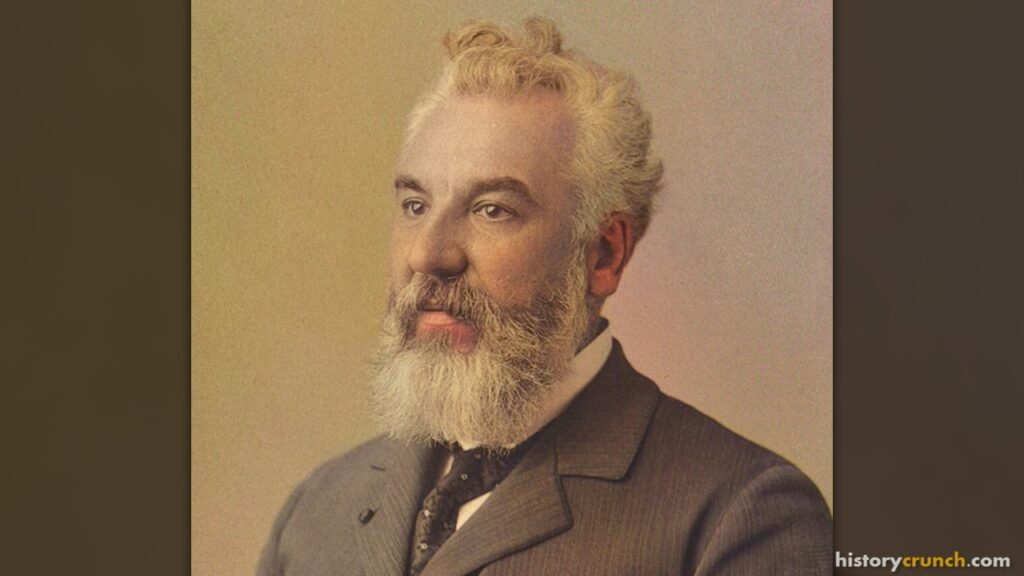
Mr. Watson—Come here—I want to see you.
Bell Telephone Company
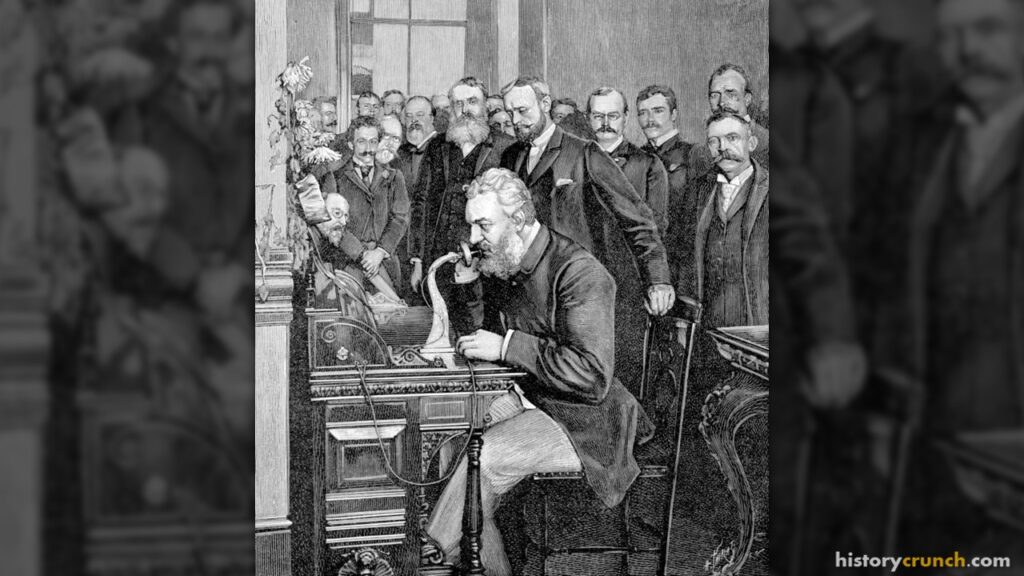
Following these tests, Bell worked hard to improve and perfect his telephone and the technology behind it. In fact, the Bell Telephone Company was created in 1877, and it made Bell and his investors incredibly wealthy. The company continued developing the telephone and installed wires all across the United States. In fact, in 1885 the Bell company set up the American Telephone and Telegraph Company (AT&T) to build long-distance lines, and through later mergersEvents where separate companies combine to form one larger company. AT&T became the parent of the whole Bell system. These mergers gave the company access to more lines and allowed people to make long-distance phone calls. For example, Bell made the first transcontinentalCrossing an entire continent from one side to the other. telephone call in January of 1915. He made the call from an AT&T office in New York City and called his assistant, Thomas Watson, in San Francisco, California.
His invention of the telephone made Bell a wealthy man. In turn, the telephone allowed communication across great distances and is one of the single most significant inventions that led to the modern age. In fact, telephone technology has improved significantly since Bell’s early designs and now includes cell phones and internet applications.
FactsthatCrunchFirst Transcontinental Telephone Call Connects New York to San Francisco
On January 25th, 1915, Alexander Graham Bell placed the first transcontinental telephone call from an AT&T office in New York City to his former assistant Thomas Watson in San Francisco, a distance of approximately 3,400 miles (5,500 kilometers). The call showed that AT&T's network could carry a clear voice from one coast of the United States to the other, nearly 40 years after Bell's first telephone test in 1876.
Key Vocabulary
Acoustic telegraphy
Patent
Prototype
Cottage industries
Factory system
Transcontinental
Mergers
Frequently Asked Questions
Who invented the telephone and when?
Alexander Graham Bell invented the telephone and secured its patent in 1876. Bell was a Scottish inventor who lived and worked in both Canada and the United States. His device let people hold real voice conversations over long distances for the first time.
What were the first words spoken on the telephone?
On March 10th, 1876, Bell said “Mr. Watson, come here, I want to see you” during a successful test. He was speaking to Thomas Watson, his assistant at the time. The test came just three days after his telephone patent was issued.
Did Alexander Graham Bell really invent the telephone first?
Bell received credit for the telephone because he was the first to secure the patent in 1876. American engineer Elisha Gray had built a similar prototype the same year. Some historians argue that Gray deserves credit, and a few even accuse Bell of copying design ideas from him.
How did the telephone fit into the Industrial Revolution?
The telephone was one of the most important inventions of the Second Industrial Revolution. This later stage began in the mid-19th century and focused on steel, the automobile and electricity. Bell’s work in the 1860s and 1870s built on this rush of new technology.
What was the Bell Telephone Company?
The Bell Telephone Company was formed in 1877 to build and improve telephone technology. It installed wires across the United States and made Bell and his investors very wealthy. In 1885 it set up the American Telephone and Telegraph Company, known as AT&T, to build long-distance lines, and AT&T later became the parent company.
When was the first transcontinental telephone call made?
The first transcontinental telephone call was made in January of 1915. Bell placed the call from an AT&T office in New York City to Thomas Watson in San Francisco, California. This showed how far the technology had come since the short tests of 1876.
Cite This Article
To cite this article as a source, use one of the formats below.
MLA: Beck, Elias. “Invention of the Telephone: A Detailed Summary.” HistoryCrunch, 26 September 2026, https://historycrunch.com/invention-of-the-telephone/.
APA: Beck, E. (2026). Invention of the Telephone: A Detailed Summary. HistoryCrunch. https://historycrunch.com/invention-of-the-telephone/
Chicago: Beck, Elias. “Invention of the Telephone: A Detailed Summary.” HistoryCrunch. September 26, 2026. https://historycrunch.com/invention-of-the-telephone/
Sources
- Fordham Modern History Sourcebook
- Robert C. Allen, The Industrial Revolution: A Very Short Introduction.