The nuclear arms race is one of the most significant events of the entire Cold War. The Cold War was a major world event that took place from approximately 1945 until 1991. In general, the Cold War involved a standoff and competition between the superpowers of the United States and the Soviet Union (USSR). This competition was seen in many aspects of life at the time, but especially in the development of nuclear weapons. Both superpowers raced each other to develop as many nuclear weapons as possible. This was the basis of the nuclear arms race in the Cold War.
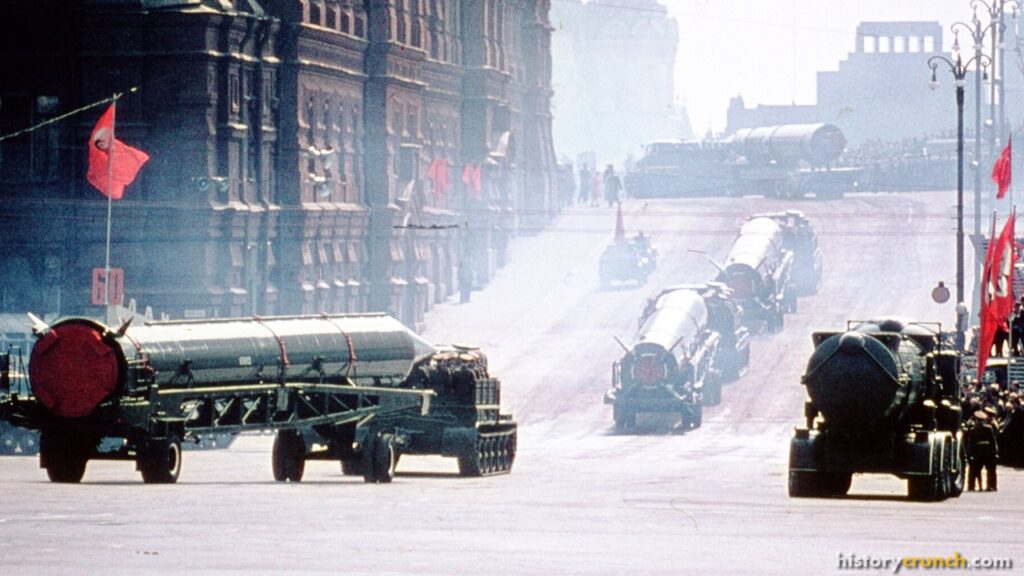

Nuclear Arms Race in the Cold War – USA and Soviet Union
World War II ended in Europe by May of 1945 with the defeat of Nazi Germany by the Allied Powers, but the war did not officially end in the Pacific Theater until the atomic bombing of Japan in August of 1945. The United States had developed its atomic weaponry through its secretive program called the Manhattan Project. With the atomic bombing of Japan, the United States had begun the era of nuclear weapons and the nuclear arms race.
At the outset of the Cold War, the United States was the only nation in the world to contain atomic weapons, such as those used against Japan in 1945. As such, the Soviet Union was not able to militaristically challenge the United States and worked to develop their own atomic weapons. However, on August 29th, 1949, the Soviet Union performed a test of their first atomic bomb codenamed ‘First Lightning’.
FactsthatCrunchIn the weeks after August 29th, 1949, American officials learned that the Soviet Union had successfully tested its first atomic bomb, codenamed First Lightning, ending the United States' position as the only nation on Earth with nuclear weapons. The two superpowers were now both armed, and U.S. leaders had to decide quickly how to respond to the collapse of America's nuclear monopoly in the Cold War.
Nuclear Arms Race in the Cold War – Summary
Throughout the rest of the Cold War, the United States and Soviet Union each stockpiledGathered and stored large quantities of weapons over time. thousands of nuclear weapons. As well, each superpower challenged the other for supremacy and developed more powerful weapons. By the 1950s each country had developed enough nuclear weapons to destroy the other. This development was an important aspect of the Cold War, as the stockpiles of nuclear weapons acted as a means of defense. Essentially, each nation was deterredPrevented from taking an action out of fear of the consequences. from going to war with the other, or from escalating tensions, due to the fear of a nuclear war. Historians refer to this idea as Mutual Assured Destruction (M.A.D.) since any escalation to war could result in the total destruction of both countries.
As stated previously, each nation had developed thousands of nuclear weapons during the Cold War. For example, the United States’ stockpile peaked at over 30,000 warheads while the Soviet Union’s peaked at about 40,000. However, as the Cold War progressed, each nation began to see the need to slow the development of nuclear weapons, from events such as the Cuban Missile Crisis. As a result, the later years of the Cold War saw the superpowers negotiate a series of treaties aimed at limiting the construction of nuclear weapons. These treaties are collectively known as the disarmament agreements and mark the ‘détente’ period of the Cold War, which involved a lessening of tensions between the two competing nations. In general, the two sides began to negotiate and discuss the dangers of nuclear proliferationThe spread and growth in the number of nuclear weapons among nations., which was a positive step toward reducing the tensions.
At its peak, about how many nuclear warheads did the Soviet Union have in its stockpile?
Nuclear Arms Race in the Cold War – Significance
The nuclear arms race in the Cold War was important for numerous reasons. First, it significantly heightened the tensions between the United States and the Soviet Union. For instance, the nuclear arms race led to the development of increasingly powerful and destructive weapons, including hydrogen bombs and intercontinental ballistic missiles (ICBMs). This arms buildup created a state of constant fear that ultimately created heightened tensions between the United States and the Soviet Union.
The nuclear arms race also sparked massive government spending on defense and scientific research, which has gone on to influence global politics and economies. For instance, the nuclear arms race eventually led to international efforts to control or limit the development of nuclear weapons through agreements, such as the Strategic Arms Limitation Talks (SALT).
The nuclear arms race also had a profound impact on popular culture and public consciousness. For instance, the nuclear arms race led to a widespread fear over potential nuclear war. This was partially responsible for the concept of Mutually Assured Destruction (M.A.D.). It is the Cold War-era doctrine that if two opposing sides both possess the capability to destroy each other with nuclear weapons, it would deter either from launching a first strike. As such, historians generally argue that the nuclear arms race in the Cold War had a profound impact on modern societies and politics around war and conflict.
Explore Cold War · 1947 – 1991
Keep exploring Cold War with these History Crunch resources.
Key Vocabulary
Manhattan Project
Stockpiled
Deterred
Détente
Nuclear proliferation
Frequently Asked Questions
What was the nuclear arms race in the Cold War?
The nuclear arms race was a competition between the United States and the Soviet Union to build nuclear weapons. Each side wanted to stockpile more and stronger bombs than the other. It lasted through most of the Cold War, which ran from about 1945 until 1991.
When did the Soviet Union get its first atomic bomb?
The Soviet Union tested its first atomic bomb on August 29th, 1949. The weapon was codenamed “First Lightning.” Before that test, the United States was the only country in the world with atomic weapons.
What does Mutual Assured Destruction mean?
Mutual Assured Destruction, or M.A.D., was the idea that both sides could destroy each other in a nuclear war. Because of this, neither side wanted to attack first. The fear of total destruction helped keep the two superpowers from going to war.
How many nuclear weapons did each side build?
At their peaks, the United States had over 30,000 warheads, while the Soviet Union had about 40,000. Each country had enough weapons to destroy the other by the 1950s. These huge stockpiles were meant to act as a form of defense and deterrence.
What treaties tried to slow the nuclear arms race?
The Strategic Arms Limitation Talks, known as SALT, were among the key treaties that limited nuclear weapons. These agreements are often called the disarmament agreements. They marked the détente period, a time when tensions between the two nations began to ease.
Cite This Article
To cite this article as a source, use one of the formats below.
MLA: Beck, Elias. “Nuclear Arms Race in the Cold War: A Detailed Summary.” HistoryCrunch, 9 October 2026, https://historycrunch.com/nuclear-arms-race-in-the-cold-war/.
APA: Beck, E. (2026). Nuclear Arms Race in the Cold War: A Detailed Summary. HistoryCrunch. https://historycrunch.com/nuclear-arms-race-in-the-cold-war/
Chicago: Beck, Elias. “Nuclear Arms Race in the Cold War: A Detailed Summary.” HistoryCrunch. October 9, 2026. https://historycrunch.com/nuclear-arms-race-in-the-cold-war/
Sources
- State Department — Office of the Historian
- John Lewis Gaddis, The Cold War: A New History.
- Wilson Center Digital Archive