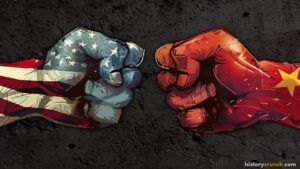
Proxy warsA conflict where stronger outside powers back local governments or armies in another country instead of fighting each other directly. in the Cold War were conflicts in which the United States and the Soviet Union supported opposite sides without fighting each other directly in a full-scale war. Proxy wars in the Cold War became one of the main ways the two superpowersThe two most powerful nations after World War II, meaning the United States and the Soviet Union. competed for power and influence after World War II, especially in conflicts, such as: the Korean War, the Vietnam War and the Soviet War in Afghanistan.
 FactsthatCrunch
Follow the chain from top to bottom. Tap any step to read what happened.
Background
After World War II, the United States and the Soviet Union emerged as the two main superpowers. The United States supported capitalism and democracy, while the Soviet Union supported communism based on the principles of a dictatorship. This ideological conflict caused the two nations to distrust each other deeply since both wanted to spread their spheres of influence. However, both also knew that a direct war between them could be deadly due to the advent of nuclear weapons. As such, both nations pursued policies in which they tried to avoid direct warfare.
In general, a proxy war was a conflict in which stronger outside powers backed local governments, rebel groups, or armies in another country. More specifically, instead of American and Soviet forces openly fighting one another on a large battlefield in Europe, they usually gave weapons, money, training, intelligence and political support to allies in other parts of the world. In some cases, one or both superpowers also sent troops or advisers, but the conflict was still framed as a war inside another country.
FactsthatCrunchKorean War
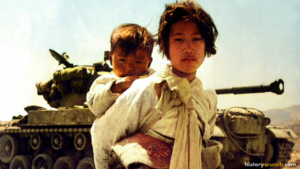
The Korean War was one of the first major examples of a proxy war in the Cold War. After the events of World War II, Korea was divided at the 38th parallel. The Soviet Union backed a communist government in the north under Kim Il-Sung, while the United States backed a capitalist government in the south under Syngman Rhee. Both sides claimed the right to rule all of Korea, so the division quickly led to a conflict.
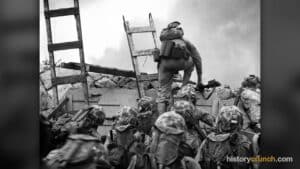
The war began on June 25th, 1950, when North Korea invaded South Korea. The United States quickly entered the war under the banner of the United Nations to defend South Korea. For their part, the Soviet Union supported North Korea with weapons, planning and political backing. Later, communist China also entered the war directly and sent large numbers of troops to support North Korea. This made the war far bigger than a local border conflict, and caused it to become a proxy war of the overall Cold War. In fact, the United States wanted to contain communism, while the Soviet Union wanted to expand its influence in East Asia. Even though Soviet and American forces did not openly fight each other in a declared war, both superpowers were deeply involved in the outcome.
The war ended in 1953 with an armistice. Korea ultimately remained divided, and the border between North Korea and South Korea became one of the most heavily armed borders in the world and remains that way today.
FactsthatCrunchHow did the Korean War end?
The Korean War ended in 1953 with an armistice agreement, which was a ceasefire deal rather than a formal peace treaty. The agreement left Korea still divided, with North Korea remaining communist and South Korea remaining anti-communist. The border between the two countries became one of the most heavily armed borders in the world and remains that way today.
Vietnam War
The Vietnam War became another major example of a proxy war in the Cold War. Its roots went back to French colonial rule and the anti-colonial struggle led by Ho Chi Minh, a Marxist-Leninist who led North Vietnam in its struggle for independence. After the French were defeated in 1954, Vietnam was divided into North Vietnam and South Vietnam. North Vietnam was communist and tied to the Soviet Union and China, while South Vietnam was anti-communist and supported by the United States.
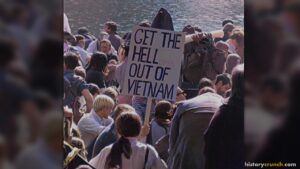
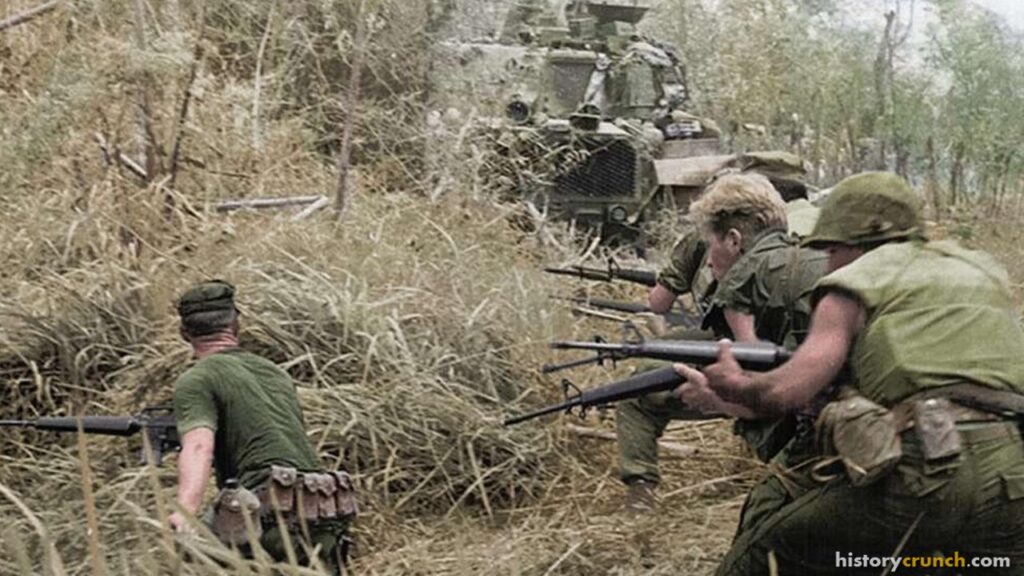
At first, the conflict in Vietnam involved a local political struggle inside South Vietnam. However, the Cold War turned it into a much larger war. More specifically, the United States feared that if South Vietnam fell to communism, other countries in Southeast Asia might follow. This idea became known as the ‘domino theory‘ and was based on the principles of American containment. Regardless, because of that fear, the United States sent advisers, money, weapons and eventually large numbers of troops to the conflict in Vietnam.
North Vietnam, meanwhile, received major support from the Soviet Union and China. Communist forces used the Ho Chi Minh Trail to move men and supplies southward. The Viet Cong fought inside South Vietnam through guerrilla warfareA style of fighting using small surprise attacks, ambushes, and local knowledge instead of large open battles., while North Vietnamese forces also played a major role in the war. The result was a long and brutal conflict that lasted for years, but ultimately was a proxy war of the overall Cold War.
FactsthatCrunchYou have a row of dominoes set up, you knock over the first one, and what will happen to the last one is the certainty that it will go over very quickly. So you could have a beginning of a disintegration that would have the most profound influences.
Eisenhower said this at a White House press conference on April 7th, 1954, answering reporter Robert Richards, who had asked why Indochina mattered to the free world while French forces were under siege at Dien Bien Phu in Vietnam.
Soviet War in Afghanistan
The Soviet war in Afghanistan was one of the clearest later examples of a proxy war in the Cold War. In 1978, a communist government took over power in Afghanistan, but it faced growing opposition from many Afghan people. As a result, the country became unstable, and Soviet leaders feared the government might collapse. As a result, in December of 1979, the Soviet Union invaded Afghanistan and sent troops to support the communist regime.
At first, Soviet leaders expected a short war. Instead, they became caught in a long and difficult struggle against the mujahideenAfghan resistance fighters who fought against the Soviet Union’s invasion of Afghanistan., who were Afghan resistance fighters. The war turned into a Cold War proxy conflict because the United States, Pakistan, Saudi Arabia and others backed the mujahideen with money, training and weapons. For their part, the Soviet Union backed the Afghan communist government with troops, aircraft, tanks and military advisers.
This conflict was different from Korea and Vietnam in one important way. In Afghanistan, it was the Soviet Union rather than the United States that became bogged down in a long war. The mujahideen used guerrilla tactics, local knowledge and outside aid to wear down Soviet forces. The war became costly for the Soviets in terms of lives, money and morale. It also weakened the Soviet Union’s international reputation.
The Soviet Union withdrew from Afghanistan in 1989. However, the war did not bring peace to the country. Afghanistan remained deeply unstable and later conflicts grew out of the destruction and political chaos left behind.
FactsthatCrunchBy February 1989, the last Soviet troops had crossed back into the Soviet Union, ending nearly a decade of fighting in Afghanistan. The mujahideen had driven out the Soviet forces, but no stable government had stepped in to replace the communist regime they had been fighting. Afghan political groups, warlords, and outside powers were all watching to see what would fill the power vacuum left behind.
Significance
Proxy wars in the Cold War were important because they became one of the main ways the Cold War was actually fought. The United States and the Soviet Union rarely attacked each other directly, but they repeatedly backed opposite sides in conflicts around the world. These wars turned local struggles into major international crises and caused enormous destruction in countries around the world.
Proxy wars in the Cold War were also significant because they showed the limits of the two superpower nations. In Korea, the war ended in division rather than victory. In Vietnam, the United States failed to stop communist victory. In Afghanistan, the Soviet Union failed to crush the resistance. In each case, a local war proved harder to control than the superpowers expected.
Most of all, proxy wars in the Cold War left deep effects for the people that experienced the war. For example, millions of people were killed, wounded or displaced. Furthermore, cities, villages and economies were ruined and political divisions lasted for decades. For that reason, proxy wars in the Cold War were one of the main ways the Cold War shaped the modern world.
FactsthatCrunchIn three Cold War conflicts, which superpower failed to win against a local resistance?
Key Vocabulary
Proxy war
Ideological
Containment
Domino theory
Guerrilla warfare
Mujahideen
Frequently Asked Questions
What is a proxy war?
A proxy war is a conflict in which strong outside powers back opposite sides without fighting each other directly. During the Cold War, the United States and the Soviet Union gave weapons, money, training and support to allies in other countries. This let them compete for power while avoiding a full war between themselves.
Why did the superpowers avoid fighting each other directly?
The United States and the Soviet Union avoided direct war mainly because of nuclear weapons. Both nations knew a direct clash could turn into a deadly war that neither side could win. As a result, they chose to support other countries and groups instead of attacking each other openly.
What were the main Cold War proxy wars?
The main Cold War proxy wars were the Korean War, the Vietnam War and the Soviet War in Afghanistan. In each one, the two superpowers backed opposite sides in a conflict inside another country. These wars turned local struggles into major international crises.
How was the Soviet War in Afghanistan different from Korea and Vietnam?
In Afghanistan, it was the Soviet Union, not the United States, that became stuck in a long and costly war. Soviet troops fought the mujahideen, who were Afghan resistance fighters backed by the United States, Pakistan and Saudi Arabia. The war drained Soviet lives, money and morale before the Soviets withdrew in 1989.
What was the domino theory?
The domino theory was the American fear that if one country fell to communism, nearby countries would soon follow. This idea shaped United States policy during the Vietnam War. It was based on the goal of containment, which aimed to stop the spread of communism.
Why were Cold War proxy wars significant?
Proxy wars were significant because they became one of the main ways the Cold War was actually fought. They caused huge destruction, and millions of people were killed, wounded or displaced. They also showed the limits of the superpowers, since neither side could fully control these local wars.
Cite This Article
To cite this article as a source, use one of the formats below.
MLA: Millar, B. “Proxy Wars in the Cold War: A Detailed Summary.” HistoryCrunch, 18 September 2026, https://historycrunch.com/proxy-wars-in-the-cold-war/.
APA: Millar, B. (2026). Proxy Wars in the Cold War: A Detailed Summary. HistoryCrunch. https://historycrunch.com/proxy-wars-in-the-cold-war/
Chicago: Millar, B. “Proxy Wars in the Cold War: A Detailed Summary.” HistoryCrunch. September 18, 2026. https://historycrunch.com/proxy-wars-in-the-cold-war/
Sources
- Vladislav Zubok, A Failed Empire.
- Wilson Center Digital Archive
- John Lewis Gaddis, The Cold War: A New History.
- Odd Arne Westad, The Global Cold War.