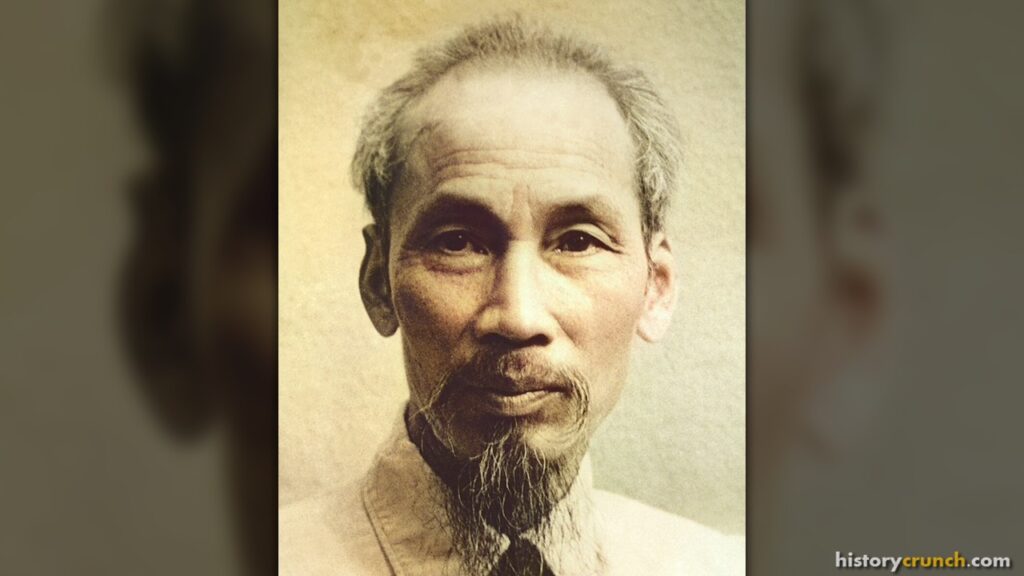
Ho Chi Minh was a communist revolutionary, an anti-colonial nationalist, and the leading figure in the creation of North Vietnam during the events of the Vietnam War. He is best known for leading the movement for Vietnamese independence and for becoming the central political figure of North Vietnam during the long conflicts against France, Japan, and later the United States and South Vietnam. In fact, his life is important to several major events of the 20th century, including the Vietnam War and the overall Cold War.
HO CHI MINH – EARLY LIFE AND RISE TO PROMINENCE
Ho Chi Minh was born in central Vietnam, in what was then part of French Indochina. He was born as Nguyễn Sinh Cung, though he later used several different names during his political life. In 1911, he left Vietnam and spent years traveling and working abroad, including time in France. these experiences helped shape his political thinking because his travels exposed him to new ideas about government and the structure of society.
By 1919, Ho Chi Minh was active in France and tried to argue for greater rights for Vietnamese people at the Versailles Peace Conference. When those efforts failed, he moved more strongly toward revolutionary politics. In fact, in 1920, he joined the French Communist Party, which resulted in communism becoming a central part of his political identity.
In the years that followed, Ho Chi Minh worked with international communist networks and helped organize Vietnamese revolutionaries. In 1930, he played a key role in founding the Indochinese Communist Party. This was a major step in his rise because it gave anti-colonial struggle in Vietnam a more organized political foundation.
HO CHI MINH – LEADER OF VIETNAMESE INDEPENDENCE
A major turning point came in 1941, when Ho Chi Minh returned to Vietnam and helped create the Viet Minh, which was the League for the Independence of Vietnam. The Viet Minh opposed both Japanese occupation and the return of French colonial rule. As such, Ho Chi Minh became the best-known face of the Vietnamese independence movement during the final years of World War II and its aftermath.
Before the Vietnam War, Vietnam had a long history of foreign domination and political struggle. For example, in the late 19th century, France controlled Vietnam as part of French Indochina, and this colonial rule caused deep anger among many Vietnamese people. Furthermore, during World War II, Japan dominated the region, but after Japan’s defeat in 1945 France tried to return and reassert control. This is important because Ho Chi Minh rose to prominence in a country already shaped by decades of foreign rule and resistance. Therefore, understanding Ho Chi Minh requires understanding that many Vietnamese nationalists wanted not only political change, but also freedom from foreign control.
Regardless, after Japan’s defeat in World War II in 1945, Ho Chi Minh and the Viet Minh moved quickly to seize political control in northern Vietnam. For example, on September 2nd, 1945, he declared the independence of the Democratic Republic of Vietnam in Hanoi. This was a decisive moment because it marked his emergence not only as a revolutionary leader, but also as the head of a new Vietnamese state.
However, independence was not secure. France attempted to regain control, which resulted in the First Indochina War. Ho Chi Minh remained the leading figure of Vietnamese resistance during that struggle, and the conflict ended only after the French defeat at Dien Bien Phu in May of 1954 and the Geneva Conference later that year. After that, Vietnam was divided along the 17th parallel, with Ho Chi Minh leading the communist north.
HO CHI MINH – VIETNAM WAR
After 1954, Ho Chi Minh became the central political symbol of North Vietnam. In fact, even though other figures were also important in the government and military, Ho Chi Minh remained the best-known leader of the northern regime. South Vietnam, by contrast, was led by Ngo Dinh Diem and was supported by the United States and other western powers. This division set the stage for the later Vietnam War.
As tensions deepened, the conflict between North and South Vietnam became part of the larger Cold War. The United States supported South Vietnam because American leaders feared the spread of communism in Asia, while Ho Chi Minh and North Vietnam continued to push for Vietnamese unification under communist leadership.
HO CHI MINH – DEATH
Although Ho Chi Minh remained an important symbol during the Vietnam War, he did not live to see the final communist victory. He died on September 2nd, 1969, in Hanoi from heart failure. Even so, his image and legacy remained central to North Vietnamese morale and propaganda during the final years of the war.
HO CHI MINH – SIGNIFICANCE
Ho Chi Minh was significant because he stood at the center of Vietnam’s long struggle against foreign domination. More specifically, he helped transform Vietnamese nationalism into a revolutionary movement that defeated French colonial rule and created a communist state in northern Vietnam.
Ho Chi Minh was also important because his life shows how decolonization and the Cold War could overlap. For many Vietnamese supporters, he was a symbol of independence and resistance. For many western governments, he was a communist threat tied to the wider expansion of Soviet and Chinese influence. Regardless, Ho Chi Minh remains one of the most influential political leaders in 20th-century Asian history.