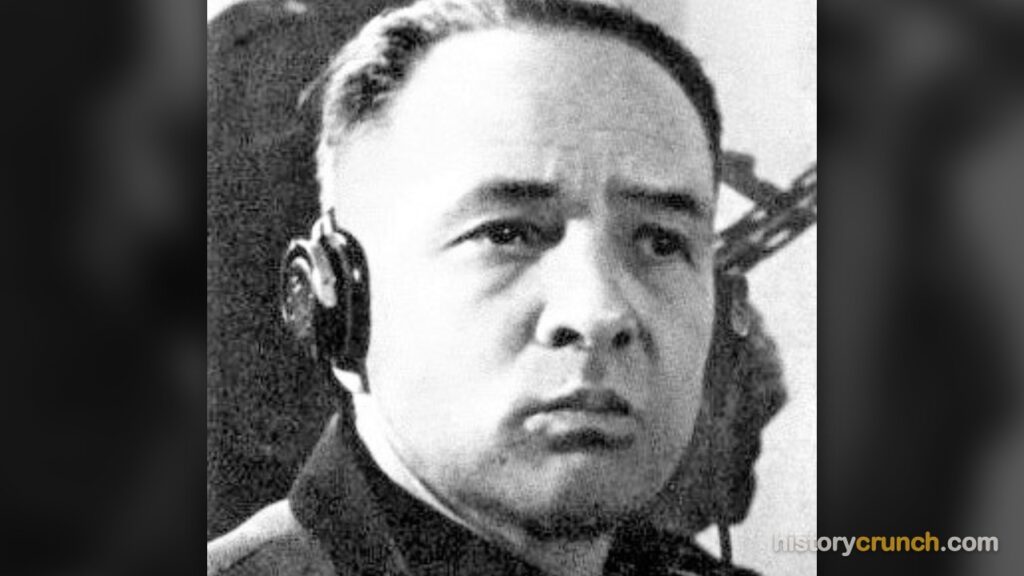
Rudolf Höss was one of the most important and infamous figures of the Holocaust because he served as the commandant, or chief officer, of the Auschwitz concentration and extermination camp in German-occupied Poland during World War II. Under his command, Auschwitz grew from a prison for political enemies into the largest killing center of the Nazi regime, a place where over one million people, most of them Jewish, were murdered. In fact, Höss personally oversaw the building of the gas chambers and the deadly system used to carry out the Nazi plan known as the “Final Solution.” His calm, businesslike role in mass murder has made him a lasting symbol of how ordinary-seeming men committed some of history’s worst crimes.
A concentration camp was a prison built by a government to hold large numbers of people, often without a trial, based on their race, religion, or political beliefs. An extermination camp, sometimes called a death camp, went a step further and existed mainly to kill the people sent there. Auschwitz became both at once, and Rudolf Höss was the man placed in charge of running it.
Early Life and Background
Rudolf Franz Ferdinand Höss was born on November 25th, 1900, in Baden-Baden, a town in southwestern Germany. He grew up in a strict, deeply religious Catholic family, and his father hoped that Rudolf would one day become a priest. Those plans, however, did not last. The death of his father and the outbreak of World War I changed the direction of his young life.
In 1916, while still a teenager, Höss joined the German army and fought in World War I. He was wounded several times during the conflict and was awarded the Iron Cross, a German medal given for bravery in battle. These early years of military service shaped him into a young man who valued obedience, discipline, and following orders without question, traits that would later define his role in the Nazi system.
After the war ended in 1918, Germany fell into political chaos and economic hardship. Like many former soldiers, Höss joined a Freikorps, which was a private army made up of nationalist ex-soldiers who fought against communists and other groups they saw as enemies of Germany. It was during this violent period that he first came into contact with the extreme nationalist movements that would eventually give rise to the Nazi Party.
Rise to Power
In 1923, Höss took part in the brutal murder of a man the group believed to be an informer. For this killing he was arrested and sentenced to ten years in prison, though he was released in 1928 as part of a general amnesty, which is a government pardon that frees prisoners. After his release, he married and joined a movement based on the idea of “Blood and Soil,” a Nazi belief that tied German identity to farming and the land, and for a time he worked on farms in northern Germany.
Höss officially joined the Nazi Party and, in 1934, became a member of the SS, short for Schutzstaffel. The SS was an elite Nazi organization led by Heinrich Himmler that ran the concentration camps and carried out much of the regime’s worst violence. Joining the SS placed Höss at the center of the machinery the Nazis used to imprison and destroy their perceived enemies.
His career in the camp system began at Dachau, one of the first concentration camps the Nazis built. There he learned how the camps were organized and how prisoners were controlled. More specifically, he was trained in a system built on cruelty, fear, and total obedience. In 1938 he was promoted and moved to the Sachsenhausen concentration camp, where he served as an adjutant, a senior assistant officer. Each new post gave him more responsibility and prepared him for the role that would make him infamous.
Commandant of Auschwitz
In May of 1940, Höss was appointed the first commandant of Auschwitz, a new camp being set up near the Polish town of Oświęcim, which the Germans renamed Auschwitz. At first, the camp was meant to hold Polish political prisoners, and it was built from old army barracks left behind by the Polish military. As commandant, Höss was responsible for building, expanding, and running the entire complex, which soon grew far beyond its original purpose.
Over the next few years, Auschwitz expanded into a sprawling system of more than 40 camps and subcamps. The three largest parts were the main camp, the enormous killing center at Auschwitz-Birkenau, and a labor camp where prisoners were worked to exhaustion. In reality, Höss oversaw a place that combined imprisonment, forced labor, and mass murder on a scale never seen before. The gate to the main camp carried the cruel and lying slogan Arbeit macht frei, which means “Work sets you free.”
The most terrible chapter of Höss’s command came when Auschwitz became a center for the “Final Solution,” the Nazi plan to murder every Jew in Europe. Acting on orders from Himmler, Höss searched for a faster and more efficient method of killing. As stated above, he was placed in charge of turning Auschwitz into the deadliest camp of the war, and he approached this task with the same cold efficiency he brought to any assignment.
Beginning in 1941, Höss ordered the testing of a poison gas called Zyklon B, a cyanide-based pesticide, on prisoners at Auschwitz. He found that it killed victims within minutes, which made it, in his view, a more effective tool for mass murder than the methods used at other camps. Under his direction, large gas chambers were built at Auschwitz-Birkenau, disguised as showers, along with crematoriums to burn the bodies of the dead. Trains carried hundreds of thousands of Jews and others from across Europe to be murdered there.
In 1943, Höss was moved to a desk job overseeing the entire concentration camp system from a central office in Berlin. Even then, his connection to Auschwitz was not over. In 1944 he returned to help organize one of the largest single operations of the Holocaust, the deportation and murder of more than 400,000 Hungarian Jews. This mass killing was so closely tied to him that it became known within the SS by his name.
Later Life
As World War II turned against Germany, Höss knew that he would be hunted for his crimes. When the war ended in 1945, he went into hiding and lived under the false name Franz Lang, working quietly on a farm in northern Germany. For nearly a year he managed to avoid capture by pretending to be an ordinary laborer.
In March of 1946, British forces tracked him down and arrested him. He was soon taken to the city of Nuremberg, where the Allied powers were holding the Nuremberg Trials, a series of famous court cases against major Nazi leaders. There, Höss gave sworn testimony describing in chilling, matter-of-fact detail how the killings at Auschwitz had been carried out. His words shocked the courtroom and provided some of the clearest evidence of how the Holocaust was organized.
After testifying, Höss was handed over to Poland, the country where his crimes had taken place. A Polish court put him on trial and sentenced him to death. While in prison awaiting execution, he wrote a memoir in which he described his life and his role in the killings with disturbing calm. On April 16th, 1947, Rudolf Höss was hanged on a small gallows built at Auschwitz itself, close to the house where he had lived with his family during the years he ran the camp.
Significance of Rudolf Höss
Rudolf Höss is significant because he was the man most directly responsible for running the deadliest site of the Holocaust. Under his command, Auschwitz became the place where over one million people were murdered, and the killing system he helped design became a model of industrial-scale genocide. For this reason, his name is permanently linked to one of the greatest crimes in human history.
His story is also important because of what it reveals about the nature of evil. In many ways, Höss did not look or act like a cruel monster. He appeared to be a quiet, disciplined, and even ordinary family man, yet he organized mass murder without hesitation because he believed he was simply following orders. This troubling contrast has made him a lasting example of how ordinary people can commit terrible crimes when loyalty and obedience replace conscience.
Finally, the testimony and memoir that Höss left behind became some of the most valuable evidence of the Holocaust. His detailed confessions confirmed how the gas chambers worked and how the “Final Solution” was carried out, helping later generations understand and prove the reality of these events. In this way, the words of one of the Holocaust’s chief perpetrators continue to serve as a warning against hatred, racism, and blind obedience to unjust authority.
Frequently Asked Questions
Who Was Rudolf Höss?
Rudolf Höss was a German SS officer who served as the commandant of the Auschwitz concentration and extermination camp during World War II. He was born in 1900 and rose through the Nazi camp system before being placed in charge of Auschwitz in 1940, where he oversaw the murder of over one million people.
What Did Rudolf Höss Do at Auschwitz?
Höss built and ran Auschwitz and turned it into the largest killing center of the Holocaust. He ordered the testing of the poison gas Zyklon B, directed the construction of gas chambers and crematoriums, and organized the arrival of trains carrying victims from across Europe to be murdered.
Is Rudolf Höss the Same Person as Rudolf Hess?
No, they were two different men whose similar names are often confused. Rudolf Höss was the commandant of Auschwitz, while Rudolf Hess was a top Nazi Party leader and deputy to Adolf Hitler who famously flew to Britain in 1941 in an attempt to make peace.
How Did Rudolf Höss Get Caught?
Höss was captured by British forces in March of 1946 after hiding under the false name Franz Lang. He had been working as a farm laborer in northern Germany for nearly a year before he was identified, arrested, and brought to justice.
What Happened to Rudolf Höss After the War?
Höss was tried and sentenced to death, then executed by hanging on April 16th, 1947. He was put to death at Auschwitz, near the very house where he had lived while running the camp, and before his death he wrote a memoir describing his crimes.
Cite This Article
To cite this article as a source, use one of the formats below.
MLA: Millar, B. “Rudolf Höss: A Detailed Biography.” HistoryCrunch, 15 August 2026, https://historycrunch.com/rudolf-h-ss/.
APA: Millar, B. (2026). Rudolf Höss: A Detailed Biography. HistoryCrunch. https://historycrunch.com/rudolf-h-ss/
Chicago: Millar, B. “Rudolf Höss: A Detailed Biography.” HistoryCrunch. August 15, 2026. https://historycrunch.com/rudolf-h-ss/
Sources
- J.M. Roberts & Odd Arne Westad, The Penguin History of the World.
- Jerry Bentley & Herbert Ziegler, Traditions & Encounters: A Global Perspective on the Past.