The Iron Curtain was a boundaryA line or border that divides two areas or groups from each other. that separated the communistRelating to a system where the government controls the economy and owns property on behalf of all citizens. Eastern Bloc of Europe from the democratic nations of the West during the Cold War. The term was first used by former British Prime Minister Winston Churchill in a 1946 speech. Ultimately, Churchill used the term ‘Iron Curtain’ to describe the ideologicalRelating to a set of beliefs or ideas that guide a government or political system. and physical division of Europe following World War II. The Iron Curtain remained a powerful symbol of Cold War tensions until the fall of communism in Eastern Europe in the late 1980s.
 FactsthatCrunch
From Stettin in the Baltic to Trieste in the Adriatic, an iron curtain has descended across the Continent. Behind that line lie all the capitals of the ancient states of Central and Eastern Europe.
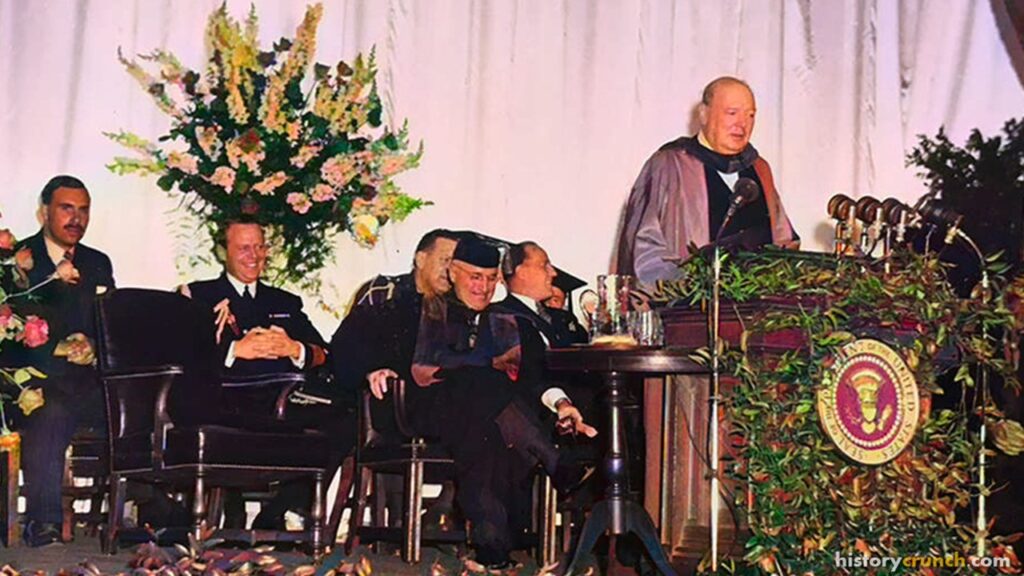
Churchill delivered these words on March 5th, 1946, at Westminster College in Fulton, Missouri, with President Harry Truman present on the platform. Churchill was describing the Soviet Union's tightening control over the countries of Eastern Europe after World War II. He used the line to urge the United States and Britain to stand together against Soviet expansion, and the phrase quickly became the public's name for the division of Europe.
What Was the Cold War?
The Cold War was a major world event that took place from approximately 1945 until 1991. In general, the Cold War was a period of increased tensions and hostility between the superpowers of the United States and the Soviet Union (USSR). It was characterized by a global struggle between capitalism and communism, with both sides competing for influence around the world. Although it never escalated into direct war between the superpowers, it involved proxy wars, nuclear arms races, and ideological confrontations. The Iron Curtain was a term first used by Winston Churchill to symbolize the division of the world between the ideologies of capitalism and democracy versus communism.
Iron Curtain – Summary
Less than a year after the end of World War II, former British Prime Minister Winston Churchill delivered a speech that introduced the Cold War era term ‘Iron Curtain’. His March 5th, 1946 speech at Westminster College in Fulton, Missouri, was titled the ‘Sinews of Peace’ and was a significant aspect of the early stages of the Cold War. Churchill used the term ‘Iron Curtain’ to describe the line in Europe that divided Western Europe from Eastern Europe. Churchill was referencing a divide that was both symbolic and physical.
The Western European nations were self-governing and based on the western principles of capitalism and democracy, while the Eastern European nations were under Soviet communist control. As such, Churchill used the term ‘Iron Curtain’ to symbolically represent the ideological divide between the differing superpowers at the time. With that said, Churchill also used the term to describe physical barriers that were being established along the border between Soviet-controlled territory in Eastern Europe and the rest of the Western European nations. For instance, Germany was divided following the events of World War II into East Germany and West Germany.
When World War II came to an end in 1945, the Allied powers (USA, Britain and the Soviet Union) held conferences to discuss how Germany should be divided up upon its defeat. The first conference was held at Yalta in February of 1945 and the second was held at Potsdam in July of the same year. The agreements ultimately led to the splitting of the defeated Germany into four Allied occupation zonesAreas of a defeated country divided up and controlled by different victorious powers after a war. with portions controlled by the Soviet Union, United States, Britain and France. This is significant because it shows the physical divide that existed for the people living in these regions, which highlights Churchill’s use of the term ‘Iron Curtain’.
Iron Curtain – Significance
The Iron Curtain was significant because it symbolized the deep ideological divide between the communist East and democratic West during the major events of the Cold War. It displayed the recognition by Western leaders of Soviet expansionismA nation’s policy of growing its territory or influence by taking control of other regions. in Eastern Europe and beyond. As such, historians view the concept of the ‘Iron Curtain’ as important to the rising tensions between the major superpowers during the Cold War. In fact, Churchill’s speech was viewed differently around the world. Some viewed it as a message from a leader that was trying to warn the world of danger while others viewed it as instigating a conflict with the Soviet Union.
Regardless, he warned of the expansion of Soviet influence in Europe and emphasized the need for unity between the United States and the United Kingdom to maintain peace and freedom. The speech marked a turning point in public awareness of the Cold War and is considered one of the earliest calls for a strong Western alliance against communist expansion. In fact, the North Atlantic Treaty Organization (NATO) was the major Western alliance that emerged from the Cold War, and it was founded just 3 years after Churchill’s speech in 1949.
FactsthatCrunchChurchill's 1946 'Sinews of Peace' speech named Soviet expansionism as a direct threat to Western freedom, and that warning gave Western nations a shared goal that led them to build NATO as a formal military alliance just three years later.
Western leaders had no common public framework for understanding Soviet behavior in Eastern Europe until Churchill named it plainly, describing cities from Warsaw to Sofia as falling under growing control from Moscow.
The speech shifted public awareness in the United States and Britain, making it harder for governments to treat Soviet expansion as a temporary postwar problem rather than a lasting strategic threat.
Churchill specifically called for unity between the United States and the United Kingdom as the foundation of Western security, a concept that shaped the structure of the North Atlantic Treaty when twelve nations signed it in Washington, D.C., on April 4th, 1949.
Because the speech framed the division of Europe as both ideological and physical, Western planners saw a military alliance as necessary, not just diplomatic cooperation, pushing NATO from an idea into a concrete treaty organization by 1949.
Iron Curtain – Excerpt from Churchill’s Speech: ‘Sinews of Peace’
The following is an excerpt from Churchill’s famous speech titled ‘Sinews of Peace’, which he delivered on March 5th, 1946 at Westminster College in Fulton, Missouri.
“Ladies and gentlemen, the United States stands at this time at the pinnacle of world power. It is a solemn moment for the American Democracy. For with primacy in power is also joined an awe-inspiring accountability to the future. If you look around you, you must feel not only the sense of duty done but also you must feel anxiety lest you fall below the level of achievement. Opportunity is here and now, clear and shining for both our countries. To reject it or ignore it or fritter it away will bring upon us all the long reproaches of the after-time.
A shadow has fallen upon the scenes so lately lighted by the Allied victory. Nobody knows what Soviet Russia and its Communist international organization intends to do in the immediate future, or what are the limits, if any, to their expansive and proselytizingActively trying to convert or persuade others to adopt one’s own beliefs or system. tendencies.
I have a strong admiration and regard for the valiant Russian people and for my wartime comrade, Marshal Stalin. There is deep sympathy and goodwill in Britain – and I doubt not here also – towards the peoples of all the Russias and a resolve to persevere through many differences and rebuffs in establishing lasting friendships. We understand the Russian need to be secure on her western frontiers by the removal of all possibility of German aggression. We welcome Russia to her rightful place among the leading nations of the world. We welcome her flag upon the seas. Above all, we welcome, or should welcome, constant, frequent and growing contacts between the Russian people and our own people on both sides of the Atlantic. It is my duty however, for I am sure you would wish me to state the facts as I see them to you. It is my duty to place before you certain facts about the present position in Europe.
From Stettin in the Baltic to Trieste in the Adriatic an iron curtain has descended across the Continent. Behind that line lie all the capitals of the ancient states of Central and Eastern Europe. Warsaw, Berlin, Prague, Vienna, Budapest, Belgrade, Bucharest and Sofia, all these famous cities and the populations around them lie in what I must call the Soviet sphere, and all are subject in one form or another, not only to Soviet influence but to a very high and, in some cases, increasing measure of control from Moscow.
The safety of the world, ladies and gentlemen, requires a new unity in Europe, from which no nation should be permanently outcast. It is from the quarrels of the strong parent races in Europe that the world wars we have witnessed, or which occurred in former times, have sprung.“
Explore Cold War · 1947 – 1991
Keep exploring Cold War with these History Crunch resources.
Key Vocabulary
Boundary
Communist
Proxy wars
Expansionism
Ideological
Occupation zones
Proselytizing
Frequently Asked Questions
What was the Iron Curtain?
The Iron Curtain was the boundary that split the communist Eastern Bloc from the democratic nations of Western Europe during the Cold War. It stood for both an ideological divide and a physical one. The border separated capitalist, self-governing countries in the West from Soviet-controlled countries in the East. It remained a symbol of Cold War tension until communism fell in the late 1980s.
Who first used the term Iron Curtain?
Former British Prime Minister Winston Churchill made the term famous in a speech on March 5th, 1946. He spoke at Westminster College in Fulton, Missouri, in a speech titled the “Sinews of Peace.” Churchill used the phrase to describe the line that divided Western Europe from Eastern Europe. The speech came less than a year after the end of World War II.
Where did the Iron Curtain run across Europe?
Churchill described the Iron Curtain as stretching from Stettin on the Baltic Sea to Trieste on the Adriatic Sea. Behind that line sat the capitals of Central and Eastern Europe. These cities included Warsaw, Berlin, Prague, Vienna, Budapest, Belgrade, Bucharest, and Sofia. Churchill said all of them had fallen under growing control from Moscow.
Why was the Iron Curtain speech significant?
The speech was significant because it brought public attention to the growing split between East and West. It warned leaders about the spread of Soviet influence across Europe. Some people saw it as a wise warning, while others thought it stirred up conflict. The speech is seen as an early call for a strong Western alliance against communism.
How was Germany divided after World War II?
Germany was split into four occupation zones controlled by the Soviet Union, the United States, Britain, and France. The Allied powers planned this division at the Yalta and Potsdam conferences in 1945. Over time the country was divided into East Germany and West Germany. This split became one of the clearest examples of the physical Iron Curtain.
Cite This Article
To cite this article as a source, use one of the formats below.
MLA: Beck, Elias. “Iron Curtain: A Detailed Summary.” HistoryCrunch, 9 October 2026, https://historycrunch.com/iron-curtain/.
APA: Beck, E. (2026). Iron Curtain: A Detailed Summary. HistoryCrunch. https://historycrunch.com/iron-curtain/
Chicago: Beck, Elias. “Iron Curtain: A Detailed Summary.” HistoryCrunch. October 9, 2026. https://historycrunch.com/iron-curtain/
Sources
- State Department — Office of the Historian
- Vladislav Zubok, A Failed Empire.
- Wilson Center Digital Archive
- Odd Arne Westad, The Global Cold War.