BrinkmanshipPushing a dangerous situation to the very edge of open conflict to pressure the other side into backing down. was one of the most significant policy strategies of the Cold War between the United States and the Soviet Union. In general, brinkmanship refers to the practice of pushing a tense or dangerous situation to the very edge, or ‘brink’, of open conflict in order to pressure the other side into making concessionsThings one side gives up or agrees to in order to settle a dispute. or backing down. It was closely connected to the overall ideological conflict of the Cold War, as well as the nuclear arms race between the two superpowers. Historians consider brinkmanship to have played an important role in several of the most significant crises of the Cold War era, including: the Korean War, the Suez Crisis and the Cuban Missile Crisis of 1962.
 FactsthatCrunch
Declassified Pentagon documents show that a U.S. military invasion of Cuba during the Cuban Missile Crisis was projected to cause 18,500 American casualties in the first 10 days, and that figure assumed no nuclear weapons would be used.
The Soviet Union had placed nuclear missiles in Cuba, approximately 90 miles (145 kilometers) from the Florida coast. American planners knew that Soviet forces on the island also had short-range nuclear-capable weapons, which meant the true casualty toll could have been far higher. In the end, the crisis ended through diplomacy, and the only confirmed military death during the 13-day standoff was U.S. Air Force Major Rudolf Anderson, whose U-2 reconnaissance plane was shot down over Cuba on October 27th, 1962.
What Was the Cold War?
The Cold War was a period of significant tensions between the United States and the Soviet Union that lasted from the end of World War II in 1945 until the early 1990s. At its heart, the Cold War was a ‘face off’ or competition between the two superpowers, rooted in a fundamental ideological conflict between capitalism and democracy on the American side, and communism and dictatorship on the Soviet side. Although the Cold War never escalated into direct military conflict between the two nations, it involved proxy wars, nuclear arms races, and a series of dangerous confrontations and crises. As such, it was within this climate of mutual distrust and nuclear danger that brinkmanship emerged as a key foreign policy strategy.
Background
To fully understand brinkmanship in the Cold War, it is first important to understand the situation that made this strategy possible. As stated above, a defining feature of the Cold War was the nuclear arms race between the United States and the Soviet Union. By the 1950s, both superpowers had developed large arsenals of nuclear weapons capable of destroying the other. This development gave rise to the concept of ‘Mutual Assured Destruction‘, which historians often refer to as M.A.D. Mutual Assured DestructionThe idea that a nuclear war between the two superpowers would destroy both nations completely. was the idea that any direct military conflict between the two superpowers would likely result in a nuclear exchange that would destroy both nations. As a result, neither side was willing to launch a direct attack on the other, but both continued to use the threat of military force to advance their political interests.
It was within this environment that brinkmanship became an important tool of Cold War foreign policy. More specifically, brinkmanship involved deliberately creating or escalating a crisis to the point where the risk of nuclear conflict became very real, with the expectation that the other side would back down rather than risk all-out war. The strategy was based on the idea that a nation willing to accept greater risk could force its opponent to make concessions. In general, brinkmanship was most closely associated with the foreign policy of the United States during the 1950s and early 1960s.
Eisenhower and Dulles
The term ‘brinkmanship’ is likely most directly associated with John Foster Dulles, the United States Secretary of State who served under President Dwight D. Eisenhower during the 1950s. Dulles argued that the United States needed to be willing to go to the very edge of war in order to deter Soviet aggression and expansionism. For instance, in a 1956 interview, Dulles described the strategy by stating that the ability to reach the brink of war without actually getting into war was an essential art of American foreign policy. As such, brinkmanship became closely identified with the Eisenhower administration’s approach to the Cold War.
Under Eisenhower and Dulles, brinkmanship was closely linked to a larger strategy known as ‘massive retaliationA U.S. strategy promising to answer any Soviet aggression with the full force of its nuclear arsenal.‘. Massive retaliation was the idea that the United States would respond to any Soviet aggression, whether large or small, with the full force of its nuclear arsenal. This was intended to deter the Soviet Union from taking aggressive actions anywhere in the world, because the potential cost of doing so would be devastating. Furthermore, massive retaliation was seen as a more cost-effective approach to Cold War competition than maintaining large and expensive conventional military forces. As such, the two strategies of brinkmanship and massive retaliation worked together as the basis of American foreign policy during the Eisenhower years.
The ability to get to the verge without getting into the war is the necessary art.
Cuban Missile Crisis
However, the most significant example of brinkmanship in the Cold War was the Cuban Missile Crisis of October 1962. The Cuban Missile Crisis began when American U-2 spy planes discovered that the Soviet Union had secretly installed nuclear missiles in Cuba, which is located approximately 90 miles (145 kilometers) from the coast of Florida in the United States. The presence of Soviet nuclear missiles so close to American territory was seen as a direct and immediate threat to national security.
In response, American President John F. Kennedy ordered a naval blockadeUsing warships to surround and cut off a coastline, preventing ships from delivering supplies. of Cuba to prevent Soviet ships from delivering additional weapons and military equipment to the island. Kennedy also demanded that the Soviet Union remove all existing missiles from Cuba immediately. This placed both superpowers at an extraordinary level of tension, as Soviet ships carrying military supplies were already heading toward Cuba and the two sides appeared to be on the verge of direct military confrontation. It should also be noted that, during this period, American military forces were placed on their highest alert level, and nuclear war appeared to be a genuine possibility.
The Cuban Missile Crisis lasted approximately 13 days, from October 16th to October 28th, 1962. During this time, both sides engaged in intense diplomatic negotiations behind the scenes. For instance, Soviet leader Nikita Khrushchev ultimately agreed to remove the missiles from Cuba in exchange for an American pledge not to invade the island, as well as the quiet removal of American missiles from Turkey. As such, the Cuban Missile Crisis is considered to be the clearest and most dangerous example of brinkmanship in the entire Cold War, as both sides pushed the situation to the very edge of nuclear conflict before stepping back from the brink.
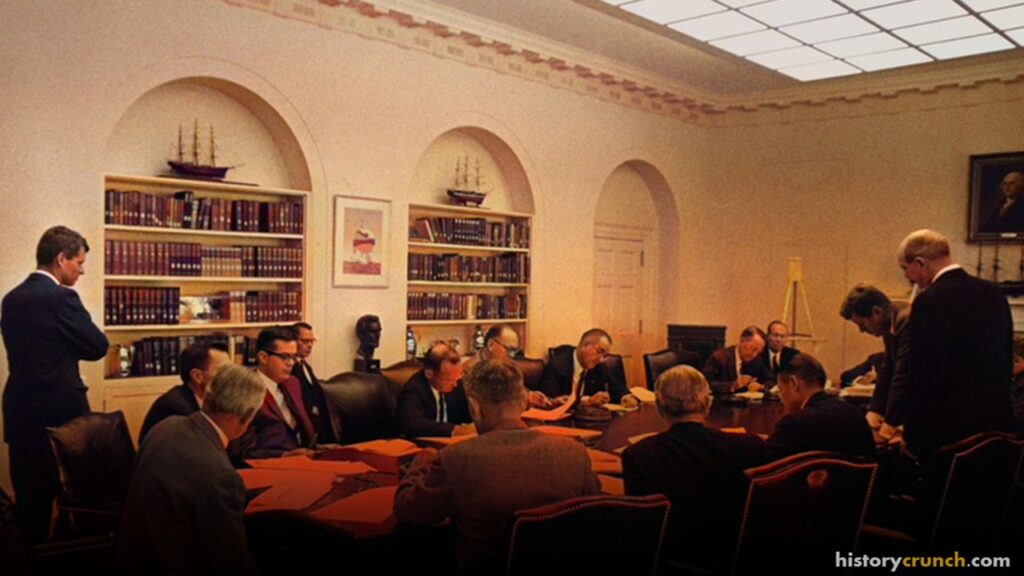
FactsthatCrunchIt is October 1962, during the Cold War, and you are President John F. Kennedy. American U-2 spy planes have just confirmed that the Soviet Union has placed nuclear missiles in Cuba, approximately 90 miles (145 kilometers) from the Florida coast. Your advisors are split on what to do next, and every hour of delay allows the Soviet buildup to continue.
Other Examples
It should also be noted that there were also other examples of brinkmanship during the Cold War. For instance, the Korean War, which lasted from 1950 to 1953, involved a series of moments in which the conflict threatened to escalate into a much larger war involving China and potentially the Soviet Union. When United Nations forces approached the Chinese border with North Korea in October of 1950, China entered the war, dramatically expanding the conflict. Throughout the Korean War, both sides were careful not to push the situation so far that it triggered a full nuclear exchange, which is itself an example of the logic of brinkmanship at work.
Another important example was the Berlin Crisis of 1961, during which Soviet leader Nikita Khrushchev threatened to sign a separate peace treaty with East Germany that would have cut off Western access to West Berlin. In response, President Kennedy reaffirmed the commitment of the United States to defend West Berlin, and both sides engaged in a tense standoff that ultimately led to the construction of the Berlin Wall rather than direct military conflict. As such, the Berlin Crisis demonstrated that brinkmanship could produce outcomes short of war, but with significant and lasting consequences.
FactsthatCrunchSoviet leader Nikita Khrushchev saw West Berlin as an open wound in the middle of East Germany. Thousands of East Germans were crossing into West Berlin each month to escape to the West, draining the communist state of workers and professionals it could not afford to lose. Khrushchev threatened to sign a separate peace treaty with East Germany that would cut off Western access to the city, using that threat to pressure the United States into accepting Soviet control of the region. When the Wall went up on August 13th, 1961, Moscow treated it as a defensive measure that stopped the population loss without triggering a war.
President Kennedy and his advisers saw Khrushchev's ultimatum over West Berlin as a direct test of American resolve in Europe. Kennedy reaffirmed the United States commitment to defend West Berlin and refused to accept any treaty that would cut Western powers off from the city. American officials viewed the Wall itself as a propaganda failure for communism, since only a government that had lost the confidence of its own people needed a concrete barrier to keep them in. The crisis confirmed to Washington that brinkmanship could produce lasting and damaging outcomes even when both sides pulled back from open conflict.
Significance
Brinkmanship was significant in the Cold War because it displayed the dangerous nature of superpower competition in the nuclear age. In general, both the United States and the Soviet Union understood that a direct military conflict between them could result in the destruction of both nations. As a result, brinkmanship became a way of competing aggressively for political advantage without crossing the line into actual war.
At the same time, brinkmanship carried enormous risks. For instance, the Cuban Missile Crisis demonstrated just how close the two superpowers could come to nuclear war when both sides committed to a confrontational strategy. Furthermore, brinkmanship depended on the assumption that both sides would ultimately choose to back down rather than accept the consequences of all-out war. This assumption was not always reliable, which made brinkmanship one of the most dangerous aspects of the Cold War. In fact, the dangers demonstrated by the Cuban Missile Crisis contributed directly to efforts to reduce Cold War tensions, including the development of détente in the 1970s and the signing of disarmament agreements such as SALT I and SALT II. As such, brinkmanship played an important role not only in shaping the most dangerous moments of the Cold War, but also in driving the efforts to manage and eventually reduce superpower tensions in the years that followed.
FactsthatCrunchThe Cuban Missile Crisis of 1962 is best understood not as an isolated confrontation but as the event that pushed both superpowers to negotiate arms control agreements rather than continue relying on brinkmanship alone.
Explore Cold War · 1947 – 1991
Keep exploring Cold War with these History Crunch resources.
Key Vocabulary
Brinkmanship
Concessions
Mutual Assured Destruction
Massive retaliation
Blockade
Détente
Disarmament
Frequently Asked Questions
What is brinkmanship in simple terms?
Brinkmanship is the practice of pushing a dangerous situation to the very edge of open conflict. The goal is to pressure the other side into backing down or making concessions. During the Cold War, it meant risking nuclear war to gain a political advantage without actually starting a fight.
Who came up with the term brinkmanship?
The term is most closely linked to John Foster Dulles, the United States Secretary of State under President Dwight D. Eisenhower. In a 1956 interview, Dulles said reaching the brink of war without falling into war was a key skill of foreign policy. His views tied brinkmanship to the Eisenhower administration in the 1950s.
How did Mutual Assured Destruction make brinkmanship possible?
Mutual Assured Destruction, or M.A.D., meant that a war between the superpowers would likely destroy both of them. Because neither side wanted this, neither would launch a direct attack. This standoff allowed both nations to use the threat of force to press their interests instead of fighting outright.
Why is the Cuban Missile Crisis the best example of brinkmanship?
The Cuban Missile Crisis of October 1962 pushed both superpowers to the very edge of nuclear war before they stepped back. It began when American spy planes found Soviet nuclear missiles in Cuba, about 90 miles (145 kilometers) from Florida. The crisis lasted about 13 days and ended through secret talks rather than fighting.
What was massive retaliation?
Massive retaliation was the idea that the United States would answer any Soviet aggression with the full force of its nuclear arsenal. It was meant to scare the Soviet Union away from aggressive acts anywhere in the world. Leaders also saw it as cheaper than keeping large conventional armies, and it worked alongside brinkmanship.
How did brinkmanship affect the Cold War later on?
The dangers shown by brinkmanship pushed both sides to look for ways to lower tensions. The close call of the Cuban Missile Crisis helped lead to détente in the 1970s. It also encouraged disarmament agreements such as SALT I and SALT II.
Cite This Article
To cite this article as a source, use one of the formats below.
MLA: Millar, B. “Brinkmanship in the Cold War: A Detailed Summary.” HistoryCrunch, 18 September 2026, https://historycrunch.com/brinkmanship-in-the-cold-war/.
APA: Millar, B. (2026). Brinkmanship in the Cold War: A Detailed Summary. HistoryCrunch. https://historycrunch.com/brinkmanship-in-the-cold-war/
Chicago: Millar, B. “Brinkmanship in the Cold War: A Detailed Summary.” HistoryCrunch. September 18, 2026. https://historycrunch.com/brinkmanship-in-the-cold-war/
Sources
- Wilson Center Digital Archive
- State Department — Office of the Historian
- Odd Arne Westad, The Global Cold War.