Dwight D. Eisenhower was one of the most important American leaders of the 20th century. He was a military commander in World War II and later served as the 34th President of the United States from January 20th, 1953 to January 20th, 1961. Eisenhower is best known for leading the Allied invasion of Normandy on June 6th, 1944, and for helping guide the United States during the early years of the Cold War.
 FactsthatCrunch
Eisenhower commanded Allied forces in North Africa and Europe, coordinating armies from multiple nations to defeat Nazi Germany. His leadership of Operation Overlord, the large-scale Allied invasion of Western Europe, proved central to ending the war on the European front.
Dwight D. Eisenhower – Early Life
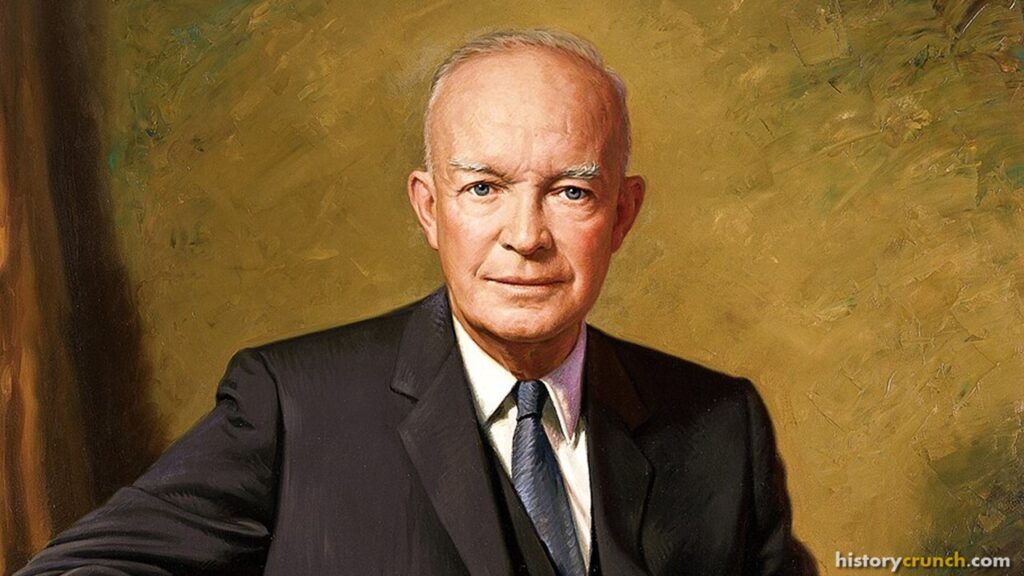
Dwight David Eisenhower was born on October 14th, 1890 in Denison, Texas, although he grew up mainly in Abilene, Kansas. He came from a modestHaving little wealth or social status; not rich or privileged. family, and his early life did not suggest that he would one day become one of the most famous military and political leaders in American history. In fact, his background helped give him the image of an ordinary American who rose through hard work and discipline.
In 1911, Eisenhower entered the United States Military Academy at West Point, and he graduated in June of 1915. His class later became famous because so many of its members became generals. This was important for Eisenhower’s future because West Point gave him military training, leadership experience, and connections that shaped the rest of his career.
Dwight D. Eisenhower – Military Career and World War II
Although Eisenhower served in the army during World War I, he did not fight overseas in Europe. Instead, he spent the war training tank units in the United States. Regardless, he continued to rise in the army during the Interwar Years, and he became known as a capable staff officerA military officer who plans and organizes operations rather than leading troops directly in combat. and planner. This resulted in Eisenhower gaining valuable experience in organization and military strategy before the outbreak of World War II.
With that said, Eisenhower became truly famous during World War II. After the United States entered the war in December of 1941, his abilities brought him rapid promotion in the United States Army. For instance, in June of 1942, he was appointed to an important command role in Europe, and later that year he led Operation Torch, the Allied invasion of North Africa, which began on November 8th, 1942. This was one of the first major American operations against Axis forces in the European Theater of World War II.
As the war continued, Eisenhower’s responsibilities grew even larger. He helped oversee Allied operations in the Mediterranean, including the Allied Invasion of Sicily in July of 1943 and mainland Italy in September of 1943. As such, Eisenhower became one of the central Allied commanders in the fight against Nazi Germany.
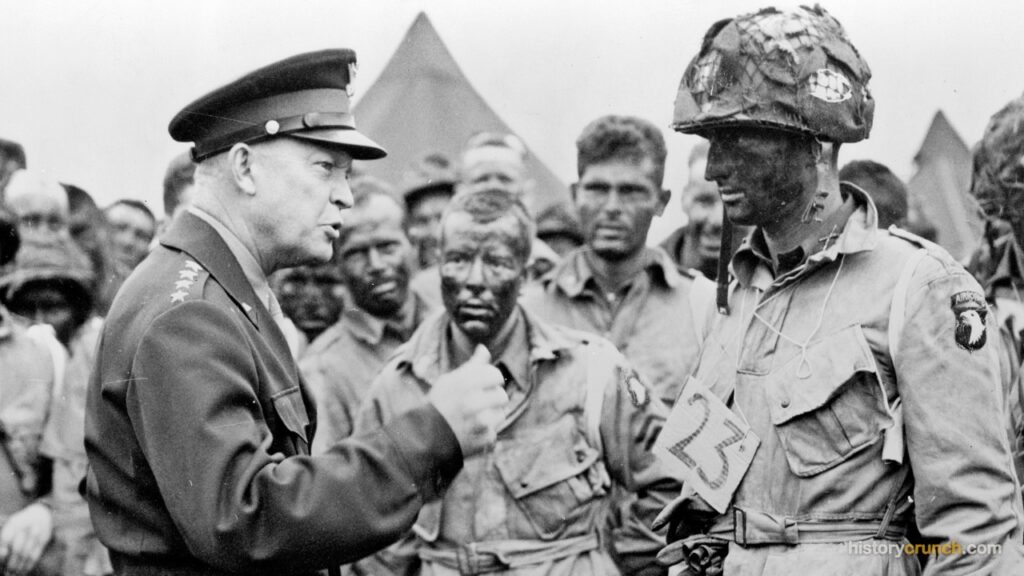
His most famous role came when he was appointed Supreme Commander of the Allied Expeditionary ForceThe top military leader responsible for planning and directing all Allied forces in the invasion of western Europe. in December of 1943. In that position, Eisenhower led the planning for the Normandy Invasion, also known as D-Day, on June 6th, 1944. The invasion opened a major western front against Germany in occupied France. This made Eisenhower one of the most recognized military leaders of the war, since the success of D-Day was essential to the Allied push into western Europe.
After the liberation of Paris, France in August of 1944 and the final defeat of Germany in May of 1945, Eisenhower emerged as an international hero. More specifically, he became closely associated with Allied victory in Europe and with the cooperation of the United States, Britain, Canada and other Allied powers. Therefore, his wartime reputation gave him enormous prestige in the years that followed and helped in his bid to become President of the United States.
FactsthatCrunchFollow the chain from top to bottom. Tap any step to read what happened.
Dwight D. Eisenhower – President of the United States
After World War II, Eisenhower continued to hold major positions. He served as Army Chief of Staff, later became president of Columbia University, and then served as the first Supreme Commander of NATO in 1951. In 1952, he ran for president as a Republican and defeated Adlai Stevenson. He formally took office on January 20th, 1953 as the 34th President of the United States.
As president, Eisenhower governed during the early Cold War years, when tensions between the United States and the Soviet Union were very high. For instance, his administration dealt with nuclear strategy, communist expansion and the fear of another world war. More specifically, Eisenhower relied on a policy often called ‘massive retaliationA Cold War strategy of threatening to use nuclear weapons to stop an enemy from attacking.‘, which meant that the United States would depend heavily on nuclear weapons as a deterrentSomething that discourages an enemy from attacking by making the cost of attacking too high. against Soviet aggression. This showed that his presidency was shaped by the dangers of the nuclear age.
Eisenhower also faced several important international crises. During his presidency, the Korean War ended in July of 1953, the Suez Crisis took place in October of 1956, and the Soviet launch of Sputnik in October of 1957 increased American concerns about science, technology and the overall Cold War. As well, Eisenhower announced the Eisenhower Doctrine in January of 1957, which stated that the United States would help Middle Eastern countries resist communism. This reflected his wider goal of containing Soviet influence around the world. This was similar in nature to the basis of the Truman Doctrine, which was named for the policies of President Harry S. Truman.
At home, Eisenhower’s presidency included major developments as well. One of the most important was the Interstate Highway Act of June 29th, 1956, which helped create the modern American interstate highway system. This was a major domestic achievement because it transformed transportation, trade, travel, and infrastructure in the United States for decades afterward.
Eisenhower was also president during an important stage of the Civil Rights Movement. In 1954, the Supreme Court decided Brown v. Board of Education, which declared school segregation unconstitutional. Later, in September of 1957, Eisenhower sent federal troops to Little Rock, Arkansas, to enforce school desegregationThe process of ending the forced separation of people by race in schools or other public places. after resistance by state authorities. This showed that his presidency was tied not only to Cold War politics, but also to major struggles over civil rights in the United States.
In September of 1957, President Eisenhower sent federal troops to Little Rock, Arkansas, to enforce school desegregation after state authorities resisted.
Dwight D. Eisenhower – Later Years and Death
After leaving office on January 20th, 1961, Eisenhower retired from the presidency but remained a respected public figure. He continued to comment on public affairs, and his military and political experience gave his views lasting weight in American life. In his farewell address on January 17th, 1961, he warned Americans about the growing power of what he called the ‘military-industrial complexThe combined influence of the armed forces and weapons industries on a country’s government and policies.‘. This was a memorable part of his legacy because it showed that even a career soldier and wartime commander worried about the long-term influence of military and industrial interests on democracy.
Dwight D. Eisenhower died on March 28th, 1969 in Washington, D.C. He was buried in Abilene, Kansas, the community most closely associated with his youth and public image. By the time of his death, he was remembered as both a victorious wartime commander and a steady president of the early Cold War era.
FactsthatCrunchIn his farewell address on January 17th, 1961, just three days before leaving office, a career soldier warned Americans about the military. Eisenhower cautioned against the growing power of what he called the military-industrial complex.
Eisenhower had led the Allied invasion of Normandy and spent most of his life in the army, which is why his warning about the influence of military and industrial interests on democracy stood out.
Dwight D. Eisenhower – Significance
Dwight D. Eisenhower was significant because he played a major role in both World War II and the postwar world. As Supreme Commander during the Normandy invasion, he helped lead one of the most important Allied operations of the entire war. That role placed him at the center of the defeat of Nazi Germany in western Europe.
Eisenhower was also important because his presidency connected wartime leadership to Cold War leadership. He governed during a period shaped by nuclear tension, anti-communism, civil rights conflict, and rapid economic and technological change. In that sense, Eisenhower’s life helps connect two major periods of modern history, which were World War II and the early Cold War.
FactsthatCrunchThe Normandy invasion of 1944 mattered because its success gave the Allies a firm foothold in western Europe and made Eisenhower the most recognized Allied commander of the war, a reputation that directly shaped American Cold War leadership for the next decade.
Allied forces crossed the English Channel and landed on the coast of occupied France, opening a major western front that forced Nazi Germany to fight on two large fronts at once.
The operation's success accelerated the liberation of western Europe, including Paris in August of 1944, and contributed directly to Germany's final defeat in May of 1945.
Eisenhower's role as Supreme Commander of the Allied Expeditionary Force gave him enormous international prestige, which helped him win the 1952 presidential election and take office on January 20th, 1953.
As president, Eisenhower used that wartime authority and credibility to manage nuclear strategy and contain Soviet expansion, connecting his record as a military commander directly to Cold War policy.
Key Vocabulary
Modest
Staff officer
Supreme Commander of the Allied Expeditionary Force
Massive retaliation
Deterrent
Military-industrial complex
Desegregation
Frequently Asked Questions
What was Dwight D. Eisenhower best known for?
Eisenhower was best known for leading the Allied invasion of Normandy on June 6th, 1944. He served as Supreme Commander of the Allied Expeditionary Force during that operation. He later became the 34th President of the United States and guided the country through the early Cold War years.
When was Eisenhower president of the United States?
Eisenhower served as president from January 20th, 1953 to January 20th, 1961. He won the 1952 election as a Republican by defeating Adlai Stevenson. His two terms fell during a tense stage of the Cold War with the Soviet Union.
What did Eisenhower do during World War II?
Eisenhower led several major Allied operations against Axis forces in Europe and North Africa. He directed Operation Torch in 1942 and the invasions of Sicily and Italy in 1943. His most famous role was planning and leading the D-Day landings in France.
What was the military-industrial complex that Eisenhower warned about?
The military-industrial complex was Eisenhower’s term for the growing power of military and industrial interests. He warned about its influence on democracy in his farewell address on January 17th, 1961. The warning stood out because it came from a career soldier and wartime commander.
What were Eisenhower’s major achievements as president?
One of Eisenhower’s biggest achievements was the Interstate Highway Act of June 29th, 1956. This law helped build the modern American interstate highway system. He also sent federal troops to Little Rock, Arkansas, in 1957 to enforce school desegregation.
Where was Eisenhower born and where is he buried?
Eisenhower was born on October 14th, 1890 in Denison, Texas, but grew up mainly in Abilene, Kansas. He came from a modest family and rose through hard work and discipline. He died on March 28th, 1969 and was buried in Abilene.
Cite This Article
To cite this article as a source, use one of the formats below.
MLA: Millar, B. “Dwight D. Eisenhower: A Detailed Biography.” HistoryCrunch, 3 October 2026, https://historycrunch.com/dwight-d-eisenhower/.
APA: Millar, B. (2026). Dwight D. Eisenhower: A Detailed Biography. HistoryCrunch. https://historycrunch.com/dwight-d-eisenhower/
Chicago: Millar, B. “Dwight D. Eisenhower: A Detailed Biography.” HistoryCrunch. October 3, 2026. https://historycrunch.com/dwight-d-eisenhower/
Sources
- Antony Beevor, The Second World War.
- Imperial War Museum