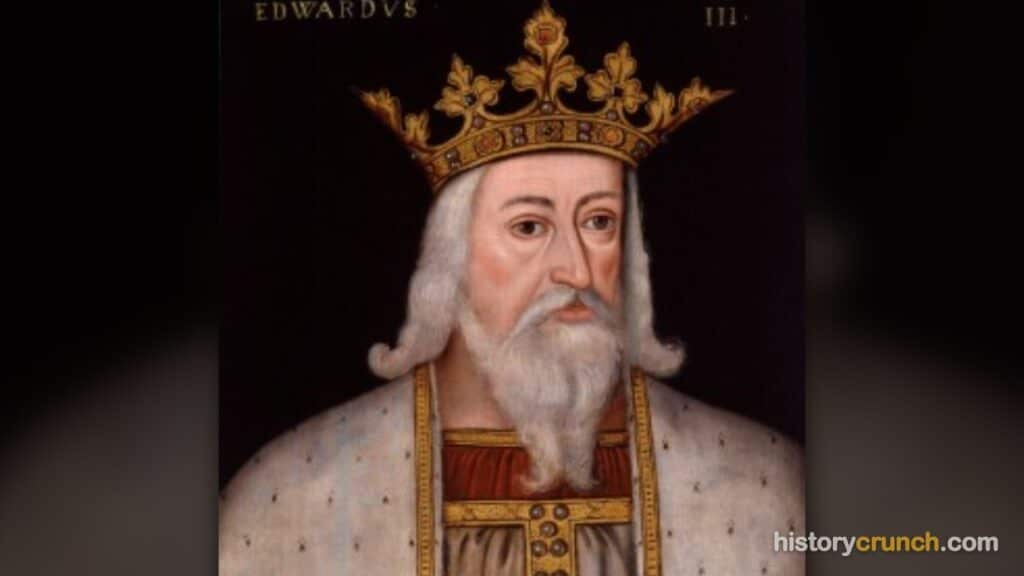
Edward III stands as one of the most important kings in the history of medieval England, ruling for fifty years and transforming a troubled kingdom into a major military power in Europe. He came to the throne as a boy in 1327 and by the time of his death in 1377 had reshaped the English monarchy, launched the long conflict with France known as the Hundred Years War, and led his country through the terrible arrival of the Black Death. His reign is remembered for great battlefield victories, the growth of English pride, and the ideals of knightly chivalry that surrounded his court.
Edward III was a king of England from the royal family known as the Plantagenets, a dynasty that had ruled England since the twelfth century. As monarch he held the highest political and military power in the kingdom, though he also relied on the growing body of nobles and representatives known as Parliament to raise money and troops for his wars. His most famous role in history is as the ruler who began the series of wars between England and France that would last well over a century.
Early Life and Background
Edward III was born on November 13th, 1312, at Windsor Castle, one of the great royal homes of England. He was the eldest son of King Edward II and Isabella of France, the daughter of the powerful French king Philip IV. This family connection to the French royal line would later become the basis for one of the most important claims of Edward’s life.
The England of Edward’s childhood was a place of conflict and political tension. His father, Edward II, was widely seen as a weak and unpopular ruler who quarreled with his nobles and suffered a humiliating military defeat by the Scots at the Battle of Bannockburn in 1314. In fact, Edward II’s poor rule created deep anger among the barons, and his marriage to Isabella collapsed into open hostility.
By the mid-1320s, Isabella had turned against her husband and joined with an English nobleman named Roger Mortimer. Together they raised support and forced Edward II from power. As a result, the young Edward found himself at the center of a struggle for control of the kingdom while he was still only a teenager.
Rise to Power
In January of 1327, Edward II was deposed and Edward III was proclaimed king. He was crowned at Westminster Abbey at the age of just fourteen. His father was imprisoned and soon died, and it was long believed that he was murdered while in captivity.
Because Edward was so young, real power at first lay in the hands of his mother Isabella and her ally Roger Mortimer. More specifically, the two of them ruled the kingdom in the young king’s name and used their position to gain lands, titles, and wealth. Their greed and arrogance made them increasingly unpopular, and the teenage king grew frustrated at being controlled by others.
In 1330, at the age of seventeen, Edward acted boldly to seize control for himself. He and a small group of trusted supporters arrested Mortimer, who was then put to death. Isabella was removed from power and sent to live quietly away from the court. From this point on, Edward III ruled England in his own right, determined to restore the dignity of the crown that his father had lost.
Major Achievements
One of Edward’s first goals as king was to deal with the threat from Scotland, which had troubled his father for years. He led armies north and won an important victory at the Battle of Halidon Hill in 1333. In this battle he made effective use of dismounted knights fighting alongside archers, a tactic that would later bring him great success against the French.
The most famous achievement of Edward’s reign was the start of the long conflict with France. The trouble grew out of a dispute over the French throne and over English-held lands in France, especially the region of Gascony in the southwest. As stated above, Edward’s mother was the daughter of a French king, and Edward used this connection to claim that he himself was the rightful king of France.
When the French king Philip VI declared that English lands in France were confiscated, Edward responded by declaring that the French crown belonged to him. This dispute grew into the Hundred Years War, a series of on-and-off conflicts between England and France that would last from 1337 until 1453. Edward even added the French royal symbol, the fleur-de-lis, to his own coat of arms to show that he claimed both kingdoms.
Edward’s early campaigns brought a great naval victory at the Battle of Sluys in 1340, which gave the English control of the sea between the two countries. His most celebrated triumph, however, came on land at the Battle of Crecy in 1346. There, a smaller English army defeated a much larger French force led by Philip VI.
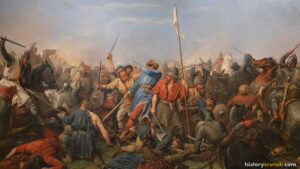
The victory at Crecy was won largely by the skill of the English longbowmen. These archers could shoot arrows farther and far more quickly than the French crossbowmen, and their deadly volleys cut down wave after wave of charging French knights. The battle shocked all of Europe and marked the decline of the heavily armored mounted knight as the master of the battlefield.
Following the victory at Crecy, Edward marched on the port town of Calais, which surrendered to him in 1347 after a long siege. Calais gave England a permanent foothold on the French coast that it would keep for more than two centuries. A decade later, Edward’s eldest son won another crushing victory at the Battle of Poitiers in 1356, and in 1360 a favorable peace treaty gave England large amounts of French territory.
Beyond the battlefield, Edward worked to strengthen the idea of chivalry, the code of honor and bravery expected of medieval knights. In 1348 he founded the Order of the Garter, an exclusive group of knights bound in loyalty to the king. His court became one of the most brilliant and admired in Europe, and his energy and skill as a warrior earned him lasting fame.
The Black Death and Edward’s Reign
One of the greatest challenges of Edward’s reign had nothing to do with war. In 1348, a deadly plague known as the Black Death reached England, arriving on trading ships from Europe. The disease spread with terrifying speed across the country, following roads and trade routes into major cities and small villages alike.
The Black Death killed a huge portion of the population, with some estimates suggesting that around a third or more of the people in England died within a few years. This enormous loss of life created a serious shortage of workers, and it briefly forced a halt in the war with France because men and money could not be spared. In reality, the plague reshaped English society, giving surviving peasants the power to demand better wages and weakening the old feudal system.
Later Life
The final years of Edward’s reign were far less glorious than his earlier triumphs. War with France broke out again in 1369, and this time the tide turned against England. Under a capable new French king, the French slowly recaptured much of the land that Edward had gained, so that by the end of his reign most of the earlier conquests had been lost.
Edward also suffered heavy personal blows in his old age. His beloved wife, Philippa of Hainault, died in 1369, and his famous eldest son, Edward of Woodstock, known as the Black Prince, died in 1376 before he could inherit the throne. The aging king grew weak and withdrew from active rule, leaving much of the government in the hands of others.
Edward III died in June of 1377, most likely from a stroke, after a reign of fifty years. Because his eldest son had died the year before, the crown passed to his young grandson, who became King Richard II. Edward left behind a kingdom that was proud of its military reputation but also strained by the enormous cost of his wars.
Significance of Edward III
Edward III is remembered as one of the most important English kings of the Middle Ages because he restored the strength and prestige of the monarchy after the disastrous reign of his father. His victories at Sluys, Crecy, and Calais turned England into a respected military power and gave the country a lasting sense of national pride.
His decision to claim the French throne began the Hundred Years War, a conflict that would shape the history of both England and France for generations. In addition, the growing need to fund his wars forced Edward to work closely with Parliament, which helped that body grow stronger and gain a larger role in English government. This development had a lasting effect on the way England would be ruled in the centuries that followed.
Edward’s reign also witnessed the arrival of the Black Death, one of the most devastating events in European history. Taken together, his military triumphs, his encouragement of chivalry, and the great changes that swept through his kingdom make Edward III a central figure in the story of medieval England.
Frequently Asked Questions
When did Edward III become king of England?
Edward III became king in January of 1327 when he was only fourteen years old. He took the throne after his father, Edward II, was forced from power. For the first three years, however, he was king in name only while his mother and her ally Roger Mortimer held the real power.
Why did Edward III start the Hundred Years War?
Edward III started the Hundred Years War mainly because he claimed to be the rightful king of France through his mother, who was a French princess. The immediate spark came when the French king moved to seize English-held lands in France. Edward responded by declaring the French crown his own, turning a land dispute into a war for the throne.
What was Edward III most famous for?
Edward III is most famous for his great military victories against France, especially the Battle of Crecy in 1346. He is also remembered for founding the Order of the Garter and for ruling England for fifty years, one of the longest reigns of any medieval English king. His long reign made him a symbol of knightly glory and English power.
Who was Edward III’s son the Black Prince?
The Black Prince was Edward of Woodstock, the eldest son of Edward III and a famous warrior of the Hundred Years War. He won a great victory at the Battle of Poitiers in 1356 and was admired across Europe as a model of chivalry. He died in 1376, one year before his father, so he never became king himself.
Who became king after Edward III died?
Edward III was succeeded by his grandson, who became King Richard II. Because the Black Prince had already died, the crown passed to the Black Prince’s young son. Richard II was still a child when he inherited the throne in 1377.
Cite This Article
To cite this article as a source, use one of the formats below.
MLA: Millar, B. “Edward III: A Detailed Biography.” HistoryCrunch, 26 July 2026, https://historycrunch.com/edward-iii/.
APA: Millar, B. (2026). Edward III: A Detailed Biography. HistoryCrunch. https://historycrunch.com/edward-iii/
Chicago: Millar, B. “Edward III: A Detailed Biography.” HistoryCrunch. July 26, 2026. https://historycrunch.com/edward-iii/
Sources
- Jerry Bentley & Herbert Ziegler, Traditions & Encounters: A Global Perspective on the Past.
- J.M. Roberts & Odd Arne Westad, The Penguin History of the World.