Aircraft in the Korean War marked a turning point in the history of military aviation, because it was the first major conflict in which jet aircraft fought one another in the sky. Fought in the early 1950s, the war pitted communist North Korea, backed by the Soviet Union and China, against South Korea and a United Nations force led by the United States. Airpower played a central role from the first days of the fighting, and the war became a proving ground where older propeller planes and modern jets shared the same skies for the last time on a large scale.
Military aircraft in the Korean War included fighters, bombers, transport planes, and helicopters used by both sides. These machines carried out many different jobs, such as attacking enemy troops on the ground, bombing bridges and supply lines, protecting slower aircraft, and rescuing wounded soldiers. The most famous role, however, was the fighter duel, in which fast jets battled for control of the air over the northern part of Korea.
 FactsthatCrunch
Why is the Korean War called the first jet war?
The Korean War is called the first jet war because it was the first major conflict in which jet aircraft fought each other directly in the sky, most famously when the Soviet-built MiG-15 and the American F-86 Sabre clashed over northwestern Korea. Before this war, jet fighters had never met in large-scale combat, so Korea became the proving ground where jet-versus-jet fighting replaced the propeller-plane dogfights of World War II. Older propeller aircraft such as the F-51 Mustang and the B-29 Superfortress still flew missions, but the jet duels over MiG Alley showed that the future of air combat belonged entirely to jet-powered planes.
What Was the Korean War?
The Korean War was the first major conflict following the end of World War II and the first war of the Cold War between the United States and the Soviet Union. In fact, historians today consider it to be a Cold War era proxy warA conflict where two powerful nations support opposing sides instead of fighting each other directly., in which the two superpowers backed opposing sides without fighting each other directly. The war was fought throughout the early part of the 1950s and had a lasting impact on both the Cold War and the wider world.
The roots of the conflict reached back to 1945, at the end of World War II. As stated above, Japan had occupied the Korean Peninsula for many years, and both the Soviet Union and the United States worked to free the region from Japanese control. The Soviet Union moved into the northern half of Korea in August of 1945, while American forces took control of the southern half soon after.
By 1948, Korea had been officially split into two halves along the 38th parallelThe geographic line dividing North and South Korea into two separate nations after World War II., each with its own government. The communist North was led by Kim Il-Sung, while the capitalist South was led by President Syngman Rhee, an anti-communist statesman. Tensions rose steadily until fighting broke out in June of 1950, when North Korean forces poured across the 38th parallel in an attempt to unify the country by force. The United States and other nations then entered the war on the side of South Korea, and the air campaign began almost immediately.
What Aircraft Were Used at the Start of the War?
When the war began, both sides relied heavily on older aircraft left over from World War II. North Korea started the conflict with a small air force built around Soviet-made piston-engineA type of aircraft engine that uses moving pistons to spin a propeller, older technology than a jet engine. planes, including the Yak-9 fighter and the Il-10 attack aircraft. These planes were quickly overwhelmed once American forces arrived in strength.
The United States entered the war with a mix of propeller planes and early jets. The F-51 Mustang, a famous piston-engine fighter of World War II, proved especially valuable because it could operate from rough South Korean airfields. It was used mainly to support ground troops by attacking enemy positions from low altitude. Alongside it flew the first American jet fighter to see combat, the F-80 Shooting Star, which helped the United States gain quick control of the air over the peninsula.
The very first air combat of the war took place on June 27th, 1950, during a clash over the Kimpo airfield near Seoul in South Korea. American F-82 Twin Mustangs and F-80 Shooting Stars shot down several attacking North Korean planes, giving the United Nations side an early edge. For the first months of the war, American and allied pilots faced little serious opposition in the air.
FactsthatCrunchThe F-80 Shooting Star was the first American jet fighter to see combat in the Korean War.
How Did the MiG-15 Change the Air War?
The situation changed dramatically in November of 1950, when the Soviet Union secretly sent squadrons of the MiG-15 jet fighter into the war. This swept-wingAn aircraft design where the wings angle backward, allowing the plane to fly faster at high speeds. jet was fast, well-armed, and able to climb higher than the American planes it first met, and it quickly outclassed the F-80 Shooting Star and the older propeller aircraft. Its appearance shocked American commanders and forced a rapid change in strategy.
Although the MiG-15 wore North Korean and Chinese markings, many of the jets were flown by experienced Soviet pilots, a fact the Soviet Union tried to keep secret to avoid open war with the United States. The MiG-15 was designed mainly to shoot down heavy bombers. It carried powerful cannons and used its high speed and steep climb to strike at American bombers, then dive away before enemy fighters could catch it.
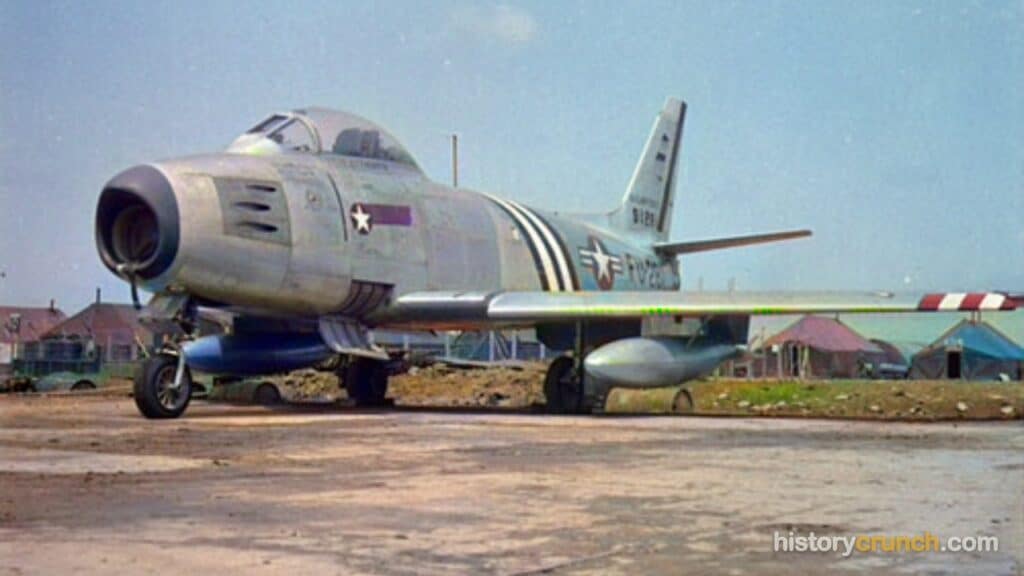
In response, the United States rushed its newest jet fighter, the F-86 Sabre, to Korea in December of 1950. The Sabre also had swept wings and was closely matched with the MiG-15 in speed and performance. More specifically, the American jet carried six fast-firing machine guns that were well suited for fighting other fighters, while the MiG relied on heavy cannons better suited for attacking bombers.
FactsthatCrunchWhat Was MiG Alley?
Much of the jet fighting took place in a stretch of sky in the far northwestern corner of North Korea, near the Yalu River that separates Korea from China. American pilots nicknamed this region “MiG AlleyA dangerous stretch of sky in northwestern Korea where American and Soviet-built jets most often fought each other.,” because it was where they most often ran into enemy MiG-15s. It became the most dangerous piece of airspace in the entire war.
The Yalu River was important because bridges across it carried weapons, supplies, and reinforcementsExtra troops or supplies sent to strengthen a fighting force that is already in battle. from China into the war zone. United Nations forces tried to destroy these supply lines with bombing raids, which meant they needed to control the air above them. The communist jets, meanwhile, were based just across the river in China, where American pilots were forbidden to attack them.
This restrictionAn official rule that forbids someone from doing something, here preventing American pilots from crossing into China. gave the MiG pilots an important advantage, since they could fly to safety across the border whenever a battle turned against them. Even so, MiG Alley became famous as the birthplace of jet-to-jet combat, where small numbers of fast fighters dueled at speeds close to 700 miles per hour (1,127 km per hour). Many of the American pilots who fought there were veterans of World War II, and their experience helped the F-86 Sabre hold its own against the MiG-15.
FactsthatCrunchMiG Alley was the nickname American pilots gave to the airspace in the far northwestern corner of North Korea, roughly between the Chongchon River and the Yalu River, where Soviet-built MiG-15 jets most often crossed into Korean airspace to fight United Nations aircraft. It became the main zone of jet-versus-jet combat during the Korean War. Control of this airspace determined how safely United Nations bombers could strike North Korean supply lines and bridges.
Because communist jets were based just across the Yalu River in China, where American pilots were forbidden to follow them, MiG Alley gave enemy pilots a safe escape route whenever a battle turned against them.
How Were Bombers and Other Aircraft Used?
Fighters were not the only aircraft that mattered in the war. The B-29 Superfortress, the same heavy bomber that had helped end World War II, was used to strike bridges, factories, railways, and cities that supplied the communist armies. These large, slow bombers could carry heavy loads of bombs over long distances, but they were vulnerable once fast jets entered the war.
In fact, the danger became clear in April of 1951, when MiG-15s attacked a bombing raid on a bridge over the Yalu River and shot down several B-29s in a single day. After suffering heavy losses in October of 1951, American commanders shifted most B-29 raids to nighttime, when the bombers were harder for the MiGs to find. This change showed how quickly jet fighters had made older bombers dangerous to use in daylight.
Many other aircraft carried out important jobs as well. Navy and Marine planes such as the F4U Corsair and the F9F Panther flew from aircraft carriers to attack targets on land. Transport planes moved troops and supplies across long distances, and the war also saw one of the first widespread uses of helicopters, which rescued downed pilots and carried wounded soldiers to safety more quickly than ever before.
In what order did these steps push B-29 bombers in the Korean War from daylight raids to nighttime raids?
Significance of Aircraft in the Korean War
The use of aircraft in the Korean War is significant because it marked the beginning of the jet age in combat. The clashes between the F-86 Sabre and the MiG-15 were the first true jet-versus-jet battles in history, and they showed the world how air combat had changed forever. In reality, the lessons learned in Korean skies shaped the design of fighter planes for decades to come.
The war was also the last time that large numbers of piston-engine planes and jet aircraft fought side by side. Older planes like the F-51 Mustang and the B-29 Superfortress proved that they still had value, but the arrival of fast jets made clear that the future of airpower belonged to the jet engine. Within a few years, most propeller-driven combat aircraft were retired.
Finally, the air war carried great importance for the Cold War itself. It was the first time American forces fought directly against Soviet aircraft, tactics, and pilots, even though both governments tried to keep that fact hidden to avoid a wider conflict. For this reason, the story of aircraft in the Korean War helps explain both the dangers and the careful limits of the long struggle between the United States and the Soviet Union.
FactsthatCrunchThe F-86 and MiG-15 clashes proved for the first time that jet speed and swept-wing design, not propeller power, would define all future air combat.
Before November 1950, military planners still relied on World War II experience with piston-engine fighters. The MiG-15's sudden appearance over North Korea made those planes obsolete almost overnight, pushing the major air forces to speed up their shift to jets.
The duels showed that a jet's gunsight and pilot training mattered more than raw speed. American pilots held a strong kill ratio over MiG-15s, even after the Air Force later cut its own claims by about half, and analysts credited the F-86's radar-ranging gunsight and superior pilot experience, not a faster airframe, for that margin. That finding reshaped how air forces trained and equipped pilots for decades.
The fighting also proved that heavy bombers could no longer operate safely in daylight once fast jets were defending the target. B-29s suffered severe losses in October 1951, and commanders moved raids to nighttime. Air force planners drew a clear lesson: daytime bomber campaigns without strong jet escort were no longer viable.
Because Soviet pilots secretly flew many of the MiG-15s, the clashes gave American planners real performance data on Soviet aircraft and tactics for the first time. That intelligence directly influenced American jet design and doctrine throughout the rest of the Cold War.
Korean War timeline · 1950 – 1953
Key Vocabulary
Proxy war
Piston-engine
38th parallel
Swept-wing
MiG Alley
Restriction
Frequently Asked Questions
What was the best fighter plane of the Korean War?
The two best fighters of the Korean War were the American F-86 Sabre and the Soviet MiG-15, which were closely matched in speed and performance. Each had different strengths, as the Sabre was better suited for fighting other fighters and the MiG-15 was designed to attack bombers. Their battles over MiG Alley are still studied today as the first great jet duels in history.
Were Soviet pilots really fighting in the Korean War?
Yes, experienced Soviet pilots secretly flew many of the MiG-15 jets during the war. To avoid triggering an open war between the superpowers, the Soviet Union hid this involvement by having its pilots fly aircraft painted with North Korean or Chinese markings. American pilots suspected the truth at the time, but it was only fully confirmed after the Cold War ended.
Why were American pilots not allowed to cross the Yalu River?
American pilots were forbidden from crossing the Yalu River because the communist air bases were located inside China, and attacking them risked pulling China and the Soviet Union into a much larger war. This rule protected enemy jets, which could flee across the border whenever they were losing a fight. The restriction frustrated many American pilots, but leaders believed it was necessary to keep the war from spreading.
Did the Korean War use helicopters?
Yes, the Korean War was one of the first conflicts to make widespread use of helicopters. They were used to rescue downed pilots from behind enemy lines and to carry wounded soldiers quickly to medical care, which saved many lives. This early success helped shape how helicopters would be used in later wars.
What happened to bomber planes during the Korean War?
Heavy bombers such as the B-29 Superfortress were used to destroy bridges, factories, and supply lines, but they became very vulnerable once fast MiG-15 jets entered the war. After suffering heavy losses in daylight raids during 1951, American commanders moved most bombing missions to nighttime for safety. This showed how the arrival of jet fighters had changed the way bombers could be used.
Cite This Article
To cite this article as a source, use one of the formats below.
MLA: Millar, B. “Aircraft in the Korean War: A Detailed Summary.” HistoryCrunch, 15 August 2026, https://historycrunch.com/aircraft-in-the-korean-war/.
APA: Millar, B. (2026). Aircraft in the Korean War: A Detailed Summary. HistoryCrunch. https://historycrunch.com/aircraft-in-the-korean-war/
Chicago: Millar, B. “Aircraft in the Korean War: A Detailed Summary.” HistoryCrunch. August 15, 2026. https://historycrunch.com/aircraft-in-the-korean-war/
Sources
- Max Hastings, The Korean War.
- Truman Presidential Library