The weapons of the Korean War shaped the way the fighting unfolded on the ground, in the air, and at sea between 1950 and 1953. The conflict came only five years after the end of World War II, so many of the guns, tanks, and planes used in Korea were the same designs that had won the earlier war. At the same time, the Korean War introduced brand new technology, especially jet-powered aircraft, that changed modern warfare forever. Because the war was fought between communist forces and the United Nations forces led by the United States, the weapons of each side often reflected the two rival superpowers of the Cold War: the Soviet Union and the United States.
In simple terms, “weapons of the Korean War” refers to the full range of military equipment used by both sides during the conflict, from small arms like rifles and pistols to heavy machinery like tanks, artillery, warships, and fighter jets. Studying these weapons helps explain why battles were won or lost and why the war eventually settled into a long and bloody stalemateA situation in a conflict where neither side can gain a decisive advantage, causing the fighting to grind to a halt..
 FactsthatCrunch
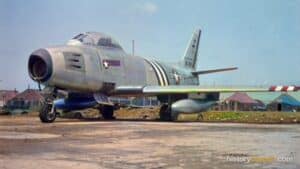
The U.S. Air Force credited its F-86 Sabre pilots with 792 MiG-15s destroyed against only 78 Sabres lost in air combat over MiG Alley near the Yalu River.
Those figures produced the famous 10 to 1 kill ratio, which the Air Force's own post-war review, code-named Sabre Measure Charlie, later cut by approximately half. Most historians credit better pilot training and the Sabre's radar-ranging gunsight, not raw aircraft speed, for the clear advantage F-86 pilots held. James Jabara, one of the war's top aces, was credited with 15 kills flying the Sabre in MiG Alley.
What Was the Cold War?
The Korean War was one of the first major conflicts of the Cold War, a long period of tension between the United States and the Soviet Union that lasted from the late 1940s until the early 1990s. The two nations never fought each other directly. Instead, they competed for power through spying, an arms race, propaganda, and support for opposite sides in smaller wars around the world.
These smaller conflicts are known as proxy warsConflicts where two powerful nations support opposite sides instead of fighting each other directly., and the Korean War is considered one of the most important examples. The causes of the Korean War were rooted in the division of Korea after World War II into a communist North supported by the Soviet Union and China, and a capitalist South backed by the United States. When North Korea invaded the South on June 25th, 1950, the fighting quickly became a battleground for Cold War rivalries. As a result, the weapons used in Korea came directly from the arsenals of the world’s two greatest military powers.
FactsthatCrunchWhat Small Arms Were Used in the Korean War?
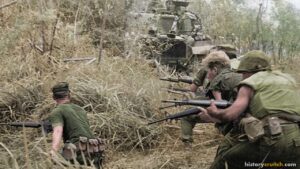
Small arms are weapons carried and fired by a single soldier, such as rifles, pistols, and machine guns. In the early battles of the Korean War, American troops carried many of the same guns that had been used to win World War II. The most common American rifle was the M1 Garand, a semi-automaticA gun that fires one bullet each time the trigger is pulled and reloads itself automatically, without the shooter doing it by hand. weapon that could fire eight rounds before reloading and that gave United States infantry a strong advantage in firepower.
American forces also relied on the lightweight M1 and M2 Carbines, which were easy to carry in Korea’s rugged terrain. For heavier firepower at the squad level, soldiers used the Browning Automatic Rifle, often shortened to BAR, an automatic weapon first designed for the United States during World War I. Officers and tank crews frequently carried the Colt M1911 pistol, a reliable sidearm that fired a large .45 caliber round.
On the communist side, North Korean and later Chinese soldiers were equipped mostly with weapons supplied by the Soviet Union. The standard rifle was the Mosin-Nagant, a bolt-actionA rifle design where the shooter must manually pull a handle to eject the old bullet casing and load the next round before firing again. design that was rugged, simple, and accurate at long range. Communist snipers armed with scoped Mosin-Nagant rifles posed a serious threat to United Nations troops.
For close combat, communist forces favored submachine gunsCompact automatic weapons that fire pistol-sized rounds rapidly and are designed for close-range combat. that could pour out a huge volume of fire. The most famous of these was the Soviet PPSh-41, which fired from a large 71-round drum magazine and proved especially effective during the fierce fighting at the Chosin Reservoir. In fact, these fast-firing weapons were well suited to the mass infantry attacks that Chinese forces used to overwhelm defenders.
FactsthatCrunchUN infantry relied on the semi-automatic M1 Garand for accurate, steady fire, while communist forces paired the long-range Mosin-Nagant with the high-volume PPSh-41 to cover both distance and close combat. The PPSh-41's rate of fire was up to 900 rounds per minute compared to the Garand's 40 to 50 rounds per minute, giving communist units a heavy volume of fire in the tight valleys and hill fights that defined much of the ground war.
What Tanks and Artillery Were Used?
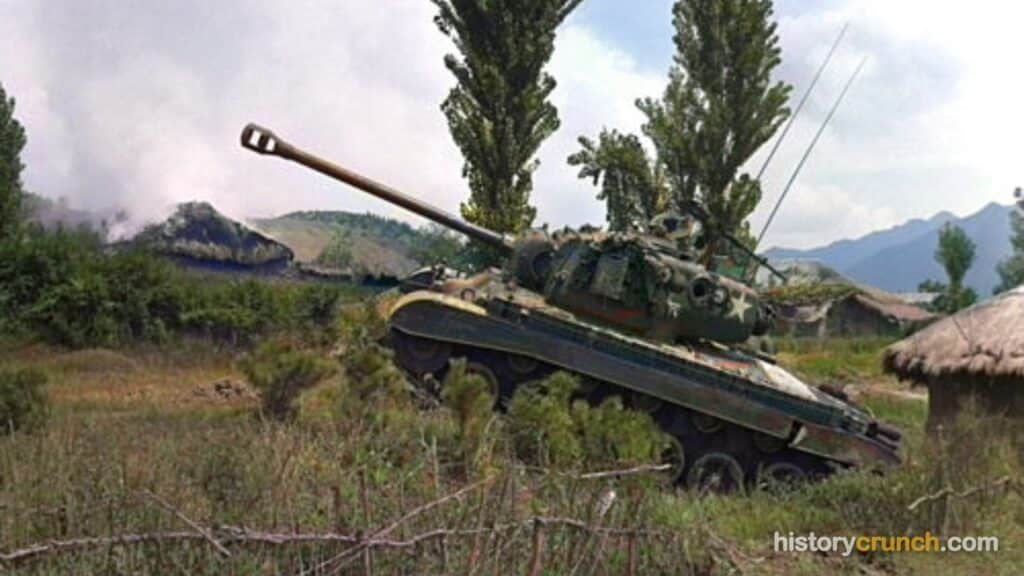
Tanks played an important role in the opening months of the war, especially during the North Korean invasion. The North Koreans attacked with the Soviet-built T-34, a powerful medium tank that had helped defeat Nazi Germany during World War II. In the first weeks of the war, South Korean and early American units had few weapons that could stop the T-34, and it drove deep into the South.
The United States quickly rushed better tanks into Korea to meet the threat. The first American tank, the light M24 Chaffee, proved to be no match for the heavier T-34. More effective were the M4 Sherman, upgraded from its World War II design, and the M26 Pershing, whose thick armor and powerful 90mm gun could knock out the T-34 in a direct fight. As stated above, however, Korea’s mountainous landscape limited large tank battles, so most fighting became an infantry struggle over hills and ridges.
Artillery, meaning large guns that fire shells over long distances, was one of the deadliest weapons of the entire war. Both sides used heavy artillery to bombard enemy positions before attacks and to break up assaults. For the United Nations forces, powerful artillery firepower often made the difference in holding a position against waves of communist attackers, particularly during the later years of the war when the front lines barely moved.
FactsthatCrunchIn what order did UN forces find an answer to the North Korean T-34 tank?
How Was Air Power Used in the Korean War?
The Korean War marked a major turning point in the history of air power because it was the first war to feature large-scale combat between jet-powered aircraft. Early in the war, both sides still flew propeller-driven planes left over from World War II, such as the American P-51 Mustang and the Corsair, which were used to attack ground targets and support troops.
Everything changed when the Soviet-built MiG-15 appeared in the skies over Korea. This fast, swept-wing jet fighter was flown by North Korean, Chinese, and Soviet pilots, and it outclassed the straight-winged American jets it first faced. In response, the United States rushed its own swept-wing fighter, the F-86 Sabre, into the war to regain control of the air.
The battles between the F-86 Sabre and the MiG-15 took place in a region near the Chinese border that pilots nicknamed “MiG Alley.” These were the first jet-versus-jet dogfights in history, and they helped the United Nations forces win overall air superiorityControl of the skies over a battlefield so that one side can fly freely while limiting the enemy’s ability to do the same.. More specifically, the Sabre earned a strong record against the MiG-15, which allowed American bombers such as the B-29 Superfortress to strike targets across North Korea.
What Naval Weapons Were Used?
Naval power gave the United Nations forces a major advantage that the communist side could not match. The United States and its allies controlled the seas around Korea, which allowed them to move troops and supplies freely and to launch attacks from the water. Aircraft carriers served as floating airbases, sending planes to bomb enemy positions and support soldiers on land.
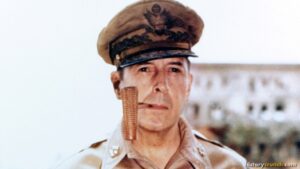
Battleships and cruisers used their heavy guns to bombard targets along the Korean coast from many miles offshore. The most famous use of naval power came in September of 1950, when General Douglas MacArthur launched a daring amphibious landingA military attack launched from the sea onto a shore, using warships to put troops directly onto enemy-held coastline. at Inchon. In reality, this bold operation, backed by warships and carrier aircraft, turned the tide of the war and pushed North Korean forces into retreat.
FactsthatCrunchWhat were the key phases of the Inchon amphibious landing in the Korean War?
Significance of Weapons of the Korean War
The weapons of the Korean War were significant because they shaped both the outcome of the conflict and the future of modern warfare. The mix of World War II equipment and brand new technology showed how quickly military science was changing during the early Cold War. For instance, the arrival of the jet fighter proved that future wars would be fought at incredible speeds in the sky.
The war also demonstrated the growing importance of air power and naval strength, which gave the United Nations forces key advantages over their enemies. At the same time, the huge armies and mass infantry attacks used by the communist side showed that traditional ground combat still mattered enormously. In the end, neither side could win a total victory, and the war settled into a stalemate that ended with an armistice in 1953.
Finally, the lessons learned about weapons in Korea influenced military planning for decades. The rivalry between the MiG-15 and the F-86 Sabre pushed both superpowers to develop even faster and more advanced jets. In this way, the weapons of the Korean War stand as an important bridge between the battles of World War II and the high-technology conflicts of the later Cold War.
FactsthatCrunchThe first jet-versus-jet air battles over Korea, fought in a strip of sky called MiG Alley, forced both superpowers to rethink how future air wars would be won.
The F-86 Sabre's radar-ranging gunsight gave American pilots a decisive edge over the MiG-15, proving that precision equipment could matter more than raw speed or climb rate. That lesson pushed both the United States and the Soviet Union to invest heavily in avionics and gunsight technology for the next generation of fighters.
The battles over MiG Alley showed that propeller-driven aircraft were finished as front-line fighters. Within a few years of the armistice, the major air forces had moved their front-line fighter squadrons from piston engines to swept-wing jets.
On the ground, the war showed that World War II-era tanks like the T-34 and the M26 Pershing were still decisive in the opening months of a conflict, but Korea's mountains quickly reduced tank warfare to a secondary role. That finding shaped how NATO and Soviet planners designed combined-arms doctrine for European scenarios throughout the 1950s and 1960s.
The contrast between the communist side's mass infantry tactics, backed by high-rate-of-fire weapons like the PPSh-41, and the United Nations' reliance on artillery firepower and air support confirmed that no single weapon type decided a war. Future Cold War armies built their strategies around combining all of these arms together.
Key Vocabulary
Stalemate
Proxy wars
Semi-automatic
Bolt-action
Submachine guns
Air superiority
Amphibious landing
Frequently Asked Questions
What was the main rifle used by American soldiers in the Korean War?
The main rifle used by American soldiers in the Korean War was the M1 Garand, a semi-automatic weapon that had been the standard United States rifle during World War II. Because it could fire eight rounds quickly before reloading, it gave American infantry more firepower than the bolt-action rifles carried by many enemy troops. Its reliability made it a favorite among soldiers throughout the war.
Why is the Korean War famous for jet fighters?
The Korean War is famous for jet fighters because it featured the first large-scale battles between jet-powered aircraft in history. Before this war, most air combat had taken place between propeller-driven planes. The clashes between the American F-86 Sabre and the Soviet MiG-15 marked the beginning of a new era of high-speed aerial warfare.
Where did most weapons for each side come from?
Most weapons for each side came from the two superpowers of the Cold War. The United Nations forces, led by the United States, used American-made equipment, while North Korean and Chinese forces relied heavily on weapons supplied by the Soviet Union. Some communist weapons were also older designs captured from Japan or supplied earlier to China.
What tank did North Korea use to invade the South?
North Korea used the Soviet-built T-34 tank to invade South Korea in 1950. This tank had earned a strong reputation fighting Nazi Germany during World War II, and it easily overwhelmed the lightly armed defenders in the first weeks of the war. The United States eventually countered it with heavier tanks like the M26 Pershing.
Did the Korean War use World War II weapons?
Yes, the Korean War used many weapons left over from World War II because the two conflicts were only five years apart. Rifles, tanks, and propeller planes from the earlier war saw heavy service, especially in the opening battles. However, the war also introduced newer technology, most notably jet fighters, that pointed toward the future of combat.
Cite This Article
To cite this article as a source, use one of the formats below.
MLA: Millar, B. “Weapons of the Korean War: A Detailed Summary.” HistoryCrunch, 15 August 2026, https://historycrunch.com/weapons-of-the-korean-war/.
APA: Millar, B. (2026). Weapons of the Korean War: A Detailed Summary. HistoryCrunch. https://historycrunch.com/weapons-of-the-korean-war/
Chicago: Millar, B. “Weapons of the Korean War: A Detailed Summary.” HistoryCrunch. August 15, 2026. https://historycrunch.com/weapons-of-the-korean-war/
Sources
- Truman Presidential Library
- Wilson Center Digital Archive
- Max Hastings, The Korean War.