Syngman Rhee was the first president of South Korea and one of the most important figures in the early history of the Korean Peninsula during the Cold War. As a lifelong nationalist, he spent decades working for Korean independence before helping to found the Republic of Korea in 1948. His long rule shaped the young nation, guided it through the Korean War, and ended in a wave of protest that pushed the country toward democracy.
 FactsthatCrunch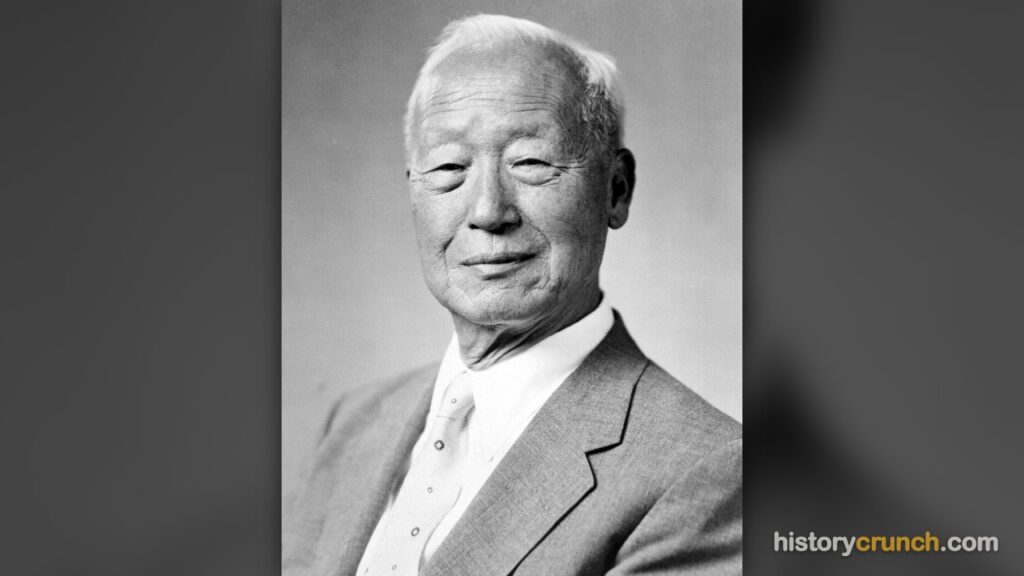
Syngman Rhee lived from 1875 to 1965 and served as the first president of the Republic of Korea, better known as South Korea, from 1948 until 1960, and his rule was marked by strong anti-communism, authoritarian measures, and support from the United States. He was a statesmanA leader involved in the affairs of a government or nation., meaning a leader involved in the affairs of a government or nation. To understand his career, it helps to know that Korea in his lifetime moved from a traditional kingdom, to a Japanese colony, and finally to a divided land split between a communist north and a non-communist south.
Early Life and Background
Syngman Rhee was born on March 26th, 1875, in the village of Pyong-san in Hwanghae Province, and his birth name was Yi Sung-man, which he later changed to the Western form Syngman Rhee. When he was very young, his family moved to Seoul, the capital city of Korea, and his family belonged to the yangbanThe noble, educated families who served the Korean kingdom for generations, often holding government positions. class, the traditional Korean elite who often held government positions and came from a long tradition of scholarly study. The term yangban referred to the noble, educated families who served the Korean kingdom for generations.
His father could recite the family genealogy going back seventeen generations to a time when the family was connected to royal blood, but the family, though elite, was fairly poor, and his father wanted him to follow the yangban tradition, so as a boy he studied the Confucian classics. As a young man, however, Rhee turned toward Western ideas. He completed a traditional classical education fitting his noble family heritage and then entered a Methodist school where he learned English.
At this mission school, Rhee converted to Christianity, a faith that shaped the rest of his life and connected him to Americans who later helped his career. In the late 1890s, Rhee entered the civil service while also joining nationalist and republican groups, and he was arrested and spent several years in prison until his release in 1904. These reform groups called for a modern, independent Korea free from foreign control, and his activity marked him as a leader of the growing nationalist movement.
FactsthatCrunchWhat role did the Confucian classics play in shaping Syngman Rhee's early education in Korea?
Rise to Power
After his release, Rhee traveled to the United States to lobby for Korean independence. In America he pursued higher education and became a respected scholar. An ardent Korean nationalist, he earned a Ph.D. from Princeton in 1910, becoming the first Korean to receive a doctorate from an American university. A Ph.D., short for Doctor of Philosophy, is the highest university degree a person can earn.
The year Rhee finished his degree was a turning point for his homeland. Japan formally annexedWhen one country formally takes control of another country or territory and makes it part of its own nation. Korea in 1910 and governed the peninsula as a colony for thirty-five years. During that period, Korean political freedom was heavily restricted, and many Koreans resisted Japanese control through protests, nationalism, and independence movements at home and abroad. Rhee spent most of these years overseas, working from the United States to build support for the Korean cause.
As the leading spokesman for Korean nationalism abroad, Rhee gained international attention. His political career began in exileBeing forced to live away from one’s home country. during Japan’s colonial rule over Korea, where he became a leading voice for Korean nationalism and was elected the first president of the Korean Provisional GovernmentA government-in-exile, a group of leaders who claimed to speak for a country while living outside it. in 1919. This provisional government was a government-in-exile, meaning a group of leaders who claimed to speak for Korea while living outside the occupied country. For decades, Rhee lobbied American leaders and world leaders to recognize Korea’s right to freedom.
The situation changed dramatically at the end of World War II. In August of 1945, Japan was defeated in World War II, Soviet forces moved into northern Korea, and American forces moved into the south. Rhee, who had been in exile from his native country for most of thirty-three years, returned in 1945 at the age of seventy, and became the first president of the Republic of Korea in 1948.
Korea did not become a single free country after the war. The Soviet Union liberated the northern half of Korea from Japanese control in August of 1945, with American forces liberating the southern half soon after, and by 1948 Korea had been officially split into two halves with separate governments along the 38th parallel. More background on this period can be found in the article Korea Before the Korean War. With American backing, Rhee emerged as the dominant political figure in the south and won election as the first president of the new southern republic.
FactsthatCrunchHow did Syngman Rhee become the first president of South Korea in 1948?
After Japan was defeated in World War II in 1945, Korea was divided along the 38th parallel into a Soviet-backed north and an American-backed south. Rhee had spent decades in the United States lobbying foreign governments for Korean independence, and that long record of nationalist leadership, combined with American backing, made him the dominant political figure in the south. After elections for a new National Assembly in May 1948, the Assembly elected Rhee president on July 20th, 1948, and he formally took office as founding president on August 15th, 1948.
Major Achievements and Presidency
Rhee’s greatest achievement was helping to establish and lead South Korea as a separate nation. After Korea’s liberation from Japan following World War II, Rhee played a crucial role in establishing the Republic of Korea amid the division of the peninsula. He built his government on firm opposition to communism and close ties with the United States, and he presented himself as the leader who could protect the south from the communist north.
The gravest test of his presidency came only two years after the republic was founded. During the war, North Korea was led by Kim Il-Sung, who ruled the country as a dictator, while South Korea was led by President Syngman Rhee, an anti-communist statesman, and tensions between the two sides escalated until fighting finally began in 1950. The details of that war are covered in the article Causes of the Korean War.
Rhee led his country through this devastating conflict. The United States and a wider UN military force came to the assistance of Rhee’s South Korean military, while the communist forces of North Korea were supported by the Soviet Union and the People’s Republic of China. The war ended in 1953 with a ceasefire rather than a clear victory, and the border between the two Koreas remained near the 38th parallel. The Korean War devastated the nation but ultimately led to U.S. military support that would later aid South Korea’s economic development.
Rhee remained firmly committed to defeating communism and reuniting Korea under his own government. Despite his authoritarian rule, Rhee aimed for Korean independence and reunification, and his actions, such as releasing anticommunist North Korean prisoners, at times defied the United Nations during the Korean War. He viewed the survival of a non-communist South Korea as his life’s mission.
His rule at home, however, grew increasingly harsh. Elected as the first president of the First Republic in 1948, he adopted a National Security Law that suppressed opposition. His leadership was marked by conflict, including disputes with the National Assembly and accusations of election fraudWhen election results are rigged and do not reflect the true votes of the people.. Over time, corruption and political repression turned much of the public against him.
FactsthatCrunchIt is June 18th, 1953, and you are Syngman Rhee, president of South Korea during the Korean War. Armistice talks between the United States, the United Nations, North Korea, and China have been going on for nearly two years, and a ceasefire agreement is close. You hold roughly 27,000 North Korean prisoners in South Korean camps, most of them anti-communist soldiers who do not want to return north. The armistice would divide Korea near the 38th parallel, leaving your dream of reunification unfulfilled, and you must decide right now what to do with those prisoners before a deal is signed.
Later Life and Downfall
By the late 1950s, discontent with Rhee had spread across South Korea. He had led South Korea through the Korean War, but because of widespread discontent with corruption and political repression, it was unlikely that he would be re-elected by fair means. In March of 1960, an election held under Rhee’s Liberal Party produced results that most people believed were dishonest.
The election involved widespread fraud, as the Liberal Party stuffed ballots, switched ballots, and removed opposition ballots. Fraud means the results were rigged and did not reflect the true votes of the people. In March of 1960, his election to a fourth term was met with massive student demonstrations alleging fraud.
These protests grew into a nationwide uprising known as the April Revolution. This movement unfolded on a national scale, led by students and intellectuals, as a collective stand against Syngman Rhee’s authoritarianism and corrupt government. On April 19th, about 30,000 students started the demonstration in the morning, and by midday over 100,000 South Koreans poured into the streets.
As the crowds grew, Rhee lost the support that had kept him in power. The Martial Law Command under General Song Yo Chan finally refused to fire on the demonstrators and turned its back on the Rhee regime. In the end, the United States also pressed for the resignation of President Rhee. Facing pressure from every side, the aging president finally gave in.
On April 26th, President Rhee issued his formal resignation and went into exile in Hawaii, which brought an end to the demonstrations. Exile means being forced to live away from one’s home country. Rhee was spirited out of the country on an American plane and flown to Hawaii, where he lived with his Austrian-born wife until his death in July of 1965.
FactsthatCrunchSignificance of Syngman Rhee
Syngman Rhee remains one of the most important and debated figures in Korean history. As the first president of South Korea, he helped bring the nation into being and steered it through the Korean War, one of the earliest and deadliest conflicts of the Cold War. His firm alliance with the United States shaped South Korea’s place in the world for decades to come.
At the same time, his rule showed the dangers of leaders who cling to power. His governance had lasting implications on South Korea’s political evolution and the public’s perception of democracy in the years that followed. His downfall proved that ordinary citizens could challenge even a powerful government.
In reality, Rhee is remembered in two very different ways. To some, he was the determined nationalist who devoted his life to Korean independence and held the young republic together during its most desperate years. To others, he was an authoritarian ruler whose corruption and election fraud sparked the April Revolution, a moment that many South Koreans still honor as an early step toward the democracy their country enjoys today.
FactsthatCrunchSyngman Rhee led South Korea from its founding in 1948 until he was forced out in 1960, leaving a complicated record as the country's first president.
Korean War timeline · 1950 – 1953
Key Vocabulary
Yangban
Statesman
Provisional government
Annexed
Authoritarianism
Fraud
Exile
Frequently Asked Questions
Who Was Syngman Rhee?
Syngman Rhee was the first president of South Korea, serving from 1948 to 1960. Before becoming president, he spent decades in exile working to free Korea from Japanese colonial rule, and he became famous as one of the leading voices of Korean nationalism around the world.
Why Is Syngman Rhee Important?
Syngman Rhee is important because he founded and led the Republic of Korea during its earliest and most dangerous years. He guided South Korea through the Korean War and tied the nation closely to the United States, decisions that still influence the Korean Peninsula and East Asia today.
What Education Did Syngman Rhee Have?
Syngman Rhee earned a Ph.D. from Princeton University in 1910, making him the first Korean to receive a doctorate from an American university. He began with a traditional Confucian education in Korea before attending an American mission school where he learned English and converted to Christianity.
Why Did Syngman Rhee Resign?
Syngman Rhee resigned in April of 1960 after a rigged election set off huge nationwide protests known as the April Revolution. When the military refused to fire on the crowds and the United States withdrew its support, he had no choice but to step down and leave the country.
What Happened to Syngman Rhee After He Left Office?
After resigning, Syngman Rhee went into exile in Hawaii, where he lived until his death in 1965. He never returned to South Korea, and an interim government soon drafted a new constitution and held fresh elections to replace his rule.
Cite This Article
To cite this article as a source, use one of the formats below.
MLA: Millar, B. “Syngman Rhee: A Detailed Biography.” HistoryCrunch, 15 August 2026, https://historycrunch.com/syngman-rhee/.
APA: Millar, B. (2026). Syngman Rhee: A Detailed Biography. HistoryCrunch. https://historycrunch.com/syngman-rhee/
Chicago: Millar, B. “Syngman Rhee: A Detailed Biography.” HistoryCrunch. August 15, 2026. https://historycrunch.com/syngman-rhee/
Sources
- Jerry Bentley & Herbert Ziegler, Traditions & Encounters: A Global Perspective on the Past.
- J.M. Roberts & Odd Arne Westad, The Penguin History of the World.