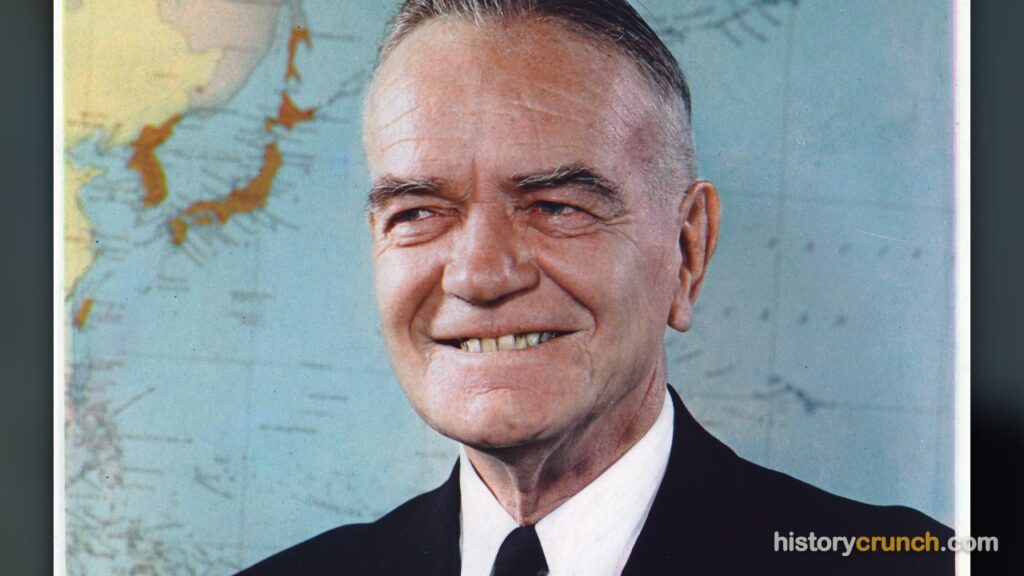
William “Bull” Halsey stands as one of the most famous and daring naval commanders of World War II, a leader whose aggressive fighting spirit came to symbolize the United States Navy in the Pacific. As commander of the U.S. Third Fleet, he led American carriers and battleships through some of the largest sea battles in history, and he was on the deck of a battleship when Japan formally surrendered. His career belongs to the story of the Pacific War, the long struggle between the United States and Imperial Japan from 1941 to 1945.
Halsey is best remembered as a champion of naval air power, meaning warfare built around aircraft launched from carriers rather than the big guns of battleships. He believed in speed, surprise, and constant attack, an approach he summed up in his slogan “Hit hard, hit fast, hit often.” That boldness made him a hero to the American public, but it also led to controversy at the Battle of Leyte Gulf and during a deadly typhoon that battered his fleet.
Early Life and Background
William Frederick Halsey Jr. was born on October 30th, 1882, in Elizabeth, New Jersey. He was the son of a U.S. Navy captain, and he came from a family with a long history of military service stretching back to colonial times. Growing up around the sea and naval life, the young Halsey developed a strong desire to follow his father into the Navy.
He applied for an appointment to the U.S. Naval Academy at Annapolis, Maryland, which he received after a two year wait. In the meantime, he spent time studying medicine at the University of Virginia. At the academy he was better known as an athlete than as a scholar. In fact, his academic performance was only average, and he graduated in 1904 near the middle of his class.
His early years in the Navy were spent aboard surface ships, and he built his reputation as a destroyer officer. When the United States entered World War I, Halsey commanded destroyers that escorted convoys of ships across the Atlantic Ocean. That ocean was regularly patrolled by German U-boats, which were submarines used to sink Allied vessels. For his service protecting these convoys, Halsey earned the Navy Cross, one of the service’s highest awards for valor.
Rise to Power
After World War I, Halsey continued to command destroyers and also served as an American naval attaché, meaning a military official stationed at embassies in foreign countries. He held that role in Germany and in several nations of northern Europe. These assignments gave him experience in diplomacy as well as in fighting ships.
The most important turn in his career came in the 1930s, when he moved into naval aviation. In 1934, at the advanced age of 52, Halsey trained to become a naval aviator, insisting on qualifying as a pilot even though he had one weak eye. From that point on, he became a leading advocate for the idea that aircraft carriers, not battleships, would decide future wars at sea.
Halsey advanced quickly in this new branch of the service. He commanded the carrier USS Saratoga and later the Pensacola Naval Air Station before rising to command a carrier division. By 1940 he had reached the rank of vice admiral and was leading the Aircraft Battle Force of the U.S. Pacific Fleet, based at Pearl Harbor, Hawaii. This was considered the premier command in the carrier forces at the time.
Major Achievements
When Japan attacked Pearl Harbor on December 7th, 1941, Halsey was at sea aboard the carrier USS Enterprise, returning to Hawaii. That timing spared his carriers from the surprise attack that crippled the American battleship fleet. In the weeks that followed, Halsey’s task force was virtually the only battle group left operating in the Pacific, which made him and his ships enormously important to the American war effort.
While the United States rebuilt its fleet, Halsey went on the offensive. He led a series of hit-and-run raids against Japanese held islands in the Marshalls and Gilberts, as well as Wake and Marcus islands. These early raids did little real damage, but they lifted American morale at a time when the news from the Pacific was mostly bad. In April of 1942, his task force maneuvered close enough to Japan for the planes of Lieutenant Colonel James Doolittle to carry out the first American bombing of Tokyo, an event known as the Doolittle Raid.
It was during these first months of the war that Halsey gained his famous nickname. According to a popular story, a newspaper reporter misspelled “Bill” Halsey as “Bull” Halsey, and the name stuck. The nickname fit his image perfectly, since he was seen as a tough, blunt, and endlessly aggressive fighter. Soon after, illness sidelined him, and he was hospitalized during the Battle of Midway in June of 1942, missing the decisive carrier battle of the Pacific War.
In October of 1942, Admiral Chester Nimitz appointed Halsey commander of the South Pacific forces and the South Pacific area. This came during the desperate fight for Guadalcanal, an island in the Solomon chain where American Marines were struggling to hold on. Halsey brought fresh energy and confidence to the campaign, and he played a vital role in the Battle of the Santa Cruz Islands and the naval Battle of Guadalcanal in November of 1942. For these successes he was promoted to full admiral.
After the victory at Guadalcanal, Halsey’s forces pushed up the Solomon Island chain and helped develop the strategy sometimes called island hopping or island skipping. More specifically, this meant bypassing strongly defended Japanese islands, cutting them off from supply, and capturing weaker positions instead. This approach let American forces advance across the vast Pacific without having to conquer every enemy stronghold.
In October of 1944, Halsey commanded the powerful Third Fleet during the Battle of Leyte Gulf, often described as the largest naval battle in history. His fleet included Task Force 38, which held the bulk of the Navy’s firepower in the Pacific, with many fast carriers and battleships. During the battle, Japanese carriers to the north served as a decoy, meant to lure Halsey’s fleet away from the invasion beaches. Halsey took his entire force north to attack them, and his aircraft sank all four Japanese carriers, including the last surviving carrier from the Pearl Harbor attack.
However, this decision left the San Bernardino Strait unguarded, and a strong Japanese battleship force slipped through and fell upon a small group of American escort carriers off the island of Samar. The lightly armed American ships and their crews fought with great bravery and held off the enemy until the Japanese commander turned back. The episode became one of the most debated moments of Halsey’s career, and it earned criticism that has followed his reputation ever since.
Later Life
Just two months after Leyte Gulf, Halsey faced another crisis. In December of 1944, his Third Fleet sailed into a powerful storm known as Typhoon Cobra, or “Halsey’s Typhoon,” east of the Philippines. The storm sank three destroyers, the Spence, the Hull, and the Monaghan, and killed nearly 800 sailors. Dozens of ships were damaged and about 146 aircraft were destroyed. A naval court of inquiry found Halsey largely responsible for the losses, though it did not find him guilty of negligence.
Despite these controversies, Halsey remained in command and continued to fight. His fleet took part in operations supporting the invasion of Okinawa in 1945, and his carrier planes struck the Japanese home islands in the final months of the war. When Japan surrendered, the ceremony took place aboard his flagship, the battleship USS Missouri, in Tokyo Bay on September 2nd, 1945.
In December of 1945, Halsey was promoted to the rank of fleet admiral, a five star rank held by only a handful of officers in American history. He retired from active service in 1947. In his later years he served on several corporate boards and led an effort, which ultimately failed, to preserve his wartime flagship USS Enterprise as a naval memorial. William Halsey died on August 16th, 1959, and he was buried in Arlington National Cemetery.
Significance of William “Bull” Halsey
Halsey’s significance rests on his role as the fighting spirit of the U.S. Navy during its darkest and most difficult moments in the Pacific. In the months after Pearl Harbor, when American forces were reeling, his hit-and-run raids and his eagerness to strike back gave the nation something to cheer for. In reality, his boldness helped rally a country that badly needed hope.
He was also one of the most important early champions of the aircraft carrier, and his career reflects the great shift in naval warfare from the battleship to the carrier. As stated above, his determination played a key part in saving the American position at Guadalcanal, which protected the overall Allied offensive in the Pacific.
At the same time, Halsey’s legacy is a mixed one. Critics have long argued that his instinct for attack sometimes overtook careful judgment, pointing to his decision at Leyte Gulf and the losses suffered in the typhoon. Even so, he remains one of the most recognizable American commanders of the war, remembered both for his daring victories and for the debates his choices still spark today.
Frequently Asked Questions
Why was William Halsey called “Bull”?
The nickname is usually traced to a newspaper reporter who misspelled “Bill” as “Bull” during the early months of the war. The name suited his tough, blunt, and hard-charging personality so well that it became permanent. Halsey himself did not choose it, but it became the name by which the public knew him.
What rank did William Halsey reach?
Halsey reached the rank of fleet admiral, the Navy’s highest rank, marked by five stars. He received this promotion in December of 1945, becoming one of only a small number of American officers ever to hold it. Earlier in the war he had risen through the ranks of rear admiral, vice admiral, and full admiral.
Was Halsey at Pearl Harbor during the attack?
No, Halsey was at sea aboard the carrier USS Enterprise when Japan attacked Pearl Harbor. His carriers were returning to Hawaii and were not in port, which spared them from destruction. This lucky timing left his task force as one of the few battle-ready American groups in the Pacific right after the attack.
Why is Halsey’s decision at Leyte Gulf controversial?
Halsey is criticized because he took his entire fleet north to chase Japanese decoy carriers, leaving a key strait undefended. This allowed a Japanese battleship force to attack American escort carriers off Samar. Supporters argue that Halsey acted reasonably with the information he had, since destroying enemy carriers was seen as the top priority throughout the war.
Where did the Japanese surrender take place?
The formal Japanese surrender took place aboard Halsey’s flagship, the battleship USS Missouri, anchored in Tokyo Bay. The ceremony was held on September 2nd, 1945, ending World War II. Halsey was present as the commander of the Third Fleet, a fitting end for an officer who had fought from the first day of the Pacific War to the last.
Cite This Article
To cite this article as a source, use one of the formats below.
MLA: Millar, B. “William "Bull" Halsey: A Detailed Biography.” HistoryCrunch, 14 August 2026, https://historycrunch.com/william-bull-halsey/.
APA: Millar, B. (2026). William "Bull" Halsey: A Detailed Biography. HistoryCrunch. https://historycrunch.com/william-bull-halsey/
Chicago: Millar, B. “William "Bull" Halsey: A Detailed Biography.” HistoryCrunch. August 14, 2026. https://historycrunch.com/william-bull-halsey/
Sources
- J.M. Roberts & Odd Arne Westad, The Penguin History of the World.
- Jerry Bentley & Herbert Ziegler, Traditions & Encounters: A Global Perspective on the Past.