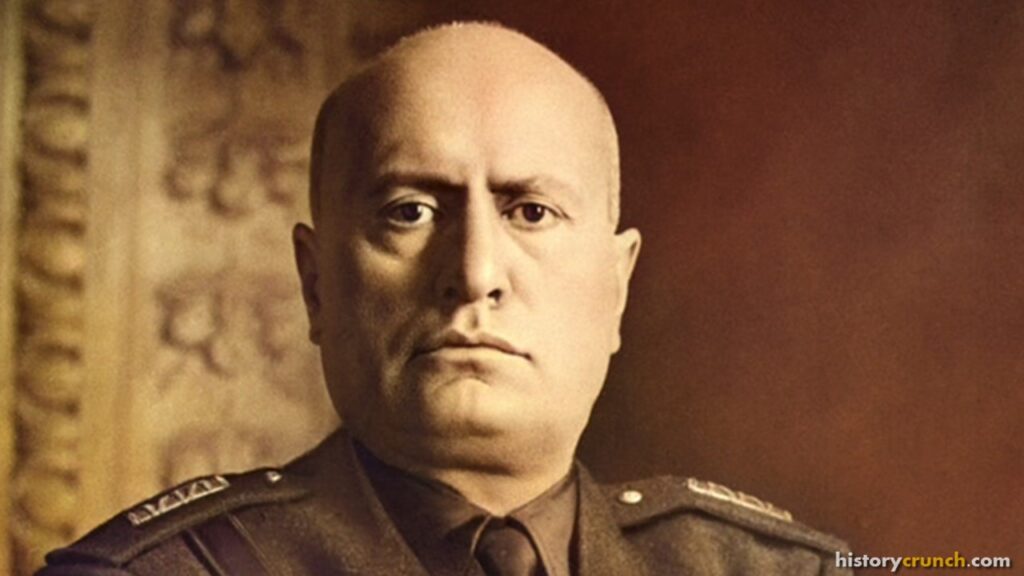
Benito Mussolini was the fascist dictator of Italy from 1922 until 1943. As such, he led Italy during the major years of World War II. Today, Mussolini is remembered for establishing the first fascist movement in the world. In fact, he seized power over Italy in 1922 following his ‘March on Rome’, which was a violent takeover of the government. Further to this, Mussolini allied his country with Nazi Germany and its leader Adolf Hitler during World War II. It should also be noted that Mussolini, and his fascist movement in Italy, inspired Adolf Hitler in Nazi Germany. Hitler even modeled aspects of his government after Mussolini’s. Because of this, Mussolini is one of the most famous dictators of the 20th century.
 FactsthatCrunch
Mussolini created the world's first fascist government and ruled Italy as Il Duce, meaning 'The Leader,' for over two decades. His alliance with Nazi Germany, signed in the Pact of Steel in May 1939, pulled Italy into World War II and shaped the conflict in Europe and North Africa.
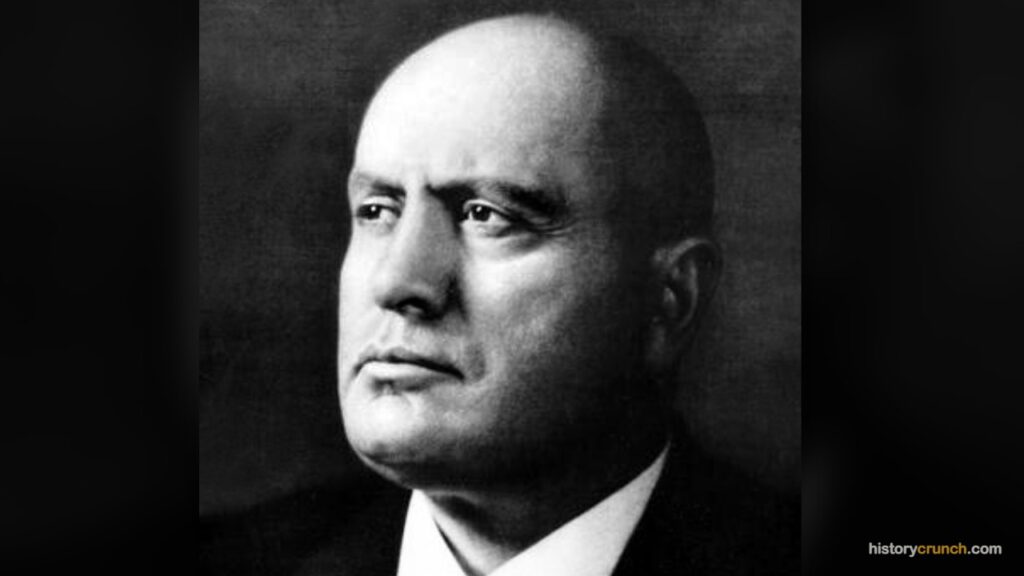
Benito Mussolini – Early Life
Benito Mussolini was born on July 29th, 1883 in a small Italian town called Dovia di Predappio. His father, Alessandro Mussolini, worked as a blacksmith and had very socialist leanings, which influenced Benito. In fact, Benito was named after influential socialists of the time. His mother, Rosa Mussolini, worked as a teacher. Together, Alessandro and Rosa had three children, of which Benito was the oldest.
Benito Mussolini was a strong student as a child and eventually trained to be an elementary schoolmaster. However, this was short-lived as he moved to Switzerland in 1902. It is believed that he went to Switzerland in order to avoid military service in Italy. At the time, military service in Italy was compulsoryRequired by law for everyone, with no option to refuse., meaning that all Italians were required to serve. Regardless, Mussolini’s time in Switzerland was significant to his early political and philosophical views. For instance, while in Switzerland, he became active in the socialist movement. Mussolini studied socialist beliefs and gave speeches, organized rallies and worked with unions. Furthermore, in 1903 he was arrested for supporting a violent general strike. He was imprisoned for a short time and returned to Italy in 1904, where he served two years in the military.
In the decade that followed, Mussolini moved between Switzerland, Italy and Austria-Hungary. He worked as a schoolteacher and political journalist. During this time, he further developed his socialist beliefs and became one of the most prominent socialists in all of Italy. For instance, he wrote several works at this time and became well known among socialists throughout Europe.
Benito Mussolini – World War I
When World War I broke out in 1914, many in Italy were torn between supporting the war or not. For instance, many supported their country fighting in the war due to a growing sense of nationalism in Italy. However, others argued against Italy participating in the war due to disagreement with the government. This was true of the main socialist movement in Italy, which was against the country fighting in the conflict.
While Mussolini’s early political views agreed with this perspective, he soon changed and was expelled from the Italian Socialist Party after supporting Italian military action in World War I. He changed his views based on his support for the socialist movement, which he had hoped could grow stronger if Germany and Austria-Hungary were defeated. This was significant, because it caused his political views to alter at this time. In fact, Mussolini began to develop a stronger sense of nationalism and less of a focus was placed on socialism. Historians agree that it was around 1914 that Mussolini began to develop his fascist beliefs.
Next, Mussolini served in the Royal Italian Army during World War I. During his time in the army, he ended up serving about nine months of time in the frontline trenches of the First World War. However, he was wounded following an explosion in his trench and eventually discharged in 1917.
FactsthatCrunchIn 1914, Mussolini broke with the Italian Socialist Party by publicly supporting Italian military action in World War I. He believed that if Germany and Austria-Hungary were defeated, the socialist movement could grow stronger across Europe, but this position directly contradicted the party's official stance against Italy joining the war, and he was expelled.
Committed socialist and prominent party member
Shifted toward nationalism and began developing fascist beliefs
Benito Mussolini – Turns to Fascism
After World War I, Mussolini continued to develop his fascist beliefs, based on extreme Italian nationalism. By this point in time, he had essentially rejected socialism and his earlier held views.
At its heart, Mussolini’s views of fascism focused on a strong sense of nationalism and less on class differences. As such, Mussolini believed it was the duty of all citizens to act in the best interest of the state as a whole and not necessarily their own individualistic wants. Therefore, Mussolini supported the rule over the country by a strong central government and rejected any elements of democracy. Furthermore, he argued in favor of a strong military and citizen support towards the goals of the state, including the buildup of a strong military.
Another element of Mussolini’s fascism was the idea of ‘spazio vitaleAn Italian phrase meaning ‘vital space,’ referring to Mussolini’s belief that Italy needed more territory to expand into.’ which translates to ‘vital space’. It is the belief that Italy required more space to operate. It further related to fascism, as the territory that Mussolini identified was where the Roman Empire had previously controlled. This concept of ‘vital space’ relates to another important aspect of fascism – racial superiority. While Mussolini did not necessarily support the racial policies and practice of Adolf Hitler and Nazi Germany, he did assert that some people were superior over others. For instance, he argued that it was justified for superior people to rule over inferior people. This is exemplified in a speech from 1920 that he gave, where he said:
“When dealing with such a race as Slavic—inferior and barbarian—we must not pursue the carrot, but the stick policy… We should not be afraid of new victims… The Italian border should run across the Brenner Pass, Monte Nevoso and the Dinaric Alps… I would say we can easily sacrifice 500,000 barbaric Slavs for 50,000 Italians…”
Furthermore, the beliefs of ‘vital space’ and racial superiority also led to Mussolini’s support of Italy practicing imperialistRelating to a policy of extending a country’s power by taking control of other territories or peoples. practices in Africa. Africa had long been the site of European imperialism, in the form of the Scramble for Africa. However, Italy had not been a major player in the earlier decades, and Mussolini supported Italy carving out its own territory on the continent. His beliefs on this matter were heavily related to his racial ideology, that was previously discussed.
Eventually, Mussolini’s growing fascist movement resulted in him and his close supporters creating their own private army of soldiers. This paramilitaryAn unofficial armed group organized like a military force but outside the official national army. group was referred to as the ‘blackshirts’ due to their distinctive uniforms. For the most part, they were Italian veterans from World War I who supported the ideals of Mussolini’s fascism. The ‘blackshirts’ were important to Mussolini’s growth of the fascist movement because they helped to suppress their political opponents. With the help of the blackshirts, the fascists in Italy grew in numbers and political influence. Eventually, this resulted in Mussolini establishing the National Fascist Party on November 9th in 1921. In that same year, fascist candidates were elected to the Italian parliament, which is called the Chamber of Deputies. Mussolini’s rise to power was nearly complete.
FactsthatCrunchWhat were the core ideas of Mussolini’s fascism after World War I?
Benito Mussolini – March on Rome
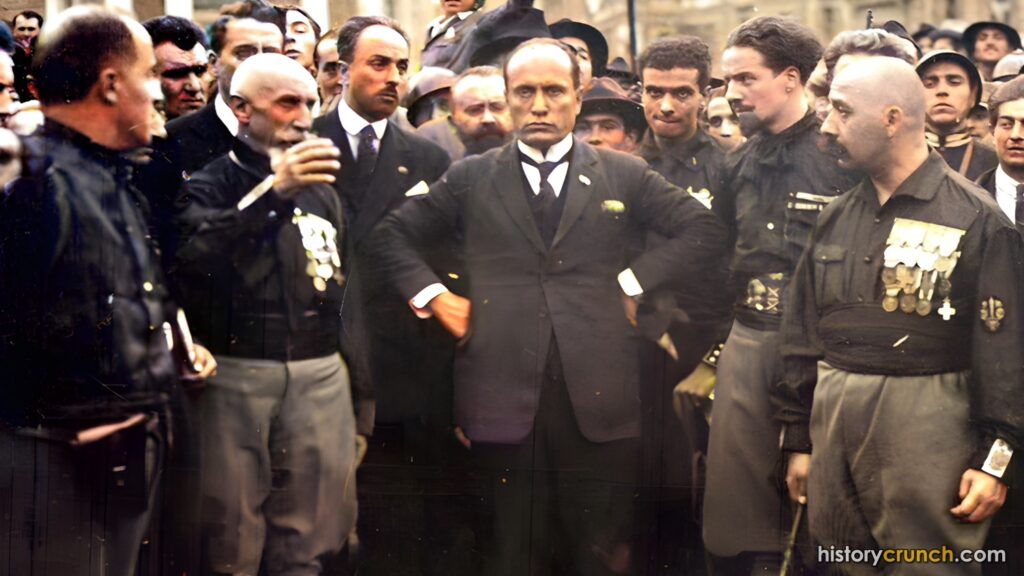
One of the most significant events in Mussolini’s rise to power was the ‘March on Rome’. It occurred on the evening of October 27th in 1922, and saw approximately 30,000 blackshirts support Mussolini’s bid to be the next leader of Italy. At the time, the country had been ruled over by Prime Minister Luigi Facta, who was a relatively liberal leader. However, the control of the Italian Military was held by King Victor Emmanuel III.
On the evening of October 27th, the blackshirts stormed into the Italian capital of Rome and demanded that Prime Minister Facta resign. Facta tried to maintain control by using the Italian Military to stop the uprising, but was denied by King Victor Emmanuel III. As such, Facta quickly resigned and Mussolini was handed the reins of power. This decision by King Victor Emmanuel III was important, as it made Mussolini’s bid to be leader relatively easy. Many historians believe that the King made this decision in fear, because Mussolini had quite a bit of support from members of the Italian Military. Regardless, Mussolini was now the Prime Minister of Italy, and had gained power through a coup d’état. This means he gained power through a violent overthrow of the government.
 FactsthatCrunch
What really made the March on Rome succeed in October 1922?
Benito Mussolini – the Dictator
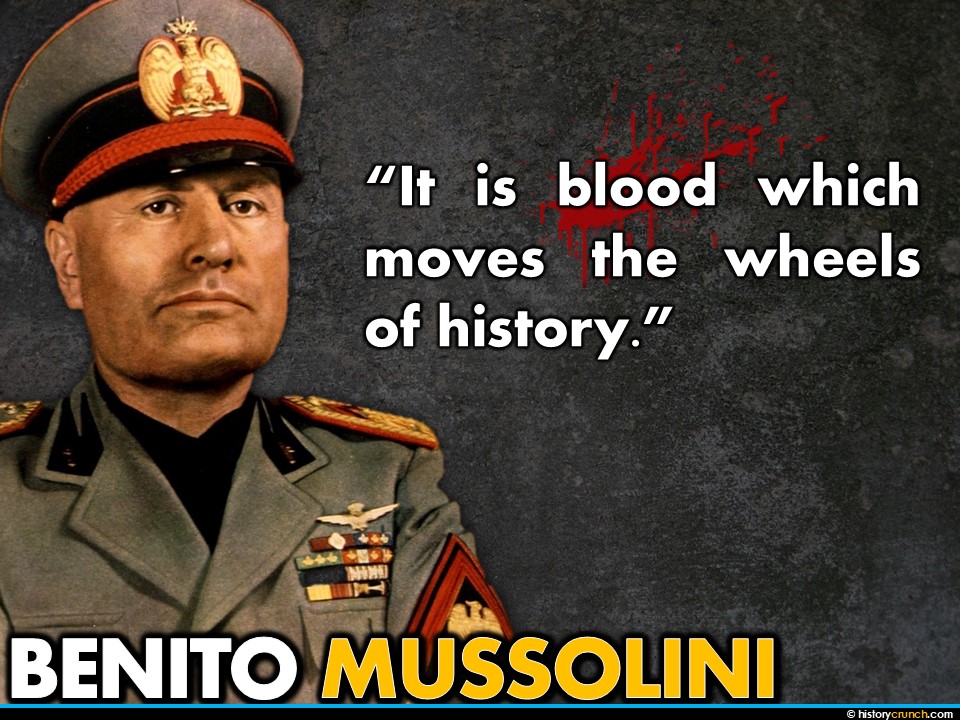
Throughout the 1920s, Mussolini worked to dismantle the parliament and democracy of the Italian state and replace it with fascism. In fact, he favored totalitarianism. A totalitarian state is one in which power is held by one single party, that rules with absolute authority. Typically, in a totalitarian state, the dictator of the country rules over all aspects of the country, and the individual rights of the citizens are denied or ignored. Essentially, Mussolini’s goal was to establish himself as a dictator. For instance, he would eventually be referred to as ‘Il Duce’ or ‘the Leader’.
For Mussolini, the Italian totalitarian state would operate a few key elements. First, Mussolini constructed the Italian parliament such that it benefitted the fascists. This essentially turned Italy into a single-party state. At the same time, his blackshirts continued to oppress other political leaders. Eventually, in 1926, all other political parties were banned. The second element was the establishment of Mussolini’s cult of personalityPropaganda that portrays a leader as almost god-like, always powerful and worthy of worship.. A cult of personality is a form of propaganda in which the leader of the country is presented in a positive manner. In fact, cults of personality usually present the leader as almost god-like in nature. This is evident in how Mussolini had himself presented to the people of Italy. For example, he was always displayed as a strong and powerful figure that commanded the authority of the people. His name of ‘Il Duce’ also was part of this cult of personality. Furthermore, Mussolini grew his cult of personality by controlling the media. For instance, during his time as dictator, the main fascist newspaper (‘Il Popolo’) was run by Mussolini’s brother and only published stories that were positive towards Mussolini’s leadership. The third element of Mussolini’s dictatorship was his use of secret police to carry out terror against his own people. Early on this was the mission of the blackshirts, who regularly attacked Mussolini’s enemies. Later, in 1927, Mussolini established the Organization for Vigilance and Repression of Anti-Fascism (OVRA). OVRA was essentially the secret police of Italy that carried out actions against the people of Italy that were considered to be acting anti-fascist. The fourth and final aspect of Mussolini’s dictatorship was the promotion of extreme Italian nationalism. He did this in several ways, including large public works projects that were intended to build up nationalistic pride. As well, Mussolini developed a youth version of the ‘blackshirts’ to promote national unity around fascism.
Beyond maintaining control over his own people, Mussolini also carried out several significant foreign policy actions. First was his invasion of Ethiopia in 1935. Also known as the Abyssinia Crisis, it saw Italian forces invade the Empire of Ethiopia. This was a central component of Mussolini’s imperialist policies in Africa, as he hoped to establish a larger empire for Italy. However, the Abyssinia Crisis is now viewed as a major event in the lead-up to World War II. This is because, the League of Nations failed to stop Italian aggression and proved to be ineffective at maintaining peace. The League of Nations was established after the end of World War I, as a part of United States President Woodrow Wilson’s famous Fourteen Points. The goal of the League of Nations was to prevent another crisis similar to World War I. However, during the Abyssinia Crisis, the League failed to hold Mussolini accountable for his actions and pushed Europe closer towards a large conflict.
 FactsthatCrunch
Benito Mussolini – Relationship with Adolf Hitler
Adolf Hitler, the fascist dictator of Nazi Germany, came to power in 1933. Initially, Mussolini did not think much of Adolf Hitler or the Nazi Party. In fact, he was relatively angered by some of the actions of the Nazis, especially in relation to Italy’s northern border. Mussolini believed that Nazi Germany was trying to gain more influence and territory. With that said, Adolf Hitler considered Mussolini to be a major influence on his own movement in Germany. In fact, Hitler had tried to gain power in Germany in a very similar manner as Mussolini, and even modeled aspects of his own dictatorship after Mussolini’s. It should be noted however, that Hitler’s brand of fascism was not entirely similar to Mussolini’s. Nazism (or National Socialism) shared many qualities with Mussolini’s fascism but differed slightly in terms of racial ideology. As stated earlier, Mussolini supported the notion that some ethnicities were superior to others. However, he differed from Hitler in the approach towards Jewish citizens. Mussolini at first did not support attacks against the Jewish and referred to the persecution of the Jewish as a German issue. However, in 1938 his government passed its own anti-Jewish racial laws.
Regardless, the growing sense of tensions in Europe in the 1930s eventually pushed Germany and Italy into an alliance. In fact, Mussolini believed that France and Britain had weakened themselves in the years after World War I and preferred an alliance with Germany as it was growing in strength. As such, on October 25th in 1936, Italy and Germany announced the ‘Rome-Berlin Axis’. The alliance between the two countries set the stage for a divide in Europe and foreshadowed the outbreak of World War II. In fact, in 1938, Mussolini attended the Munich Conference, where he supported Hitler’s claims that Germany should gain control over the Sudetenland of Czechoslovakia. The alliance strengthened further in 1939, when Italy and Germany agreed to the ‘Pact of Steel’ on May 22nd. This agreement joined Italy and Nazi Germany together in a military alliance. World War II erupted just months later in September of 1939.
Mussolini and Hitler were close allies from the moment Hitler came to power in 1933.
Benito Mussolini – World War II
World War II began in September of 1939, following Nazi Germany’s invasion of Poland on September 1st. Europe was again divided, and Italy found itself allied with Germany against France and Britain. The Soviet Union was not allied with France and Britain, as it had signed a non-aggression pact with Germany, which made it a relative non-player at the start of the war. Regardless, Italy entered the war when it declared war on Britain and France on June 10th in 1940.
Italy faced a severe problem in the years of World War II – it lacked the necessary industrial capacity to wage war. Mussolini knew his country was not prepared for major wartime operations and worked to try to get the country to increase its industrial pace in order to create weapons and vehicles. Regardless, the country struggled, and this led to its poor performance militarily in the fighting of World War II. For instance, while Italy joined only the final days of the Battle of France and had some early success in its African Campaign, it was never really able to establish itself militarily. In fact, much of Italy’s military successes were due to fighting alongside the much more powerful Nazi forces. However, as the war progressed, Italy suffered several major defeats, especially in Africa, where the British forces had captured large sections of Italy’s territory. These losses began to threaten Mussolini’s authority over Italy, and he became worried about maintaining public support.
World War II for Italy took a major turn for the worse when the Allied Powers carried out the Invasion of Sicily. The invasion occurred throughout the summer months of 1943 and saw the British, Americans, French and their allies soundly defeat Italian and Nazi German forces on the island of Sicily. The Allied Invasion of Sicily was significant for the Allied Powers because it allowed them to open a new front in Europe. However, it was disastrous for the Italians, and ultimately Mussolini, because it made Italy one of the major fronts of the war. As stated previously, Italy’s military was not prepared to withstand the Allied invasion and Italy suffered greatly from a lack of supplies and worsening morale among the citizens. This furthered the crisis facing Mussolini’s leadership as he struggled to maintain his authority over the situation. In fact, in late July of 1943, Mussolini was removed as Prime Minister of the country by King Victor Emmanuel III, after members of Mussolini’s government pushed for his removal. Mussolini was then imprisoned by his own government at a remote mountain plateau called Campo Imperatore in central Italy.
Mussolini was replaced by Pietro Badoglio who immediately began negotiating an end to Italy’s involvement in the war. In general, most of the people of Italy supported Mussolini’s removal because he had lost their support, and because they were hopeful that it meant an end to Italy’s involvement in World War II. However, the decision to remove Mussolini angered Adolf Hitler and the Nazis who viewed Mussolini as essential to maintaining their own influence in Italy. This caused Hitler to order a daring raid at Campo Imperatore in order to rescue Mussolini and reinstate him as leader over the country. The rescue occurred on September 12th in 1943 and led to the development of the Italian Social Republic.
The Italian Social Republic, which was also known as the Salò Republic, was a territory in the northern half of Italy that was still controlled by Nazi forces and Italian fascists that were still loyal to Mussolini. The southern half of Italy was referred to as the Kingdom of Italy and was under the control of the Allied forces and those who opposed Mussolini’s rule. However, Mussolini’s leadership of the Italian Social Republic was little more than a symbolic role. This is because the northern half of Italy was basically a puppet-state for Nazi Germany. For instance, during these remaining years of his life, he wrote parts of his autobiography that were later published under the title ‘My Rise and Fall’. As such, he was well aware of his downfall and lack of real leadership in his final years. Furthermore, in a 1945 interview he stated that “Seven years ago, I was an interesting person. Now, I am little more than a corpse.”
FactsthatCrunch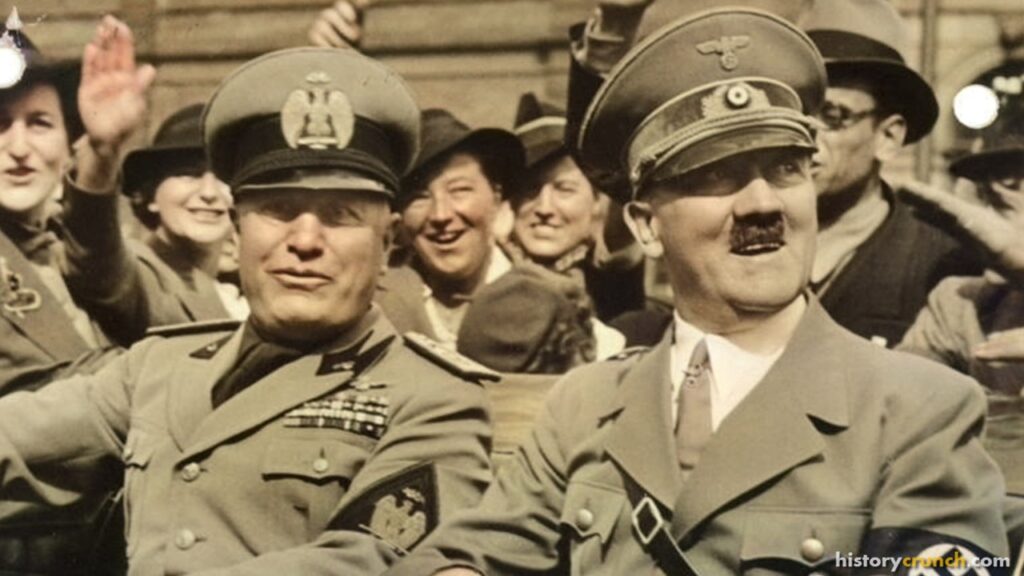 Black & whiteColor
Benito Mussolini – Death and Legacy
Throughout 1945, the Allied forces continued their push through the different fronts of the war in Europe, including Italy. This put immense pressure on the Italian Social Republic and caused Mussolini to plan his escape to Switzerland, where he hoped to find freedom. However, on April 27th in 1945, during his escape, he was captured by communist partisans. These communists kept Mussolini imprisoned over night and executed him and his companions the next day, on the 28th. Mussolini was killed by firing squad in the Italian region of Lombardy. The next day, Mussolini’s body, along with the bodies of the others that were killed, were taken to Milan. Once here, Mussolini’s body was hung upside down from the roof of a gas station. Italian civilians used the opportunity to throw stones and other objects at the bodies. Mussolini’s body was later interred at his birthplace in Dovia di Predappio. His body remains there today.
Benito Mussolini remains one of the most significant figures of the 20th century. His life is an important topic in relation to the rise of fascism in Europe and the events of World War II. While not necessarily as brutal as other dictators of his time, Mussolini is still remembered for ruling over Italy as a totalitarian dictator who commanded complete authority of his people. He is also famous for giving rise to fascism as an ideology, which became an important aspect of Europe during World War II. In fact, many of the aspects of fascism that Mussolini spearheaded became integral parts of Adolf Hitler’s own leadership in Nazi Germany.
FactsthatCrunchExplore World War II · 1939 – 1945
Keep exploring World War II with these History Crunch resources.
Key Vocabulary
Compulsory
Paramilitary
Coup d’état
Totalitarianism
Cult of personality
Spazio vitale
Imperialist
Frequently Asked Questions
Who was Benito Mussolini?
Benito Mussolini was the fascist dictator of Italy from 1922 until 1943. He created the first fascist movement in the world and led Italy into World War II. He ruled as a totalitarian leader and took the title “Il Duce,” meaning “the Leader.”
What was the March on Rome?
The March on Rome was the event that brought Mussolini to power on October 27th, 1922. About 30,000 blackshirts stormed into Rome and demanded that Prime Minister Luigi Facta resign. King Victor Emmanuel III refused to use the military against them, so Mussolini became Prime Minister through this coup.
How were Mussolini and Adolf Hitler connected?
Mussolini inspired Hitler, who modeled parts of his own dictatorship after Italy’s fascist state. The two leaders joined their countries in the Rome-Berlin Axis on October 25th, 1936, and later signed the Pact of Steel in 1939. Their ideas differed most on racial policy, since Mussolini at first called the persecution of Jewish people a German issue.
Why did Mussolini lose power during World War II?
Mussolini lost power because Italy performed poorly in the war and suffered major defeats. Italy lacked the industry to build enough weapons and vehicles for a long conflict. After the Allied Invasion of Sicily in 1943, King Victor Emmanuel III removed him as Prime Minister in late July of that year.
How did Mussolini die?
Mussolini was executed by firing squad on April 28th, 1945, in the Italian region of Lombardy. Communist partisans captured him the day before as he tried to escape to Switzerland. His body was taken to Milan and hung upside down from a gas station roof before being buried in his hometown.
What is fascism as Mussolini defined it?
Mussolini’s fascism focused on extreme nationalism and placed the state above individual wants. It rejected democracy and called for a strong central government and a powerful military. It also included ideas like “spazio vitale,” or vital space, and the belief that some people were superior to others.
Cite This Article
To cite this article as a source, use one of the formats below.
MLA: Beck, Elias. “Benito Mussolini: A Detailed Biography.” HistoryCrunch, 3 October 2026, https://historycrunch.com/benito-mussolini/.
APA: Beck, E. (2026). Benito Mussolini: A Detailed Biography. HistoryCrunch. https://historycrunch.com/benito-mussolini/
Chicago: Beck, Elias. “Benito Mussolini: A Detailed Biography.” HistoryCrunch. October 3, 2026. https://historycrunch.com/benito-mussolini/
Sources
- Imperial War Museum
- Max Hastings, Inferno / All Hell Let Loose.