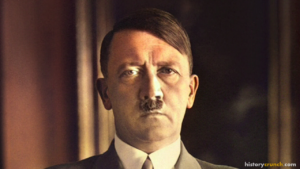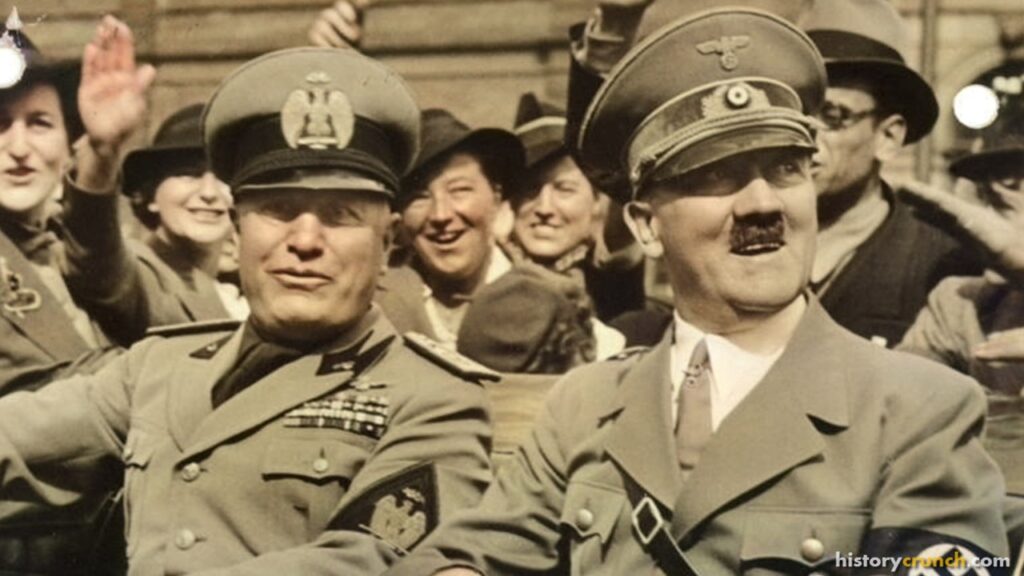
The Rome-Berlin Axis was the political partnership between fascist Italy and Nazi Germany that helped lay the foundation for the larger Axis alliance in World War II. It grew out of the cooperation between Benito Mussolini and Adolf Hitler, and it marked the point at which Italy and Nazi Germany began to move toward a more aggressive foreign policy. The agreement itself was reached on October 25th, 1936, and Mussolini publicly announced the Rome-Berlin Axis on November 1st, 1936.
 FactsthatCrunch
Italy and Nazi Germany were already firm allies before 1936, with Mussolini and Hitler working closely together from the moment Hitler came to power.
The two countries did not form a formal partnership until the Rome-Berlin Axis agreement of October 25th, 1936. Before that point, Italy had actually maintained cooler relations with Nazi Germany, and Mussolini had positioned Italy as a barrier to German expansion in central Europe. It was Italy's growing isolation after invading Ethiopia in 1935, and the League of Nations sanctions that followed, that pushed Mussolini toward Hitler.
What Was the Rome-Berlin Axis?
As mentioned above, the Rome-Berlin Axis was a coalition formed in 1936 between fascistRelating to a far-right dictatorship that uses extreme nationalism, militarism, and total government control over citizens. Italy and Nazi Germany, and it represented a major change in European diplomacy during the years before World War II. In fact, the Rome-Berlin Axis was a political partnership between Rome, the capital of Italy, and Berlin, the capital of Germany. In simple terms, it meant that Mussolini and Hitler were choosing to work together more closely in foreign policy at a time when both leaders wanted to challenge the existing balance of power in Europe.
Nazi Germany and Italy sought to form the Rome-Berlin Axis because both regimes believed in dictatorship, militarismThe belief that a country should build up strong armed forces and be ready to use military power aggressively. and territorial expansion. Furthermore, Hitler wanted to overturn the Treaty of Versailles, expand German territory (lebensraumA German term for the additional territory Hitler believed Germany needed to expand and support its population.), and build Nazi German power in Europe. For his part, Mussolini wanted to strengthen Italy, expand its influence in the Mediterranean and Africa, and revive the image of Roman greatness.
FactsthatCrunchRome-Berlin Axis – Why Did It Form?
The Rome-Berlin Axis developed partly because Italy had become more isolated after its invasion of Ethiopia (Abyssinia). Italy invaded Ethiopia on October 3rd, 1935, which caused the League of Nations to respond by imposing sanctionsPenalties, such as trade restrictions, that countries impose on another country to punish its actions. on Italy. After that, Italy’s relations with Britain and France weakened, and Mussolini became more willing to move closer to an alliance with Hitler. In this way, the Ethiopian crisis helped push Italy towards an agreement with Nazi Germany.
Another reason the Rome-Berlin Axis developed was the Spanish Civil War, which began in 1936. During that conflict, both Hitler and Mussolini supported Francisco Franco and the Nationalists. This gave Nazi Germany and Italy a chance to cooperate in practice, not just in words, and it helped strengthen the bond between the two dictatorships. Therefore, the Rome-Berlin Axis grew out of both diplomatic change and shared military intervention.
FactsthatCrunchTap each impact to read what it led to.
Rome-Berlin Axis – History and World War II
As mentioned previously, the Rome-Berlin Axis was agreed to on October 25th, 1936, when Nazi Germany and Italy signed their treaty of friendship and pledged to pursue a common foreign policy. A week later, on November 1st, 1936, Mussolini publicly announced the Rome-Berlin Axis. The Rome-Berlin Axis became stronger and wider in focus over the next several years. For instance, on November 25th, 1936, Nazi Germany signed the ‘Anti-Comintern Pact‘ with Imperial Japan. Italy joined that pact on November 6th, 1937. Then, on May 22nd, 1939, Hitler and Mussolini signed the ‘Pact of SteelA 1939 treaty that transformed the earlier Rome-Berlin political partnership into a full military alliance between Hitler and Mussolini.‘, which turned the earlier Rome-Berlin Axis into a stronger political and military alliance. Later, on September 27th, 1940, Nazi Germany, Italy, and Japan signed the Tripartite PactThe 1940 agreement that formally united Nazi Germany, Italy, and Japan as the Axis Powers of World War II., which formally created the Axis Powers of World War II.
Throughout the remainder of World War II, the members of the Axis Powers fought across battlefields in Europe, Africa, Asia and the Pacific. Despite their strength and military coordination, the Axis Powers were eventually defeated by the Allied Powers, and World War II formally ended in 1945 following the American atomic bombing of Japan.
FactsthatCrunch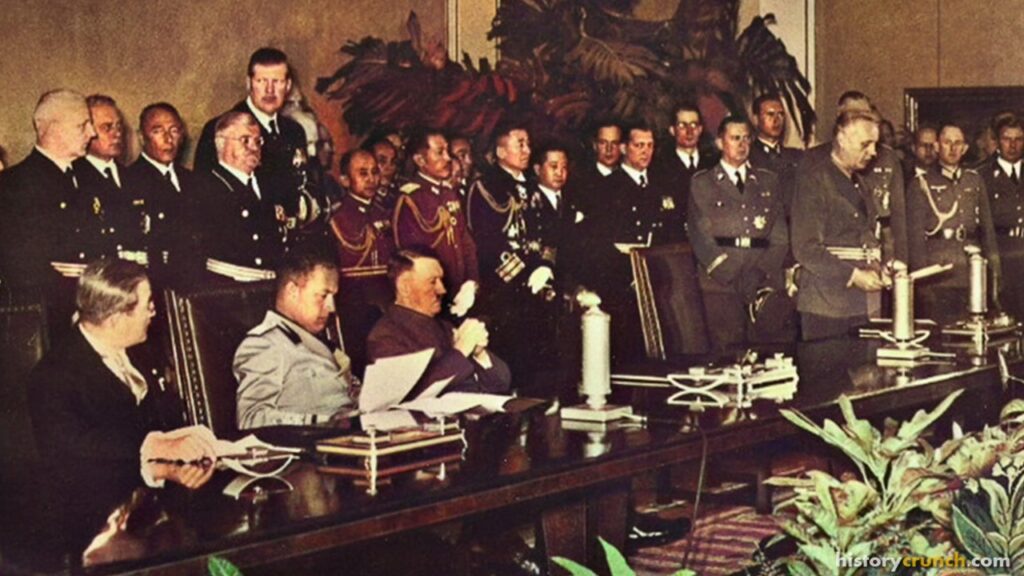 Black & whiteColor
Rome-Berlin Axis – Significance
The Rome-Berlin Axis was significant for a few key reasons. First, it marked the beginning of the close political relationship between Benito Mussolini and Adolf Hitler. It brought together fascist Italy and Nazi Germany at a crucial moment in the 1930s, and it helped create the larger Axis alliance that eventually fought together in World War II. Without the Rome-Berlin Axis, the later wartime partnership between Nazi Germany, Italy, and Imperial Japan would have developed very differently.
Second, the Rome-Berlin Axis helped make Adolf Hitler and Nazi Germany more dangerous because it reduced Nazi Germany’s diplomatic isolation. During the late 1930s, Hitler became increasingly more aggressive in Europe as he went against the terms of the Treaty of Versailles. For instance, Nazi Germany annexed Austria in 1938, took the Sudetenland later that same year, and then dismantled the rest of Czechoslovakia in March of 1939. With Italy no longer acting as a barrier to Nazi German expansion, Hitler had greater freedom to push forward. As such, the Rome-Berlin Axis played an important role in weakening resistance to Nazi aggression before the war began.
Which treaty transformed the Rome-Berlin Axis from a political partnership into a full military alliance between Hitler and Mussolini?
Explore World War II · 1939 – 1945
Keep exploring World War II with these History Crunch resources.
Key Vocabulary
Fascist
Sanctions
Lebensraum
Militarism
Anti-Comintern Pact
Pact of Steel
Tripartite Pact
Frequently Asked Questions
When was the Rome-Berlin Axis formed?
The Rome-Berlin Axis agreement was reached on October 25th, 1936, when Italy and Nazi Germany signed a treaty of friendship. Mussolini publicly announced it a week later, on November 1st, 1936. The two dictators pledged to follow a common foreign policy in Europe.
Why did Italy move closer to Nazi Germany?
Italy drew closer to Germany because it became isolated after invading Ethiopia on October 3rd, 1935. The League of Nations placed sanctions on Italy, which weakened its ties with Britain and France. This pushed Mussolini to seek a partner in Hitler instead.
How did the Spanish Civil War strengthen the Axis?
The Spanish Civil War, which began in 1936, let Germany and Italy work together in practice. Both Hitler and Mussolini sent support to Francisco Franco and the Nationalists. Fighting on the same side built trust and tightened the bond between the two dictatorships.
How did the Rome-Berlin Axis lead to the Axis Powers?
The Rome-Berlin Axis grew into the wider Axis alliance through a series of later agreements. The Pact of Steel in May 1939 turned the partnership into a military alliance. The Tripartite Pact of September 27th, 1940, then joined Germany, Italy, and Japan as the Axis Powers.
Why was the Rome-Berlin Axis important?
The Rome-Berlin Axis mattered because it reduced Germany’s diplomatic isolation and emboldened Hitler. With Italy no longer standing in his way, Hitler acted more freely against the Treaty of Versailles. Germany annexed Austria in 1938 and dismantled Czechoslovakia by March 1939.
Cite This Article
To cite this article as a source, use one of the formats below.
MLA: Millar, B. “Rome-Berlin Axis: A Detailed Summary.” HistoryCrunch, 1 October 2026, https://historycrunch.com/rome-berlin-axis/.
APA: Millar, B. (2026). Rome-Berlin Axis: A Detailed Summary. HistoryCrunch. https://historycrunch.com/rome-berlin-axis/
Chicago: Millar, B. “Rome-Berlin Axis: A Detailed Summary.” HistoryCrunch. October 1, 2026. https://historycrunch.com/rome-berlin-axis/
Sources
- The National WWII Museum
- Gerhard L. Weinberg, A World at Arms.