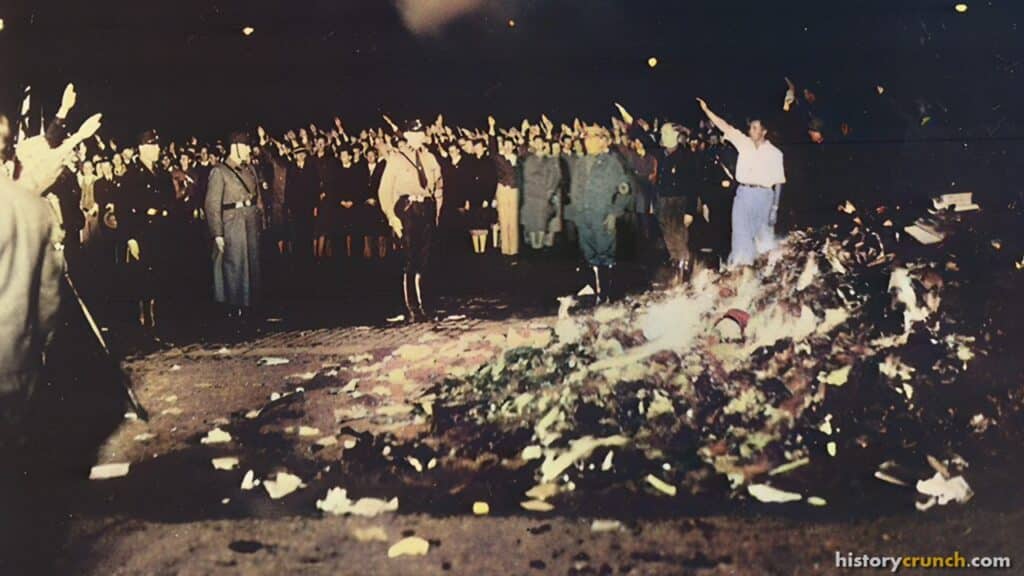
The Nazi book burning rallies were public events in 1933 in which books labeled ‘un-German’ were gathered and burned in towns and cities across Germany. The most famous rally took place in Berlin, Germany on May 10th, 1933, only a few months after Adolf Hitler became Chancellor on January 30th, 1933. These rallies were significant because they showed that the Nazi regime and its supporters were trying to control not only politics, but also ideas, culture, education and freedom of thought. As such, historians consider the Nazi book burning rallies as significant to the overall development of Nazi ideology.
WHAT WAS NAZI GERMANY?
To understand the Nazi book burning rallies, it is first necessary to understand Nazi Germany. Nazi Germany was the dictatorship created by Adolf Hitler and the Nazi Party after they took control of Germany in 1933. The Nazis used several different methods to maintain control over the German people, including censorship, propaganda, terror and repression, racial ideology and secret police. This is significant because the book burnings were one part of a much larger effort to reshape German society under Nazi rule.
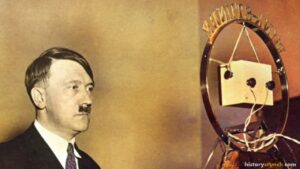
After Hitler became Chancellor, the Nazi regime moved quickly to centralize power and silence opposition. In March of 1933, Hitler appointed Joseph Goebbels as Minister of Propaganda, and Goebbels played a major role in promoting Nazi ideas and giving the impression that Hitler enjoyed complete public support. This is important because the book burning rallies were closely connected to that propaganda effort and helped present Nazi censorship as something dramatic, patriotic and popular.
WHY DID THE NAZIS BURN BOOKS?
The Nazis burned books because they believed certain ideas were dangerous to their ideology and their plans for Germany. In general, they attacked books that promoted ideologies they disagreed with, such as: liberalism, pacifism, socialism and communism. As well, they burned books that were critical of nationalism and war. They also targeted works by Jewish writers because anti-Semitism was central to Nazi ideology. This is significant because the Nazi book burning rallies were not only attacks on books. They were attacks on entire groups of people and on the right to think differently.
The campaign behind the burnings was called the ‘Campaign against the Un-German Spirit’. Furthermore, in early April of 1933, the national German student association announced the campaign and planned for it to end in public burnings on May 10th, 1933. In fact, student leaders also created slogans and ‘fire oaths’ to be read aloud while books were thrown into the flames. This is important because it shows that the burnings were carefully organized political rituals rather than spontaneous protests.
NAZI BOOK BURNING RALLIES – PROPAGANDA AND CENSORSHIP
Joseph Goebbels was one of the most important figures connected to the Nazi book burning rallies. As Minister of Propaganda, he helped shape Nazi public messaging in 1933. This is significant because Goebbels helped turn censorship into propaganda and helped make the rallies part of the Nazi image of unity, discipline, and national renewal. Furthermore, Goebbels used speeches, newspapers, radio, rallies, and later films to spread Nazi ideas. His wider propaganda work is important to this story because the book burnings were not isolated. They fit into a larger campaign in which the Nazis tried to control what Germans read, heard, and believed.
NAZI BOOK BURNING RALLIES – SIGNIFICANCE
The Nazi book burning rallies were significant because they revealed the true character of Nazi rule very early. Only a few months after Hitler came to power, the regime and its supporters were already using intimidation, censorship and propaganda to reshape German life. This is important because the burnings warned that the Nazis were not simply building a new government. They were building a dictatorship that would decide which ideas, which people, and which forms of culture could survive.
The rallies were also significant because they became a symbol of what happens when a government turns against free thought. The destruction of books came before the wider destruction of rights, communities, and lives that followed under Nazi rule. Overall, the Nazi book burning rallies were an early and powerful sign of the censorship, anti-Semitism and authoritarian control that would come to define Nazi Germany. As such, historians consider the Nazi book burning rallies as an important component of life in Nazi Germany and overall Nazi ideology.