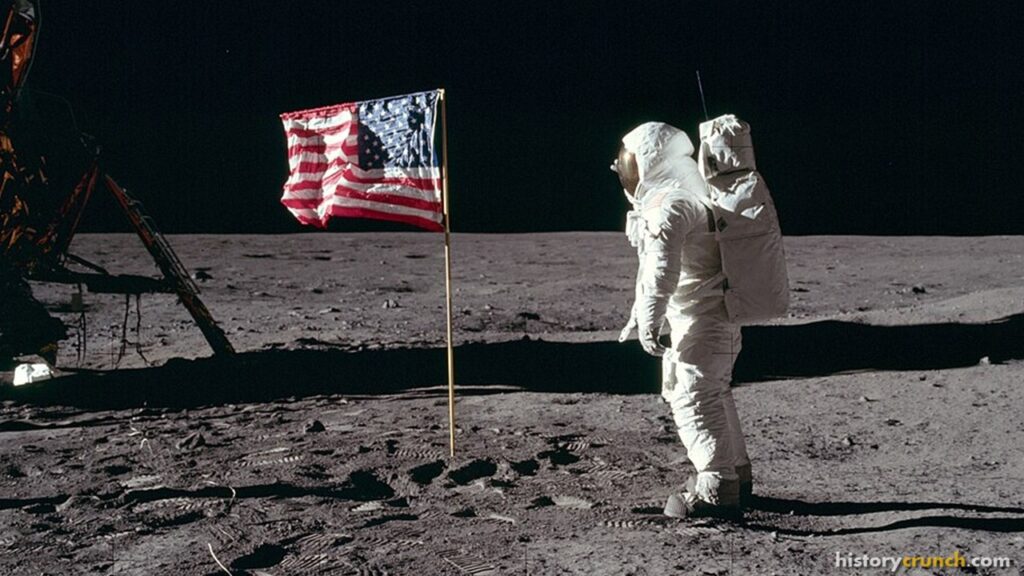
The first moon landing was one of the most significant events of the 20th century. On July 20th, 1969, NASA astronauts Neil Armstrong and Buzz Aldrin landed the lunar moduleA small spacecraft designed to detach and carry astronauts from orbit down to the Moon’s surface. Eagle in the Sea of Tranquility on the Moon’s surface, while their crewmate Michael Collins orbited above in the command module Columbia. Armstrong became the first human to set foot on the Moon approximately six and a half hours after landing, followed shortly afterward by Aldrin. The mission, known as Apollo 11, fulfilled a national goal set by President John F. Kennedy in 1961 and is widely considered to be the highest achievement of the Space Race between the United States and the Soviet Union during the Cold War.
 FactsthatCrunch
Which definition fits each Apollo 11 key term?
What Was the Space Race?
The Space Race was a Cold War-era competition between the United States and the Soviet Union to achieve the first major achievements in space exploration. In general, the Space Race began in October of 1957 when the Soviet Union launched the world’s first artificial satellite, Sputnik 1, into orbit. The launch shocked the United States and sparked an intense competition between the two superpowers to demonstrate technological and ideological superiority through achievements in space. Both nations invested enormous resources into their space programs throughout the late 1950s and 1960s, and the competition produced a series of major milestones including the first animal in space, the first human in space, and the first spacewalk. As such, the race to land a human on the Moon became the defining challenge of the Space Race and the event that would ultimately determine which superpower had won the competition.
First Moon Landing – Background
To fully understand the first moon landing, it is first important to understand the events that led to it. On April 12th, 1961, Soviet cosmonautA Russian or Soviet space traveler, the equivalent of an American astronaut. Yuri Gagarin became the first human to travel to space, orbiting the Earth and returning safely. This achievement demonstrated that the Soviet Union was ahead of the United States in the Space Race and caused significant concern among American leaders. In response, President John F. Kennedy addressed a special joint session of Congress on May 25th, 1961, and committed the United States to the goal of landing a man on the Moon and returning him safely to Earth before the end of the 1960s.
Kennedy’s challenge committed enormous resources to the American space program. NASA, which had been established on October 1st, 1958, became the agency responsible for carrying out the lunar landing program, which was known as the Apollo program. Throughout the 1960s, NASA developed the spacecraft, rocket technology, and training programs required to achieve a lunar landing. For instance, the Apollo program was preceded by the Mercury and Gemini programs, which were designed to develop the skills and technologies needed for deep space travel. As well, the development of the Saturn V rocket, which stood approximately 363 feet (110 meters) tall and produced 7.5 million pounds of thrustThe pushing force a rocket engine produces to lift a spacecraft off the ground., was central to making the lunar mission possible. The Saturn V remained the most powerful rocket ever successfully launched throughout this period.
It should also be noted that the Apollo program suffered a serious setback on January 27th, 1967, when a fire broke out during a launch pad test of the Apollo spacecraft, killing all three crew members on board: Gus Grissom, Ed White, and Roger Chaffee. The disaster, which became known as the Apollo 1 fire, caused a significant delay in the program while NASA investigated the causes and redesigned the spacecraft. Despite this setback, the program resumed, and by December of 1968 the Apollo 8 mission successfully carried three astronauts around the Moon and back, marking the first time humans had traveled to lunar orbit. In March of 1969, Apollo 9 tested the lunar module in Earth orbit, and in May of 1969 Apollo 10 conducted a full dress rehearsalA full practice run of a mission that copies every step of the real thing without completing the final goal. of the lunar landing mission, flying the lunar module to within approximately 50,000 feet (15,000 meters) of the lunar surface before returning to orbit.
FactsthatCrunchThe Saturn V rocket was a three-stage vehicle that burned through its engines in sequence to push Apollo astronauts out of Earth's atmosphere and onto a path toward the Moon.
First Moon Landing – The Apollo 11 Mission
Apollo 11 launched from Kennedy Space Center in Florida on July 16th, 1969, at 9:32 am Eastern Time, atop a Saturn V rocket. The three crew members of the mission were: Neil Armstrong, who served as mission commander, Michael Collins, who served as command module pilot, and Buzz Aldrin, who served as lunar module pilot. Over one million spectators gathered near Kennedy Space Center to watch the launch, and the event was broadcast live on television to a global audience.
After traveling approximately 240,000 miles (386,000 kilometers) over the course of three days, Apollo 11 entered lunar orbit on July 19th, 1969. On July 20th, Armstrong and Aldrin entered the lunar module Eagle and separated from the command module Columbia, in which Collins remained in orbit. The powered descent to the lunar surface began approximately two hours after separation. During the final stages of the descent, Armstrong and Aldrin encountered a series of computer alarm warnings indicating that the onboard computer was overloaded. Mission Control in Houston, Texas, determined that it was safe to continue, and the descent proceeded. As the Eagle approached its planned landing site, Armstrong realized that the computer was directing the spacecraft toward a crater filled with boulders, which would have made landing dangerous. He took manual control of the spacecraft and flew it to a safe landing spot beyond the crater, landing with approximately 45 seconds of fuel remaining in the descent stage.
At 4:17 pm Eastern Time on July 20th, 1969, the Eagle touched down on the surface of the Moon in an area known as the Sea of Tranquility. Armstrong announced the landing to Mission Control with the words: “Houston, Tranquility Base here. The Eagle has landed.”
FactsthatCrunch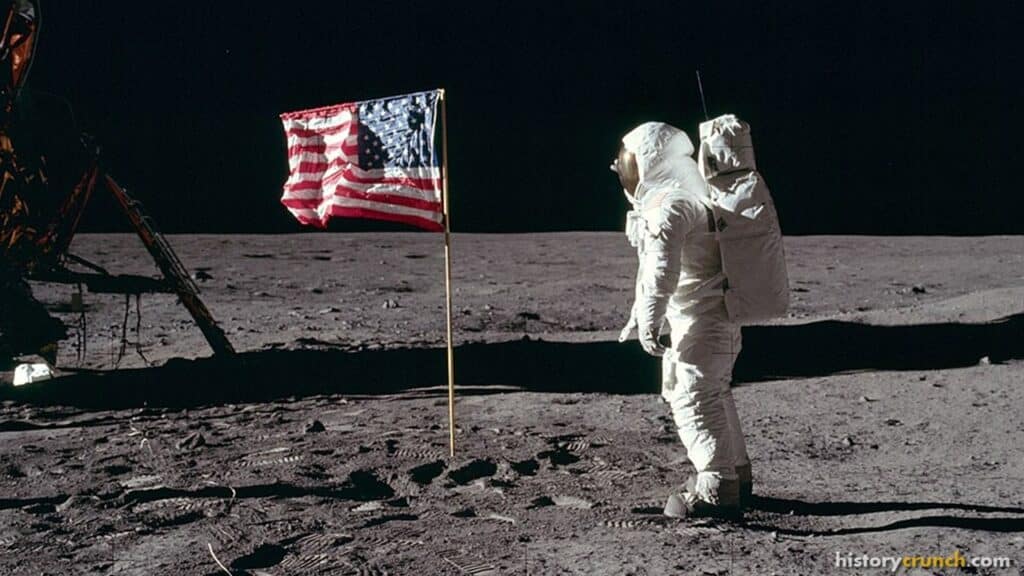
First Moon Landing – The Moonwalk
Approximately six and a half hours after landing, Armstrong opened the hatch of the lunar module and descended the ladder to the lunar surface. At 10:56 pm Eastern Time on July 20th, 1969, Neil Armstrong stepped off the ladder and onto the Moon, becoming the first human being to walk on the surface of another world. As he took his first step he said: “That’s one small step for man, one giant leap for mankind.” The moment was broadcast live on television and watched by an estimated 530 million people around the world, making it one of the most widely viewed events in television history to that point.
Buzz Aldrin descended to the surface approximately twenty minutes after Armstrong, and the two astronauts spent approximately two and a half hours conducting a moonwalk. For instance, during their time on the surface they: planted an American flag, collected approximately 47 pounds (21 kilograms) of lunar rock and soil samples for return to Earth, deployed a series of scientific instruments including a seismographAn instrument that detects and records vibrations or quakes moving through the ground. for measuring moonquakes and a laser ranging retroreflectorA device that bounces laser beams back to Earth so scientists can measure exact distances. for measuring the precise distance of the Moon from Earth, and spoke by telephone with President Richard Nixon. Michael Collins remained in lunar orbit throughout the moonwalk, unable to communicate directly with Armstrong and Aldrin whenever his orbit took him around the far side of the Moon.
After completing the moonwalk, Armstrong and Aldrin returned to the lunar module and rested before lifting off from the lunar surface on July 21st, 1969. After 21 hours and 36 minutes on the surface, the ascent stage of the Eagle launched from the Moon and rendezvoused with the command module Columbia in lunar orbit. The crew then began their return journey to Earth, splashing down in the Pacific Ocean on July 24th, 1969, where they were recovered by the USS Hornet. In case the Moon contained any unknown biological pathogensA tiny organism such as a bacterium or virus that can cause disease in living things., the three astronauts were kept in biological quarantine for 21 days following their return.
During the Apollo 11 mission of the Cold War Space Race, did each of these actions happen on the Moon's surface, or somewhere else during the mission?
First Moon Landing – Significance
The first moon landing was significant for several important reasons. First, it fulfilled the goal set by President Kennedy in 1961 and represented a decisive victory for the United States in the Space Race. The achievement demonstrated the technological and scientific capabilities of the United States at a time when the two superpowers were competing intensely for global prestige and influence. As such, the first moon landing is widely regarded as the symbolic end of the Space Race, as the Soviet Union never succeeded in landing cosmonauts on the Moon.
Second, the first moon landing was a major scientific achievement that advanced human understanding of the Moon and the solar system. The rock and soil samples returned by Apollo 11 and subsequent Apollo missions provided scientists with important data about the composition, age, and geological history of the Moon. For instance, the Apollo 11 basalt samples were found to be between 3.6 and 3.9 billion years old, providing important evidence about the early history of the solar system.
Third, the Apollo program produced important technological advances that had lasting benefits for society. The competition of the Space Race caused enormous investment in emerging technologies including computing, communications, and materials science, many of which found applications in everyday life in the decades that followed.
Finally, the first moon landing had an important cultural impact. The image of Armstrong stepping onto the lunar surface and the words he spoke at that moment became some of the most recognized and quoted in modern history. The achievement inspired generations of scientists, engineers, and explorers and demonstrated what human ingenuity and determination could accomplish when directed toward a shared goal.
FactsthatCrunchTap each impact to read what it led to.
Explore Cold War · 1947 – 1991
Keep exploring Cold War with these History Crunch resources.
Key Vocabulary
Cosmonaut
Lunar module
Thrust
Dress rehearsal
Seismograph
Retroreflector
Pathogen
Frequently Asked Questions
Who was the first person to walk on the Moon?
Neil Armstrong was the first person to walk on the Moon. He stepped onto the surface at 10:56 pm Eastern Time on July 20th, 1969. Buzz Aldrin joined him about twenty minutes later. Michael Collins stayed in orbit in the command module.
What did Neil Armstrong say when he stepped onto the Moon?
Armstrong said, “That’s one small step for man, one giant leap for mankind.” The moment was shown live on television to an estimated 530 million people. It became one of the most watched events in television history to that point. His words are still among the most quoted in modern history.
What was the name of the Apollo 11 mission?
The first moon landing was carried out by the Apollo 11 mission. The lunar module that landed was named Eagle, and the command module was named Columbia. The spacecraft launched from Kennedy Space Center in Florida on July 16th, 1969. It landed on the Moon four days later.
Why did the United States want to land on the Moon?
The United States raced to the Moon to win the Space Race against the Soviet Union. President John F. Kennedy set the goal in 1961 after the Soviets sent the first human into space. The landing showed American technological and scientific strength during the Cold War. It gave the United States a major victory in global prestige.
How long did the astronauts stay on the Moon?
Armstrong and Aldrin spent 21 hours and 36 minutes on the lunar surface. Of that time, about two and a half hours were spent walking outside the module. They planted an American flag and collected about 47 pounds (21 kilograms) of rock and soil. They also set up science instruments before lifting off on July 21st, 1969.
What did Apollo 11 bring back from the Moon?
Apollo 11 brought back about 47 pounds (21 kilograms) of lunar rock and soil. These samples gave scientists new data about the Moon’s makeup, age, and history. Some basalt samples were found to be between 3.6 and 3.9 billion years old. That evidence helped explain the early history of the solar system.
Cite This Article
To cite this article as a source, use one of the formats below.
MLA: Millar, B. “First Moon Landing: A Detailed Summary.” HistoryCrunch, 9 October 2026, https://historycrunch.com/first-moon-landing/.
APA: Millar, B. (2026). First Moon Landing: A Detailed Summary. HistoryCrunch. https://historycrunch.com/first-moon-landing/
Chicago: Millar, B. “First Moon Landing: A Detailed Summary.” HistoryCrunch. October 9, 2026. https://historycrunch.com/first-moon-landing/
Sources
- Wilson Center Digital Archive
- Vladislav Zubok, A Failed Empire.
- State Department — Office of the Historian