Emmett Louis Till was a 14 year old African American boy from Chicago, Illinois, who was kidnapped and murdered in August of 1955 while visiting family in the state of Mississippi. His murder, and the acquittal of the men responsible, shocked the country and helped galvanize the Civil Rights Movement of the 1950s and 1960s. Till is considered to be one of the most important figures in the history of the Civil Rights Movement, and his death continues to be remembered as a symbol of the racial injustice faced by African Americans in the United States.
WHAT WAS THE CIVIL RIGHTS MOVEMENT?
The Civil Rights Movement was a widespread social and political campaign for equal rights that took place primarily during the 1950s and 1960s in the United States. The movement was driven by African Americans and their allies who sought to end the system of racial segregation and discrimination that had existed in the United States for centuries. Racial segregation meant that African Americans were legally separated from white Americans in schools, restaurants, transportation, hospitals, and other public spaces, and were routinely denied the same rights and opportunities available to white citizens.
The Civil Rights Movement used a variety of methods to challenge this system, including: peaceful protests, legal challenges through the courts, boycotts, and political pressure on the United States government. Some of the most important events of the Civil Rights Movement included the Supreme Court ruling in Brown v. Board of Education in 1954, the Montgomery Bus Boycott of 1955, the March on Washington in 1963, and the passage of the Civil Rights Act of 1964 and the Voting Rights Act of 1965. The murder of Emmett Till was one of the defining moments of the Civil Rights Movement, and its impact was felt throughout the entire struggle for racial equality that followed.
EMMETT TILL – BACKGROUND
To understand the significance of Emmett Till’s murder, it is important to understand the system of racial inequality that existed in the American South in the 1950s. Following the end of the Civil War, southern states had passed a series of laws known as ‘Jim Crow’ laws, which enforced racial segregation and denied African Americans equal access to education, employment, voting, and public life. Violence against African Americans, including lynching, was used to enforce this system and keep African Americans from challenging it. In many parts of the South, African Americans who were perceived to have violated the unwritten rules of racial conduct faced the threat of serious harm or death, with little hope of legal protection or justice.
Emmett Till had grown up in Chicago, where racial discrimination was less openly enforced than in the Deep South. His mother, Mamie Till-Mobley, warned him before his trip to Mississippi that the rules were different there and that he would need to be careful. In August of 1955, Till traveled to Money, Mississippi, to visit his great-uncle, Moses Wright.
EMMETT TILL – THE MURDERS
On the evening of August 24th, 1955, Till visited Bryant’s Grocery and Meat Market in Money, Mississippi, with a group of cousins. Accounts of what happened inside the store vary, but it was reported that Till interacted with Carolyn Bryant, the white woman who worked at the store. Several days later, on the night of August 28th, Carolyn Bryant’s husband Roy Bryant and his half-brother J.W. Milam went to Moses Wright’s home and took Till from his bed at gunpoint. The two men beat Till severely, shot him in the head, and threw his body into the Tallahatchie River with a heavy cotton gin fan tied around his neck with barbed wire to weigh it down. Till’s body was discovered three days later, on August 31st, 1955. He had been so badly beaten that he could only be identified by a ring on his finger.
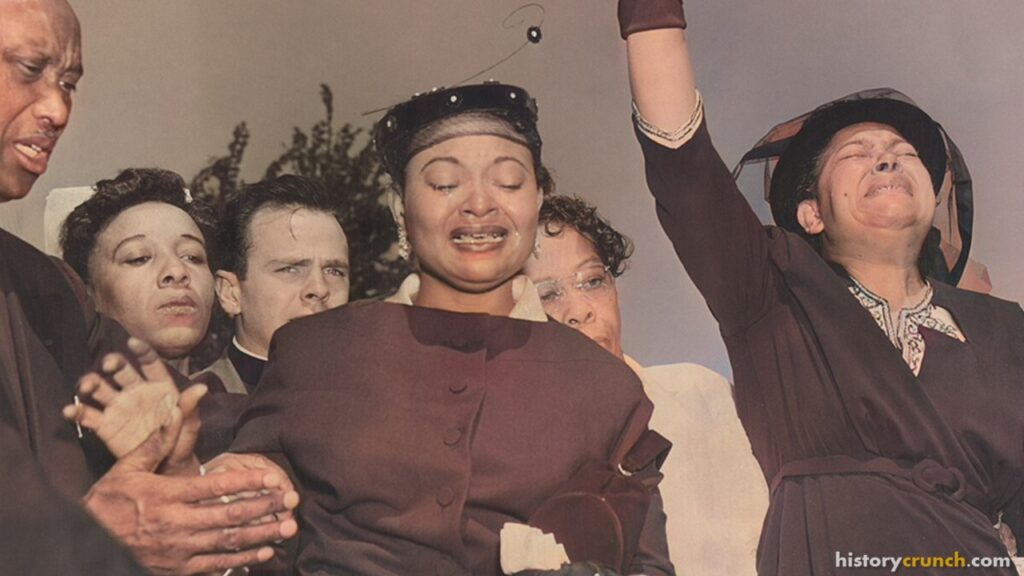
Till’s mother, Mamie Till-Mobley, made the decision to have an open-casket funeral in Chicago so that the world could see what had been done to her son. Tens of thousands of people came to view Till’s body, and photographs of his face were published in the African American magazine Jet and in newspapers across the country. The images shocked people across the United States and around the world and brought widespread attention to the violence faced by African Americans in the South.
EMMETT TILL – THE TRIAL
Roy Bryant and J.W. Milam were arrested and charged with Till’s murder. The trial took place in September of 1955 in Sumner, Mississippi. Till’s great-uncle, Moses Wright, displayed extraordinary courage by taking the stand and identifying Bryant and Milam as the men who had taken Till from his home. It was one of the first times a Black man had publicly testified against white men in the state of Mississippi.
Despite the testimony against them, Bryant and Milam were acquitted by an all-white, all-male jury after deliberating for only 67 minutes. Jurors later admitted in interviews that they knew the men were guilty but did not believe that white men should be imprisoned or executed for killing a Black man. Protected from being tried again for the same crime, Bryant and Milam later sold their confession to Look magazine in 1956 for $4,000, publicly admitting in detail how they had murdered Till. No one else was ever prosecuted for their role in the crime.
EMMETT TILL – SIGNIFICANCE
The murder of Emmett Till was significant for several reasons. First, the murder of Emmett Till was significant because it exposed the brutal reality of racial violence in the American South to a national and international audience. The decision by Mamie Till-Mobley to hold an open-casket funeral, and the publication of photographs of her son’s body, made it impossible for many Americans to ignore the violence that African Americans faced in the South. The widespread outrage that followed helped build public support for the Civil Rights Movement and increased pressure on the United States government to take action on civil rights.
The murder of Emmett Till was also significant because it directly inspired some of the most important figures and events of the Civil Rights Movement. Rosa Parks later stated that she thought of Emmett Till when she refused to give up her seat on a Montgomery city bus in December of 1955, just one hundred days after Till’s murder. Many young African Americans who became activists in the 1960s described Till’s murder as the event that convinced them to join the movement. This generation of activists became known as the ‘Emmett Till Generation’.
Finally, the murder of Emmett Till was significant because it demonstrated the failures of the American justice system in protecting the rights of African Americans. The acquittal of Bryant and Milam, followed by their public confession, made clear to many Americans that African Americans in the South could not rely on the legal system for justice. As such, Till’s case strengthened the argument that federal civil rights legislation was urgently needed and contributed to the political pressure that eventually led to the Civil Rights Act of 1964 and the Voting Rights Act of 1965.