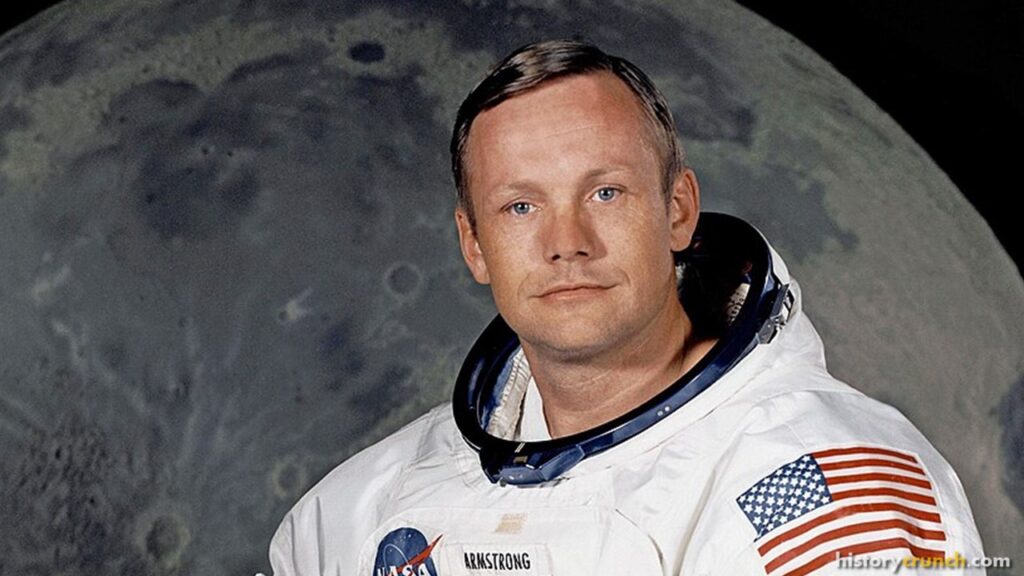
Neil Armstrong was an American astronaut, aerospace engineer, and the first person to walk on the Moon during NASA’s Apollo 11 mission in 1969.
NEIL ARMSTRONG – EARLY LIFE
Neil Armstrong was born in Wapakoneta, Ohio on August 5th, 1930. He was fascinated by flying from an early age, and when he was just 16 earned his student pilots licence. In 1947, Armstrong started at Purdue University where he started his studies in aeronautical engineering. However, just two years in to his studies he was called to serve in the Korean War where he served as a naval aviator. During his time in the war, he flew 78 combat missions and earned several military honors, including the Air Medal. In 1952, after the war ended, Armstrong left the military and went back to college to finish his studies.
After graduating from college, Armstrong joined the National Advisory Committee for Aeronautics (NACA) in Cleveland, Ohio. When he started working at NACA, he was also able to start to settle down and as a result got married to Janet Sharon and they had two children: Eric and Karen. Sadly, Janet died as a result of complications associated with a brain tumour in 1962. Armstrong continued to work for NACA and its successor agency National Aeronautics and Space Administration (NASA) for 17 years. During that time, he had a number of roles over that time including being an engineer and a test pilot. As a test pilot Armstrong worked on over 200 different high speed aircrafts including jets, rockets and gliders.
NEIL ARMSTRONG – ASTRONAUT
In 1962, Armstrong transferred roles again and became an astronaut. In 1966, he was command pilot for the Gemini 8 mission which was the first successful docking of spacecrafts in orbit. Despite technical issues that endangered the mission, Armstrong’s calm and quick thinking helped safely return the spacecraft to Earth.
Later, Armstrong was spacecraft commander for Apollo 11, the first manned lunar landing mission. The mission was launched from Kennedy Space Center in Florida. Aboard a Saturn V rocket the mission carried three astronauts: Neil Armstrong (mission commander), Buzz Aldrin (lunar module pilot), and Michael Collins (command module pilot). After traveling over 240,000 miles through space, the spacecraft entered lunar orbit. On July 20th, the Lunar Module ‘Eagle’, piloted by Armstrong and Aldrin, separated from the Command Module ‘Columbia’, where Collins remained in orbit. As they descended, Armstrong had to manually pilot the module to avoid boulders and craters, eventually landing in the Sea of Tranquility with the famous words, “Houston, Tranquility Base here. The Eagle has landed.”
As stated above, the spacecraft landed on the moon on July 20th, 1969 and Armstrong gained the distinction of being the first man to land a craft on the moon, and also the first person to walk on the moon’s surface. As he stepped off Eagle, the lunar landing module, he said: “That’s one small step for man, one giant leap for mankind”. The phrase was heard by over a billion people on earth who were eagerly listening to the lunar landing broadcast from NASA on the radio or were watching on the TV. Alongside Buzz Aldrin, he spent about two and a half hours exploring the Moon’s surface while Michael Collins orbited above in the command module.
After spending 21 hours on the Moon, Armstrong and Aldrin lifted off in the lunar module and reunited with Collins in the command module. The crew safely returned to Earth, splashing down in the Pacific Ocean on July 24th, 1969, where they were recovered by the USS Hornet and greeted as national heroes.
NEIL ARMSTRONG – LATER LIFE AND DEATH
After his successful mission to the moon, Armstrong continued to work at NASA, but now worked in the NASA headquarters where he was responsible for research and technology. In 1971 Armstrong went on to become Professor of Aerospace Engineering at the University of Cincinnati. He also joined a number of societies and commissions where he helped to make important decisions about space travel, astronautics and engineering. For instance, he also served on various corporate boards and was part of the Rogers Commission, which was responsible for investigating the Challenger disaster in 1986.
Neil Armstrong was known for his humility, rarely seeking the spotlight despite his global fame. He received numerous awards, including the Presidential Medal of Freedom, Congressional Space Medal of Honor, and Congressional Gold Medal.
Armstrong passed away on August 25th, 2012, due to complications from heart surgery. He remains a symbol of exploration and is remembered worldwide as the first man to walk on the Moon.