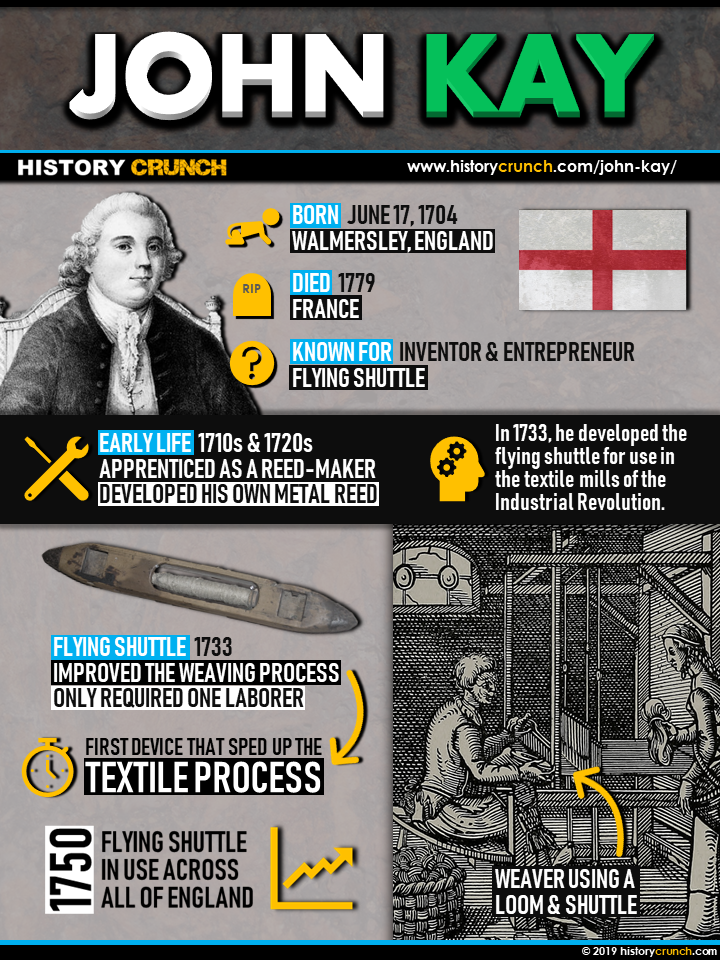
John Kay was one of the pioneering inventors of the Industrial Revolution. Born in England in 1704, Kay is best remembered for inventing the flying shuttle in 1733, the first device in the modern era to significantly improve the productivity and efficiency of the textile weaving process. His invention helped spark a wave of further innovation in textile manufacturing and played an important role in launching the broader Industrial Revolution. This infographic was designed for students to visually summarize the key aspects of John Kay’s life and significance and is based on the History Crunch article titled John Kay.
John Kay – Infographic
About This Infographic
This John Kay infographic was created by the History Crunch team to help students and teachers quickly understand the life and significance of one of the earliest and most important inventors of the Industrial Revolution. It is designed as a visual learning and study tool, summarizing the essential information covered in our full article on John Kay. Teachers may use it as a classroom display, a discussion prompt, or a study aid for students preparing for assessments.
What This Infographic Covers
John Kay was born on June 17th, 1704 in Walmersley, England. His father owned an estate but died before Kay was born, leaving the property to Kay as the oldest son. He showed an aptitude for practical invention from a young age. At the age of fourteen he became an apprentice hand-loom reed-maker but left after only one month, claiming he had already mastered the craft. He went on to develop an improved metal reed that he sold across the country, establishing himself as a skilled craftsman and inventor before his most famous work.
The centerpiece of the infographic is Kay’s invention of the flying shuttle in 1733, which is considered the first major mechanized improvement to the weaving process in the modern era. Before the flying shuttle, weaving on a traditional hand-loom required two workers to pass the shuttle back and forth across the loom by hand. Kay’s flying shuttle could be operated by a single worker and moved much faster, dramatically speeding up the weaving process and reducing labor costs. It was the first device to significantly improve the productivity and efficiency of textile production and laid the groundwork for the many further inventions that would follow.
The infographic also covers the mixed reception that greeted Kay’s invention. While factory and mill owners recognized the benefits of the flying shuttle, many laborers opposed it because it threatened their livelihoods by reducing the number of workers needed. This resistance was connected to the broader Luddite Movement that emerged during the Industrial Revolution, in which workers opposed new technologies they feared would cost them their jobs. Kay made very little money from his invention, struggling with copyright infringement of his original design by manufacturers who copied it without paying him.
Frustrated by his treatment in England, Kay left for France in 1747, where the government was known to support textile innovations. He sold his patent for the flying shuttle to French manufacturers and received an ongoing pension in return. His invention contributed to the mechanization of French textile production and helped clothe a large population. Kay died in 1779 and is remembered today as one of the unsung pioneers of the Industrial Revolution whose work helped make the mechanization of the textile industry possible.
How to Use This Infographic in the Classroom
This infographic works well as a visual introduction to John Kay before students read the full biography article or the article on the flying shuttle. It can also be used as a review tool before an assessment, or as a discussion prompt asking students to consider why inventors like Kay often failed to benefit financially from inventions that transformed entire industries. Teachers may also use it alongside related articles on the flying shuttle, textile manufacturing and the Luddite Movement to help students understand the social tensions that accompanied the introduction of new technology during the Industrial Revolution.
Related Articles
To learn more about the topics covered in this infographic, visit the following History Crunch articles:
- John Kay
- Flying Shuttle Invention in the Industrial Revolution
- Industrial Revolution Overview
- Inventions and Inventors of the Industrial Revolution
- Textile Manufacturing in the Industrial Revolution
- James Hargreaves
- Spinning Jenny Invention in the Industrial Revolution
- Luddites
- Factory System in the Industrial Revolution