
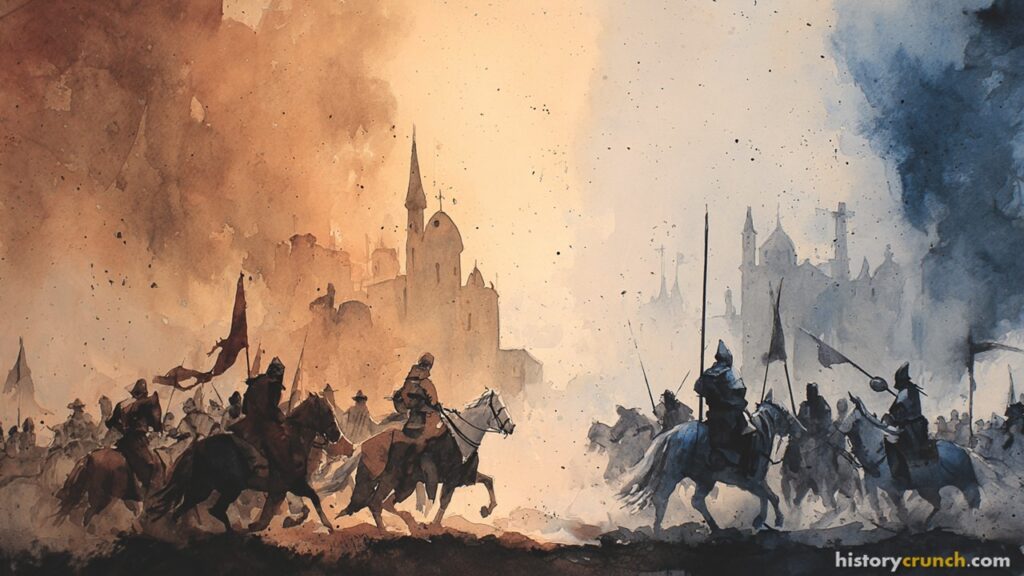
The Middle Ages is the thousand years between the fall of the western Roman Empire and the Renaissance, and it is the period most people know least accurately. It contains the Vikings, the Normans, the crusades, Magna Carta, the Mongols, the Black Death and the Hundred Years War, and it also contains the invention of the university, the parliament, the bank and the printing press. This timeline runs from the sack of Rome in 410 to the ships that reached America and India, and one of its eight chapters has no dates in it at all, because it is about how people actually lived.
From the sack of Rome in 410 to the end of the medieval world in 1500.
The Middle Ages is the thousand years between the fall of the western Roman Empire and the Renaissance, and it is the period most people know least accurately. It contains the Vikings, the Normans, the crusades, Magna Carta, the Mongols, the Black Death and the Hundred Years War, and it also contains the invention of the university, the parliament, the bank and the printing press. This timeline runs from the sack of Rome in 410 to the ships that reached America and India, and one of its eight chapters has no dates in it at all, because it is about how people actually lived.
There was an emperor in the west in 475 and none in 477. There was also an empire calling itself Roman until 1453.
One date, two answers, and a question about what an empire is.
Roads, taxes, law courts and a standing army all stop working. What do people use instead?
Kings, bishops and the deal that binds them.
Almost everything in this period was written by churchmen, about people who could not read.
Chronicles, charters, court rolls and what none of them mention.
Every textbook has the pyramid diagram. Historians point out that nobody in the Middle Ages ever drew it.
Land, service, and a word invented centuries later.
Nine people in ten on this timeline farmed. Almost none of them appear by name in any source.
The year, the field, the church and the manor court.
In much of Europe a serf who lived in a town for a year and a day was free.
Charters, guilds, markets and money.
The law treated her as a dependant. The economy could not function without her work.
Field, household, convent and, very occasionally, a throne.
A guild of students hiring their own teachers, and fining them for turning up late.
Bologna, Paris, Oxford and a system still running.
Nobody who laid the first stone of a cathedral expected to see the roof go on.
Stone, glass, money and an idea about light.
Not a battle, not a coronation. A day.
Waking, working, eating, and what happened when you got ill.
He is called Great and he executed 4,500 prisoners in a day. Both are on the record.
Forty-three years of campaigning, one coronation, and a school.
Three claimants, two invasions three weeks apart, and one afternoon that decided it.
A childless king, a forced march, and a shield wall that held until it did not.
An emperor in the snow at Canossa, an archbishop dead on his own altar. It was not settled.
Two quarrels, a hundred years apart, with opposite endings.
Sixty-three clauses, most of them about feudal dues and fish weirs, and three that changed the world.
What it says, what it did, and what was made of it later.
It had no army worth the name and it could make an emperor stand in the snow.
Land, literacy, salvation and the power to exclude.
Faith, land, debt, adventure and the promise that the journey itself would wipe away sin.
One speech, and the many reasons people answered it.
Four crusader states, none of which lasted, and a great deal that did.
Territory lost, trade gained, and a grievance that outlived both.
The monks who wrote the sources were the people being robbed, which is worth remembering.
Raid, winter, settle, rule.
In 1206 they were feuding tribes. Within fifty years they ruled from Korea to Hungary.
An army built on tens, and a road it made safe.
Because they were not fighting continuously, and because neither could finish it.
A dynastic claim, a series of raids, and a war that outlived ten kings.
At Crécy about a hundred Englishmen died and fifteen hundred French knights did not go home.
A weapon a commoner could learn, against a class built on horses.
Four hundred years of building the strongest thing anybody knew how to build, ended by gunpowder.
Earth and timber, then stone, then a cannon.
Not a tragedy that passes. A change in the price of everything.
Arrival, death toll, and the bargaining power of the survivors.
A tax, a labor shortage and a promise that was withdrawn within a fortnight.
Poll taxes, wage laws, and a fourteen year old king on a horse.
The same disease, eight hundred years apart, in two very different worlds.
541 and 1347, and what each one broke.
Pick your ending: a press, a cannon, a ship or a plague. Each has a case.
Four candidates, and the argument between them.
Somebody in this period invented the university, the mechanical clock, the bank and the parliament.
Where the phrase comes from, and what it hides.
She had no rank, no training and no business being there, and it worked.
A court with nothing to lose, a siege, and a trial about clothing.
It ended the Roman Empire, 1,480 years after it began, and almost nobody in the west helped.
A wall, a cannon, and what left the city before it fell.
Four of the other timelines start inside this one's last chapter.
Printing, exploration, reformation and the state.
In 410 the Visigoths sacked Rome, and people across the empire wrote as though the world had ended. The city was not even the capital by then. Sixty-six years later a Germanic commander removed the last western emperor and simply did not replace him, which is the date historians picked for the start of the Middle Ages and which nobody alive at the time noticed. The empire in the east carried on calling itself Roman, tried to take the west back under Justinian, and was stopped by a plague that returned in waves for two hundred years.
A Visigothic army under King Alaric entered Rome and plundered it for three days. It was the first time in 800 years that the city had been taken by an outside force.
LEARN MORESHOW LESSwhy it matters · key numbersWARRome was no longer even the capital, so the damage was mostly to the idea of Rome. People across the empire wrote as though the world had ended, which tells you what the city still meant.
A Germanic commander named Odoacer removed Romulus Augustulus, the last emperor in the west, and did not replace him. He sent the imperial regalia to Constantinople and ruled Italy as a king.
LEARN MORESHOW LESSwhy it matters · a debatePOLITICSHistorians pick 476 as the start of the Middle Ages. Nobody alive in 476 thought anything had begun; the empire in the east carried on for another thousand years and still called itself Roman.
Did the Roman Empire fall in 476?
In the west, yes. There was an emperor in Ravenna in 475 and there was not one in 477, and the western provinces never had one again.
The empire did not fall, it moved. Constantinople ruled as Rome until 1453, called its people Romans, and reconquered Italy briefly in the 530s. 476 is a line historians drew later.
Clovis I ruled the Franks from 481 CE, united them under one kingdom, and converted to Catholic Christianity rather than the Arian form most Germanic kings followed.
LEARN MORESHOW LESSwhy it mattersPOLITICSThat choice of church tied the Frankish kings to the popes in Rome, and three centuries later it is why a pope had a Frankish king to crown instead of anybody else.
Justinian I ruled from Constantinople from 527 to 565 CE. He codified Roman law, rebuilt the capital, and sent armies to retake Italy, North Africa and southern Spain from the Germanic kingdoms.
LEARN MORESHOW LESSwhy it mattersPOLITICSFor about twenty years it worked. The reconquest is the last serious attempt to make the Mediterranean Roman again, and what stopped it was not an army.
Justinian's great church in Constantinople was completed in 537 CE, with a dome nobody had built at that scale before. It was the largest cathedral in the world for nearly a thousand years.
LEARN MORESHOW LESSwhy it mattersCULTUREIt was a cathedral for 916 years, a mosque for 481, and it is still standing. Very little else on this timeline can say that.
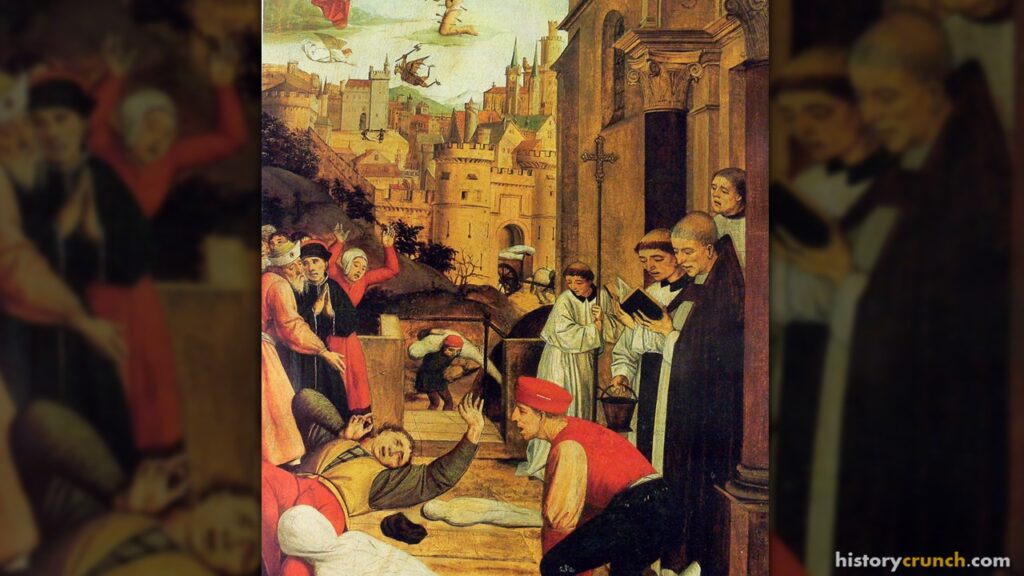
Plague broke out in the Egyptian port of Pelusium in 541 CE and reached Constantinople in 542. Contemporaries described the dead piling up faster than the city could bury them.
LEARN MORESHOW LESSwhy it mattersDISEASEThe reconquest stopped because there were no longer the men or the taxes to pay for it. The first great plague ended the last Roman recovery, eight hundred years before the second one changed Europe again.
Famines followed the plague in 542 and again in 545 and 546 CE, striking populations that had already lost a large share of the people who farmed the land.
LEARN MORESHOW LESSwhy it mattersDISEASEThis is the pattern the Middle Ages repeats: the disease kills, and then the missing harvest kills again. It happens in exactly the same order in 1348.
The plague returned in waves for more than two centuries, striking the Byzantine Empire and its neighbors again and again, until it faded around 750 CE.
LEARN MORESHOW LESSwhy it mattersDISEASETwo hundred years of recurring plague is the real reason the eastern empire never recovered the west. The map of medieval Europe was set by a bacterium.
One Frankish king spent forty-three years at war and ended up ruling most of western Europe. He forced Christianity on the Saxons at sword point, gathered scholars to rebuild education because he needed an administration, and on Christmas Day 800 a pope crowned him Emperor of the Romans, reviving a title that had been dead for 324 years. His empire was split three ways within thirty years of his death, and while his grandsons were arguing about the borders, raiders from Scandinavia arrived.
When Pepin the Short died in 768 CE, his kingdom was divided between his sons Charlemagne and Carloman, as Frankish custom required.
LEARN MORESHOW LESSwhy it matters · 1 key figurePOLITICSFrankish kings divided their kingdoms between sons, which is why no Frankish empire ever lasted. Charlemagne's own empire is split three ways within thirty years of his death for exactly this reason.
Carloman died unexpectedly in 771 CE, leaving Charlemagne sole ruler of the Frankish kingdom at about twenty-three.
LEARN MORESHOW LESSwhy it matters · 1 key figurePOLITICSHe spent the next forty-three years at war, and by the end he ruled most of western Europe. Almost none of it was planned; it was a series of campaigns that kept working.
In 774 CE Charlemagne invaded northern Italy, defeated the Lombard king Desiderius and took the crown himself, adding the Italian peninsula to his territory.
LEARN MORESHOW LESSwhy it matters · 1 key figureWARIt put a Frankish king on the pope's doorstep as a protector rather than a threat, which is the arrangement that produces a coronation twenty-six years later.
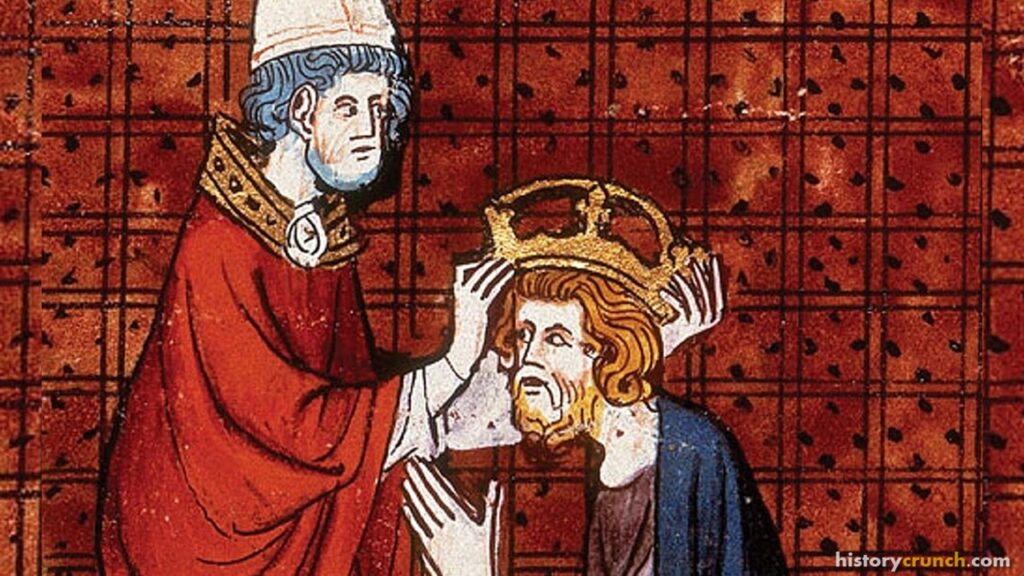
After a Saxon rebellion, Charlemagne ordered the execution of approximately 4,500 Saxon prisoners in a single day at Verden.
LEARN MORESHOW LESSwhy it matters · key numbers · 1 key figureWARThe conversion of the Saxons took thirty years and was carried out at sword point. The emperor the Church called Great did this, and both facts belong on the same card.
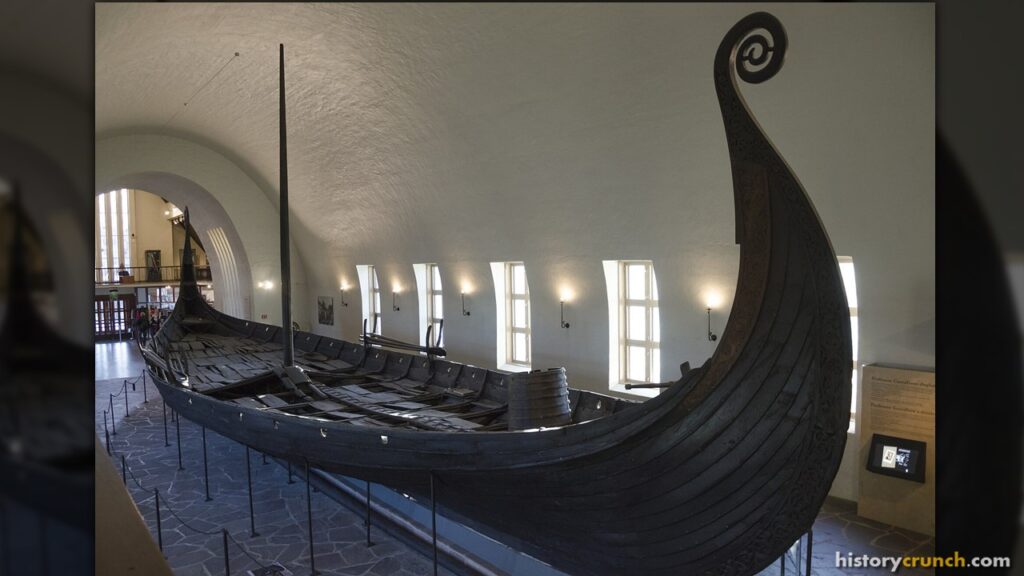
Raiders from Scandinavia attacked the monastery of Lindisfarne off the Northumbrian coast in 793 CE, killing monks and carrying off its treasures. Jarrow was raided the following year.
LEARN MORESHOW LESSwhy it mattersWARMonasteries held gold and had no walls. The Vikings were not doing anything new by raiding, but they were the first to work out that the richest buildings in Europe were undefended.
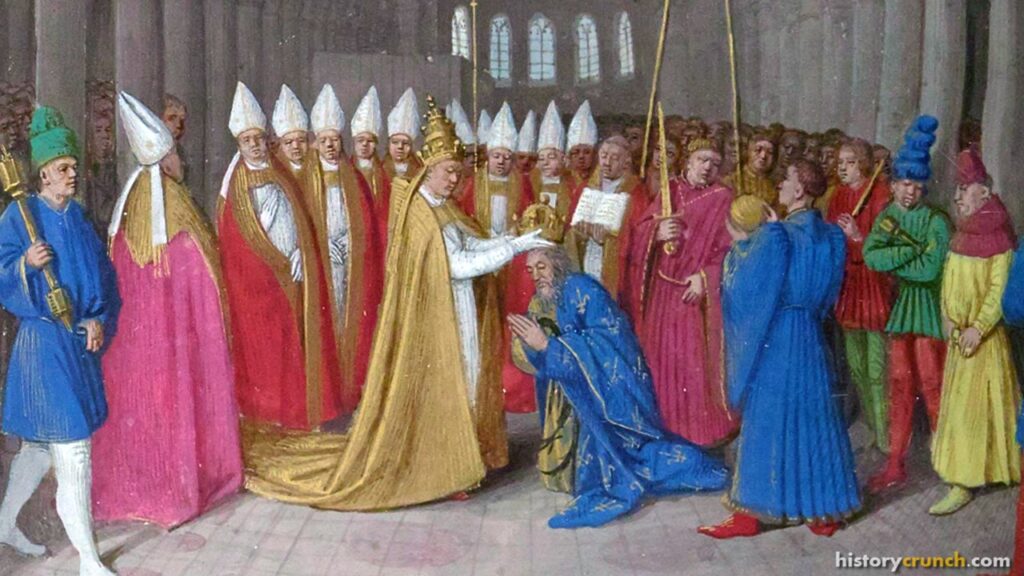
On Christmas Day 800 CE, Pope Leo III crowned Charlemagne Emperor of the Romans in St Peter's in Rome, reviving a title that had not existed in the west for 324 years.
LEARN MORESHOW LESSwhy it matters · key numbers · 1 key figurePOLITICSA pope had just made an emperor. Every argument between popes and emperors for the next seven hundred years starts from the question of what exactly happened in that church, and who was doing the giving.
Charlemagne died in 814 CE. His son Louis the Pious inherited the whole empire and spent his reign struggling to hold it together against his own sons.
LEARN MORESHOW LESSwhy it mattersPOLITICSThe empire held as long as one man could ride around it. It did not survive the second generation, which is the standing problem of every medieval state: the institution was the person.
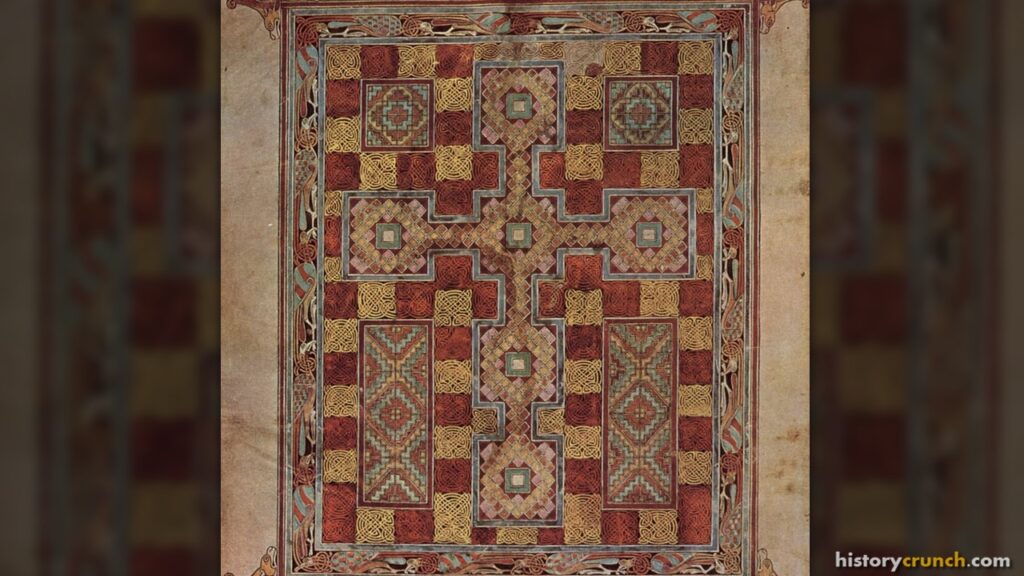
When Louis the Pious died in 840 CE his three sons fought, then divided the empire between them at Verdun in 843 CE: a western kingdom, an eastern kingdom and a strip between them.
LEARN MORESHOW LESSwhy it mattersPOLITICSThat western kingdom becomes France and the eastern one becomes Germany. The strip in the middle is fought over for the next eleven hundred years, which includes both world wars.
A large Viking force landed in East Anglia in 865 CE. Unlike the raiding parties of earlier decades, it came to conquer, and it stayed through the winter.
LEARN MORESHOW LESSwhy it mattersWARThe moment raiders start wintering is the moment raiding becomes settlement. Within fifteen years half of England is under Danish law.
The Viking army captured York in 866 CE, the largest city in northern England, and made it the capital of a kingdom they called Jorvik, which lasted nearly a century.
LEARN MORESHOW LESSwhy it mattersWARYork was a Viking city for nearly a century. The street names ending in -gate are still there, which is the most ordinary evidence of the whole conquest.
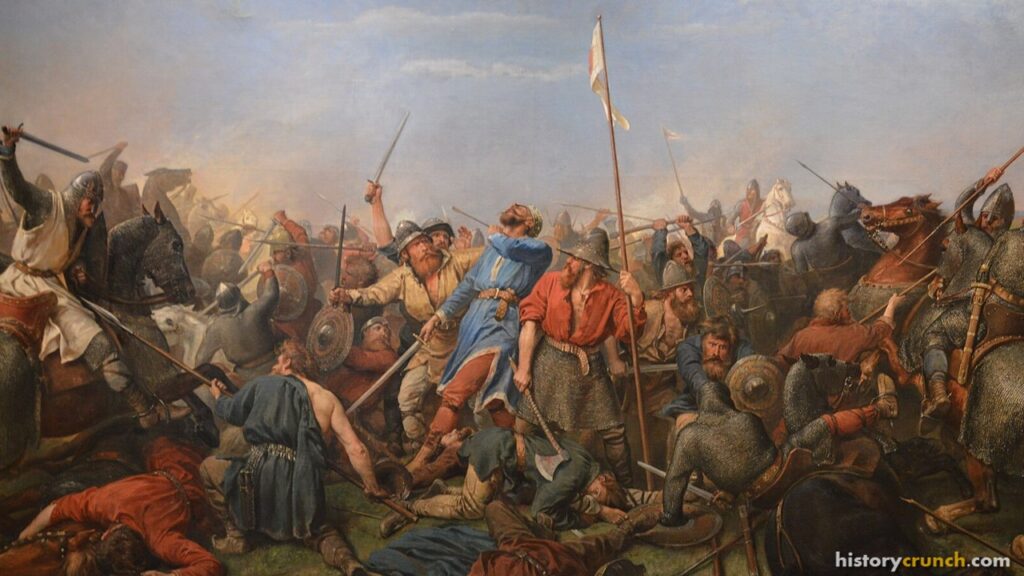
Driven into the Somerset marshes by a surprise attack, Alfred of Wessex rallied his forces and beat Guthrum's army at Edington in May 878 CE. The Treaty of Wedmore then split England between them.
LEARN MORESHOW LESSwhy it mattersWARAlfred is the only English king called the Great, and this is why: he was six months from losing the country entirely. The Danelaw line he agreed still shows up in English place names.
The Vikings raided monasteries because they were rich and had no walls, then wintered, then settled, then ruled. One of their leaders was given Normandy in 911 on condition that he stop. A century and a half later his descendant crossed the Channel, and 1066 became the most famous date in English history: two invasions three weeks apart, a forced march of 190 miles, and one afternoon near Hastings that ended five hundred years of Anglo-Saxon rule and replaced almost the entire landholding class of England.
Charles the Simple of France granted land around the mouth of the Seine to the Viking leader Rollo in 911 CE, in exchange for his promise to stop raiding and to defend the coast against other raiders.
LEARN MORESHOW LESSwhy it mattersPOLITICSNormandy means the land of the Northmen. In 1066 the Duke of Normandy conquers England, so the English crown descends from a Viking who was paid to stop being one.
Erik the Red, exiled from Iceland, sailed west and founded a Norse settlement in Greenland around 985 CE. It lasted roughly 500 years before dying out.
LEARN MORESHOW LESSwhy it mattersEXPLORATIONThe name was a sales pitch. He called it Greenland because he wanted people to come, which makes him the first recorded property developer in the North Atlantic.
Leif Erikson is believed to have reached North America around 1000 CE, nearly 500 years before Columbus. Norse remains at L'Anse aux Meadows in Newfoundland confirm a settlement there.
LEARN MORESHOW LESSwhy it matters · key numbersEXPLORATIONEuropeans found America, stayed a few years and left, and it changed nothing at all. Contact only matters when something on either side can sustain it, which is the whole difference between 1000 and 1492.
Sweyn Forkbeard invaded England in 1013 CE and forced King Ethelred to flee to Normandy. Sweyn's son Cnut ruled England, Denmark and Norway together.
LEARN MORESHOW LESSwhy it mattersWAREngland spent a generation as part of a North Sea empire ruled from Denmark. Ethelred's exile in Normandy is also how the Norman claim to the English throne begins.
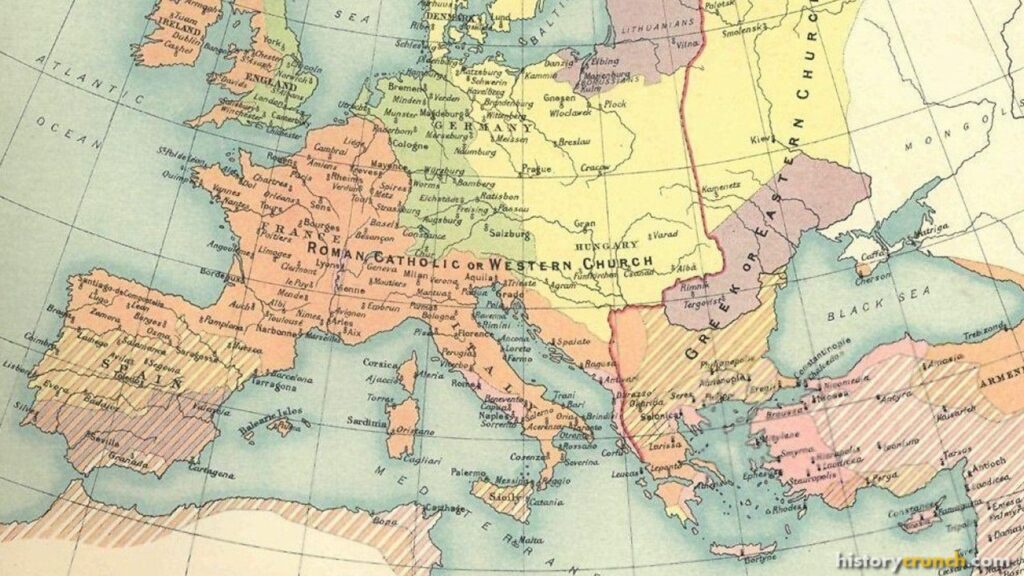
Centuries of argument over authority, language and doctrine ended in 1054 CE with the pope's legate and the patriarch of Constantinople excommunicating each other. The Roman Catholic and Eastern Orthodox churches have been separate ever since.
LEARN MORESHOW LESSwhy it mattersRELIGIONIt is the longest-running split in European history, and it is not over. It also means that when Constantinople is besieged in 1453, the Christian west is not in much of a hurry.
Edward died on 5 January 1066 after twenty-four years as king, leaving no son. Harold Godwinson was elected by the Witenagemot and crowned the next day. William of Normandy and Harald Hardrada of Norway both claimed the throne too.
LEARN MORESHOW LESSwhy it matters · key numbersPOLITICSThree claimants, one crown, and no rule for deciding between them. The whole of 1066 follows from a king dying childless in January.
Harald Hardrada of Norway invaded northern England with Harold's exiled brother Tostig. Harold marched north at speed and destroyed them at Stamford Bridge on 25 September 1066.
LEARN MORESHOW LESSwhy it mattersWARIt is usually called the end of the Viking Age, and it was also a catastrophe for the winner: Harold's army had just marched 190 miles and fought a battle when the news came that William had landed in the south.
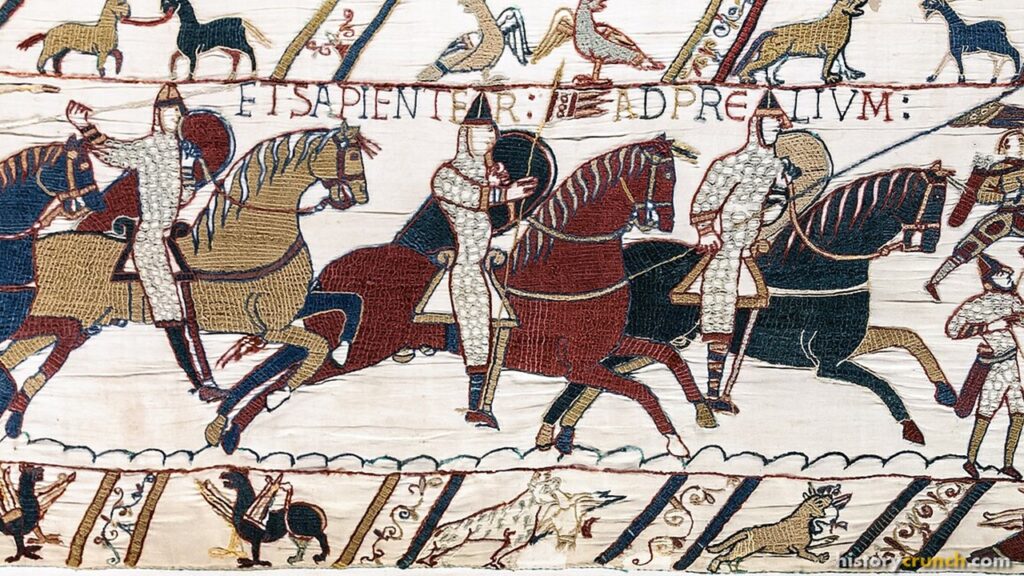
William landed at Pevensey on 28 September. On 14 October the two armies met near Hastings and fought all day. Harold was killed, the English shield wall broke, and about 500 years of Anglo-Saxon rule ended in an afternoon.
LEARN MORESHOW LESSwhy it matters · key numbersWARTwo invasions in three weeks, at opposite ends of the country. If Hardrada had not sailed, or had sailed later, England is a different country and so is the English language.
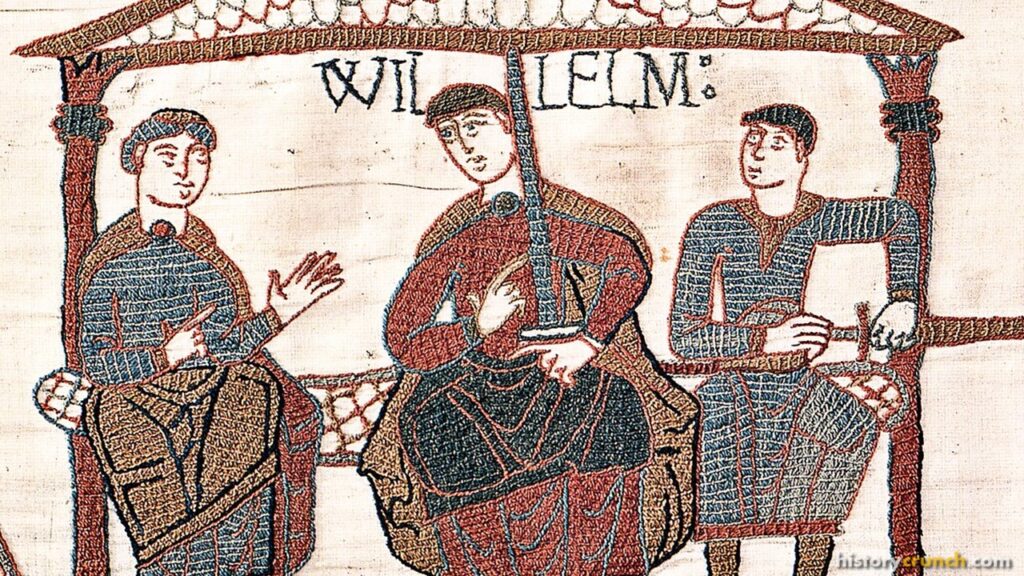
William took London's submission and was crowned in Westminster Abbey on Christmas Day 1066. He replaced the English landholding class almost entirely, and twenty years later recorded what he owned in the Domesday Book.
LEARN MORESHOW LESSwhy it matters · 1 key figurePOLITICSThe conquest was not one battle but twenty years of castles, confiscation and suppression. By 1086 almost no English noble held significant land, which is the most complete change of ruling class in European history.
This chapter has no dates in it. A quarter of the articles behind this timeline are about how people lived rather than what happened to them, and scattering them through the wars would ruin both. So here is the feudal world at its most settled: land held for service rather than money, a manor that most people never left, three orders that were presented as God's arrangement, and the towns, guilds and trade that were quietly making all of it obsolete.
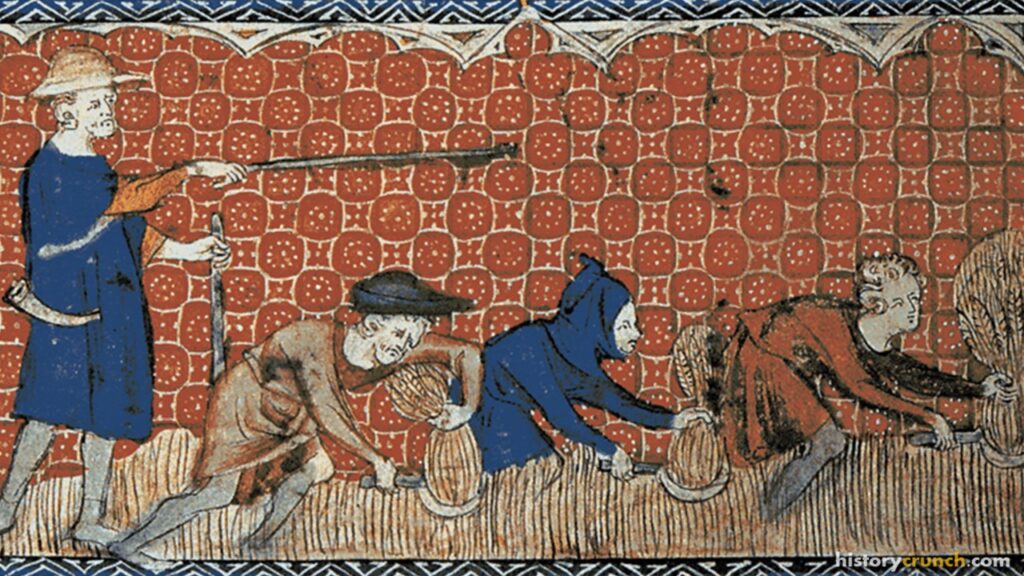
Land was held in exchange for obligations rather than bought and sold. A lord granted an estate, called a fief, to a vassal who knelt and did homage for it, owing military service and loyalty in return, and who granted land in turn to men below him.
LEARN MORESHOW LESSwhy it mattersSOCIETYThere was no standing army and no tax office worth the name, so a king paid in the only thing he had, which was land. Every relationship on this card exists because coins were scarce and soldiers were not.
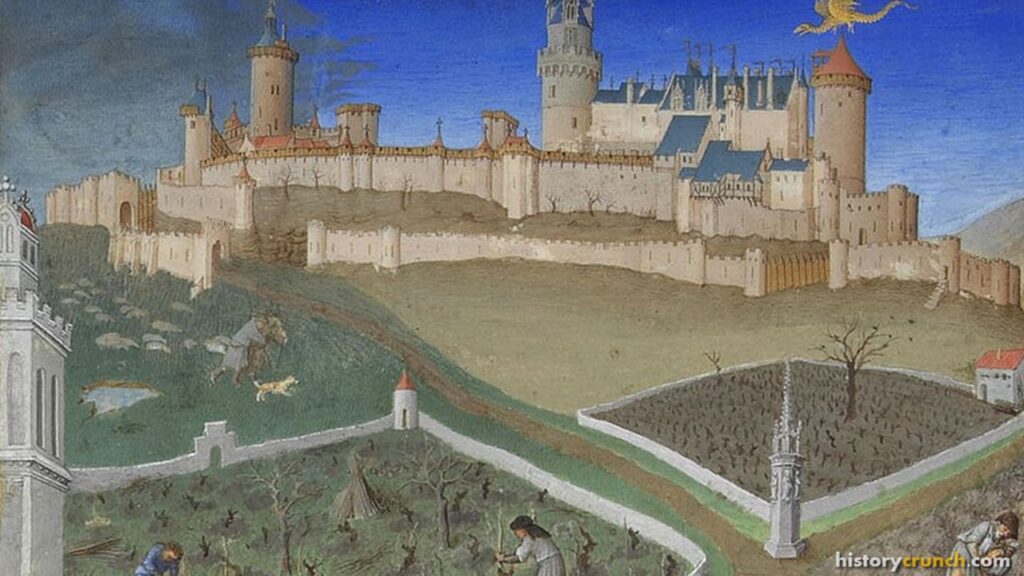
The manor was the working unit of the countryside: the lord's hall, the fields, the mill, the church and the village. Most people were born, worked and died inside one.
LEARN MORESHOW LESSwhy it mattersSOCIETYA medieval peasant might never travel more than a few miles from where they were born. When you read about kings and crusades, remember that almost nobody involved in this timeline left their manor.
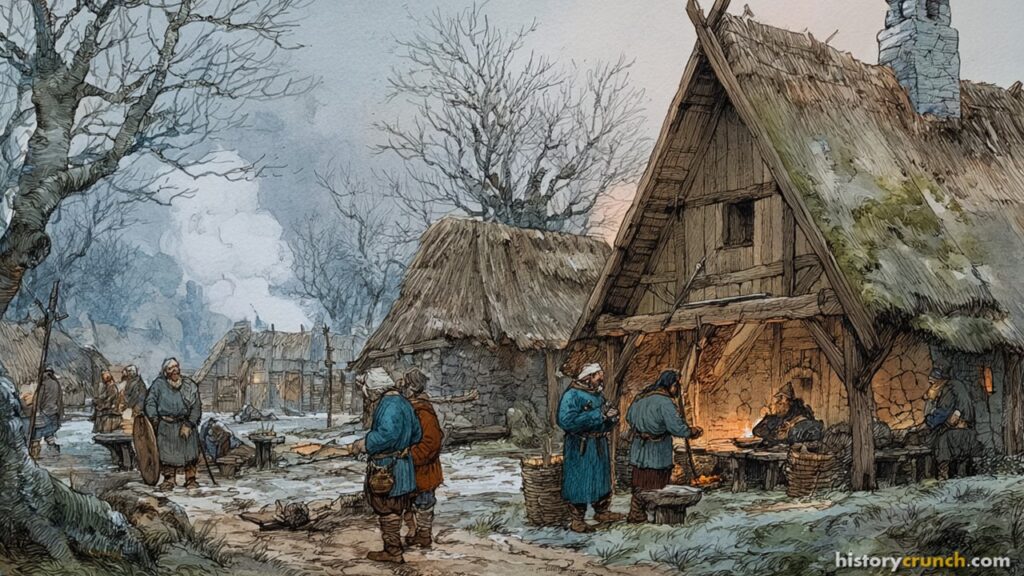
A serf was bound to the land. They could not leave, marry or sell their surplus without the lord's permission, and they owed labor on his fields. They could not be bought and sold as individuals, and they could not walk away. In England an unfree peasant was called a villein.
LEARN MORESHOW LESSwhy it mattersSOCIETYThe distinction between a serf and a slave mattered in law and made very little difference in a field. It is the single best example of how medieval society defined people by their obligations rather than their rights.
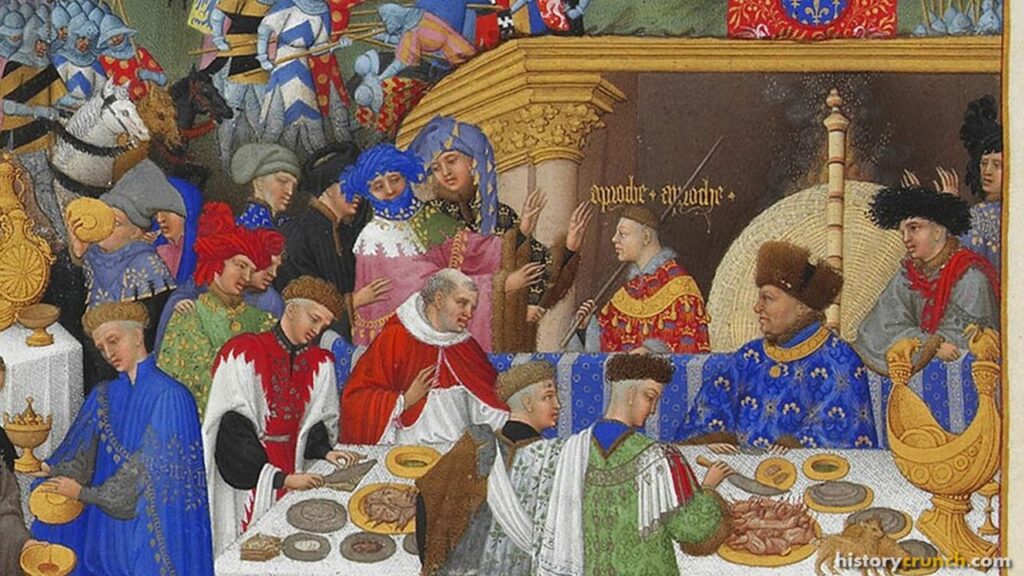
Medieval writers described society as three orders: those who pray, those who fight and those who work. In practice the third order was about nine people in ten.
LEARN MORESHOW LESSwhy it mattersSOCIETYIt was presented as God's arrangement, which made it very hard to argue with. The Black Death is what finally makes people argue with it, because it made labor scarce.
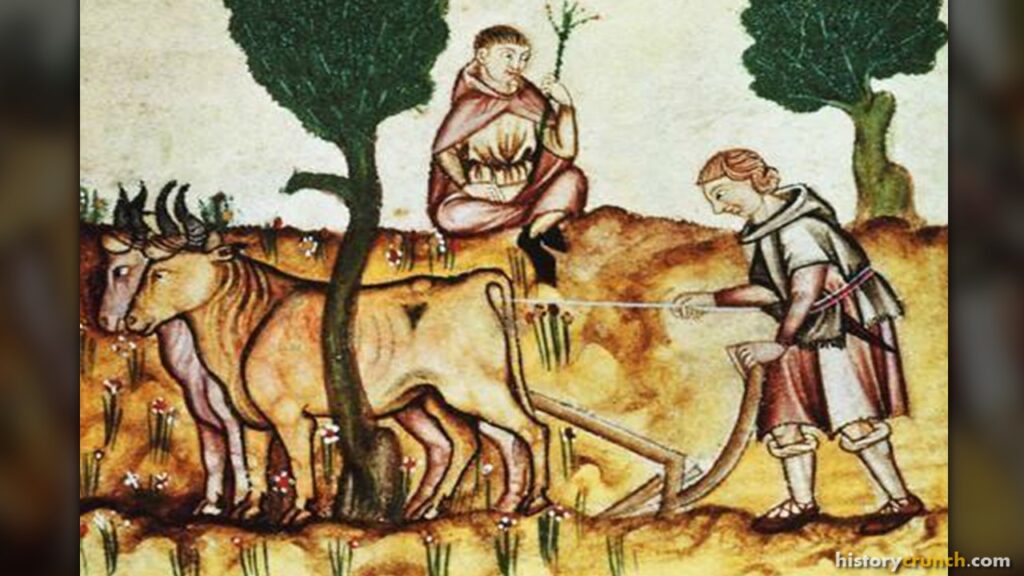
Work ran with the seasons: ploughing, sowing, harvest, threshing, days owed on the lord's land, and a tithe, a tenth of everything grown, owed to the Church. Rights to the common land for grazing and firewood mattered as much as wages.
LEARN MORESHOW LESSwhy it mattersDAILY LIFENine people in ten on this timeline lived this life. Every king, crusade and cathedral on the other cards was paid for out of these fields.
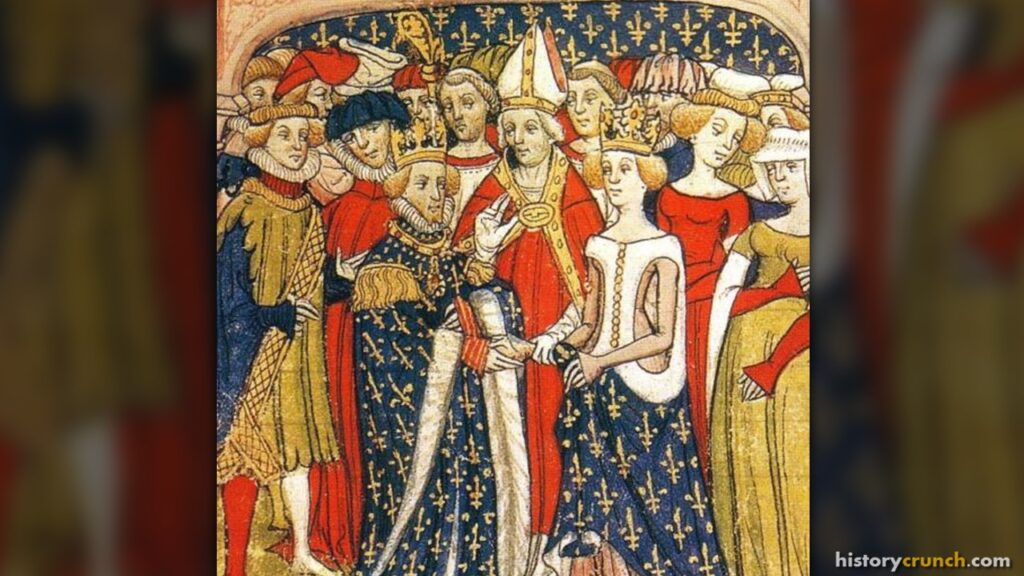
Nobles held land in exchange for military service, managed estates, administered local justice and spent heavily on display: feasts, hunting, marriages and buildings.
LEARN MORESHOW LESSwhy it mattersDAILY LIFEThe gap between the top and bottom of this system was enormous and entirely visible. You could tell a person's place in it from across a field, by their clothes.
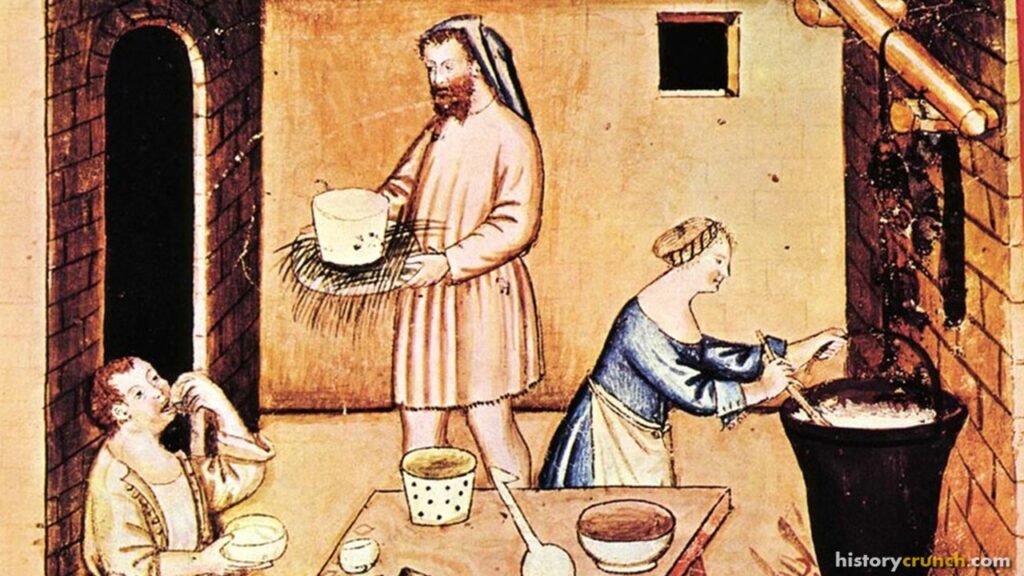
A woman's life depended almost entirely on her class. Peasant women worked the fields alongside men and ran the household economy; noblewomen managed estates while husbands were away at war; convents offered the only route to education and authority outside marriage.
LEARN MORESHOW LESSwhy it mattersSOCIETYThe law treated women as dependants and the economy could not function without their work. Eleanor of Aquitaine is on this timeline because she was extraordinary, not because she was typical.
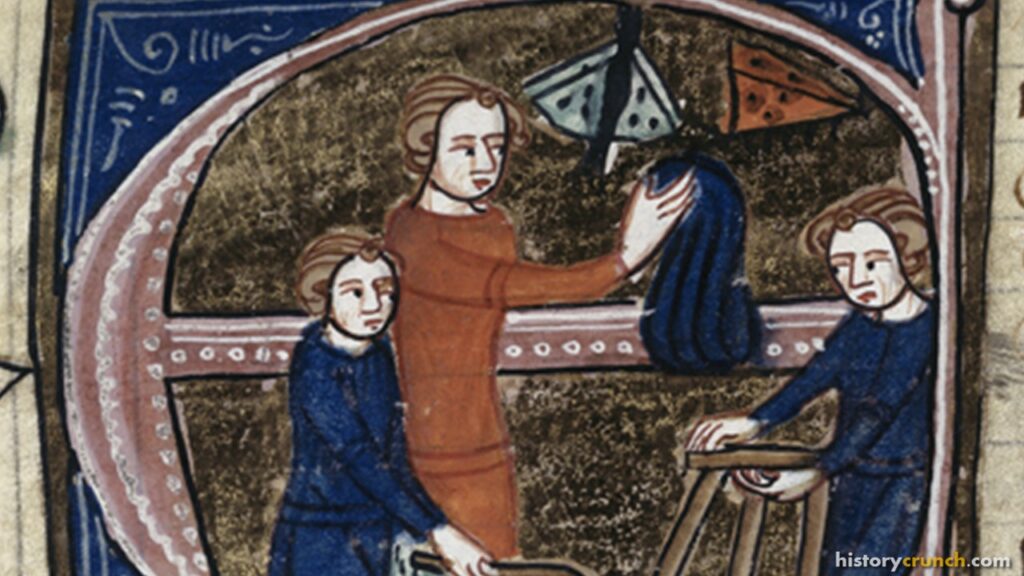
Childhood was short. Children worked from about seven, noble sons were sent away to other households to train, and a large share of children died before adulthood.
LEARN MORESHOW LESSwhy it mattersDAILY LIFEParents in a world with that much child death still grieved exactly as parents do now, whatever the old histories claim. The wills and letters are unambiguous about it.
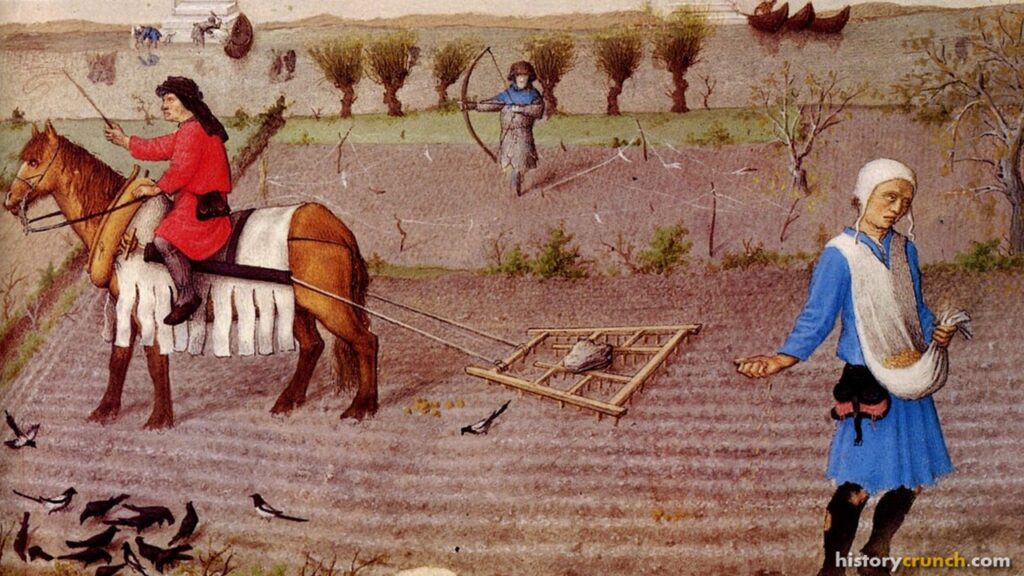
Bread, pottage and ale made up most of the diet. The three-field system, the heavy plough and the horse collar slowly raised how much land could feed, which is what let the population double between 1000 and 1300.
LEARN MORESHOW LESSwhy it mattersDAILY LIFEAlmost every big change in this timeline sits on top of a change in farming. More food means more people, more towns and more soldiers, until 1315 when the weather turns.
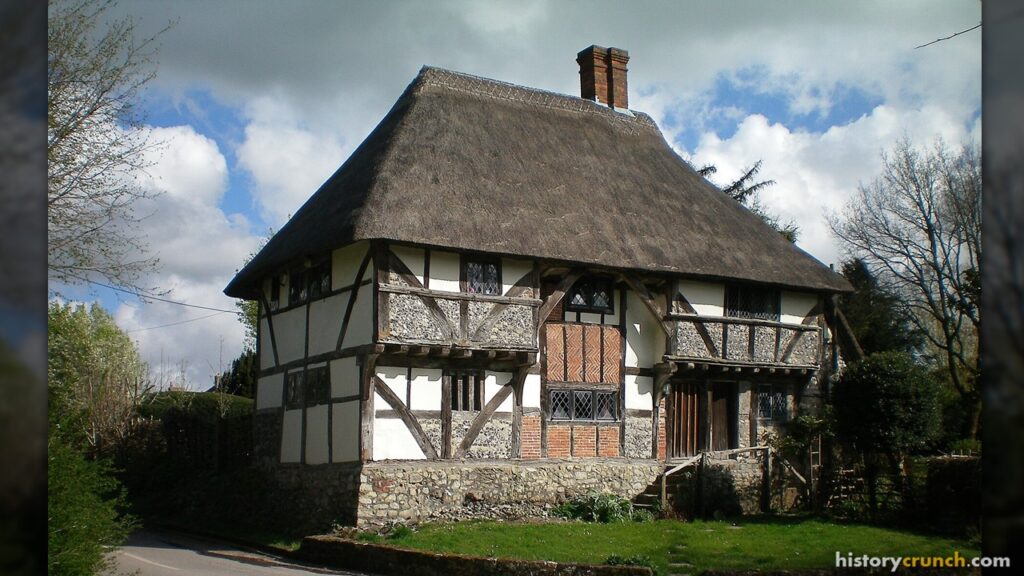
Most people lived in one or two rooms of timber, wattle and thatch, shared with the smoke of an open hearth and often with animals. Stone was for churches, castles and the very rich.
LEARN MORESHOW LESSwhy it mattersDAILY LIFEAlmost nothing ordinary people built survives, which is why medieval life looks grander in pictures than it was. What is left standing is the exception.
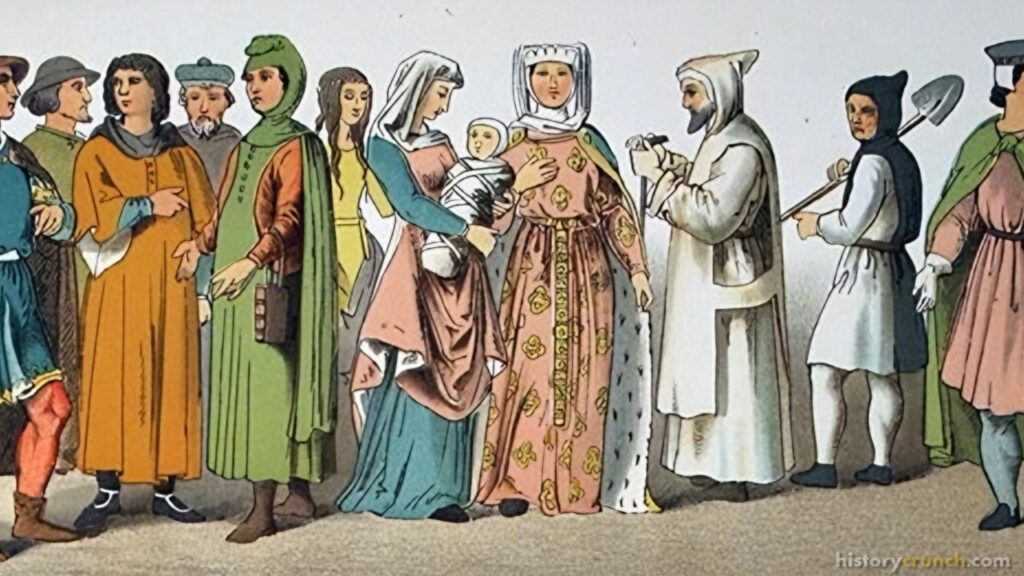
Cloth was expensive and clothes were worn until they fell apart. Colour and cut signalled rank so clearly that some governments passed laws about who could wear what.
LEARN MORESHOW LESSwhy it mattersDAILY LIFEA law telling a merchant he may not wear the same cloth as a knight is a society worried that money is starting to matter more than birth. It was right to worry.
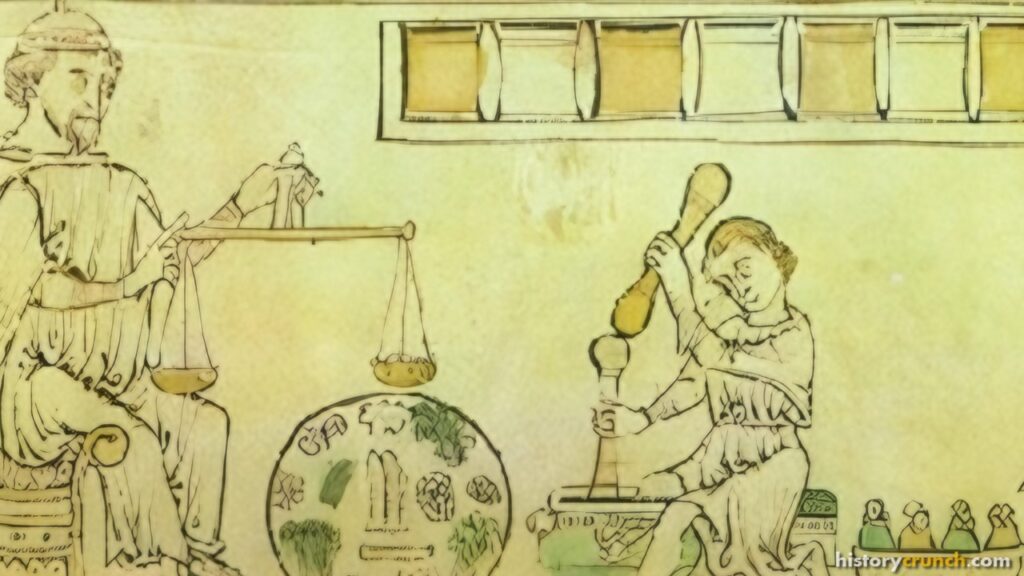
Medieval medicine mixed herbal remedies with inherited Greek theory about the four humours and with prayer. Monasteries grew the herbs and kept the books.
LEARN MORESHOW LESSwhy it mattersDAILY LIFEMuch of it did nothing and some of it worked, and nobody could tell which was which. That is why the Black Death is met with processions and bloodletting rather than quarantine, at least at first.
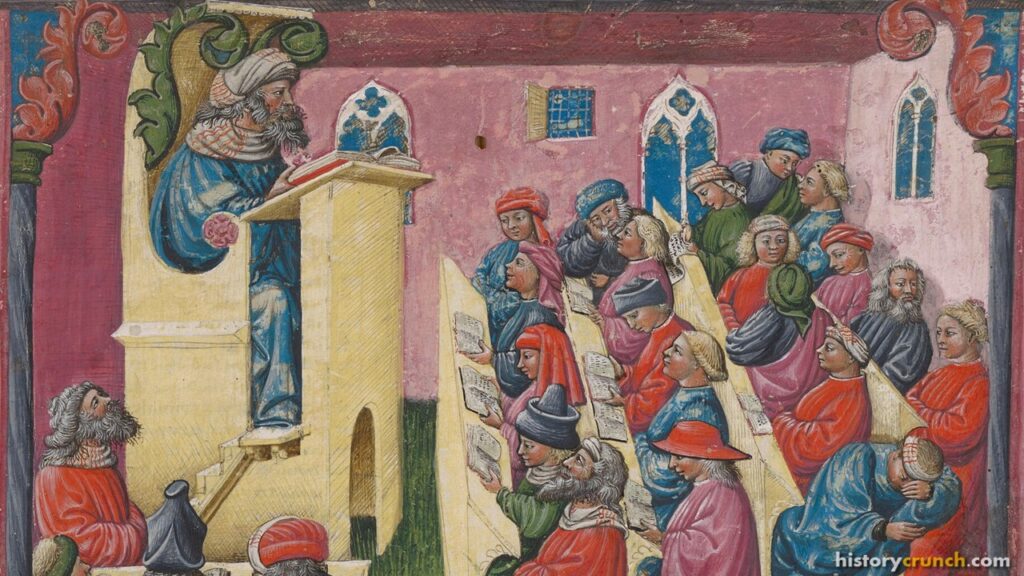
Schooling was the Church's business, conducted in Latin, and available to very few. From the late eleventh century universities appeared at Bologna, Paris and Oxford, run as guilds of masters and students.
LEARN MORESHOW LESSwhy it mattersIDEASA university is a medieval invention and it still runs on medieval furniture: degrees, faculties, gowns and the word dean. Very little else on this timeline survived so completely intact.
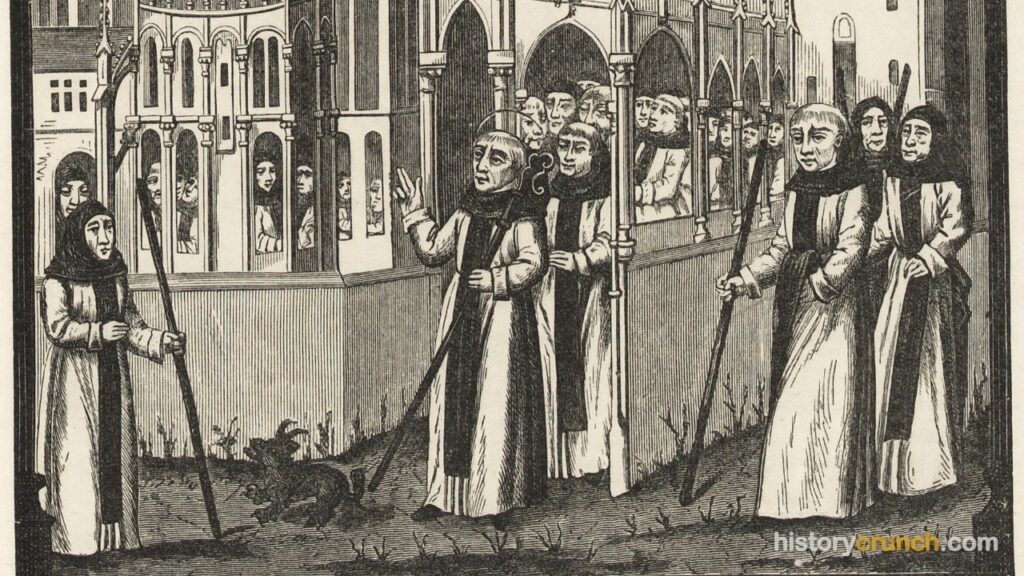
Monasteries were religious houses, farms, schools, hospitals and libraries at once. Monks followed a daily round of prayer and work, and copied manuscripts by hand in the scriptorium.
LEARN MORESHOW LESSwhy it mattersRELIGIONAlmost every classical text that reached the modern world did so because a monk copied it. They were not trying to preserve Greek philosophy for us; they were filling the hours the rule set aside for work.
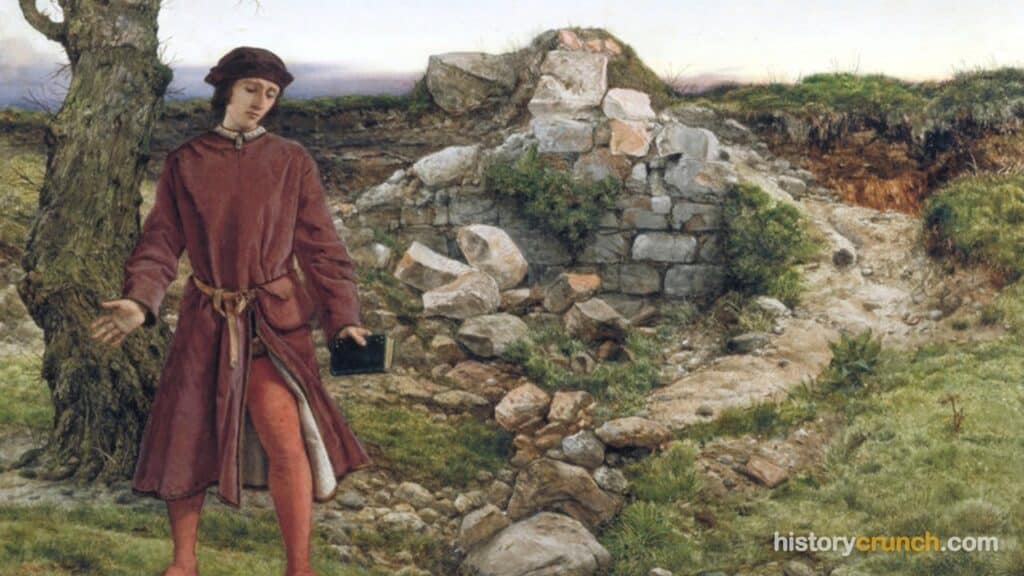
Feast days broke up the year with fairs, music, dancing, games and travelling performers. The Church calendar set the holidays, and there were a great many of them.
LEARN MORESHOW LESSwhy it mattersDAILY LIFEThe medieval year had more days off than a modern one. They were holy days rather than holidays, which is the same word and not the same thing.
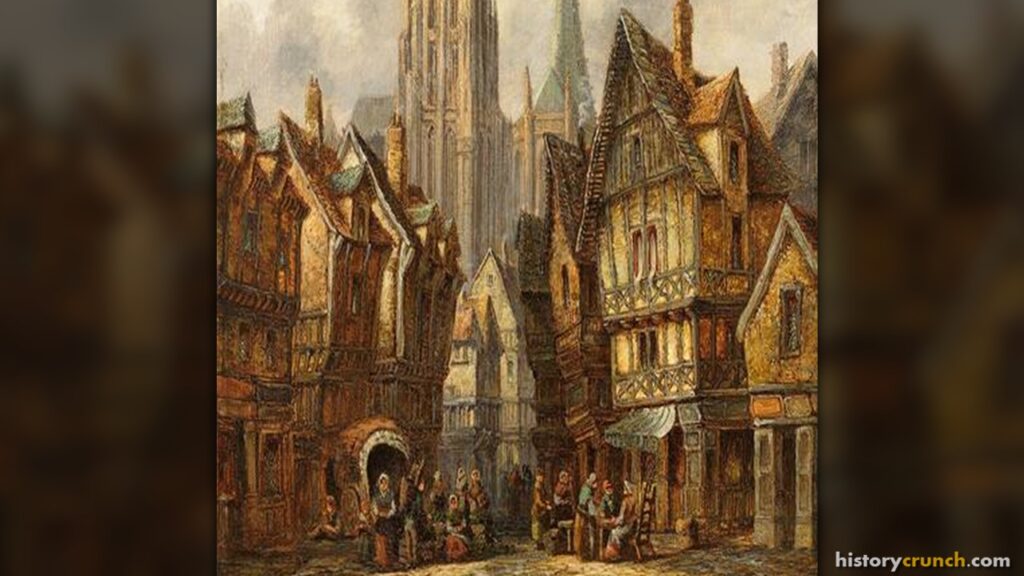
Towns grew around markets, cathedrals and castles, and bought charters from kings and lords that gave them the right to govern themselves. In many places a serf who lived in a town for a year and a day became free.
LEARN MORESHOW LESSwhy it mattersECONOMYThis is the crack in the feudal system. A place where money buys rights is a place where land is no longer the only thing that counts.
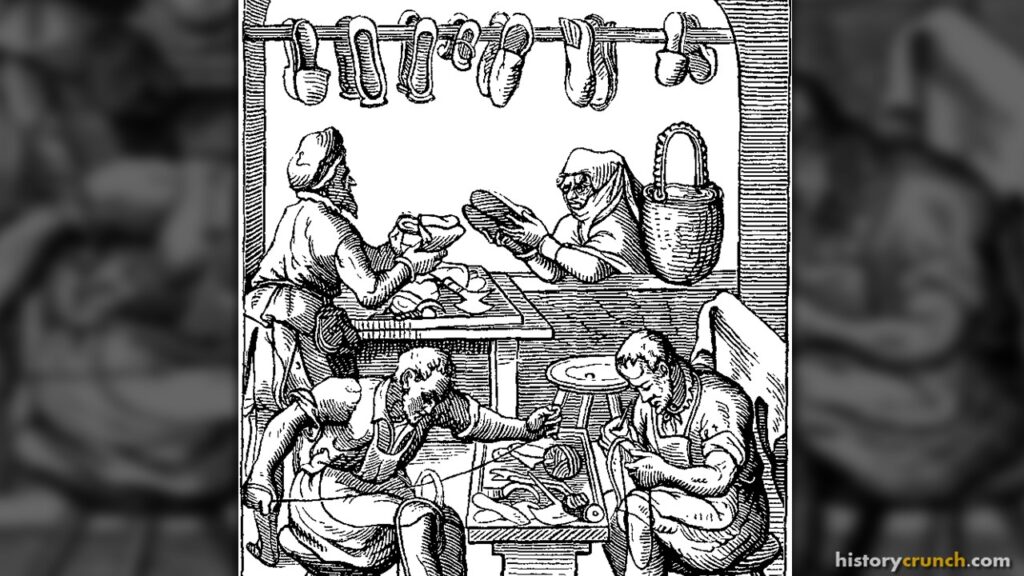
A guild controlled who could practice a trade in a town, how long an apprenticeship lasted, what quality was acceptable and often what price could be charged.
LEARN MORESHOW LESSwhy it mattersECONOMYThey protected standards and they shut people out, which is what every professional body since has been accused of. The apprentice, journeyman and master ladder is still the shape of a trade today.
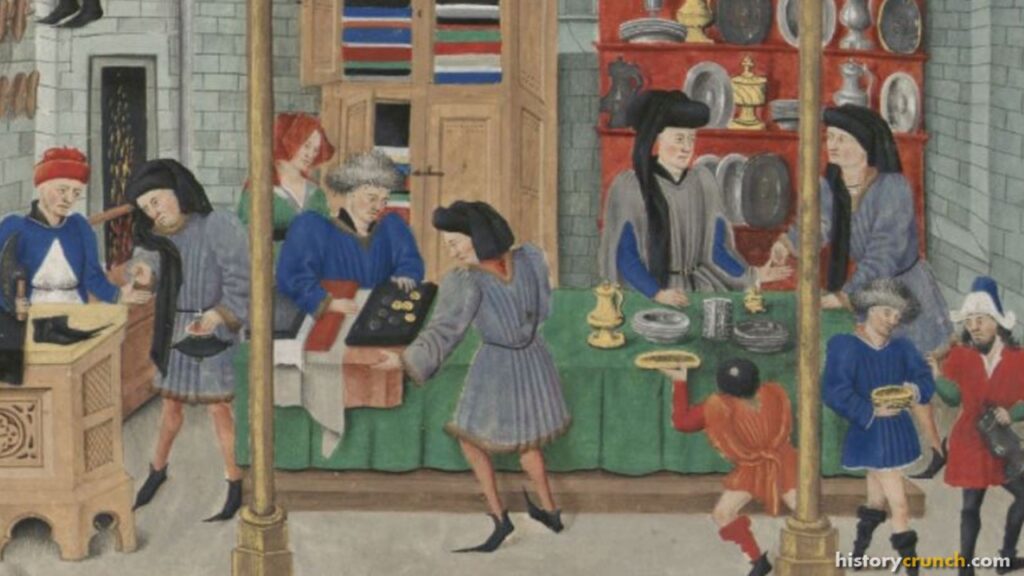
Long-distance trade in wool, cloth, salt, spices and silver ran through fairs in Champagne and through the ports of Italy and the Baltic. Italian merchants developed bills of exchange and double-entry bookkeeping to move money without carrying it.
LEARN MORESHOW LESSwhy it mattersECONOMYThe machinery of modern finance is medieval. It was built by merchants who needed to pay somebody in Bruges without carrying coins across a continent full of bandits.
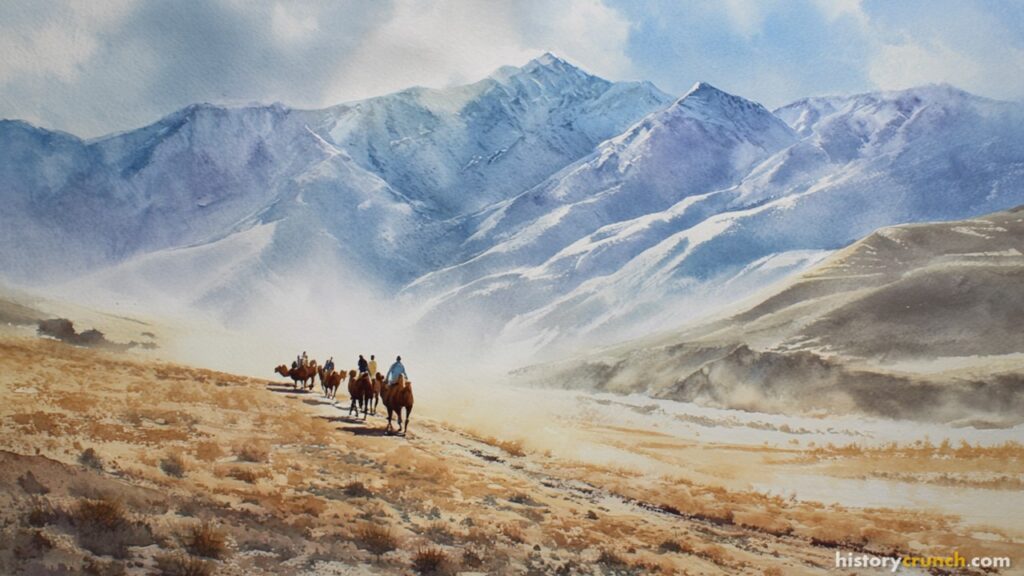
The overland routes between China and the Mediterranean carried silk, spices, paper and ideas over more than 4,000 miles, through a chain of middlemen rather than end to end.
LEARN MORESHOW LESSwhy it mattersECONOMYIt also carried the plague. The same road that brought paper and the compass to Europe brought the fleas that killed a third of it.
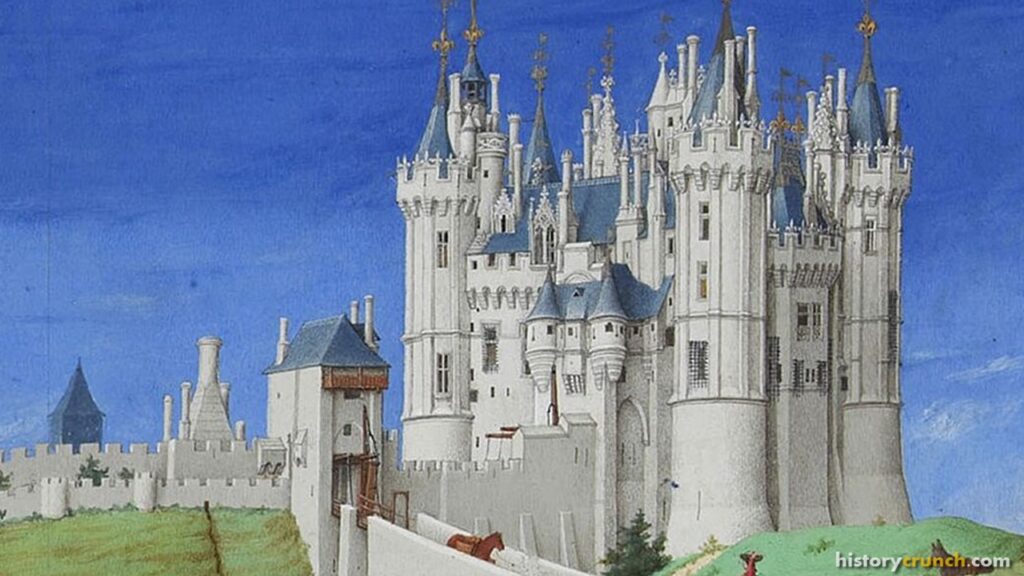
Castles were fortress, home and government office at once. They began as earth and timber and became stone, with concentric walls, gatehouses and towers designed to make attacking them ruinous.
LEARN MORESHOW LESSwhy it mattersWARA castle is an argument in stone: it says this land is held, and taking it will cost you a year and an army. William built them across England precisely because twenty of them are worth more than one battle.
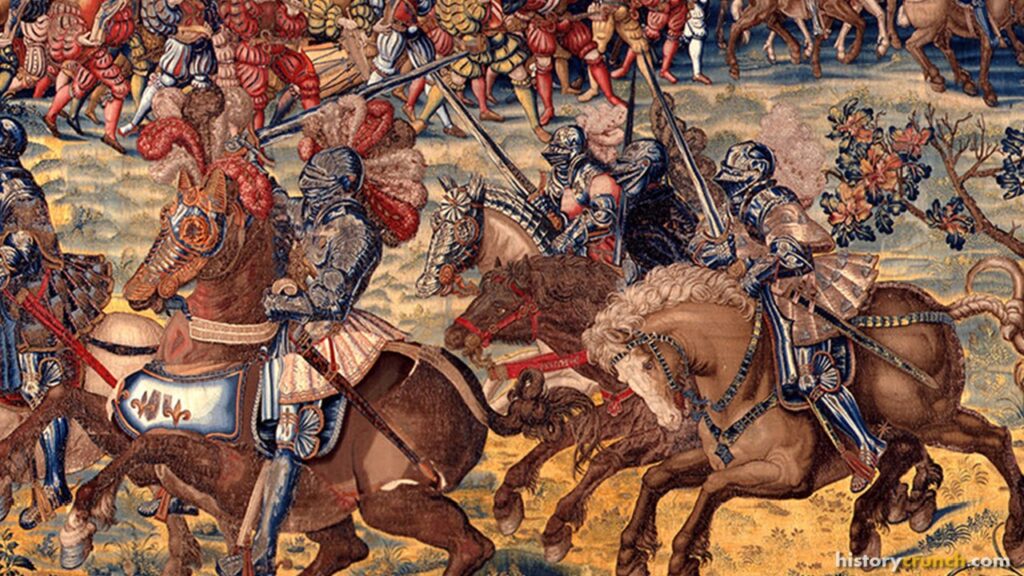
A knight was an armoured man on an expensive horse, trained from boyhood, holding land in exchange for service. The equipment cost roughly what a small farm was worth.
LEARN MORESHOW LESSwhy it mattersWARThe knight dominates the battlefield until the longbow and the pike prove that a professional on foot can kill one for a fraction of the price. Crécy is where that arithmetic becomes public.
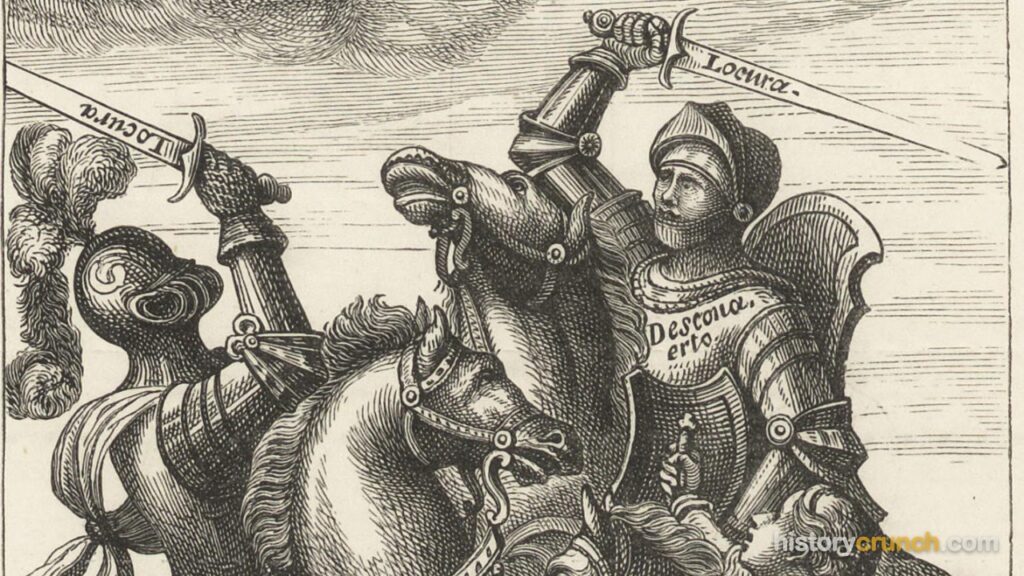
Chivalry was the code knights were supposed to follow: courage, loyalty, generosity, protection of the weak and of the Church. It was written down mostly in poems.
LEARN MORESHOW LESSwhy it mattersIDEASIt was an ideal aimed at men who spent their lives in armed robbery with a coat of arms. The gap between the code and the conduct is the point, and the code still shaped how they saw themselves.
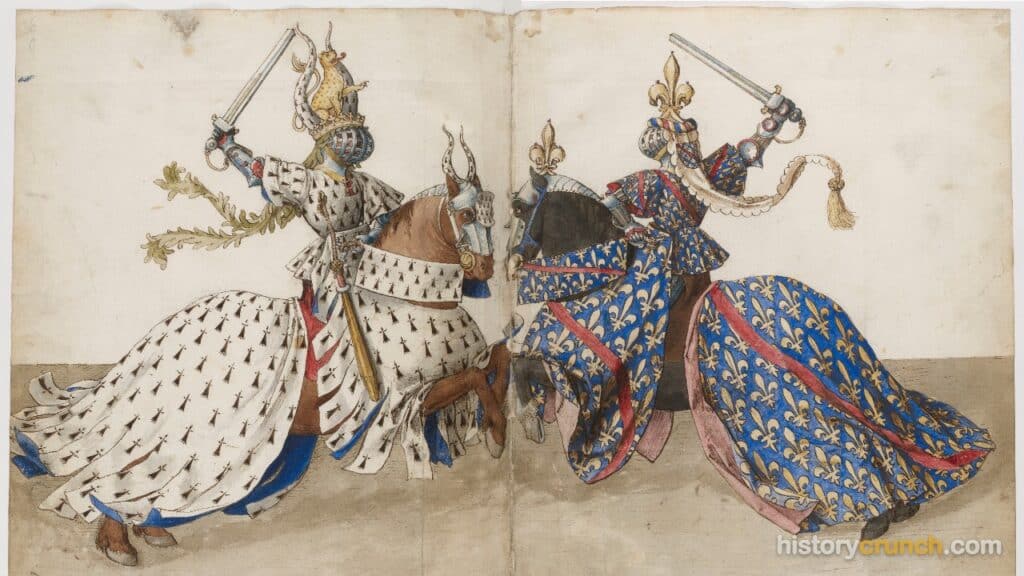
Tournaments began as mass mock battles across open country, where knights captured each other for ransom, and became the formal jousting spectacles of the later Middle Ages.
LEARN MORESHOW LESSwhy it mattersWARThey were training, entertainment and a way to make a living. A landless knight with a good horse could ransom his way to a fortune, which is how William Marshal started.
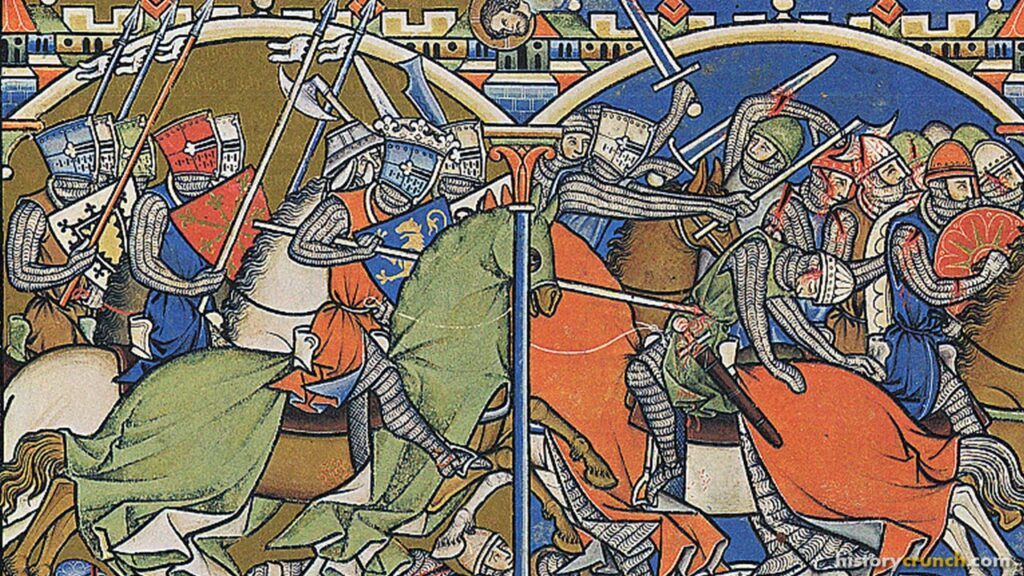
Mail gave way to plate over the period, and the sword, lance, axe, crossbow and longbow all had their moment. Armour got better because weapons got better, and the other way round.
LEARN MORESHOW LESSwhy it mattersWAREvery improvement in armour bought perhaps a generation before something was designed to defeat it. The last full plate armour was made just as gunpowder made it pointless.
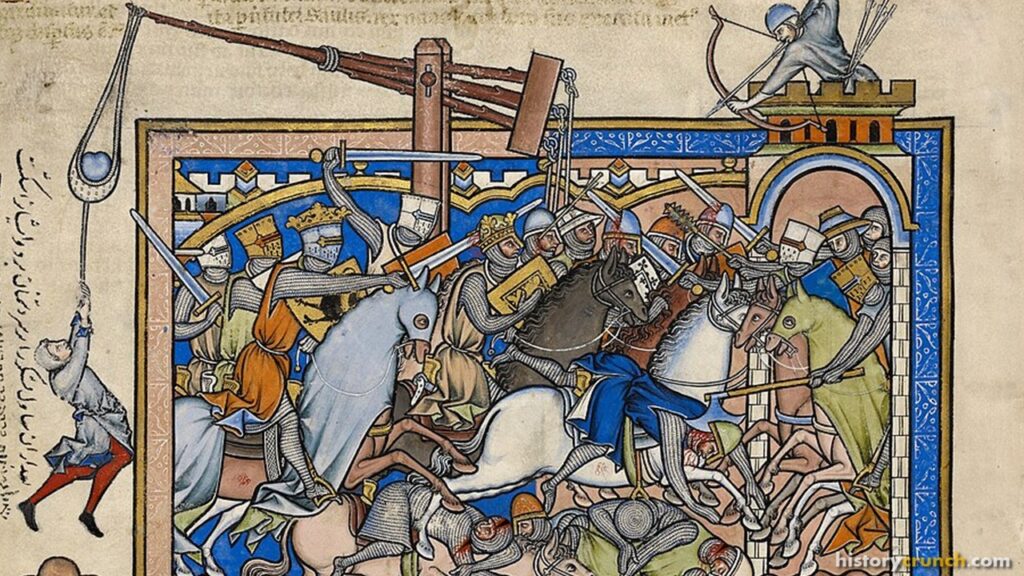
Trebuchets, mangonels, battering rams, siege towers and mining were used to take castles and walled towns. Most sieges were won by starvation rather than by machinery.
LEARN MORESHOW LESSwhy it mattersWARCastles were built to make attacking them slow, and siege engines were built to make them less slow. That argument runs the whole period and is settled abruptly by the cannon at Constantinople.
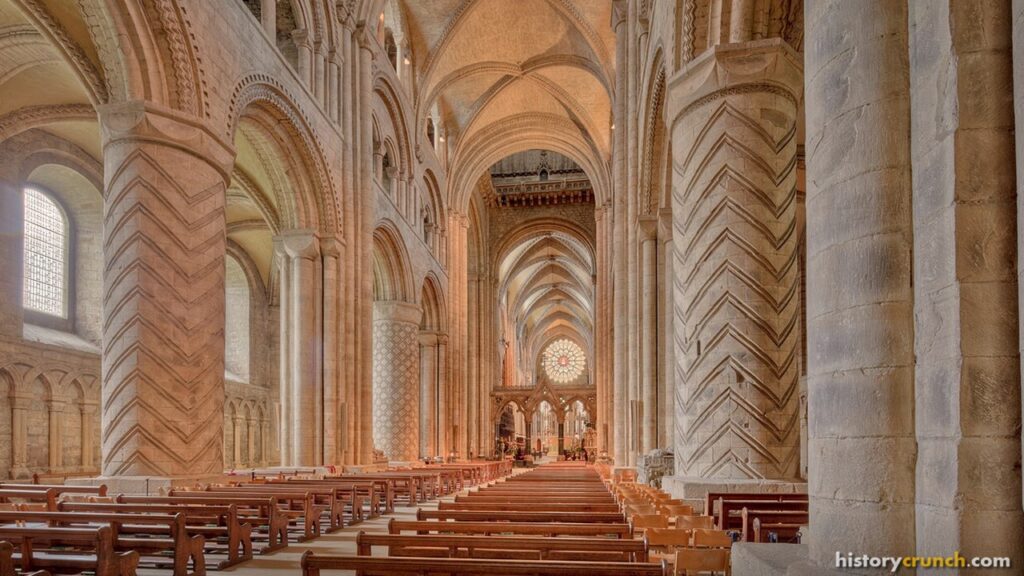
Heavy Romanesque churches with round arches and thick walls gave way from the twelfth century to Gothic: pointed arches, ribbed vaults, flying buttresses and walls that could hold enormous windows.
LEARN MORESHOW LESSwhy it mattersCULTUREA Gothic cathedral took a century and the wealth of a whole region to build, and the builders knew they would not see it finished. They are the largest thing the Middle Ages left standing.
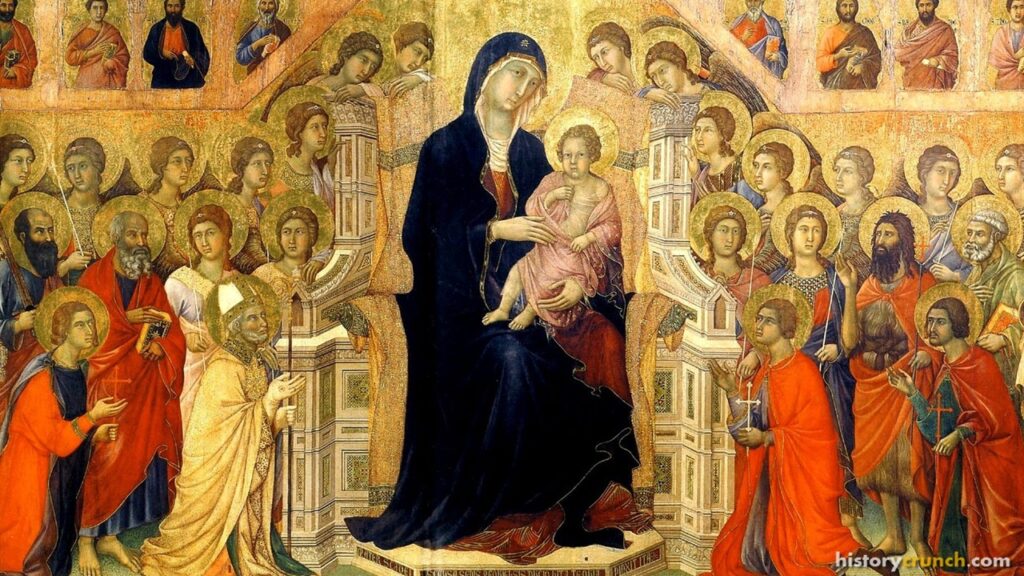
Most medieval art was religious and made for churches: illuminated manuscripts, altarpieces, stained glass and carving. Artists were craftsmen in workshops and rarely signed their work.
LEARN MORESHOW LESSwhy it mattersCULTUREIt was not trying to look real. It was trying to explain, to a population that mostly could not read, who everybody in the picture was and why they mattered.
The Church was the only Roman institution to survive the collapse intact, and it spent these centuries proving what that was worth: an emperor waiting barefoot in the snow at Canossa, a call at Clermont that sent thousands of people 2,000 miles to take Jerusalem, and an archbishop murdered on his own altar by knights who thought they were doing the king a favour. It ends with the Fourth Crusade sacking Constantinople, the Christian city the whole enterprise had begun by trying to help.
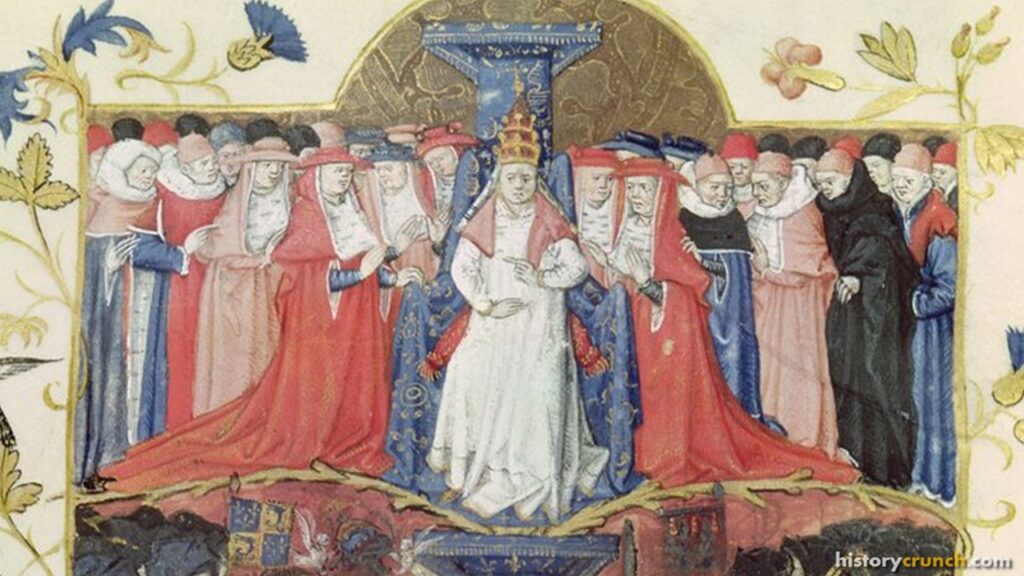
Pope Gregory VII pronounced excommunication on the Holy Roman Emperor Henry IV in 1076 over who had the right to appoint bishops, which released Henry's own subjects from obedience to him. Henry crossed the Alps in winter and stood outside the pope's residence at Canossa for three days before he was forgiven.
LEARN MORESHOW LESSwhy it mattersRELIGIONAn emperor in the snow, waiting on a pope, is the high-water mark of papal power. It did not last, and Henry later drove Gregory out of Rome, but the image did.
The University of Bologna, founded in 1088 CE, is considered the oldest university in the western world. Paris and Oxford followed within a century.
LEARN MORESHOW LESSwhy it mattersIDEASBologna started as a guild of students who hired their own professors and fined them for turning up late. It has been going for nine hundred years.
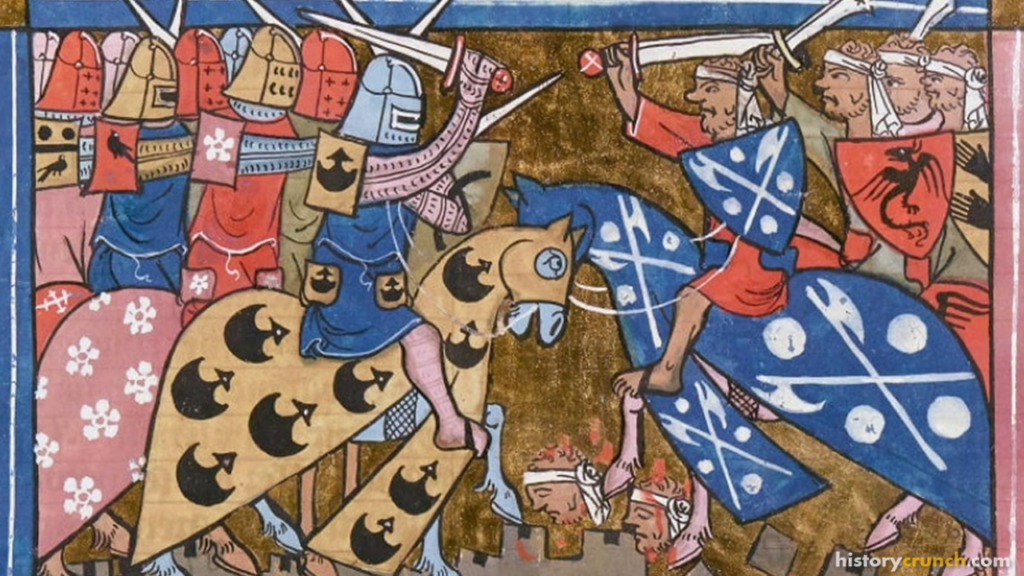
At the Council of Clermont on 27 November 1095, Pope Urban II called on Christian knights to march east and recover Jerusalem, promising remission of sins to those who went. The response was far larger than he expected.
LEARN MORESHOW LESSwhy it mattersRELIGIONOne speech launched two hundred years of war. Urban was answering an appeal from Constantinople for soldiers and got a mass movement instead, which is a reminder that nobody controls what they start.
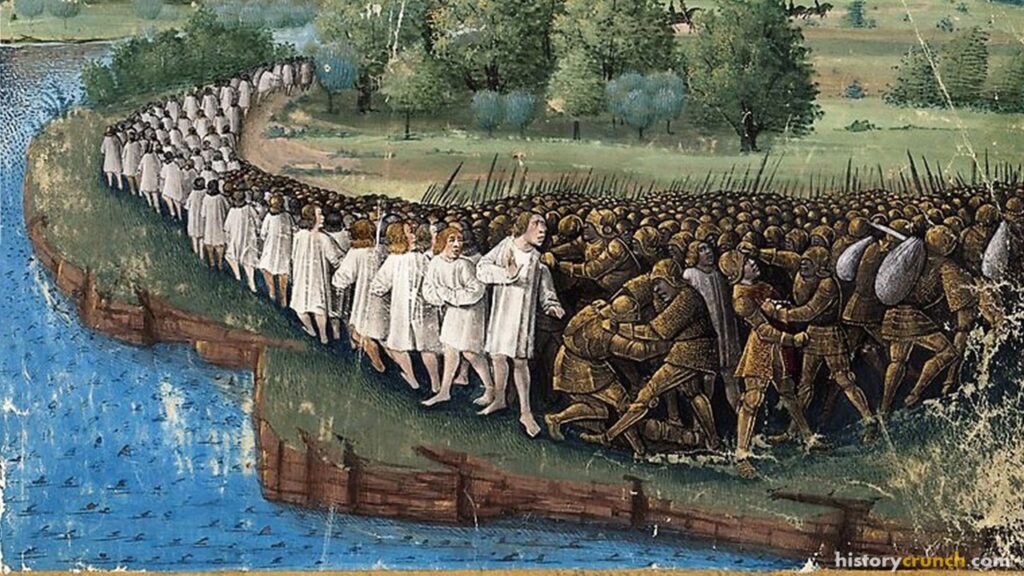
Before the armies were ready, a preacher called Peter the Hermit led thousands of poorly armed commoners east. They massacred Jewish communities in the Rhineland, the German lands along the Rhine, on the way and were destroyed in Anatolia within months.
LEARN MORESHOW LESSwhy it mattersWARThe first violence of the First Crusade happened in Europe, against Europeans. That is not an afterthought to the crusades, it is the beginning of them.
The official crusade, led by nobles including Godfrey of Bouillon, left in August 1096, marched through Constantinople and Anatolia, and took Antioch after a siege lasting eight months.
LEARN MORESHOW LESSwhy it mattersWARIt is the only crusade that achieved what it set out to do. Nobody involved expected that, least of all the Byzantine emperor who had asked for a few hundred mercenaries.
The crusaders stormed Jerusalem on 15 July 1099 and massacred much of its Muslim and Jewish population. Four crusader states were established along the coast.
LEARN MORESHOW LESSwhy it mattersWARThe massacre was remembered in the Islamic world for centuries and shaped everything that followed. Saladin's conduct in 1187, when he took the city back without a slaughter, is a deliberate answer to it.
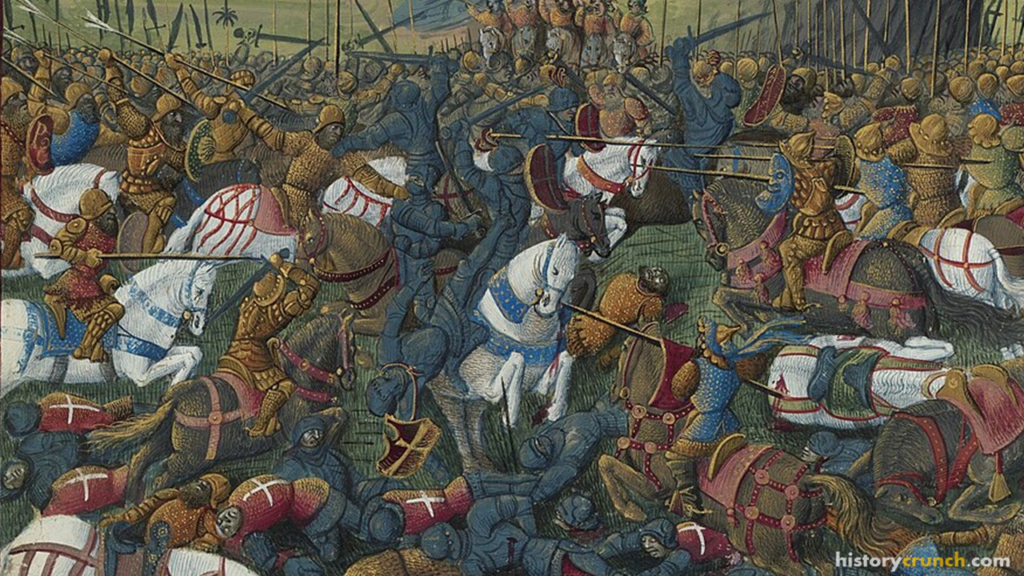
Called after the crusader county of Edessa fell, the Second Crusade was led by the kings of France and Germany, achieved nothing, and ended in a failed attack on Damascus, a city that had been an ally.
LEARN MORESHOW LESSwhy it mattersWARThe First Crusade succeeded with no kings. The Second failed with two of them, which did a great deal of damage to the idea that God was obviously on their side.
The University of Paris was founded around 1150 CE and Oxford at about the same time, teaching theology, law, medicine and the arts in Latin to students from across Europe.
LEARN MORESHOW LESSwhy it mattersIDEASA student could travel from Bologna to Paris to Oxford and follow the same course in the same language. Europe had a shared intellectual system four hundred years before it had a postal one.
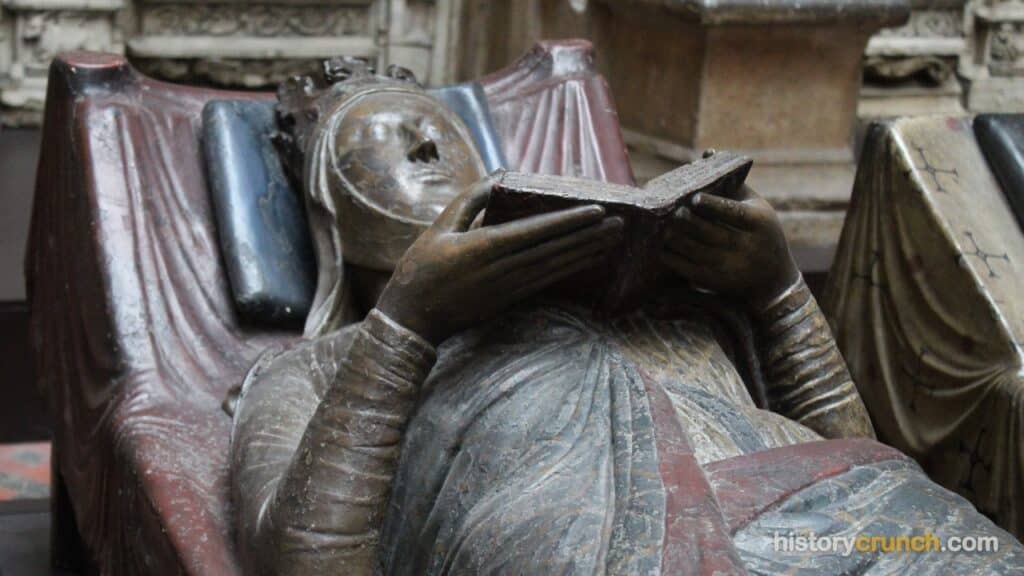
Eleanor inherited Aquitaine at fifteen and married the king of France. The marriage was annulled in March 1152, and within two months she married Henry of Anjou, who became Henry II of England two years later. She was queen of France and then queen of England, and later led a revolt against her second husband with her sons.
LEARN MORESHOW LESSwhy it matters · key numbers · 1 key figurePOLITICSShe brought Aquitaine to whichever crown she married, which is why a French duchy ended up in English hands and why the two kingdoms spent the next three hundred years fighting about it.
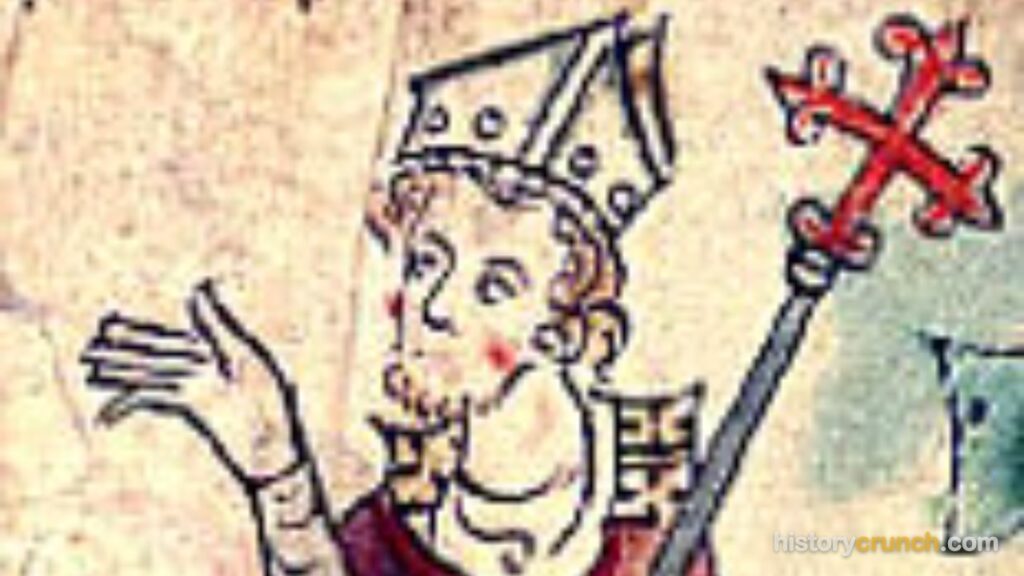
Thomas Becket, Henry II's chancellor and close friend, was consecrated Archbishop of Canterbury on 3 June 1162. Henry expected a compliant church. Becket immediately resigned the chancellorship and began opposing him.
LEARN MORESHOW LESSwhy it matters · 1 key figureRELIGIONHenry appointed him precisely because he trusted him to take the king's side against the Church. It is one of the great misjudgements of character in English history.
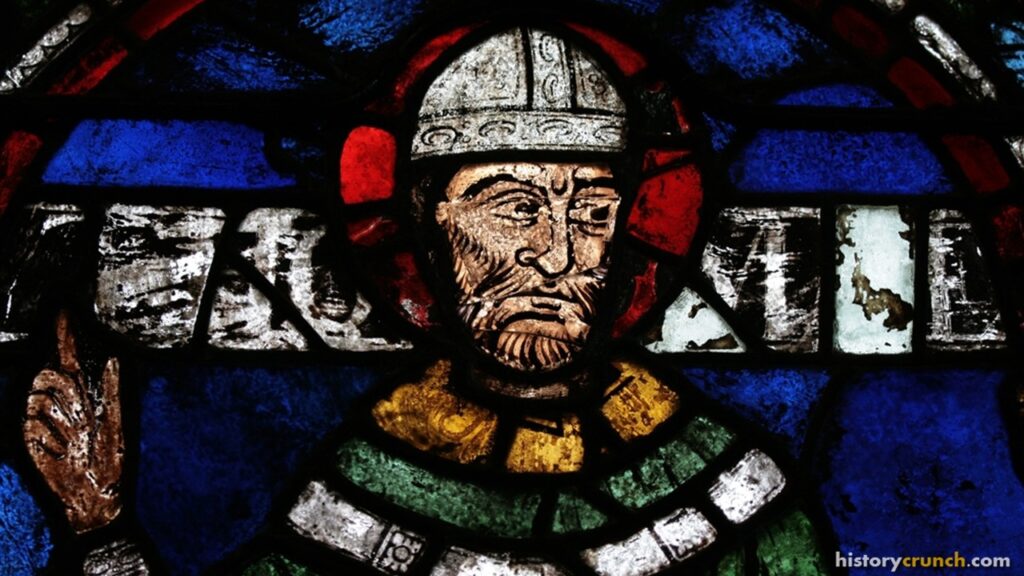
After years of quarrelling over whether clergymen could be tried in royal courts, four knights who had heard Henry rage about Becket rode to Canterbury and killed him at the altar on 29 December 1170.
LEARN MORESHOW LESSwhy it matters · 1 key figureRELIGIONHenry did his penance barefoot and the Church won the argument for a century. Canterbury became the most profitable pilgrimage site in England, which is what Chaucer's pilgrims are travelling to two hundred years later.
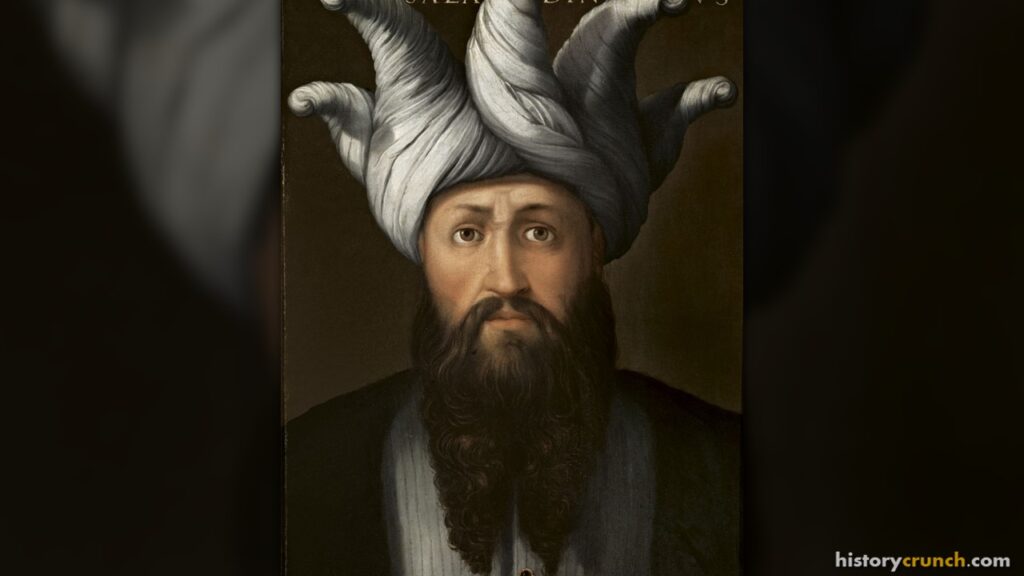
After destroying the crusader army at Hattin, Saladin took Jerusalem on 2 October 1187. He allowed the Christian population to leave on payment of ransom and stopped his troops from sacking the city.
LEARN MORESHOW LESSwhy it matters · 1 key figureWAREighty-eight years after the crusaders took it with a massacre, he took it back without one, and European writers have been comparing the two ever since.
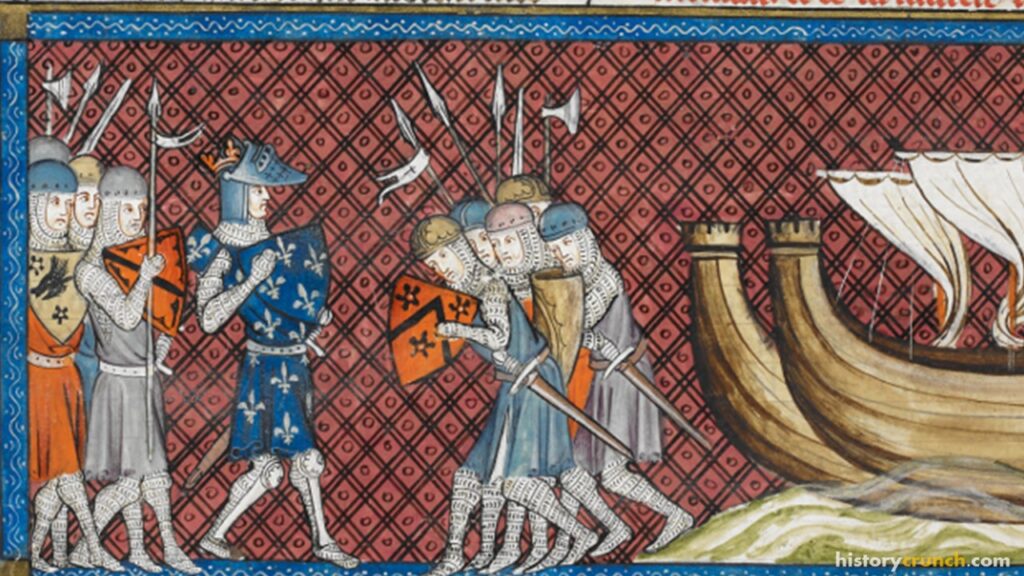
The Third Crusade brought Richard the Lionheart of England, Philip II of France and the Holy Roman Emperor Frederick Barbarossa, who drowned on the way. Richard won battles, failed to take Jerusalem, and agreed a truce allowing Christian pilgrims access to the city.
LEARN MORESHOW LESSwhy it matters · 1 key figureWARTwo of the most capable commanders of the age fought each other to a draw and then made a deal. That is the most honest ending any crusade gets.
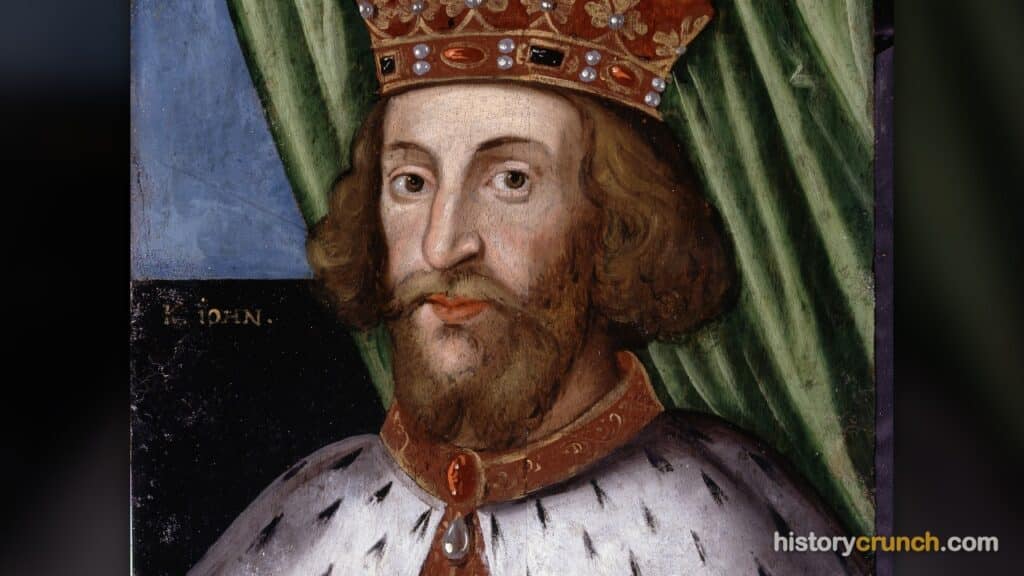
Richard the Lionheart was killed by a crossbow bolt in France in 1199 and his brother John became king, ruling until 1216. He quarrelled with the pope so badly that England was placed under an interdict for six years, with the churches closed.
LEARN MORESHOW LESSwhy it matters · 1 key figurePOLITICSJohn is the king everybody has heard of for being bad at it. The interesting part is that his failures produced the most quoted document in English legal history.
By 1204 John had lost Normandy and almost all the other English holdings in France to Philip II. The wars to get them back were expensive and unsuccessful.
LEARN MORESHOW LESSwhy it matters · 1 key figureWARLosing Normandy is what made the English barons English. It also meant John had to tax them hard for a war abroad, and that is the road to Runnymede.
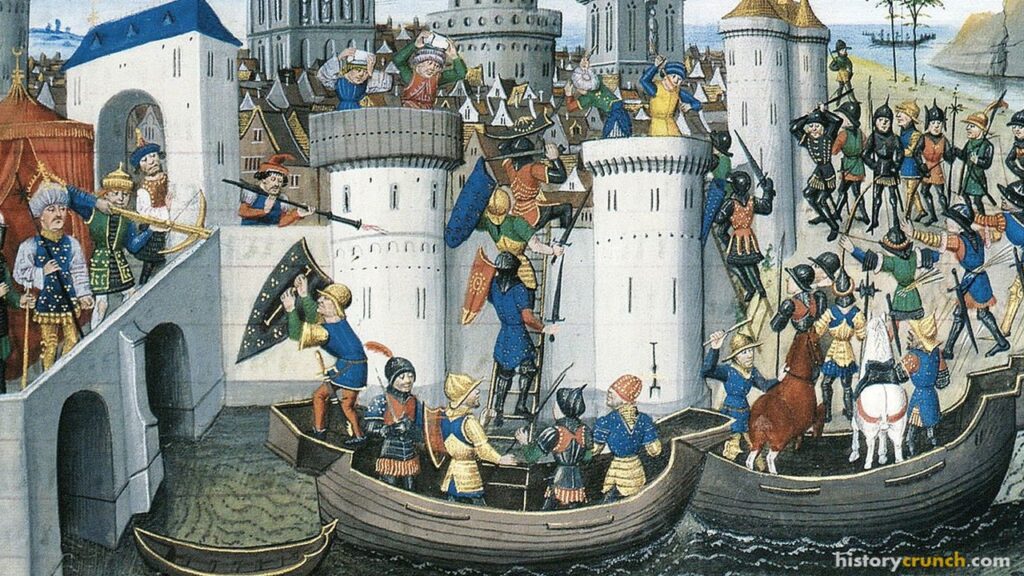
Unable to pay the Venetians for their transport, the crusaders were diverted first against a Christian city on the Adriatic and then against Constantinople itself, which they stormed and looted in April 1204.
LEARN MORESHOW LESSwhy it mattersWARA crusade called to fight Muslims destroyed the greatest Christian city in the world and crippled the empire that had asked for help in 1095. Constantinople never recovered, and in 1453 there was almost nothing left to defend.
An English king lost Normandy, taxed his barons to get it back, failed, and was forced at Runnymede to seal a charter that mostly concerned feudal dues and fish weirs and that contained a handful of clauses still quoted eight hundred years later. Meanwhile an empire stretching 6,000 miles was assembled on the steppe by a man who replaced tribal loyalty with a decimal army, reached the Adriatic, withdrew because of a funeral, and left the roads east safe enough for a Venetian teenager to walk to China.
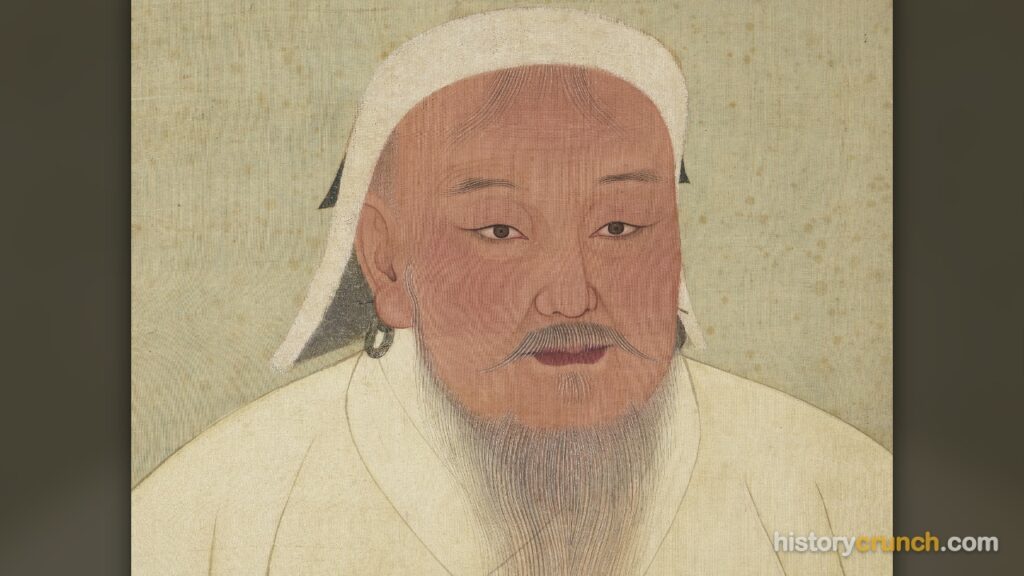
In 1206 Temujin was proclaimed Genghis Khan, universal ruler, over the united tribes of the steppe. He reorganized his army into units of ten, hundred, thousand and ten thousand, cutting across tribal loyalties.
LEARN MORESHOW LESSwhy it matters · 1 key figureWARThe decimal army is the whole story. He replaced who your family was with where you stood in the line, which turned a collection of feuding tribes into the most effective military machine of the age.
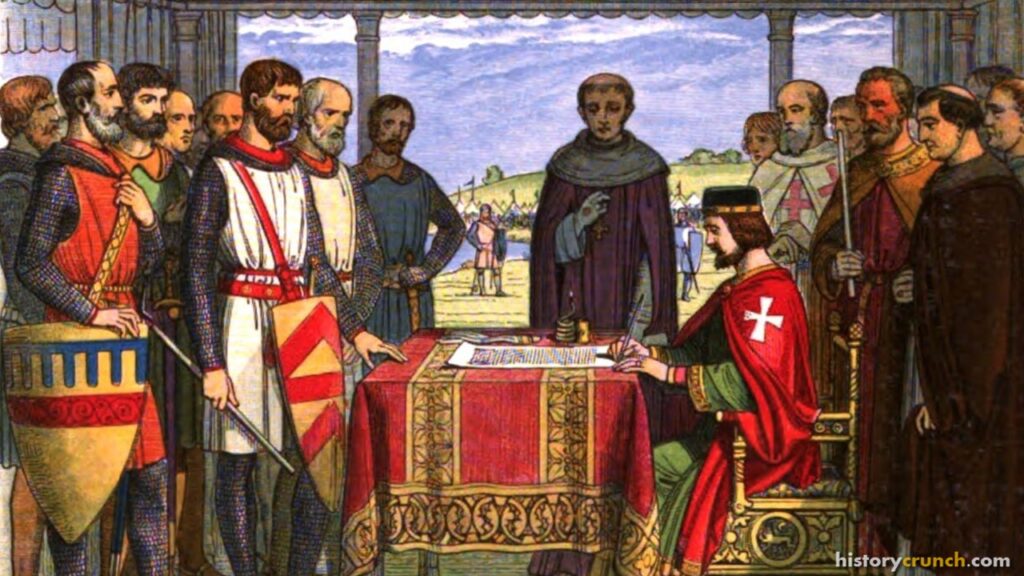
Facing rebellion after years of heavy taxation and lost wars, John met his barons at Runnymede and sealed a charter of sixty-three clauses on 15 June 1215. It was annulled by the pope within ten weeks and war followed anyway.
LEARN MORESHOW LESSwhy it matters · key numbers · a debateLAWMost of it is about feudal dues and fish weirs. Three or four clauses are about justice, and those are the ones that were still being quoted six hundred years later in a courtroom in Philadelphia.
Was Magna Carta a great charter of liberty?
In effect, yes. The principle that the king is under the law, and that free men cannot be imprisoned without judgement, entered English law from this document and travelled everywhere English law went.
Not as written. It was a peace treaty between a king and about forty rebel barons protecting their own privileges, it failed within weeks, and the word everybody quotes, free man, excluded most of the population.
Genghis Khan died in 1227 on campaign against the Xi Xia in what is now China. His burial place is unknown. Most of the empire's expansion happened under his sons and grandsons.
LEARN MORESHOW LESSwhy it matters · 1 key figureWAREmpires built by one man usually die with him. This one did not, which says more about the system he built than about his own campaigns.
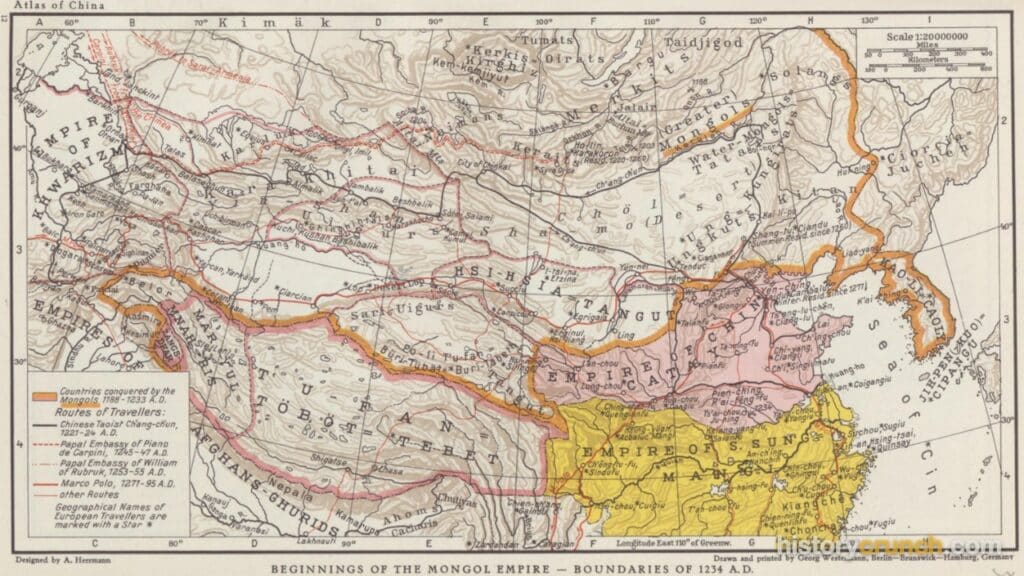
Mongol armies destroyed Polish and Hungarian forces within two days of each other in April 1241 and reached the Adriatic. They withdrew the following year after the Great Khan died, and never came back in force.
LEARN MORESHOW LESSwhy it mattersWAREurope was saved by a funeral. The empire eventually stretched roughly 6,000 miles, and the part of it that mattered most to Europe was the safe road it opened east.
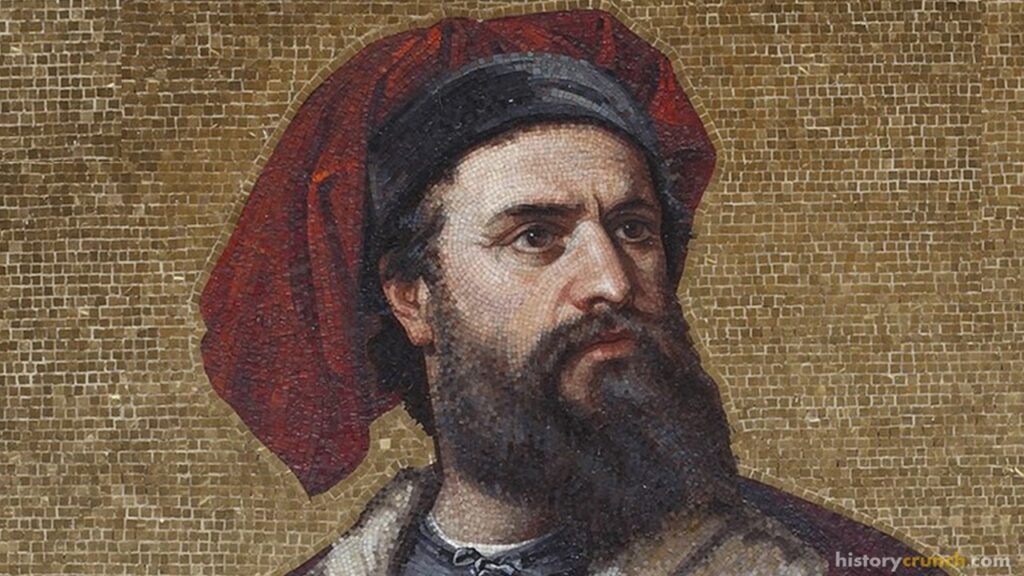
In 1271, aged about seventeen, Marco Polo left Venice with his father and uncle on a journey that lasted twenty-four years and covered more than 15,000 miles, much of it in the service of Kublai Khan.
LEARN MORESHOW LESSwhy it matters · 1 key figureEXPLORATIONHe could make that journey because the Mongols had made the roads safe from one end of Asia to the other. Conquest on that scale opens routes as well as closing them.
Acre, the last major crusader possession in the Holy Land, fell to the Mamluks on 18 May 1291. Two centuries of crusader states in the east were over.
LEARN MORESHOW LESSwhy it mattersWARNearly two hundred years, enormous expense and a great many lives, and the territorial result was nothing. What lasted was the trade, the contact and the grievance.
The Polos reached Venice in 1295. Captured in a war with Genoa, Marco dictated an account of his travels to a fellow prisoner, and it became the most widely read description of Asia in Europe.
LEARN MORESHOW LESSwhy it matters · 1 key figureEXPLORATIONColumbus owned a copy and wrote notes in the margins. A book by a Venetian merchant in a Genoese prison is one of the reasons ships sailed west two hundred years later.
Europe's population had doubled in three centuries and was farming at the limit of what the land could feed. The weather turned in 1315 and the harvests failed. Twenty-two years later England and France began a war that lasted 116, and ten years after that a ship from the Black Sea reached Sicily. Within four years a third of Europe was dead, wages rose because there was nobody to do the work, governments passed laws to stop that happening, and in 1381 the peasants of England marched on London.
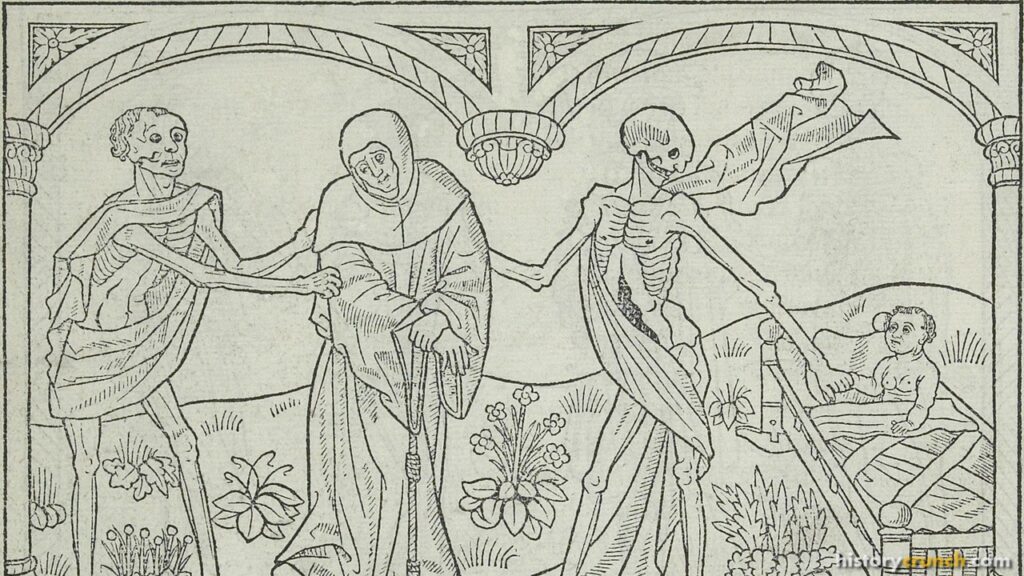
Years of cold, wet weather ruined harvests across northern Europe from 1315 to 1317. Perhaps one person in ten died in the worst-affected regions, and the survivors were weakened for a generation.
LEARN MORESHOW LESSwhy it mattersDISEASEEurope's population had doubled in three centuries and was living at the limit of what the land could feed. The weather turned, and it turned out there was no margin at all.
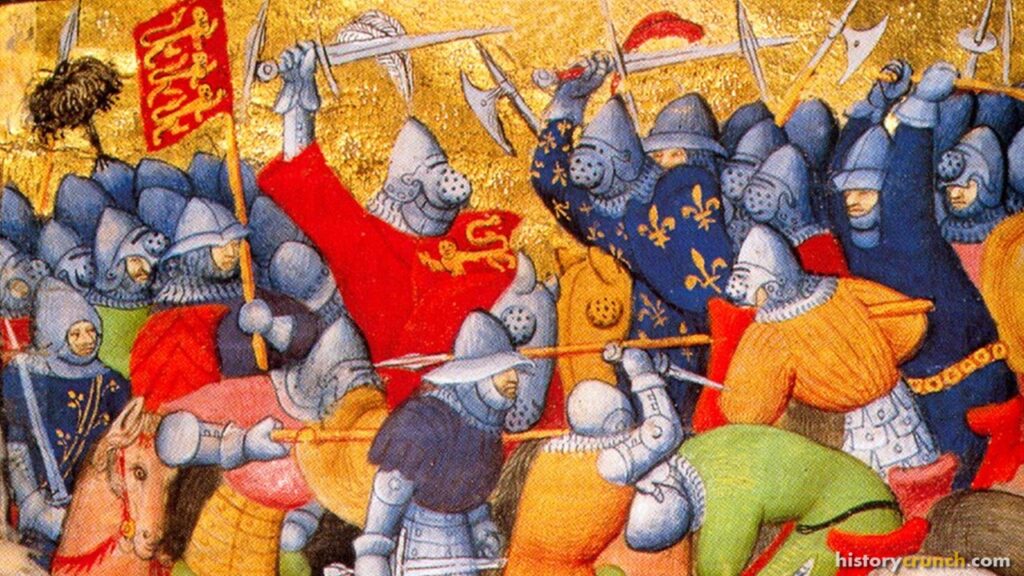
Philip VI of France declared the English-held duchy of Guyenne confiscated in May 1337, and Edward III of England responded by claiming the French throne. The wars that followed ran, on and off, for 116 years.
LEARN MORESHOW LESSwhy it mattersWARIt is not one war but a series of them, fought by five English and five French kings over the same two questions: who owns land in France, and who is entitled to the French crown.
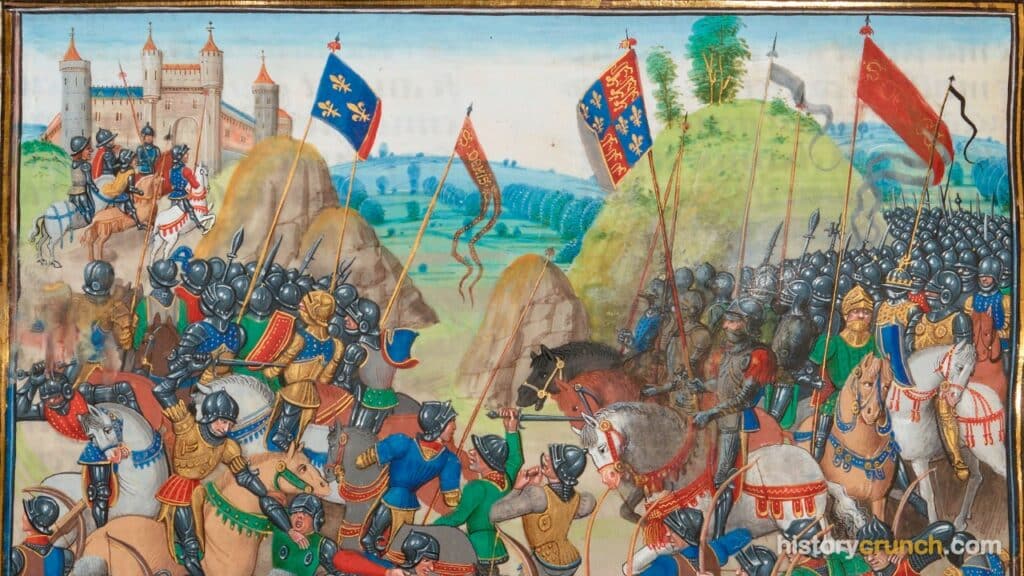
On 26 August 1346 an English army of about 14,000, built around longbowmen, destroyed a much larger French force of mounted knights and Genoese crossbowmen. Between 5,000 and 8,000 French were killed, against about 100 English.
LEARN MORESHOW LESSwhy it matters · key numbersWARA weapon a commoner could be trained to use killed 1,500 knights in an afternoon. The social order on this timeline said those men were the ones who fought. Crécy is where that stops being true.
After Crécy, Edward besieged Calais for eleven months until it surrendered in 1347. It remained an English possession for over two hundred years.
LEARN MORESHOW LESSwhy it mattersWARA port on the French coast gave England a door into the continent and a base for the wool trade. England only lost it in 1558, a century after the war itself ended.
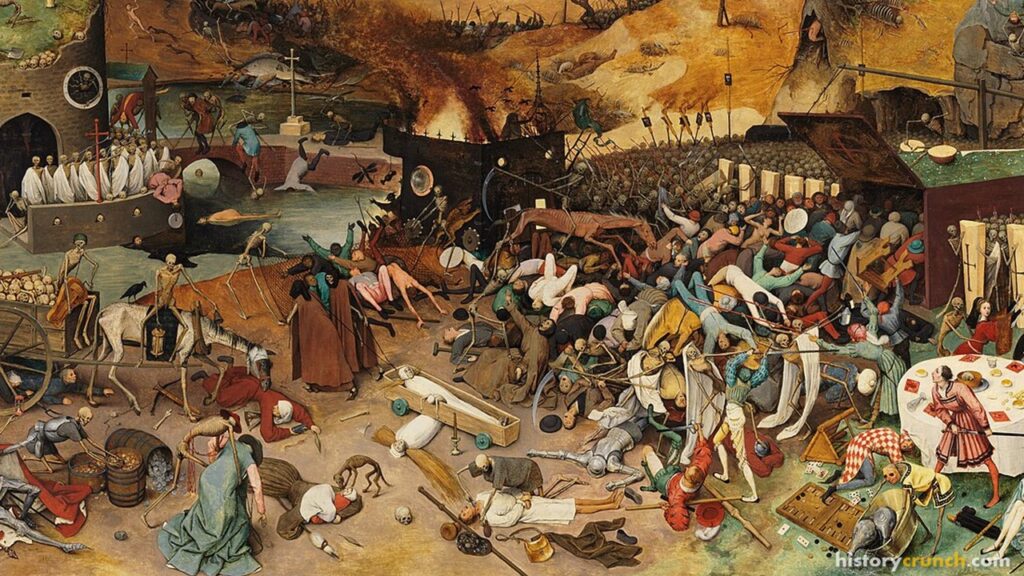
A Genoese ship carrying plague arrived in Sicily in 1347. Within four years the disease had reached almost every part of Europe, carried along the same trade routes that carried everything else.
LEARN MORESHOW LESSwhy it mattersDISEASEIt came up the Silk Road and in through the busiest ports in Europe. The more connected a place was, the worse it was hit, which is the oldest lesson in epidemic history.
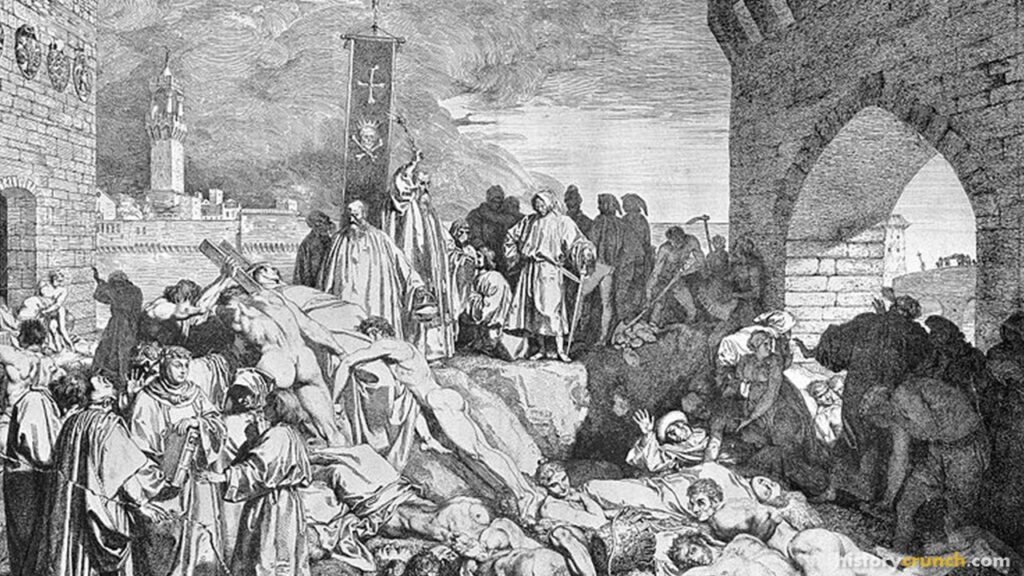
A major outbreak in Pisa in January 1348 spread the disease through northern Italy. Florence lost perhaps half its people; Boccaccio, who lived through it, described the city in the Decameron.
LEARN MORESHOW LESSwhy it mattersDISEASEItaly had the best records, the biggest cities and the most trade, so it has the clearest account of what happened and the highest death toll to go with it.
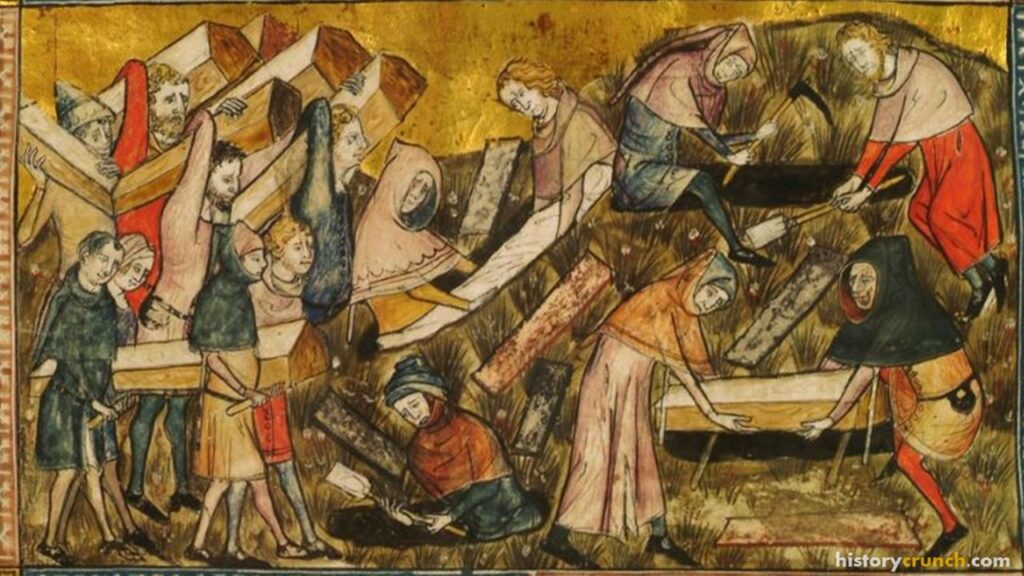
Towns ran out of graves, priests and gravediggers. Some places banned church bells at funerals because the constant ringing was frightening the living.
LEARN MORESHOW LESSwhy it mattersDISEASENobody knew what caused it, so the remedies were prayer, flight, flagellation and blaming somebody. Jewish communities across Europe were massacred by people looking for a cause.
The plague reached Russia in 1351, having crossed the continent in four years. Estimates of the total death toll across Europe and Asia run between 75 and 200 million people, with some regions losing half their population.
LEARN MORESHOW LESSwhy it matters · key numbersDISEASEA third of Europe died in four years. There is no other event on any of these timelines with a number like that, and the closest thing to it is the plague on the first chapter of this one.
With so many dead, surviving workers could demand higher wages and better terms, or simply leave for a lord who offered them. Governments answered with laws freezing wages at pre-plague levels, which largely failed.
LEARN MORESHOW LESSwhy it mattersECONOMYThis is where serfdom starts to die in western Europe, and it is pure supply and demand. The law said a peasant could not ask for more; the empty fields said otherwise.
A schism is a split, and this one ran from 1378 to 1417 with rival claimants holding the papacy at once, one in Rome and one in Avignon, and a third added later. Each excommunicated the others, and kingdoms chose sides politically.
LEARN MORESHOW LESSwhy it mattersRELIGIONIf two popes both say the other is not the pope, an ordinary Christian has no way of knowing who is right. The authority that had humbled an emperor at Canossa never fully recovered from this.
England, needing money for the war with France, imposed a third poll tax in 1380 at three times the rate of the previous one. It was the same amount for a labourer as for a merchant.
LEARN MORESHOW LESSwhy it mattersECONOMYA flat tax on every head falls hardest on the people with the fewest of them. The revolt the following summer is what happens when a government ignores that arithmetic.
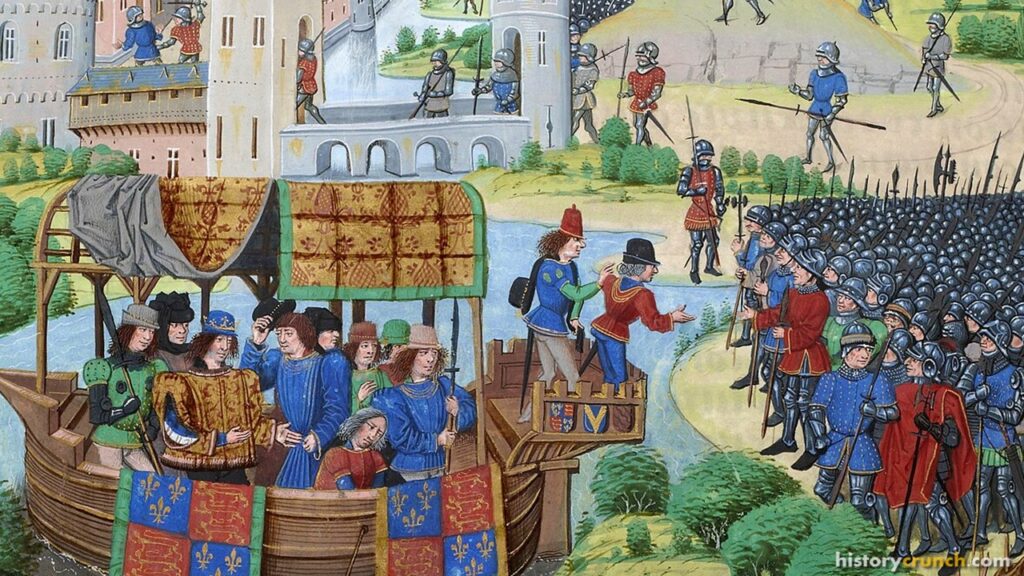
Rebels from Essex and Kent marched on London in June 1381, entered the city on the 13th, burned the Savoy Palace and killed the Archbishop of Canterbury and the Lord Treasurer.
LEARN MORESHOW LESSwhy it mattersPROTESTIt was not only peasants and it was not aimless. They had a list of demands, an idea of what a fair settlement looked like, and they got inside the capital, which terrified the ruling class for a generation.
Richard II, then fourteen, rode out to Mile End and agreed to the rebels' demands, including the end of serfdom. The next day their leader Wat Tyler was killed in front of the king at Smithfield, and the promises were withdrawn.
LEARN MORESHOW LESSwhy it mattersPROTESTHe promised everything, took it all back within weeks and hanged the leaders. Serfdom in England died anyway over the following century, killed by the labor shortage rather than by the charter.
Four things end it, all within a lifetime of each other. A press in Mainz makes books cheap. A cannon outside Constantinople brings down walls that had held for a thousand years and ends the Roman Empire. Ships reach the Americas and then India, and the center of the world moves to the Atlantic. And the labor shortage left by the plague finishes off serfdom in the west. The period is called the Middle Ages because Renaissance writers thought it was the gap between two better ones; almost every institution a modern European lives under was invented in that gap.
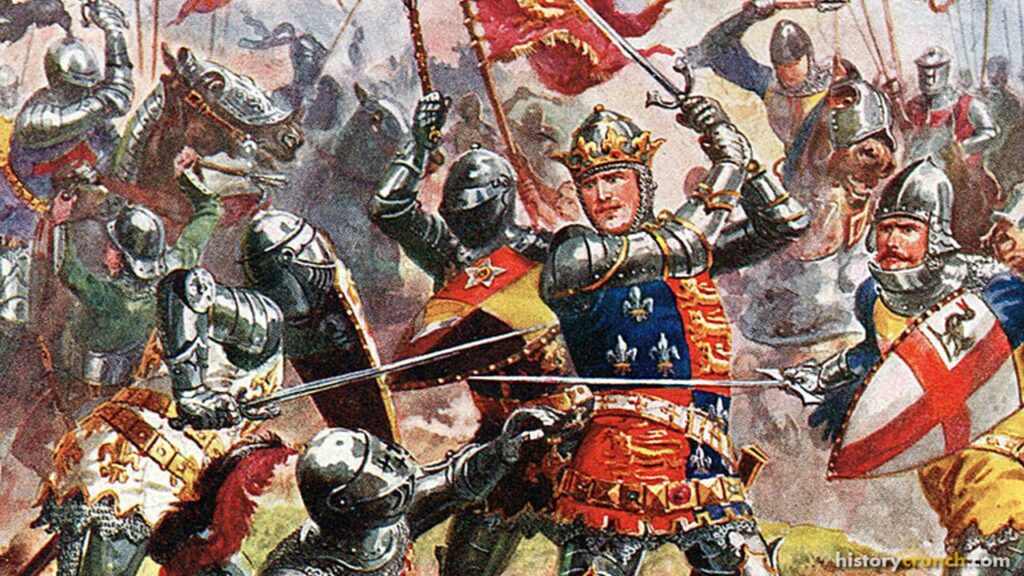
Henry V, with about 6,000 men, most of them longbowmen and many of them sick, met a French army estimated at 20,000 to 30,000 on a muddy ploughed field between two woods. The French knights could not deploy and were destroyed.
LEARN MORESHOW LESSwhy it matters · key numbersWARIt is the last great victory of the longbow and it decided nothing permanent: everything Henry won was lost again within thirty years of his death.
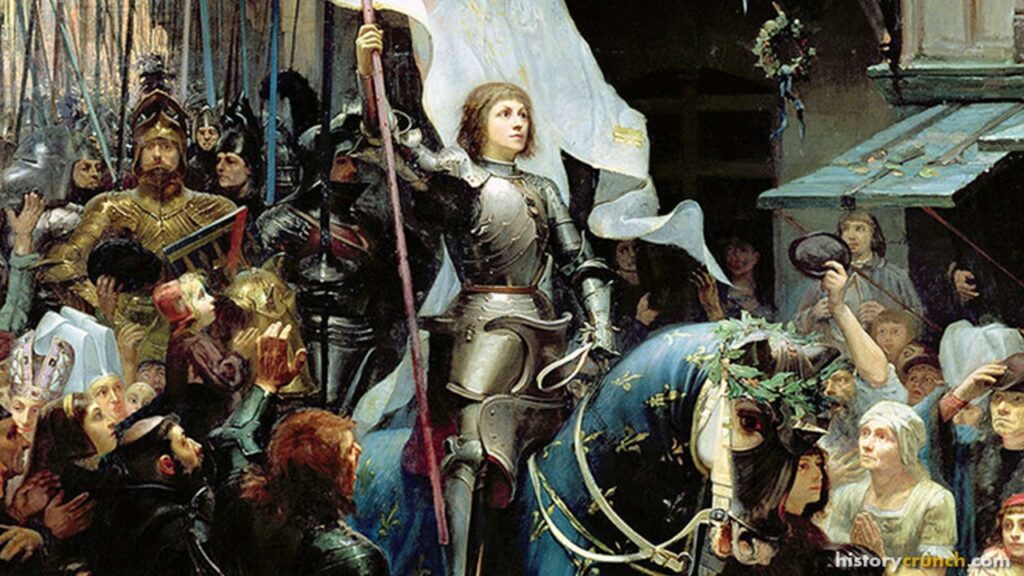
A teenage peasant girl from Domremy convinced the French court that her voices had sent her to relieve Orleans, besieged since October 1428. She arrived in April 1429 in armour, carrying a banner.
LEARN MORESHOW LESSwhy it matters · 1 key figureWARNothing about this should have worked. A court with no options gave a seventeen year old girl an army because it had nothing left to lose, and it worked.
In four days of attacks between 4 and 7 May 1429, French forces with Joan at the front took the English fortifications around Orleans. The siege was lifted and Charles VII was crowned at Reims in July.
LEARN MORESHOW LESSwhy it matters · 1 key figureWARThe war had been going France's way badly for ninety years. From Orleans it turns, and within twenty-four years the English hold nothing but Calais.
Captured by Burgundians and sold to the English, Joan was tried by a church court for heresy and burned at Rouen on 30 May 1431, aged nineteen. A retrial in 1456 annulled the verdict, and she was made a saint in 1920.
LEARN MORESHOW LESSwhy it matters · 1 key figureDEATHThe trial was about her clothes and her voices because it could not be about her victories. It took twenty-five years to overturn the verdict and nearly five hundred to make her a saint.
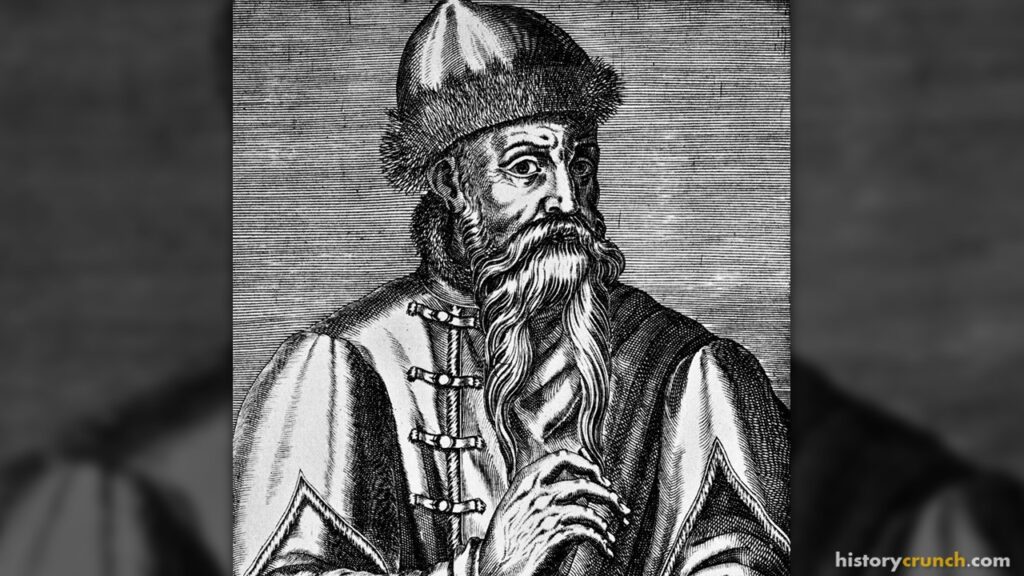
Johannes Gutenberg developed movable metal type in Mainz around 1440 and printed his Bible by 1455. Within fifty years there were printing presses in more than 250 European towns.
LEARN MORESHOW LESSwhy it matters · key numbersIDEASA monk could copy a book in a year. A press could produce hundreds. Everything after this on every timeline, from the Reformation to the Revolution, moves at the speed of print.
Mehmed II brought an army and a train of enormous cannon to the walls of Constantinople in April 1453. The largest gun was about 30 feet long and fired a stone ball weighing around 1,100 pounds. The city had perhaps 7,000 defenders.
LEARN MORESHOW LESSwhy it mattersWARThose walls had held for a thousand years and made the city almost impossible to take. Gunpowder ended that argument in fifty-three days.
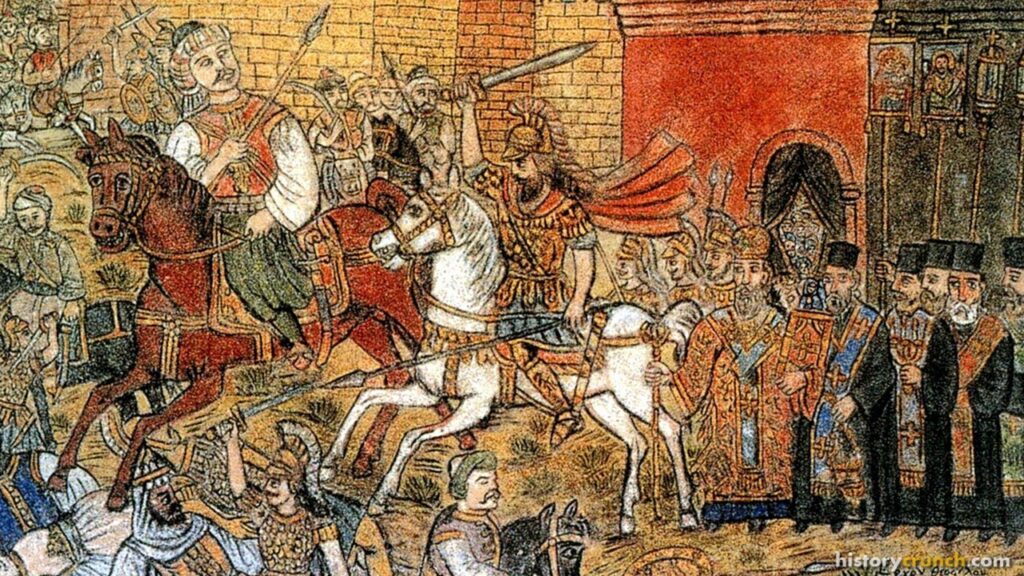
The city fell on 29 May 1453 after a fifty-three day siege. The last Byzantine emperor, Constantine XI, died in the fighting. The Roman Empire, in the form that had begun in 27 BCE, ended that morning.
LEARN MORESHOW LESSwhy it matters · key numbersWARScholars fled west with Greek manuscripts, feeding the Renaissance. The overland routes east became harder for European merchants, which is one of the reasons ships started looking for a way round Africa.
The French took Bordeaux in October 1453, ending 116 years of war. England kept only Calais. No treaty was signed; the fighting simply stopped.
LEARN MORESHOW LESSwhy it mattersWAREngland lost an empire in France and gained a civil war at home within two years, because the nobles who had been fighting abroad came back with armies and grievances.
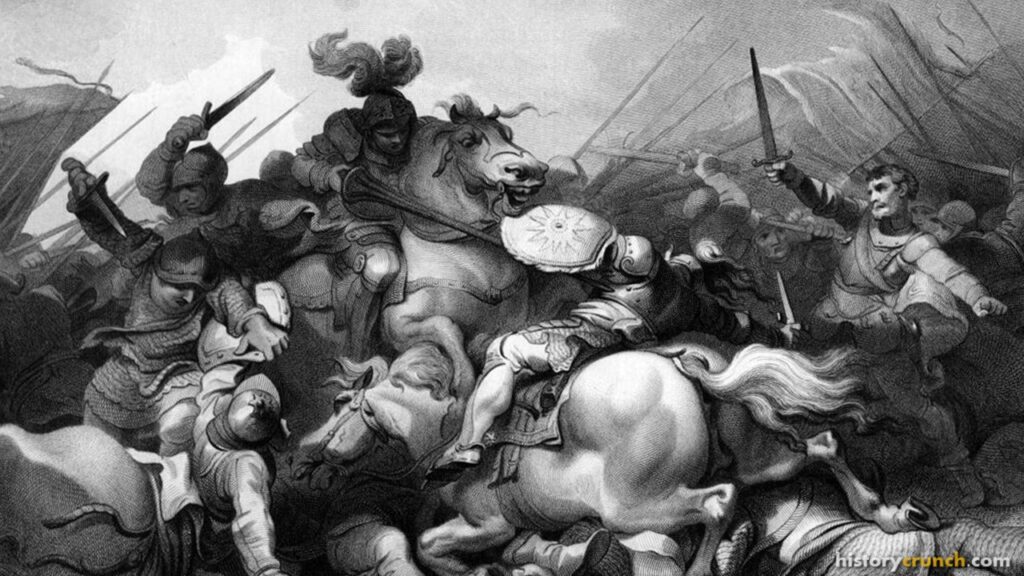
With Henry VI mentally incapacitated and the war in France lost, Richard, Duke of York, took up arms against the king's party in 1455. Thirty years of intermittent civil war followed.
LEARN MORESHOW LESSwhy it mattersWARTwo branches of the same family, both descended from Edward III, fought over a crown while the country paid for it. It ends at Bosworth in 1485 with a Tudor on the throne.
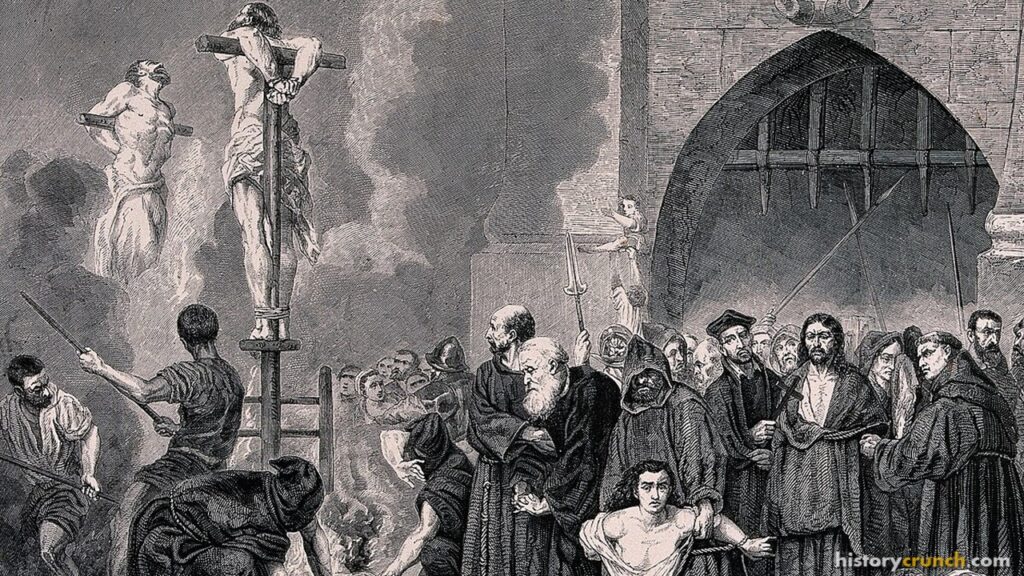
Ferdinand and Isabella obtained papal authority in 1478 to establish an inquisition in Castile, aimed at Jewish and Muslim converts suspected of practicing their old faiths in secret.
LEARN MORESHOW LESSwhy it mattersRELIGIONIt was a royal instrument, not merely a religious one: the monarchy appointed the inquisitors and took the property of the condemned. Religious unity was being used to build a unified state.
Tomás de Torquemada was appointed the first Grand Inquisitor in 1483. Thousands were tried under his authority and an estimated 2,000 were burned during his tenure.
LEARN MORESHOW LESSwhy it mattersRELIGIONTrials used torture, denunciation was anonymous, and the accused were not told who had accused them. The word inquisition means inquiry, and this is what it came to mean instead.
Henry Tudor beat Richard III at Bosworth Field in 1485 and put down the last Yorkist rising at Stoke Field in 1487, ending the wars and beginning the Tudor dynasty.
LEARN MORESHOW LESSwhy it mattersWARThe fighting ended because one family had killed enough of the other. Henry VII then married Edward IV's daughter, which is the most efficient peace treaty in English history.
On 31 March 1492, months after the fall of Granada completed the reconquest of Spain, Ferdinand and Isabella ordered all Jews who would not convert to Christianity to leave the country.
LEARN MORESHOW LESSwhy it mattersRELIGIONA community that had lived in Spain for more than a thousand years was given four months to go. The decree was not formally revoked until 1968.
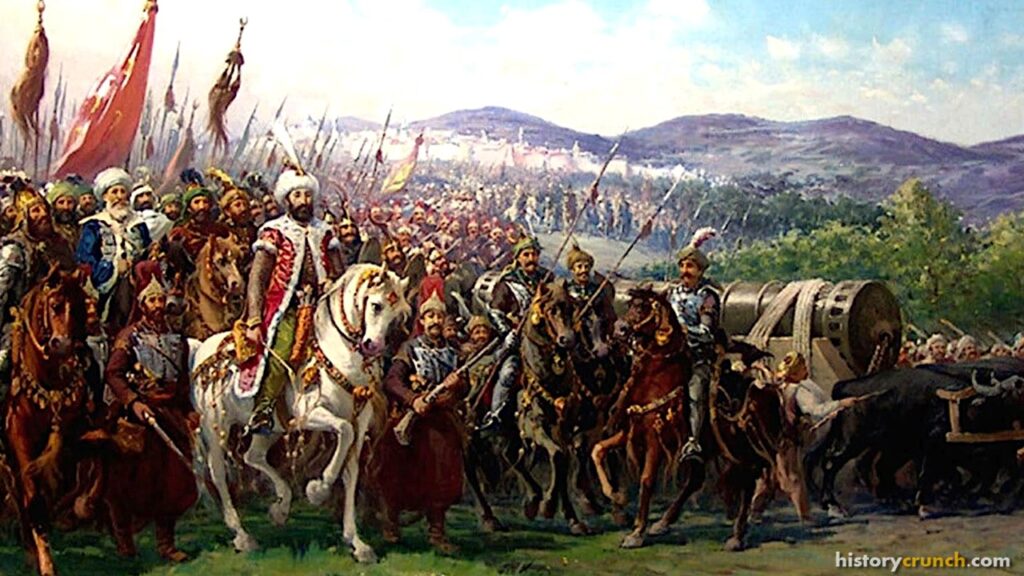
Christopher Columbus, funded by the same monarchs in the same year, made landfall in the Caribbean in October 1492 believing he had reached Asia.
LEARN MORESHOW LESSwhy it mattersEXPLORATIONThe Middle Ages ends here as much as anywhere. The Age of Exploration timeline picks this up on the same day and follows what it cost the people already living there.
Vasco da Gama sailed around Africa and reached Calicut in May 1498, opening a sea route to Asia that bypassed the overland routes entirely.
LEARN MORESHOW LESSwhy it mattersEXPLORATIONThe Silk Road had been the artery of Eurasian trade for fifteen hundred years. Within a generation of this voyage, the important routes were at sea and the old ones were a backwater.
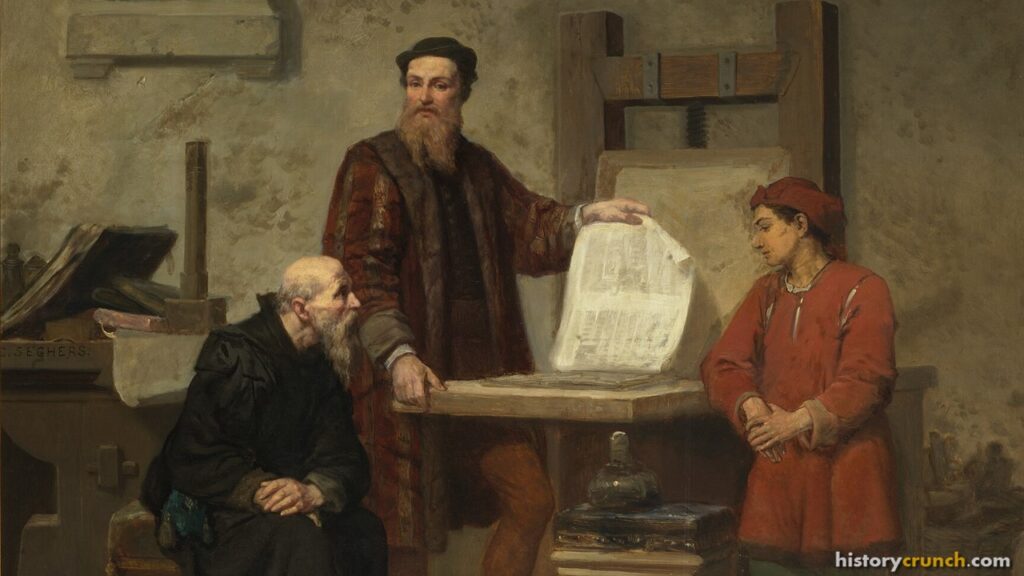
Historians place the end of the Middle Ages around 1500. What the period left includes universities, parliaments, common law, guilds and trade companies, cathedrals, the shape of most European nations, and the printing press that would take all of it apart and rebuild it.
LEARN MORESHOW LESSwhy it mattersIDEASIt is called the Middle Ages because Renaissance writers thought it was the gap between two better periods. Almost every institution a modern European lives under was invented during that gap.

I'm the founder of History Crunch, which I first began in 2015 with a small team of like-minded professionals. I have an Education Degree with a focus in Social Studies education. I spent nearly 15 years teaching history, geography and economics in secondary classrooms to thousands of students. Now I use my time and passion researching, writing and thinking about history education for today's students and teachers.

I'm a passionate history and geography teacher with over 15 years of experience working with students in the middle and high school years. I have an Education Degree with a focus in World History. I have been writing articles for History Crunch since 2015 and love the challenge of creating historical content for young learners!

K.L. is a content writer for History Crunch. She is a fantastic history and geography teacher that has been helping students learn about the past in new and meaningful ways since the mid-2000s. Her primary interest is Ancient History, but she is also driven by other topics, such as economics and political systems.
To cite this timeline as a source, use one of the formats below.
MLA: Millar, B., et al. “Middle Ages Timeline.” HistoryCrunch, 14 September 2026, https://historycrunch.com/middle-ages-timeline/.
APA: Millar, B., Beck, E., & Woida, K.L. (2026). Middle Ages Timeline. HistoryCrunch. https://historycrunch.com/middle-ages-timeline/
Chicago: Millar, B., Elias Beck, and K.L Woida. “Middle Ages Timeline.” HistoryCrunch. September 14, 2026. https://historycrunch.com/middle-ages-timeline/
© History Crunch
There was an emperor in the west in 475 and none in 477. There was also an empire calling itself Roman until 1453.
Roads, taxes, law courts and a standing army all stop working. What do people use instead?
Almost everything in this period was written by churchmen, about people who could not read.
Every textbook has the pyramid diagram. Historians point out that nobody in the Middle Ages ever drew it.
Nine people in ten on this timeline farmed. Almost none of them appear by name in any source.
In much of Europe a serf who lived in a town for a year and a day was free.
The law treated her as a dependant. The economy could not function without her work.
A guild of students hiring their own teachers, and fining them for turning up late.
Nobody who laid the first stone of a cathedral expected to see the roof go on.
Not a battle, not a coronation. A day.
He is called Great and he executed 4,500 prisoners in a day. Both are on the record.
Three claimants, two invasions three weeks apart, and one afternoon that decided it.
An emperor in the snow at Canossa, an archbishop dead on his own altar. It was not settled.
Sixty-three clauses, most of them about feudal dues and fish weirs, and three that changed the world.
It had no army worth the name and it could make an emperor stand in the snow.
Faith, land, debt, adventure and the promise that the journey itself would wipe away sin.
Four crusader states, none of which lasted, and a great deal that did.
The monks who wrote the sources were the people being robbed, which is worth remembering.
In 1206 they were feuding tribes. Within fifty years they ruled from Korea to Hungary.
Because they were not fighting continuously, and because neither could finish it.
At Crécy about a hundred Englishmen died and fifteen hundred French knights did not go home.
Four hundred years of building the strongest thing anybody knew how to build, ended by gunpowder.
Not a tragedy that passes. A change in the price of everything.
A tax, a labor shortage and a promise that was withdrawn within a fortnight.
The same disease, eight hundred years apart, in two very different worlds.
Pick your ending: a press, a cannon, a ship or a plague. Each has a case.
Historians argue about the end of the Middle Ages and about whether the label is any use. The term was coined by Renaissance writers who wanted to describe themselves as reviving antiquity after a long gap, which makes it a judgement rather than a description, and the word medieval still carries that insult. Others defend the period as a coherent unit with its own institutions, and point out that every attempt to replace the label has produced something worse. The dates are equally contested: 1453, 1492 and 1517 all have supporters, and Italy, England and Russia would each pick a different one.
Somebody in this period invented the university, the mechanical clock, the bank and the parliament.
She had no rank, no training and no business being there, and it worked.
It ended the Roman Empire, 1,480 years after it began, and almost nobody in the west helped.
Four of the other timelines start inside this one's last chapter.
No question matches that word.
Research question 1There was an emperor in the west in 475 and none in 477. There was also an empire calling itself Roman until 1453.
Research question 2Roads, taxes, law courts and a standing army all stop working. What do people use instead?
Research question 3Almost everything in this period was written by churchmen, about people who could not read.
Research question 4Every textbook has the pyramid diagram. Historians point out that nobody in the Middle Ages ever drew it.
Research question 5Nine people in ten on this timeline farmed. Almost none of them appear by name in any source.
Research question 6In much of Europe a serf who lived in a town for a year and a day was free.
Research question 7The law treated her as a dependant. The economy could not function without her work.
Research question 8A guild of students hiring their own teachers, and fining them for turning up late.
Research question 9Nobody who laid the first stone of a cathedral expected to see the roof go on.
Research question 10Not a battle, not a coronation. A day.
Research question 11He is called Great and he executed 4,500 prisoners in a day. Both are on the record.
Research question 12Three claimants, two invasions three weeks apart, and one afternoon that decided it.
Research question 13An emperor in the snow at Canossa, an archbishop dead on his own altar. It was not settled.
Research question 14Sixty-three clauses, most of them about feudal dues and fish weirs, and three that changed the world.
Research question 15It had no army worth the name and it could make an emperor stand in the snow.
Research question 16Faith, land, debt, adventure and the promise that the journey itself would wipe away sin.
Research question 17Four crusader states, none of which lasted, and a great deal that did.
Research question 18The monks who wrote the sources were the people being robbed, which is worth remembering.
Research question 19In 1206 they were feuding tribes. Within fifty years they ruled from Korea to Hungary.
Research question 20Because they were not fighting continuously, and because neither could finish it.
Research question 21At Crécy about a hundred Englishmen died and fifteen hundred French knights did not go home.
Research question 22Four hundred years of building the strongest thing anybody knew how to build, ended by gunpowder.
Research question 23Not a tragedy that passes. A change in the price of everything.
Research question 24A tax, a labor shortage and a promise that was withdrawn within a fortnight.
Research question 25The same disease, eight hundred years apart, in two very different worlds.
Research question 26Pick your ending: a press, a cannon, a ship or a plague. Each has a case.
Research question 27Somebody in this period invented the university, the mechanical clock, the bank and the parliament.
Research question 28She had no rank, no training and no business being there, and it worked.
Research question 29It ended the Roman Empire, 1,480 years after it began, and almost nobody in the west helped.
Research question 30Four of the other timelines start inside this one's last chapter.