The Mongol Empire was the largest continuous land empire in world history, and its rise reshaped much of Asia, the Middle East, and parts of Europe during the 1200s and 1300s. The Mongol Empire began in 1206 when Genghis Khan united Mongolian tribes, and it was founded by Genghis Khan, the first Great Khan or “universal ruler” of the Mongol peoples. From a small collection of nomadic tribes on the grasslands of Central Asia, the Mongols built a state that connected distant civilizations, controlled the trade routes of the Silk Road, and left a lasting mark on nearly every region it touched.
In simple terms, the Mongol Empire was a nomadic empire, meaning it was created by herding peoples who moved across open grasslands with their animals rather than living in permanent cities. It was built through conquest and held together by a highly organized army, a network of fast messengers, and a system of laws. At its center stood the Great Khan, the supreme ruler, while lower khans governed the different regions the empire absorbed.
What Was the Medieval World of Central Asia?
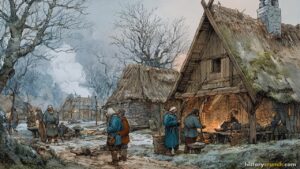
The Mongol Empire arose during the Middle Ages, a long period of European and Asian history that lasted roughly from the 5th century CE to the 15th century CE. In Central Asia, this era was defined by wide, treeless grasslands known as the steppe, where nomadic tribes raised horses, sheep, and cattle. These peoples were expert riders who lived much of their lives in the saddle.
Before the empire formed, the tribes of the Mongolian steppe were divided and often fought one another. There was no single ruler and no lasting peace, only shifting alliances and constant raiding. In fact, this competition for animals, grazing land, and power shaped the harsh world into which the empire’s founder was born.
Beyond the steppe lay wealthy settled civilizations, including the kingdoms of China, the Islamic empires of the Middle East, and the growing states of Eastern Europe. These regions had cities, farms, and treasure that the mobile steppe warriors would later target. As stated above, the meeting of the nomadic and settled worlds became one of the central features of Mongol history.
Who Was Genghis Khan?
The Mongol Empire was founded by a leader known to history as Genghis Khan. He was originally named Temujin, and he unified nomadic Mongol and Turkic groups under his leadership in the early 13th century. His early life was extremely difficult, and that hardship shaped the ruthless leader he became.
Genghis Khan was born to a royal clan of the Mongols, and when he was nine his father was poisoned and the young Temujin was held captive by his former supporters. Through skill, courage, and careful alliances, he slowly gathered followers and defeated rival tribes one by one. In 1206 he was accepted as emperor of all the steppe people and was proclaimed Genghis Khan, a title that means “universal ruler,” an event regarded as the beginning of the Mongol Empire.
Genghis Khan was more than a warrior. Many people were slaughtered in the course of his invasions, but he also granted religious freedom to his subjects, abolished torture, encouraged trade, and created the first international postal system. These policies helped turn a group of scattered tribes into a working state that could govern conquered lands.
How Did the Mongols Build Such a Large Empire?
The rapid growth of the Mongol Empire came mainly from its powerful army. Mongol armies were primarily cavalry, meaning soldiers who fought on horseback, and they used superior tactics, signals, and messenger services. The Mongols could ride enormous distances quickly, attack from many directions at once, and strike before their enemies were ready.
Genghis Khan also organized his forces in a fair and disciplined way. He employed several military and political strategies that contributed to the success of his empire, promoting his soldiers based on merit, distributing loot equally, and assimilating people from conquered groups into his ranks. More specifically, skilled workers and soldiers from defeated lands were often folded into the empire rather than simply destroyed.
The Mongols were not born experts at attacking walled cities, so they learned. They employed bows and arrows along with siege expertise borrowed from conquered peoples. Fear was also a weapon, since cities that surrendered were often spared, while those that resisted faced terrible destruction, a reputation that convinced many towns to give up without a fight.
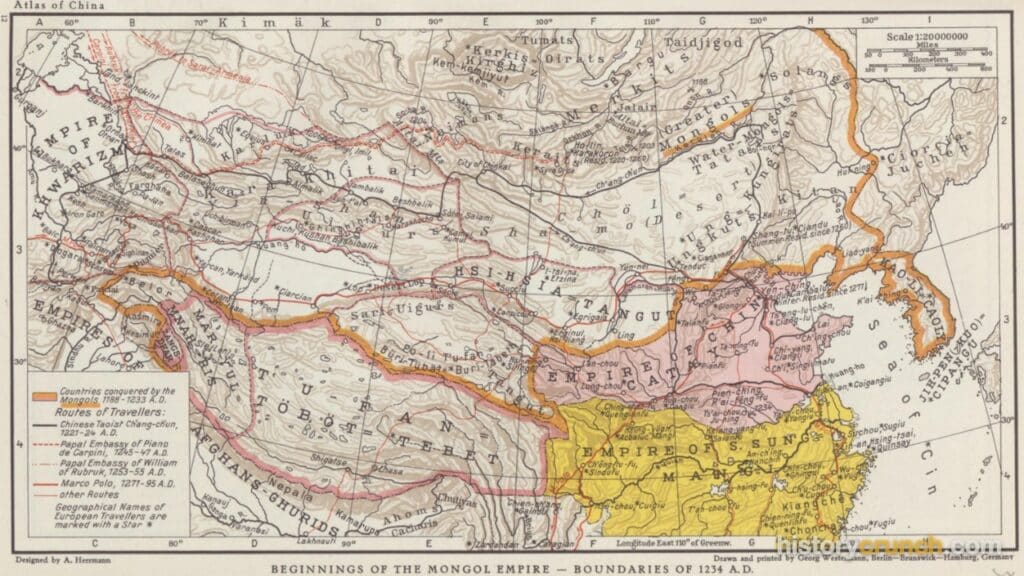
Under Genghis Khan and his early campaigns, the Mongols struck in many directions. Soon after unification, the Mongols captured Northern China and Siberia, and Genghis Khan’s fast-moving armies pushed westward into Central Asia and Persia as well.
How Far Did the Empire Spread?
After Genghis Khan died, his family carried the conquests even further. The Mongol Empire was led by the Golden Lineage, Genghis Khan’s children, after his death in 1227, and they went on to conquer the rest of Central Asia, parts of Russia and Europe, and southern China over the next fifty years. Few forces in the medieval world could stand against them.
At its greatest size, the empire was staggering. By the 13th century it stretched from the Pacific Ocean to the Danube River, covering approximately 9 million square miles, making it the largest contiguous land empire in history. This meant a single empire touched the coast of the Pacific in the east and reached the edge of Central Europe in the west, roughly 6,000 miles (9,600 km) across.
To govern such distances, the Mongols built a communication network of riders and relay stations. A well-organized messenger system covering most of Asia kept Mongol rulers aware of what was happening over the vast empire. Riders could change to fresh horses at stations along the routes, carrying orders and news across the empire with remarkable speed.
What Was the Pax Mongolica?
Once the fighting settled, the empire entered a calmer stage often called the Pax Mongolica, a Latin phrase meaning “Mongol Peace.” The Pax Mongolica describes a period of relative stability in Eurasia under the Mongol Empire during the 13th and 14th centuries, and it brought a period of stability among the people who lived in the conquered territory. With one empire controlling so much land, travel became far safer than before.
This peace had a huge effect on trade. After the death of Genghis Khan in 1227, the resulting empire extended from China’s Pacific coast to Eastern Europe, which meant that the Silk Road network, once dangerous to travel because of warring kingdoms, fell completely under Mongol control. Merchants, ideas, goods, and inventions now moved between East and West more freely than ever.
The Mongols also allowed conquered peoples to keep much of their own way of life. The Mongol Empire promoted artistry, technological innovations, and trade throughout its dominion, and after forcibly conquering a region, the Mongols sought to restore industries and centers of innovation under their rule. In reality, this mix of order and openness turned the empire into a bridge between distant civilizations.
How Did the Empire Break Apart?
The Mongol Empire did not last as one united state. Following a period of relative unity, the regime fractured over leadership skirmishes, and years after his passing, Genghis Khan’s grandchildren fought over inheritance and split the Mongol Empire into four parts. These four divisions were known as khanates, each ruled by a different branch of the family.
The descendants of Genghis each ruled a part of the empire, the four khanates, the most powerful of which was the Mongol Yuan Dynasty in China, established by Kublai Khan. One grandson, Kublai Khan, moved the empire’s capital toward the east. Kublai, a brother of the earlier Great Khan Möngke, was elected great khan and moved the empire’s capital to what is now Beijing.
Over time, the khanates drifted apart and grew weaker. Feuding among khanates and shifts of power to bureaucrats led to the empire’s decline, and by 1368 the Mongols lost China to the Ming dynasty. As settled peoples reclaimed their lands, the once unstoppable empire faded from power.
Even as they lost their unity, the Mongols themselves changed. Eventually, the Mongols became part of the sedentary societies they had so easily overwhelmed, and many converted from traditional shamanism to Tibetan Buddhism or Islam. The rulers who had once swept out of the steppe slowly blended into the civilizations they had conquered.
Significance of Mongol Empire
The Mongol Empire is one of the most important states in world history because of both its size and its lasting effects. Established by Genghis Khan in 1206, it was the largest contiguous empire in recorded history, a record that still stands today. Its story shows how quickly a united and disciplined people could reshape the map of the medieval world.
Its most important legacy was connection. By controlling the Silk Road and keeping it safe, the empire allowed trade goods, technology, religions, and ideas to flow between Asia, the Middle East, and Europe on a scale never seen before. This exchange helped spread inventions and knowledge across continents that had once been almost cut off from each other.
The empire also left a darker legacy of destruction. Many of the Mongol invasions included large-scale slaughters of local populations, and as a result Genghis Khan and his empire have a fearsome reputation in local histories. Because of this, the Mongols are remembered both as brutal conquerors and as builders of an age of exchange, a combination that makes the empire one of the most studied subjects in world history.
Frequently Asked Questions
When did the Mongol Empire begin and end?
The Mongol Empire began in 1206 CE and ended during the 14th century CE. It started when Genghis Khan united the Mongol tribes, and its power in China finally collapsed in 1368 when the Ming dynasty took control. In total, the empire lasted for roughly 160 years across the 1200s and 1300s.
Who was the most famous leader of the Mongol Empire?
Genghis Khan is by far the most famous leader of the Mongol Empire. He founded the empire and led its first great wave of conquests before his death in 1227. His grandson Kublai Khan is also well known, especially for ruling China as the first emperor of the Yuan Dynasty.
Why were the Mongols so successful in battle?
The Mongols were successful because of their skilled cavalry, discipline, and clever use of fear. Mongol soldiers grew up riding and shooting bows from horseback, which made them fast and deadly. They also carried their own supplies, used spies to gather information, and spread terrifying stories so that many enemies surrendered without fighting.
What were the four khanates of the Mongol Empire?
The four khanates were the separate regions the empire split into after Genghis Khan’s family fought over power. They included the Yuan Dynasty in China, the Golden Horde in Russia, the Chagatai Khanate in Central Asia, and the Ilkhanate in Persia. Each was ruled by a different branch of Genghis Khan’s descendants.
Did the Mongols allow religious freedom?
Yes, the Mongols were unusually tolerant of different religions for their time. They generally allowed conquered peoples to keep their own faiths and customs rather than forcing them to convert. Over time many Mongols themselves adopted the religions of the lands they ruled, including Islam in the west and Buddhism in the east.
Cite This Article
To cite this article as a source, use one of the formats below.
MLA: Millar, B. “Mongol Empire: A Detailed Summary.” HistoryCrunch, 26 July 2026, https://historycrunch.com/mongol-empire/.
APA: Millar, B. (2026). Mongol Empire: A Detailed Summary. HistoryCrunch. https://historycrunch.com/mongol-empire/
Chicago: Millar, B. “Mongol Empire: A Detailed Summary.” HistoryCrunch. July 26, 2026. https://historycrunch.com/mongol-empire/
Sources
- David Morgan, The Mongols.
- The Met (Heilbrunn Timeline) — Mongol/Yuan/Ilkhanid art
- Timothy May, The Mongol Empire.
- Marie Favereau, The Horde: How the Mongols Changed the World.