Medieval weapons and armor were an essential part of life during the Middle Ages, shaping the way wars were fought and determining who survived on the battlefield. From the sword carried by a mounted knight to the longbow used by ordinary foot soldiers, the weapons of the Middle Ages were carefully designed for the demands of medieval warfare. As well, the armor worn by knights and soldiers evolved significantly over the course of the Middle Ages as new weapons were developed and military technology improved.
 FactsthatCrunch
What Were the Middle Ages?
The Middle Ages, also known as the Medieval Period, lasted for approximately 1000 years from the 5th century to the 15th century. Due to its timeframe, the Middle Ages in Europe is divided into three smaller periods referred to as the Early, High, and Late Middle Ages. Life in the Middle Ages was characterized by religious faith in the Catholic Church and the social structure of feudalismA rigid, hierarchical system of government that structured medieval European society around an absolute monarch holding all power.. Feudalism was a form of government common during medieval Europe that involved society being structured in a very rigid and hierarchical way. It was popular in European society from the 9th century until the 15th century and was the form of government in which the country was dominated by an absolute monarch, in which all power was held within a single king. Warfare was a constant feature of the Middle Ages, and as such, weapons and armor were among the most important and valuable items that a person could own during this period.
Medieval Weapons – Sword
The sword was the most important and iconic weapon of the Middle Ages and was most closely associated with the knights who dominated medieval warfare. More specifically, the sword was not only a weapon but also a symbol of a knight’s honor, status, and identity. In fact, the sword played a central role in the ceremony in which a young man was officially made a knight, and many swords were blessed by priests and treated with deep religious significance. Medieval swords were typically made of iron or steel, had a double-edged blade, and were designed for both cutting and thrusting in close combat.
The design of the medieval sword changed significantly over the course of the Middle Ages. For example, in the Early Middle Ages swords tended to have broader, heavier blades designed mainly for slashing. As armor technology improved during the High and Late Middle Ages, sword designs adapted accordingly, with blades becoming more pointed and narrow to allow knights to thrust their swords through the gaps in an enemy’s armor. A typical sword blade during the High Middle Ages measured approximately 70 to 80 centimeters (28 to 31 inches) in length. As well, larger two-handed swords, sometimes called great swords or longswords, were also developed, measuring over 5 feet (1.5 meters) in length, and were capable of delivering devastating blows in open battle.
How did sword blade design change to defeat improved armor in the High and Late Middle Ages?
Medieval Weapons – Lance
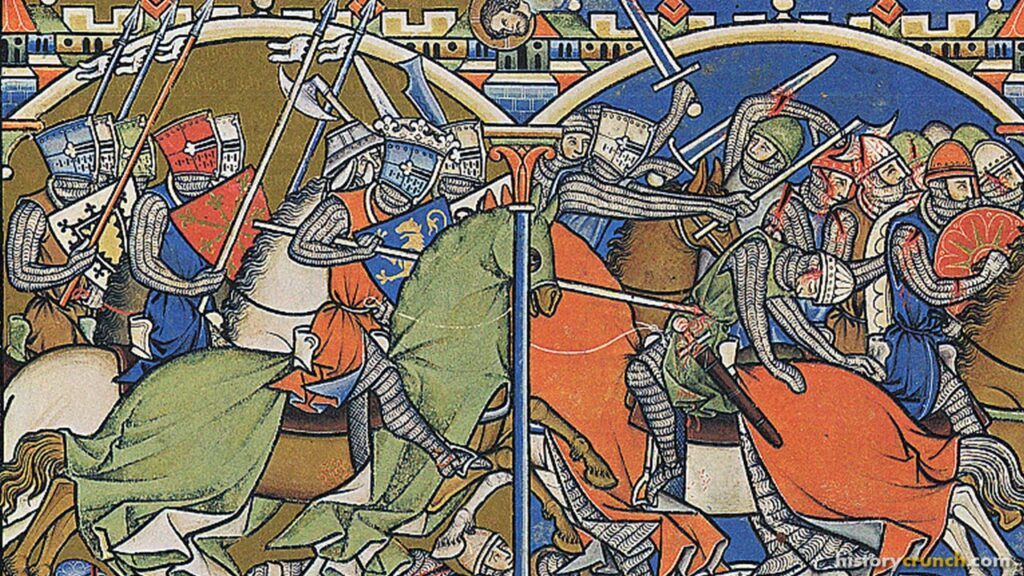
The lance was the primary weapon used by mounted knights when charging into battle on horseback. It was a long wooden pole with a sharp metal tip at the end, and its great length gave the mounted knight a significant advantage over enemy foot soldiers who could not easily reach him. For instance, when a mounted knight charged at full speed with a lance lowered toward his enemy, the combined momentum of the horse and rider made the lance an extraordinarily powerful weapon capable of piercing even heavy armor. In fact, two knights charging each other at full speed could reach a combined impact speed of approximately 60 miles per hour (97 kilometers per hour), making the lance one of the most dangerous weapons on the medieval battlefield.
As well, the lance was an important weapon in tournaments, which were competitions in which knights practiced their fighting skills. In tournaments, lances were sometimes made of hollow wood with rounded tips to reduce the risk of serious injury, though accidents were still common. The lance was closely associated with the ideals of chivalryA code of knightly ideals involving honor and noble conduct, closely associated with weapons like the lance. and knightly honor that were so important in medieval noble culture.
FactsthatCrunchTwo Knights Charging with Lances in the Middle Ages Closed at a Combined Speed of 60 mph
When two mounted knights charged each other at full speed with lances lowered, each rider traveled at roughly 30 mph (48 km/h), but the combined closing speed at the moment of impact reached approximately 60 mph (97 km/h). That is about as fast as a car on a highway, which helps show why a lance strike could pierce even heavy armor. The force of the horse, rider, and armor all traveled into the lance tip at the same instant, making the charge one of the most powerful attacks on the medieval battlefield.
Medieval Weapons – Mace, Axe and Dagger
Knights and soldiers in the Middle Ages carried a variety of weapons beyond the sword and lance. The mace was a heavy club with a large metal head, designed to crush and batter an opponent rather than cut them. For example, the mace was particularly effective against heavily armored enemies, as it could inflict serious injury through armor by the force of its blow even when it could not penetrate the metal directly. As armor became heavier and more complete during the later Middle Ages, blunt weapons such as the mace and the war hammer became increasingly important on the battlefield.
The battle axe was another common weapon of the Middle Ages, used by both knights and ordinary foot soldiers. Axes were cheaper to produce than swords and could be highly effective in close combat. Furthermore, the dagger was an essential secondary weapon carried by almost every soldier and knight during the Middle Ages. Daggers were short, pointed blades designed for close combat and were often used as a weapon of last resort when a knight had lost or broken his primary weapon. More specifically, daggers were also used to deliver the final blow to a fallen enemy by thrusting through the gaps in their armor, a practice that gave some daggers the name misericordeA dagger used to deliver a finishing thrust through gaps in a fallen enemy’s armor; the name means mercy blow in French., meaning mercy blow in French.
FactsthatCrunchA misericorde was a short, narrow dagger used to deliver a finishing thrust through the gaps in a fallen enemy's armor. Knights and soldiers carried it as a secondary weapon when close combat had brought an opponent to the ground. The name comes from the French word for mercy, reflecting the idea that the blow ended a wounded enemy's suffering.
When a heavily armored knight fell in close combat, a soldier could use a misericorde to thrust through the gaps in the fallen knight's armor and deliver a finishing blow.
Medieval Weapons – Longbow and Crossbow
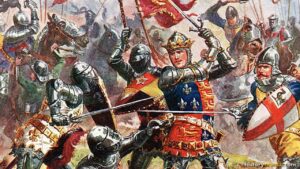
Not all medieval weapons were designed for close combat. The longbow and the crossbow were two of the most important ranged weapons of the Middle Ages and played a major role in some of the period’s most famous battles. The longbow was a tall bow, typically made from yew wood in England, that could fire arrows with great accuracy and force at distances of up to 250 yards (229 meters). For instance, the longbow proved devastatingly effective at the Battle of Crécy in 1346, the Battle of Poitiers in 1356, and the Battle of Agincourt in 1415, where English and Welsh longbowmen cut down large numbers of heavily armored French knights with rapid and accurate fire.
The crossbow was another important ranged weapon, particularly popular in continental Europe. It was easier to use than the longbow and required less physical strength and training to operate effectively. As such, crossbowmen could be recruited and trained much more quickly than longbowmen, making the crossbow a practical choice for rulers who needed to field large armies quickly. With that said, the crossbow fired more slowly than the longbow, which was a significant disadvantage in battle. Both weapons changed the nature of medieval warfare significantly by allowing foot soldiers to kill armored knights from a safe distance.
FactsthatCrunchEnglish longbowmen valued their weapon's rapid rate of fire above all else. A trained longbowman could loose many arrows per minute, which made it possible to send dense waves of arrows into advancing enemy formations. At Crécy in 1346 and Agincourt in 1415, that speed of fire proved decisive against French knights.
Commanders on the continent favored the crossbow because it required far less physical strength and training time to use effectively. A ruler who needed a large army quickly could recruit and equip crossbowmen in a fraction of the time it took to produce a skilled longbowman. The slower rate of fire was a real drawback, but the practical ease of building crossbow units outweighed it for many European armies.
Medieval Armor – Chain Mail
Just as weapons evolved over the course of the Middle Ages, so too did the armor worn by soldiers and knights. In the Early and High Middle Ages, the most common type of armor was chain mailArmor made from thousands of small interlocking metal rings linked together to form a flexible protective garment., which was made from thousands of small interlocking metal rings linked together to form a flexible protective garment. The most typical piece of chain mail armor was a long tunic called a hauberkA long chain mail tunic covering the body from shoulders to knees, the most common piece of mail armor in the Early and High Middle Ages., which covered the body from the shoulders to the knees. A chain mail hauberk could weigh as much as 30 pounds (14 kilograms) and was worn over a padded undergarment called a gambesonA padded undergarment worn beneath chain mail to absorb the impact of blows., which helped absorb the impact of blows.
Chain mail was effective at protecting against cutting weapons but had significant weaknesses. For example, it could be pierced by arrows and by pointed weapons such as lances and daggers, and it did not provide good protection against blunt force from weapons such as the mace. As well, chain mail was expensive and time-consuming to produce, meaning that it was mainly worn by knights and wealthy soldiers rather than ordinary foot soldiers, who often fought with little or no protective armor at all.
FactsthatCrunchWhat were the main weaknesses of chain mail armor in the Middle Ages?
Medieval Armor – Plate Armor
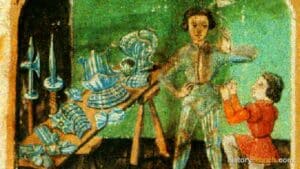
As the Middle Ages progressed, knights began to supplement their chain mail with additional pieces of solid metal plate armorSolid overlapping metal plates shaped to deflect blows and cover the entire body, standard equipment for the wealthiest knights by about 1420 CE. placed over the most vulnerable parts of the body, such as the chest, knees, and elbows. By the 14th century this had developed into increasingly complete sets of plate armor, and by approximately 1420 CE full head-to-toe plate armor had become the standard equipment of the wealthiest and most powerful knights in Europe. This is the image of the knight in shining armor that most people recognize from popular culture today.
Full plate armor was extraordinarily expensive and could take a skilled armorer months to produce. For instance, a complete suit of plate armor in the 15th century could cost roughly the same as a small farm, placing it well beyond the reach of all but the wealthiest members of society. With that said, a well-made suit of plate armor was also highly effective at protecting its wearer. The overlapping plates were carefully shaped to deflect blows and cover every part of the body, and a fully armored knight was almost impossible to kill with ordinary cutting weapons. As such, this drove further developments in weapons such as the war hammer, the crossbow, and eventually early firearms, all of which were designed to overcome the protection offered by plate armor.
FactsthatCrunchHow much did a suit of plate armor cost in the 15th century, and why was it so expensive?
A complete suit of plate armor in the 15th century could cost roughly the same as a small farm, putting it far out of reach for ordinary people. The price was so high because a skilled armorer needed months to shape and fit the overlapping metal plates that covered every part of the body. Only the wealthiest and most powerful knights in Europe could afford a full set.
Significance of Medieval Weapons and Armor
Medieval weapons and armor were far more than just tools of warfare. They were symbols of power, wealth, and social status, and their development over the course of the Middle Ages tells the story of how warfare itself changed during this period. For example, the gradual development from chain mail to full plate armor, and from simple swords to sophisticated pointed blades designed to exploit gaps in armor, shows how medieval warfare was a constant competition between attack and defense in which each new development in one area drove new developments in the other. In all, the weapons and armor of the Middle Ages helped shape the major events of the period, from the Crusades to the Hundred Years War, and are an essential part of understanding how medieval people lived, fought, and died.
FactsthatCrunchWhat drove the shift from chain mail to plate armor in the Middle Ages, and what forces were pushing beneath the surface?
Explore Middle Ages · 476 – 1500 CE
Keep exploring Middle Ages with these History Crunch resources.
Key Vocabulary
Feudalism
Hauberk
Gambeson
Misericorde
Chivalry
Chain mail
Plate armor
Frequently Asked Questions
What was the most important weapon in the Middle Ages?
The sword was the most important and iconic weapon of the Middle Ages. It was closely tied to knights and served as a symbol of honor, status, and identity. Many swords were even blessed by priests and used in the ceremony that made a young man a knight.
Why did knights switch from chain mail to plate armor?
Knights switched to plate armor because chain mail could be pierced by arrows, lances, and daggers. Chain mail also gave poor protection against blunt weapons like the mace. By about 1420 CE, full head-to-toe plate armor had become standard for the wealthiest knights in Europe.
How far could a medieval longbow shoot?
An English longbow could fire arrows with force and accuracy at distances up to 250 yards (229 meters). It was usually made from yew wood and needed years of training to use well. Longbowmen proved deadly against French knights at battles like Crécy, Poitiers, and Agincourt.
What was the difference between a longbow and a crossbow?
The main difference was that the crossbow was easier to use and needed less strength and training. This let rulers recruit and train crossbowmen quickly for large armies. The longbow, however, could fire much faster, which gave it a big advantage during battle.
How much did a suit of plate armor cost?
A complete suit of plate armor in the 15th century could cost roughly the same as a small farm. It took a skilled armorer months to build and was far beyond the reach of ordinary people. Because of this, full plate armor was worn only by the wealthiest and most powerful knights.
What weapons were used against heavily armored knights?
Blunt weapons such as the mace and war hammer were used against heavily armored knights. These weapons could injure through armor by force even without piercing the metal. As plate armor improved, crossbows and early firearms were also developed to defeat it.
Cite This Article
To cite this article as a source, use one of the formats below.
MLA: Beck, Elias. “Medieval Weapons and Armor: A Detailed Summary.” HistoryCrunch, 15 October 2026, https://historycrunch.com/medieval-weapons-and-armor/.
APA: Beck, E. (2026). Medieval Weapons and Armor: A Detailed Summary. HistoryCrunch. https://historycrunch.com/medieval-weapons-and-armor/
Chicago: Beck, Elias. “Medieval Weapons and Armor: A Detailed Summary.” HistoryCrunch. October 15, 2026. https://historycrunch.com/medieval-weapons-and-armor/
Sources
- Jacques Le Goff, Medieval Civilization 400-1500.
- Chris Wickham, Medieval Europe.