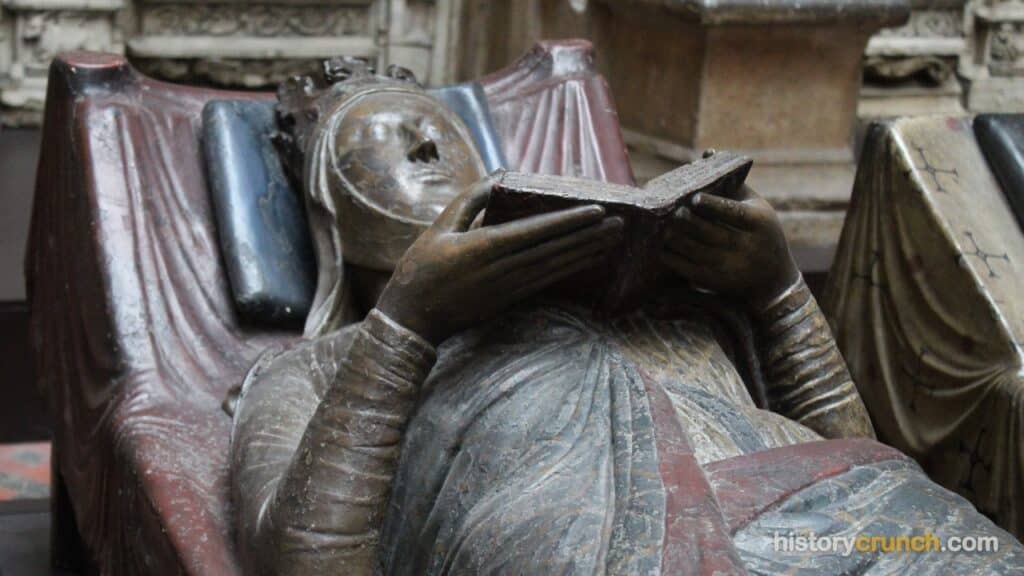
Eleanor of Aquitaine was one of the most powerful women in Europe during the Middle Ages, a period in European history that lasted from roughly 500 to 1500 CE. She was Queen of France from 1137 to 1152 as the wife of King Louis VII, Queen of England from 1154 to 1189 as the wife of King Henry II, and Duchess of Aquitaine in her own right from 1137 until her death in 1204. Over a long and dramatic life she helped lead a crusade, ruled great stretches of land, and became the mother of two kings of England.
A duchess is a noblewoman who rules a large territory called a duchy, and a queen consort is the wife of a reigning king. Eleanor was unusual because she was not only the wife of two kings but also a ruler in her own right. As the heiress of the House of Poitiers, which controlled much of southwestern France, she was one of the wealthiest and most powerful women in western Europe during the High Middle Ages. This combination of wealth and independence made her a central figure in the politics of both France and England.
Early Life and Background
Eleanor was born around 1122 in what is now southwestern France. Eleanor was the eldest daughter of William X, Duke of Aquitaine, and Aénor de Châtellerault. Her father ruled one of the largest and richest regions in France, which gave her family enormous importance.
She received an unusually strong education for the time. She was well educated by her cultured father, thoroughly versed in literature, philosophy, and languages and trained to the rigors of court life when she became her father’s heir presumptive at the age of 5. An heir presumptive is a person expected to inherit a title unless a more direct heir is born first.
In fact, Eleanor grew up surrounded by the lively culture of the south of France, where poets called troubadours performed songs about love and courtly manners. An avid horsewoman, she led an active life until she inherited her father’s title and extensive lands upon his death when she was 15, becoming in one stroke duchess of Aquitaine and by far the most eligible single young woman in Europe. Suddenly, the teenage Eleanor controlled a territory that made her one of the most sought-after brides on the continent.
Rise to Power
Eleanor’s inheritance quickly led to marriage. She became duchess upon her father’s death in April 1137, and three months later she married Louis, son of her guardian King Louis VI of France. The wedding tied her vast lands to the French crown.
The marriage made her queen almost immediately. A few weeks later, Eleanor’s father-in-law died and her husband succeeded him as Louis VII. As stated above, Eleanor became queen of France, a title she held for the next 15 years.
Life at the French court was a difficult adjustment for her. The French court was austere, pious, and dominated by the influence of Abbot Suger and the monastic reformer Bernard of Clairvaux, and Eleanor, accustomed to the lively troubadour culture of the south, found the northern court stifling. More specifically, she brought poets and musicians north with her, which set her apart from the serious, religious atmosphere that Louis preferred.
The Second Crusade
One of the boldest events in Eleanor’s life was her decision to join a crusade. A crusade was a religious war launched by Christian Europe to gain or defend control of the Holy Land in the Middle East. In 1147, Eleanor took the extraordinary step of accompanying Louis VII on the Second Crusade, and she was not content to wait at home, riding to the Holy Land with her own entourage of Aquitanian ladies.
Eleanor was not simply a passenger on this journey. People from her lands made up the bulk of the French forces, and she accompanied them as their leader, the Duchess of Aquitaine. This made her one of the very few women of the age to travel with an army on such a mission.
The expedition ended badly for the crusaders. The crusade was a military disaster, and the royal marriage frayed under the strain. In reality, her enemies later blamed her for the failure, spreading rumors that were often exaggerated or untrue. Critics of Eleanor delighted in spreading rumors about her, detailing her excesses and blaming her for military failures, and many of these misconceptions have lingered until this day.
Trouble on the crusade damaged the royal marriage beyond repair. Eleanor’s conduct during this expedition, especially at the court of her uncle Raymond of Poitiers at Antioch, aroused Louis’s jealousy and marked the beginning of their estrangement. The couple also lacked a son, which was a serious problem for a king who needed a male heir. After their return to France and a short-lived reconciliation, their marriage was annulled in March 1152.
Queen of England
The end of one marriage led swiftly to another. Because feudal custom allowed her to keep her lands, Eleanor regained full control of Aquitaine, which made her once again a powerful and desirable partner. Feudal custom worked to her advantage and she retained possession of the duchy of Aquitaine, which was approximately one third of France at the time, and she wasted little time in remarrying, within two months wedding the future King of England, who was at the time count of Anjou and Duke of Normandy.
Her new husband was Henry of Anjou, who soon became King Henry II of England in 1154. Together they founded a powerful ruling family. With her husband, Henry II, she founded the Plantagenet dynasty in England, and during her lifetime also controlled a great deal of France. A dynasty is a line of rulers from the same family who pass power from one generation to the next.
Eleanor and Henry built a large family and an even larger empire. The royal couple had eight children, five sons and three daughters, and Queen Eleanor remained heavily involved in the ruling of King Henry II’s vast empire in France and England. Two of her sons, Richard and John, would each become king of England.
Rebellion and Imprisonment
The marriage between Eleanor and Henry eventually broke down, and their conflict spilled into open rebellion. In 1173, Henry’s sons started a revolt against their father with Eleanor siding with her sons. This was a dangerous choice, because it placed her directly against the king of England.
Henry crushed the uprising and punished his wife severely. Henry stifled the revolt and, as punishment for her involvement, confined her. Eleanor remained a prisoner for many years, though she was not treated harshly. Fine clothes for Eleanor and her household seem to have been dispatched regularly from London, and between 1175 and 1180 the sheriff of Wiltshire spent large amounts of money on the queen’s maintenance at the castle.
Her long captivity finally ended when her husband died. Henry II died in July 1189 and their son Richard succeeded him, and one of his first acts was to free his mother from prison and restore her to full freedom. After years of confinement, Eleanor returned to public life with remarkable energy.
Later Life
In her later years, Eleanor became one of the most capable rulers in Europe, even though she was well into old age. During the last 15 years of her life Eleanor displayed extraordinary abilities as a ruler, as Richard spent most of his time away on crusade and Eleanor acted as vice regent along with her younger son, John. A regent is someone who governs a kingdom when the king is absent or unable to rule.
Her most famous act during this time was rescuing her son Richard I. When her beloved son Richard I departed on the Third Crusade, Eleanor served as regent of England, and when Richard was captured and held for ransom by the Holy Roman Emperor, it was Eleanor who marshaled the resources to secure his release. A ransom is a large payment demanded in exchange for the release of a captive.
Eleanor stayed active in politics almost until her death. After Richard’s death in 1199, Eleanor supported the succession of her youngest son John, traveling across the Pyrenees at the age of seventy-seven to fetch her granddaughter Blanche of Castile, who would marry the future Louis VIII of France and eventually become one of the most powerful regents in French history. For instance, this journey through the mountains at such an advanced age showed the determination that marked her entire life. Eleanor of Aquitaine died on April 1, 1204, at Fontevrault in Anjou, France.
Significance of Eleanor of Aquitaine
Eleanor of Aquitaine mattered because she held real power in an era when few women could. As the queen consort of King Louis VII of France and of King Henry II of England, and as the mother of King Richard I and King John, she held the spotlight, wielding power over the most important men of her time. Her ability to govern lands, lead armies, and shape royal politics made her stand out sharply among the rulers of the age.
She also left a lasting mark on culture. She was instrumental in turning the court of Poitiers, then frequented by the most famous troubadours of the time, into a centre of poetry and a model of courtly life and manners. In this way, she helped spread the ideas of courtly love and chivalry that shaped European literature for centuries.
Finally, her family connections shaped the future of Europe. She has been called the “Grandmother of Europe” due to many of her descendants becoming kings, queens or empresses. Through her children and grandchildren, Eleanor’s influence reached far beyond her own lifetime and across many royal courts.
Frequently Asked Questions
Who was Eleanor of Aquitaine?
Eleanor of Aquitaine was a powerful medieval noblewoman who ruled the duchy of Aquitaine and became queen of both France and England. She lived from about 1122 to 1204 and was known for her wealth, intelligence, and long involvement in European politics. Few women of the Middle Ages held as much influence over so many kings and kingdoms.
Why did Eleanor of Aquitaine have her first marriage annulled?
Her marriage to Louis VII of France was annulled in 1152, officially on the grounds that the couple were too closely related by blood. In truth, the marriage had failed for several reasons, including tensions that arose during the Second Crusade and the fact that Eleanor had given Louis two daughters but no son. An annulment is a legal ruling that a marriage was never valid.
Who were Eleanor of Aquitaine’s most famous children?
Her two most famous children were Richard I, often called Richard the Lionheart, and John, who both became kings of England. Richard is remembered as a warrior king who spent much of his reign on crusade, while John is known for the troubles of his reign that later led to the famous charter of rights known as the Magna Carta. Eleanor had eight children in total with Henry II.
Why was Eleanor of Aquitaine imprisoned?
Eleanor was imprisoned by her second husband, Henry II of England, because she supported a rebellion by their sons against him in 1173. Henry defeated the revolt and kept her confined for roughly 16 years, though she lived in relative comfort. She was finally freed in 1189 when her son Richard became king.
How did Eleanor of Aquitaine die?
Eleanor died on April 1, 1204, at the abbey of Fontevrault in France, where she had spent her final years. She lived to be around 82, an unusually long life for the Middle Ages, and remained politically active until nearly the end. She was buried at Fontevrault alongside members of her family.
Cite This Article
To cite this article as a source, use one of the formats below.
MLA: Millar, B. “Eleanor of Aquitaine: A Detailed Biography.” HistoryCrunch, 26 July 2026, https://historycrunch.com/eleanor-of-aquitaine/.
APA: Millar, B. (2026). Eleanor of Aquitaine: A Detailed Biography. HistoryCrunch. https://historycrunch.com/eleanor-of-aquitaine/
Chicago: Millar, B. “Eleanor of Aquitaine: A Detailed Biography.” HistoryCrunch. July 26, 2026. https://historycrunch.com/eleanor-of-aquitaine/
Sources
- Jerry Bentley & Herbert Ziegler, Traditions & Encounters: A Global Perspective on the Past.
- J.M. Roberts & Odd Arne Westad, The Penguin History of the World.