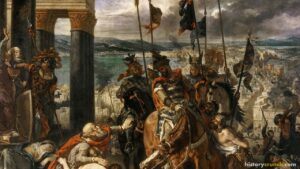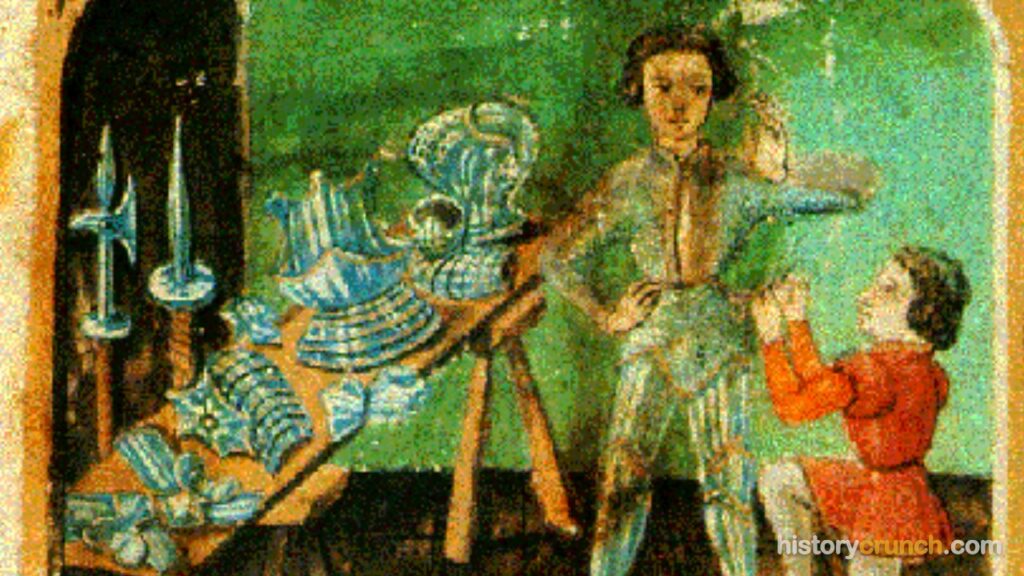
The weapons of a medieval knight were among the most important tools of warfare in Europe during the Middle Ages, and they helped define how battles were fought for hundreds of years. A knight was a heavily armed and armored warrior who usually fought on horseback and served a king or noble lord. To carry out this role, a knight relied on a range of weapons, including the sword, lanceA long wooden pole with a sharp iron tip used by mounted knights to strike enemies from a distance., maceA club with a heavy metal head that crushed with brute force rather than cutting, useful against armored enemies., battle-axe, war hammer, and dagger. Each weapon was designed for a specific purpose, and a skilled knight was expected to master all of them over years of training.
In simple terms, a knight’s weapons were the offensive equipment he used to attack and defeat enemies in combat, both while mounted on a warhorse and while fighting on foot. These weapons were often expensive and finely made, which meant that only wealthy nobles could afford a full set. As a result, a knight’s weapons were not only tools of battle but also symbols of his status, wealth, and honor in medieval society.
 FactsthatCrunch
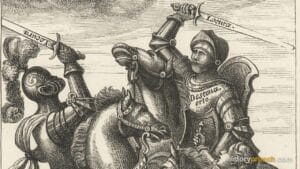
The medieval lance was a long wooden pole tipped with a sharp iron point, used by mounted knights charging at full speed toward enemy lines. As the Middle Ages progressed, lances grew sturdier and were fitted with handguards and specialized metal tips to make them more effective in battle. In tournaments, knights used hollow wooden lances with rounded tips to reduce the risk of serious injury during practice contests.
Today, the lance survives in the ceremonial role of mounted cavalry units such as the Household Cavalry of the British Army, whose troopers carry lances during state occasions and royal escorts. These modern lances are lighter than their medieval predecessors and are carried as symbols of military tradition rather than as weapons of war. The form of the weapon, a long pole held upright by a mounted soldier, remains recognizable after more than 800 years.
The lance moved from the front lines of medieval battle to the parade ground, but its shape and its connection to mounted military honor have changed very little.
What Were the Middle Ages?
The Middle Ages was a period in European history that lasted for approximately 1,000 years, from the 5th century to the 15th century CE. Because of its long timeframe, historians divide the Middle Ages into three smaller periods known as the Early, High, and Late Middle Ages. It was a time shaped by feudalismThe political, economic, and social system where kings granted land to lords, who granted land to knights for military service., the power of the Catholic Church, frequent warfare, and the rise of powerful kings and nobles.
Knights first appeared during the Early Middle Ages, when rulers such as Charlemagne began to rely on mounted warriors to fight across their large territories. Over time, knights became central figures in the feudal system, which was the political, economic, and social structure of medieval Europe. Under feudalism, a king granted land to noble lords, and those lords in turn granted smaller pieces of land to knights in exchange for military service. In this way, the knight’s weapons were tied directly to his duties within medieval society.
Why Was the Sword the Most Important Knightly Weapon?
The sword was the most important and prized weapon of a medieval knight. It was made of iron or steel, and it was long, heavy, and sharp enough to sever a limb with a single powerful blow. In fact, the sword was so central to a knight’s identity that it played a role in the ceremony that made him a knight, and the blade was often blessed by a priest before use.
There were several different types of swords used during the Middle Ages. The most common was the arming swordA one-handed sword about 30 inches long that a knight often carried alongside a shield., which was a one-handed weapon about 30 inches (76 cm) long that a knight often used together with a shield. Larger two-handed swords, sometimes called great swords or longswords, had blades that could reach around 3 feet (1 m) in length and required both hands to swing. More specifically, the longsword became especially popular in the 14th and 15th centuries, as it could be used for both cutting and thrusting.
The shape of the medieval sword stayed remarkably stable for centuries, changing only slightly from the 11th to the 15th century. Because the sword was so closely linked to a knight’s honor and noble rank, the handle and blade were often shaped like a cross, which allowed a knight to hold his weapon up in prayer. This blend of religious meaning and deadly force made the sword the defining weapon of the age.
FactsthatCrunchBoth the arming sword and the longsword were standard knightly weapons in medieval Europe, but they were built for different situations.
How Did Knights Use the Lance?
The lance was a long wooden pole with a sharp iron tip, and it was the primary weapon of a knight fighting on horseback. When a group of mounted knights charged at full speed with their lances lowered, they formed one of the most powerful and frightening forces on the medieval battlefield. The weapon worked because it allowed a knight to strike an enemy from a distance while still remaining safely mounted on his warhorse.
As the Middle Ages progressed, lances became sturdier and were fitted with handguards and specialized metal tips. Knights also used lances in tournaments, which were mock battles and contests held to train and entertain. For these events, lances were often made of hollow wood with rounded tips so that they were safer to use. However, in real combat, a lance frequently broke or was dropped after the first clash, and the knight then had to rely on his sword or another close-combat weapon.
FactsthatCrunch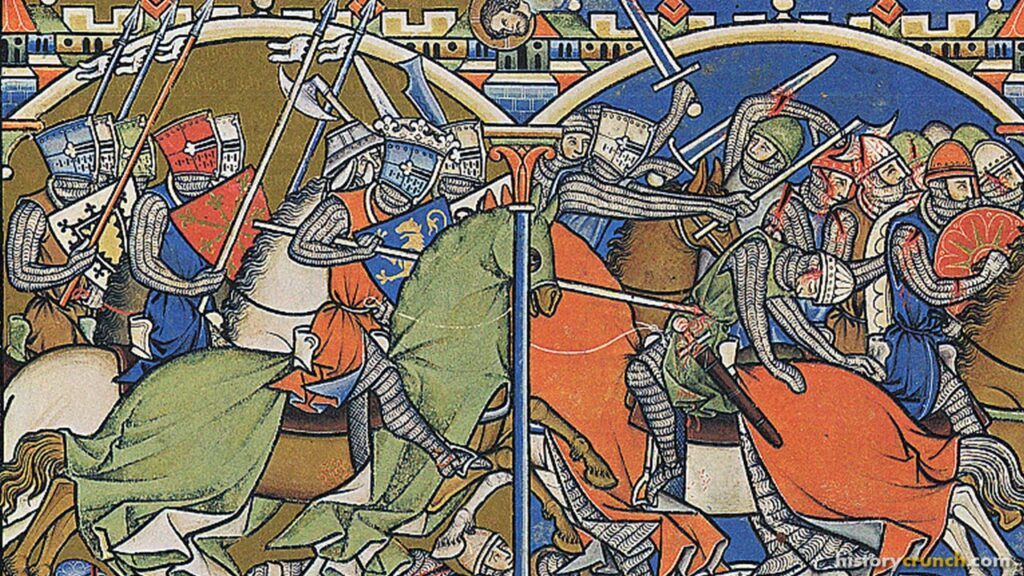
What Weapons Did Knights Use in Close Combat?
When a knight was dismounted or lost his sword, he needed other weapons for close, hand-to-hand fighting. One of the most effective was the mace, which was a club with a heavy metal head made of iron, bronze, or steel. Rather than cutting like a sword, the mace crushed with brute force, which made it useful against enemies protected by strong armor. In fact, a solid blow from a mace could crack a skull or break bones even through a helmet.
The battle-axe was another common close-combat weapon, popular especially in the earlier part of the Middle Ages. Axes lost some popularity as armor improved, but they returned to use after the 14th century, when the introduction of plate armorFull metal body armor made of fitted metal plates that became common in the 14th century. created a need for high-impact weapons. Around the same period, knights also used the war hammer and the poleaxe, which combined a hammer, a blade, and a spike on a long shaft. These heavy weapons could smash through breastplates and helmets, which lighter blades could not do.
Knights sometimes used the flail as well, which was a spiked or heavy head attached to a handle by a chain. Like the mace, the flail was designed to deliver crushing blows that ignored the protection of armor. Overall, these close-combat weapons became more important as armor grew stronger, since sharp swords alone were no longer enough to defeat a fully armored opponent.
FactsthatCrunchWhen full plate armor became common in the 14th century, sharp sword blades could no longer reliably cut through fitted metal plates, so knights turned back to crushing weapons like the mace and war hammer, which could injure an opponent even when the armor held.
The war hammer and poleaxe combined a hammer, a blade, and a spike on one shaft, giving a knight several ways to smash or pierce a breastplate or helmet that a lighter blade could not damage.
Why Was the Dagger a Weapon of Last Resort?
The dagger was the smallest weapon a knight carried, and it was usually the weapon of last resort. A knight turned to his dagger when he had lost his other weapons or when he was locked in very close combat, such as a grappling struggle on the ground. Medieval daggers were long and tapered to a very sharp point, which allowed them to make fast stabbing and thrusting motions.
One special type was the rondel daggerA dagger with a stiff, narrow blade made to slip into the gaps between pieces of plate armor., which had a stiff, narrow blade designed to slip into the gaps between pieces of plate armor. This made it deadly in situations where a knight needed to finish an armored opponent at extremely close range. As stated above, as plate armor became more common, weapons that could pierce or bypass it grew more valuable, and the dagger played an important part in this kind of fighting.
FactsthatCrunchA misericorde was a short, narrow dagger used to deliver a finishing thrust through the gaps in a fallen enemy's armor. Knights and soldiers carried it as a secondary weapon when close combat had brought an opponent to the ground. The name comes from the French word for mercy, reflecting the idea that the blow ended a wounded enemy's suffering.
When a heavily armored knight fell in close combat, a soldier could use a misericorde to thrust through the gaps in the fallen knight's armor and deliver a finishing blow.
Did Knights Use Ranged Weapons?
In general, knights did not rely on ranged weapons such as bows in battle. Weapons like the longbow and the crossbow were mostly used by archers, who came from lower social classes rather than the noble class of knights. In reality, knights were more often on the receiving end of these ranged weapons, since arrows and bolts could strike a mounted warrior from a distance.
Knights did know how to use a bow, but for them archery was mainly a skill used for hunting rather than warfare. This connection to the noble class helps explain why the sword and lance, rather than the bow, became the celebrated weapons of knighthood. Ranged and larger siege weapons, meanwhile, were the work of specialized soldiers and engineers who supported the army as a whole.
FactsthatCrunchMedieval knights chose to leave ranged weapons like the longbow and crossbow to lower-class archers, treating archery as a hunting skill rather than a battlefield duty.
Significance of Weapons of a Medieval Knight
The weapons of a medieval knight were significant because they shaped the way wars were fought across Europe for centuries and helped make the mounted knight the most feared warrior of his time. The combination of the lance for the charge and the sword for close fighting gave knights a powerful advantage on the battlefield, and this dominance lasted throughout much of the Middle Ages. For a long period, well-armed and well-trained knights could break through enemy lines and decide the outcome of major battles.
These weapons were also significant as symbols of power and social status. Because a full set of quality weapons was so expensive, only nobles could afford them, which reinforced the idea that knighthood belonged to the wealthy upper class of feudal society. The sword in particular carried deep meaning, connecting a knight to ideas of honor, faith, and the code of chivalryA code of conduct that guided the behavior, honor, and values expected of medieval knights. that guided knightly behavior.
Finally, the story of knightly weapons shows how warfare changed over time. During and after the 14th century, new weapons such as the longbow, the pike, and eventually cannons and other gunpowder weapons proved effective against armored horsemen. These changes gradually reduced the importance of the knight on the battlefield, and by the end of the Middle Ages the heavily armed knight had lost much of his old military role. In this way, the rise and fall of the knight’s weapons reflects the overall transformation of medieval Europe.
FactsthatCrunchFrom the 14th century onward, new weapons gave ordinary foot soldiers the ability to stop armored knights at a distance. This shift gradually ended the knight's military dominance and transformed how wars were fought across Europe.
Key Vocabulary
Arming sword
Lance
Mace
Plate armor
Rondel dagger
Feudalism
Chivalry
Frequently Asked Questions
What was the main weapon of a medieval knight?
The sword was the main weapon of a medieval knight, prized above all others. It was valued not only for its deadly power in close combat but also because it stood as a symbol of a knight’s noble rank and honor. A knight often kept the same sword for many years and treated it as a personal and even sacred object.
How heavy was a knight’s sword?
Most medieval swords were lighter than people often imagine, usually weighing between about 2 and 4 pounds (1 to 2 kg). This lighter weight allowed a skilled knight to swing the blade quickly and control it with precision. Larger two-handed swords weighed more, but they were still balanced carefully so that a trained warrior could handle them in battle.
Why did knights start using maces and war hammers?
Knights began using maces and war hammers more often because these crushing weapons were effective against strong armor. As plate armor spread in the later Middle Ages, sharp swords struggled to cut through metal plates. Blunt weapons could deliver enough force to injure an enemy even when his armor stayed intact, which made them valuable in this new kind of fighting.
How did knights learn to use their weapons?
Knights learned to use their weapons through many years of training that usually began in childhood. A boy from a noble family often started as a page around age 7 and later became a squire, serving an experienced knight while practicing combat skills. Tournaments and mock battles also gave knights a chance to sharpen their fighting abilities before facing real war.
Why did knights stop being important in warfare?
Knights lost their importance mainly because of new weapons and changes in how armies were organized. Longbows, pikes, and later gunpowder weapons could defeat armored horsemen from a distance, which reduced the advantage of the mounted knight. In addition, kings began to raise paid, professional standing armies, so they no longer depended as heavily on individual knights called up through the feudal system.
Cite This Article
To cite this article as a source, use one of the formats below.
MLA: Millar, B. “Weapons of a Medieval Knight: A Detailed Summary.” HistoryCrunch, 26 July 2026, https://historycrunch.com/weapons-of-a-medieval-knight/.
APA: Millar, B. (2026). Weapons of a Medieval Knight: A Detailed Summary. HistoryCrunch. https://historycrunch.com/weapons-of-a-medieval-knight/
Chicago: Millar, B. “Weapons of a Medieval Knight: A Detailed Summary.” HistoryCrunch. July 26, 2026. https://historycrunch.com/weapons-of-a-medieval-knight/
Sources
- Chris Wickham, Medieval Europe.
- Jacques Le Goff, Medieval Civilization 400-1500.