William the Conqueror was one of the most important and influential rulers in the history of the Middle Ages. As Duke of Normandy and later King of England, he transformed the history of England through his conquest of the country in 1066 CE and left a lasting impact on the political, social and cultural life of the nation that continues to be felt to the present day. Every monarch of England since William’s reign has been his direct descendant.
 FactsthatCrunch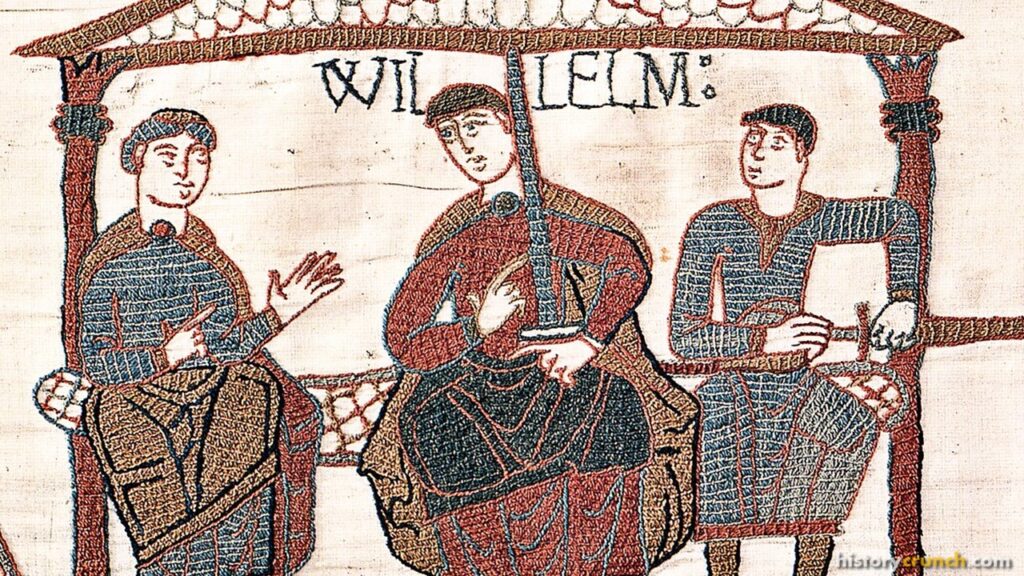
William the Conqueror – Early Life
William the Conqueror was born around 1028 CE in Falaise, in the region of Normandy in northern France. His father was Robert I, Duke of Normandy, and his mother was a woman named Herleva, who was not married to his father. Because his parents were not married, William was born illegitimateBorn to parents who were not married, which in medieval times limited a person’s social and legal standing. and was known to many of his contemporaries as William the Bastard. His illegitimacy would prove to be a defining challenge of his early life and shaped much of the difficult path he had to follow before he could establish himself as a powerful ruler.
When William was approximately seven or eight years old, his father Robert I died in 1035 CE while returning from a pilgrimageA journey to a holy or religious place, often done as an act of devotion or faith. to Jerusalem. Before leaving, Robert had formally nominated William as his heir, and the Norman nobles accepted the young boy as the new Duke of Normandy. With that said, William’s early years as duke were extremely difficult and dangerous. The duchyA territory ruled by a duke or duchess, similar to a small kingdom within a larger region. was thrown into a period of instability and violence, as powerful Norman nobles competed for influence and control. For instance, three of William’s guardians died violent deaths during his childhood and his tutor was murdered. His mother, however, worked hard to protect him through the most dangerous years of his youth. As such, the difficulties and dangers of his childhood likely contributed to the strength of character and determination that would define his later life.
FactsthatCrunchHow did Normandy's nobles and William's own guardians each view his right to rule as a child duke?
William the Conqueror – Duke of Normandy
As William grew older he gradually began to assert his authority over the duchy of Normandy. A key moment came in 1047 CE when, with the help of King Henry I of France, William defeated a rebellion led by his cousin Guy of Burgundy at the Battle of Val-ès-Dunes near Caen. This victory helped William establish himself as the legitimate ruler of Normandy and was an important step in his rise to power. Over the following years, William worked to strengthen his control over Normandy and expand his territory. For instance, he conquered the neighboring French province of Maine in 1063 CE and also secured control over Brittany, significantly extending the reach of his duchy.
An important development in William’s rise to power was his marriage to Matilda of Flanders, the daughter of Count Baldwin V of Flanders. The marriage took place in the early 1050s CE and was an important political alliance that gave William a powerful and well-connected wife and strengthened his position in continental Europe. Matilda proved to be an important partner throughout William’s life and the couple had four sons and five daughters together. As well, William was a strong supporter of the Catholic Church and worked to promote Church reform within his duchy, founding several monasteries and encouraging the work of scholars and monks. As such, by the early 1060s CE William had established himself as one of the most powerful and capable rulers in France and was ready to turn his ambitions toward a much greater prize.
FactsthatCrunchWilliam the Conqueror – Claim to the English Throne
William’s claim to the throne of England was based on his belief that the English King Edward the Confessor had promised him the throne during a visit to England in 1051 CE. Edward and William were distant cousins, and Edward was childless throughout his reign, which meant the question of who would succeed him was a major political issue throughout his kingship. William also claimed that the powerful English Earl Harold Godwinson had personally sworn an oath in Normandy in 1064 CE to support William’s claim to the English throne. Harold, however, disputed both of these claims.
When Edward the Confessor died on January 5th, 1066 CE, Harold Godwinson was crowned King of England the following day, on January 6th, 1066 CE. William was furious at what he considered to be a betrayal of Harold’s oath and a theft of the English throne. He immediately began preparing an invasion of England and secured the support of Pope Alexander II in Rome for his campaign, which gave his cause important religious legitimacy. William spent several months in 1066 CE assembling an army of approximately 7,000 men, including 2,000 to 3,000 cavalrySoldiers who fight on horseback, used in medieval armies for speed and striking power., and building a fleet of ships to carry them across the English Channel. As such, the preparation for the Norman Conquest was a major logistical achievement that demonstrated William’s skill as a military organizer and commander.
FactsthatCrunchHarold rejected William's claim on two grounds: he denied that King Edward the Confessor had ever promised the throne to William, and he disputed the oath he had sworn in Normandy in 1064 CE. Harold held that Edward had named him successor on his deathbed, and the English king's council confirmed this by choosing Harold as king the day after Edward died on January 5th, 1066 CE.
William the Conqueror – Norman Conquest and the Battle of Hastings
While William was preparing his invasion in Normandy, King Harold of England faced a second threat from the north. In September of 1066 CE, the Norwegian king Harald Hardrada invaded northern England. Harold marched his army north at great speed and defeated and killed Harald Hardrada at the Battle of Stamford Bridge on September 25th, 1066 CE. Just days later, Harold received news that William had landed in the south of England. He was forced to turn his exhausted army around and march south immediately.
William had crossed the English Channel on September 27th, 1066 CE, and landed at Pevensey in Sussex on September 28th before moving east to establish his base at Hastings. Harold assembled his forces near Hastings by October 13th. His men were tired from the rapid march of approximately 250 miles (402 kilometers) from Yorkshire and had not fully recovered from the fighting at Stamford Bridge just weeks before. On the morning of October 14th, 1066 CE, the two armies met in battle on a ridge approximately 7 miles (11 kilometers) northwest of Hastings. Harold’s army formed a tight shield wall on the ridge that proved difficult for the Normans to break. The battle lasted all day. For much of the fighting the English line held firm, but the Normans used a tactic of pretending to retreat in order to draw the English soldiers off the ridge and into the open, where Norman cavalry could cut them down. Late in the afternoon Harold was killed, reportedly struck by an arrow, and with his death the English army collapsed and fled. William had won one of the most decisive battles in English history.
FactsthatCrunchFollow the chain from top to bottom. Tap any step to read what happened.
William the Conqueror – King of England
Following his victory at Hastings, William marched his army toward London. The remaining English leaders submitted to William at Berkhamsted, and he was crowned King of England at Westminster Abbey on Christmas Day, December 25th, 1066 CE, becoming King William I of England.
With that said, resistance to Norman rule continued for several years after the Battle of Hastings. For instance, in 1069 CE a serious revolt broke out in the north of England, supported by a Danish fleet. William suppressed this rebellion with great brutality in a campaign known as the Harrying of the North, in which his forces burned villages, destroyed crops and slaughtered livestock across a large area of northern England to prevent further rebellion. The devastation was so severe that large areas of northern England remained largely depopulatedHaving lost most of its people, leaving an area largely empty or abandoned. for many years afterward. As well, William rapidly built castles across England to control the population and establish Norman authority. For instance, the Tower of London was begun during this period as a powerful symbol of Norman royal power.
After the Battle of Hastings, a serious revolt broke out in the north of England in 1069 CE, supported by a Danish fleet.
William the Conqueror – Government and Reforms
As King of England, William introduced a strict and highly organized form of the feudal system. Under this system, William distributed the lands of the defeated Anglo-Saxon nobility among his Norman followers, who became the new ruling class of England. The old English nobility was almost completely swept away within a generation of the conquest. In exchange for the land they received, William’s Norman followers owed him military service and loyalty, which gave him a powerful and reliable military force to call upon when needed.
One of the most remarkable achievements of William’s reign was the Domesday Book, which was commissioned in 1085 CE and completed in 1086 CE. The Domesday BookA detailed royal survey of all land and property in England, used to assess wealth and taxes owed. was a comprehensive survey of all land and property in England that recorded who owned what, how much it was worth and how much tax it should pay. It was an extraordinary achievement for the time and gave William detailed knowledge of the wealth and resources of his kingdom. As such, the Domesday Book is one of the most important historical documents of the Middle Ages and remains a vital source of information about life in England immediately after the Norman Conquest.
William also had a significant impact on the English language. Before 1066 CE, the language spoken in England was Old English, also known as Anglo-Saxon. After the conquest, French became the language of the royal court, the government and the nobility, while Latin remained the language of the Church. Over time, these languages blended with Old English to create Middle English, which is much closer to the modern English spoken today. For example, many words in modern English related to government and law come directly from the French that the Normans brought with them.
FactsthatCrunchAfter his victory at the Battle of Hastings in 1066 CE, William I used the feudal system to reorganize all of England's land and people under his direct control.
William the Conqueror – Later Life
William spent much of the last decade of his life moving between England and Normandy, dealing with various threats and rebellions on both sides of the Channel. For instance, in 1079 CE he was wounded in a skirmish by his own eldest son Robert, who had repeatedly rebelled against his father and sided with his enemies. The relationship between William and Robert remained difficult and tense for much of the rest of William’s life, though they eventually reconciled. As well, the death of his wife Queen Matilda in 1083 CE was a significant personal loss for William, as the couple had been very close throughout their long marriage.
FactsthatCrunchIn 1079 CE, during a skirmish near the border of Normandy, William the Conqueror was wounded by his own eldest son Robert, who had sided with his father's enemies. Robert had repeatedly rebelled against William throughout the later years of his reign, and the two were openly in conflict. The outcome of this conflict between the king and his heir would shape the future of the Norman lands.
William the Conqueror – Death and Legacy
William the Conqueror died on September 9th, 1087 CE in Rouen, Normandy, after suffering a fatal injury while on campaign near the town of Mantes on the border between Normandy and France. He was buried at his abbey of St. Stephen in Caen, Normandy, where his tomb can still be visited today. Before his death, William divided his lands between his sons, leaving Normandy to his eldest son Robert and the Kingdom of England to his second surviving son William, who became King William II of England.
William the Conqueror is remembered as one of the most significant rulers of the Middle Ages and one of the most important figures in English history. His victory at the Battle of Hastings in 1066 CE permanently changed the political, social, cultural and linguistic life of England and linked the country far more closely to the rest of Europe than it had ever been before. As such, the impact of William the Conqueror on the history of England and the Middle Ages was enormous and his influence continues to be felt to the present day.
FactsthatCrunchBefore 1066 CE, the people of England spoke Old English, also called Anglo-Saxon. After the Norman Conquest, French became the language of the royal court, the government, and the nobility, while Latin remained the language of the Church. These three languages existed side by side in England for generations, with different groups using different languages for different parts of daily life.
Over time, French, Latin, and Old English blended together to form Middle English, which then developed into the modern English spoken today. Many everyday English words related to government and law come directly from the French that the Normans brought with them in 1066 CE. Words like 'court,' 'justice,' 'parliament,' and 'noble' are French in origin, while older English words for the same ideas often survived in everyday speech.
The Norman Conquest of 1066 CE did not replace the English language but reshaped it, layering French and Latin on top of Old English to produce a richer vocabulary that modern English speakers still use today.
Key Vocabulary
Illegitimate
Pilgrimage
Duchy
Cavalry
Feudal system
Domesday Book
Depopulated
Frequently Asked Questions
Why was William called William the Conqueror?
William earned the name after he conquered England in 1066 CE following his victory at the Battle of Hastings. Before that, he was known as William the Bastard because his parents were not married. His conquest made him King William I of England and changed the country forever.
What was William’s claim to the English throne?
William believed King Edward the Confessor had promised him the English throne during a visit in 1051 CE. He also claimed that Harold Godwinson swore an oath in 1064 CE to support that claim. When Harold was crowned king instead, William prepared to invade England.
How did William win the Battle of Hastings?
William won by using cavalry and a clever tactic of pretending to retreat. This trick drew English soldiers off the ridge and into the open, where Norman horsemen cut them down. Harold was killed late in the day, and the English army then collapsed and fled.
What was the Domesday Book?
The Domesday Book was a huge survey of land and property across England, commissioned in 1085 CE and finished in 1086 CE. It recorded who owned what, its value, and the tax owed. It gave William detailed knowledge of his kingdom and remains a key record of life after the conquest.
How did William change England?
William replaced the Anglo-Saxon nobility with Norman followers and set up a strict feudal system. He built castles like the Tower of London to control the people and enforce Norman rule. French also shaped the language, which over time blended with Old English to form Middle English.
How and when did William the Conqueror die?
William died on September 9th, 1087 CE in Rouen, Normandy, after a fatal injury on campaign near Mantes. He was buried at his abbey of St. Stephen in Caen. He left Normandy to his son Robert and England to his son William, who became King William II.
Cite This Article
To cite this article as a source, use one of the formats below.
MLA: Millar, B. “William the Conqueror: A Detailed Biography.” HistoryCrunch, 17 October 2026, https://historycrunch.com/william-the-conqueror/.
APA: Millar, B. (2026). William the Conqueror: A Detailed Biography. HistoryCrunch. https://historycrunch.com/william-the-conqueror/
Chicago: Millar, B. “William the Conqueror: A Detailed Biography.” HistoryCrunch. October 17, 2026. https://historycrunch.com/william-the-conqueror/
Sources
- Fordham Medieval Sourcebook
- Jacques Le Goff, Medieval Civilization 400-1500.
- The Met (Heilbrunn Timeline): medieval art
- Barbara Rosenwein, A Short History of the Middle Ages.