Clothing in the Middle Ages was an important part of daily life and played a significant role in communicating a person’s social status, wealth and identity. In medieval European society, what a person wore was closely connected to their position in the social hierarchy of feudalism, and strict rules and customs governed what different groups of people were allowed to wear. In general, clothing in the Middle Ages varied greatly depending on a person’s social class, with the clothing of peasants being simple and practical while the clothing of the nobility was elaborate, colorful and made from expensive materials.
What Was Clothing Like in the Middle Ages?
Clothing in the Middle Ages refers to the garments and dress worn by people in medieval Europe during the period from approximately the 5th century to the 15th century. Throughout this period, clothing was produced almost entirely by hand and was a time-consuming and labor-intensive process. Most clothing was made from natural fibers, including wool, linen and, for the very wealthy, silk. Wool was by far the most common material used for clothing in the Middle Ages and was produced in large quantities across Europe, particularly in England, which was one of the most important wool-producing regions in the medieval world. As such, the production of clothing was closely connected to the agricultural economy of the Middle Ages and to the trade networks that connected different regions of Europe and beyond.
 FactsthatCrunch
Clothing of Peasants in the Middle Ages
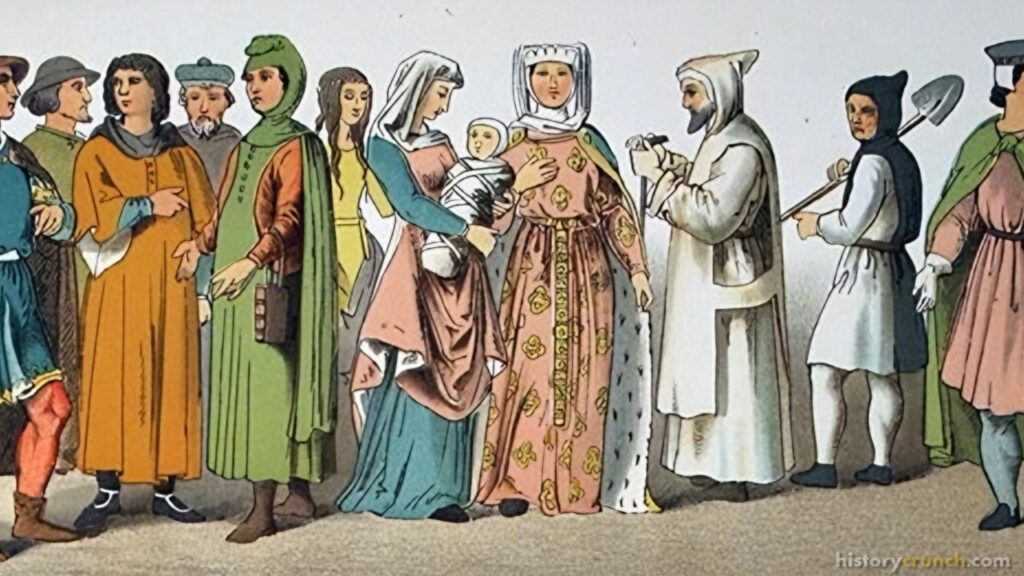
The clothing of peasants in the Middle Ages was simple, practical and designed primarily for warmth and durability rather than for appearance or status. Most peasants owned very few items of clothing, and what they did own was worn repeatedly and repaired many times before being discarded. The basic garment for both men and women in the peasant class was a simple tunicA loose-fitting garment worn by both men and women that fell to the knee for men and to the ankle for women., which was a loose-fitting garment that fell to approximately the knee for men and to the ankle for women. Tunics were typically made from undyed or roughly dyed wool or linen and were worn close to the body as an undergarment as well as on the outside.
Peasant men typically wore their tunics belted at the waist and paired with simple trousers or leggings made from wool. During cold weather, additional layers such as a simple cloak or a heavier wool outer garment were added for warmth. Peasant women wore long tunics or dresses, often with a simple head covering such as a linen cloth or veil. Footwear for peasants was simple and often consisted of basic leather shoes or boots, though some of the poorest peasants went barefoot during the warmer months. In general, the clothing of peasants in the Middle Ages was functional above all else and reflected the difficult and physically demanding lives that most people in medieval society led.
FactsthatCrunchMost medieval peasants owned many sets of clothing for different seasons.
Clothing of the Nobility in the Middle Ages
The clothing of the nobility in the Middle Ages was very different from that of peasants and was designed to communicate wealth, status and power. Noble men and women wore garments made from much finer and more expensive materials than those available to peasants, including high-quality wool, silk imported from Asia along the Silk Road, and fabrics dyed in rich and vibrant colors. The production of brightly colored fabrics required expensive dyes that were imported from distant regions, making colorful clothing a clear symbol of wealth and social status in the Middle Ages.
Noble men in the Middle Ages typically wore fine tunics, often decorated with embroidery or trimmed with fur, paired with fitted hose or leggings and leather shoes or boots of high quality. Over time, the clothing of noble men became increasingly elaborate and fashionable, with styles changing significantly across the different periods of the Middle Ages. For instance, by the High and Late Middle Ages, noble men’s clothing had become much more fitted and decorative than the simpler garments of the Early Middle Ages, reflecting the growing wealth and sophistication of the European nobility.
Noble women in the Middle Ages wore long flowing dresses or gowns made from fine fabrics and often decorated with elaborate embroidery, jewels and fur trim. Headdresses were an important part of a noblewoman’s appearance and became increasingly elaborate and varied in style throughout the Middle Ages. For instance, the henninA tall conical hat popular among noblewomen in the Late Middle Ages, often associated with the image of a medieval princess., which was a tall conical hat often associated with the image of a medieval princess, was a popular style among noblewomen in the Late Middle Ages. As such, the clothing of noble women in the Middle Ages was an important expression of their social status and identity and was subject to the changing fashions of the time.
FactsthatCrunchIn the Late Middle Ages, noblewomen in Europe wore a tall conical hat called a hennin. It was often made from fine fabric, sometimes with a long veil attached at the tip, and could reach striking heights above the head. Wearing a hennin was a clear sign of wealth and high social rank, since only women of the nobility wore this elaborate style.
The hennin is the direct ancestor of the pointed princess hat seen in fairy-tale costumes and fantasy artwork today. Modern versions appear in Halloween costumes, theater productions, and theme park merchandise, always keeping the tall cone-and-veil shape that made the original famous. Most people who wear one today have no idea it comes from a real fashion worn by actual medieval noblewomen.
A hat that once marked real social power in medieval Europe has become the universal shorthand for a storybook princess.
Clothing and Social Status in the Middle Ages
One of the most important functions of clothing in the Middle Ages was to communicate social status. In medieval European society, which was organized around the rigid hierarchy of feudalism, it was important for people to be able to identify at a glance the social class of the people they encountered. As such, clothing played a central role in making these social distinctions visible. For instance, the use of certain colors, fabrics and styles of dress was often restricted to specific social classes, either by custom or by law.
In some parts of medieval Europe, laws known as sumptuary lawsRules introduced in some parts of medieval Europe that controlled which fabrics, colors, and decorations each social class was allowed to wear. were introduced to regulate what different groups of people were allowed to wear. Sumptuary laws placed restrictions on the use of expensive fabrics such as silk and velvet, as well as on the use of certain colors and decorative elements such as fur and gold thread. For instance, in some regions, the color purple was reserved exclusively for royalty, while other colors and fabrics were restricted to the higher levels of the nobility. These laws were intended to maintain the social order of medieval European society by ensuring that clothing remained a reliable indicator of a person’s position in the feudal hierarchy. As such, clothing in the Middle Ages was not simply a matter of personal choice but was closely regulated by the social and legal norms of the time.
FactsthatCrunchClothing and the Catholic Church in the Middle Ages
The Catholic Church also had an important influence on clothing in the Middle Ages. The Church played a central role in shaping the values and customs of medieval European society, and this extended to the way people dressed. For instance, the Church emphasized the importance of modesty in dress and discouraged the wearing of overly extravagant or revealing clothing. As well, members of the clergy and those living in religious communities such as monasteries and convents wore distinctive clothing that set them apart from the rest of society. Monks typically wore simple robes in dark colors such as black or brown, while nuns wore habits that covered most of the body and included a distinctive head covering known as a wimpleA distinctive head covering worn by nuns as part of their religious habit. or veil.
The clothing worn by the higher ranks of the Catholic Church, such as bishops and cardinals, was by contrast often extremely elaborate and richly decorated. For instance, bishops and cardinals wore ceremonial robes in colors such as red and purple that signified their rank and authority within the Church hierarchy. As such, just as in secular society, clothing within the Catholic Church served as an important marker of rank, status and identity throughout the Middle Ages.
FactsthatCrunchMonks wore simple robes in dark colors such as black or brown. This plain dress expressed the Church's teaching that modesty mattered more than wealth or display. Their clothing set them apart from ordinary people but showed no rank above their fellow monks.
Cardinals and bishops wore ceremonial robes in rich colors such as red and purple. These elaborate garments were richly decorated and signaled rank and authority within the Church hierarchy. In this way, the Church's most powerful figures used clothing in the same way the nobility did, to make their status visible at a glance.
How Was Clothing Made in the Middle Ages?
The production of clothing in the Middle Ages was a time-consuming and labor-intensive process that involved several stages. The first stage was the production of raw fiber, which for most people in medieval Europe meant the shearing of sheep for wool. Wool was then cleaned, combed and spun into thread using a spindle or spinning wheel. The thread was then woven into cloth on a loomA frame used to interlace threads together to create a length of fabric., which was a frame used to interlace threads together to create a length of fabric. In peasant households, these tasks were typically carried out by women and were an important part of the domestic economy of the medieval home.
In towns and cities, clothing production was organized through a system of guildsAssociations of craftsmen in towns and cities who specialized in a particular trade and set standards for quality and pricing.. Guilds were associations of craftsmen who specialized in a particular trade and set standards for the quality and pricing of their goods. Different guilds were responsible for different stages of the cloth-making process, including: weavers who produced the fabric, dyers who colored it and tailors who cut and sewed it into finished garments. The growth of the cloth trade during the Middle Ages, particularly in regions such as Flanders and northern Italy, was one of the most important economic developments of the medieval period and contributed significantly to the rise of towns, cities and a merchant class in European society.
FactsthatCrunchWhat is the correct order of the stages in turning raw wool into finished medieval cloth?
Significance of Clothing in the Middle Ages
In conclusion, clothing in the Middle Ages was far more than simply a practical necessity. It was a powerful communicator of social status, wealth and identity in a society organized around the rigid hierarchy of feudalismThe medieval social system that ranked people from kings and nobles down to peasants, with each rank having specific duties and privileges.. From the simple woolen tunics of peasants to the elaborate silk gowns of the nobility, the clothing of the Middle Ages reflected the deep social divisions of medieval European society and the central role of institutions such as the Catholic Church and the feudal system in shaping everyday life. As such, understanding clothing in the Middle Ages is important for gaining a complete picture of the social, economic and cultural life of medieval Europe.
FactsthatCrunchTap each impact to read what it led to.
Explore Middle Ages · 476 – 1500 CE
Keep exploring Middle Ages with these History Crunch resources.
Key Vocabulary
Feudalism
Tunic
Sumptuary laws
Hennin
Guilds
Wimple
Loom
Frequently Asked Questions
What materials were used to make clothing in the Middle Ages?
Most medieval clothing was made from natural fibers such as wool, linen, and silk. Wool was by far the most common material and was produced across Europe, with England as a leading source. Silk was costly and imported from Asia, so only the very wealthy could afford it.
What did peasants wear in the Middle Ages?
Peasants wore simple, practical clothing built for warmth and durability rather than appearance. The basic garment was a loose tunic made from undyed or roughly dyed wool or linen. Men belted their tunics and wore trousers or leggings, while women wore long tunics with a linen head covering.
What were sumptuary laws?
Sumptuary laws were rules that controlled what different groups of people were allowed to wear. They placed limits on expensive fabrics like silk and velvet, as well as certain colors and decorations. These laws helped keep clothing a reliable sign of a person’s rank in the feudal system.
Why was the color purple important in medieval clothing?
In some regions of medieval Europe, purple was reserved only for royalty. Bright colors required costly dyes imported from distant places, so they signaled great wealth and power. High-ranking Church leaders such as bishops and cardinals also wore red and purple to show their authority.
How was cloth made in the Middle Ages?
Cloth making began with raw fiber, such as wool sheared from sheep, which was cleaned, combed, and spun into thread. The thread was then woven into fabric on a loom. In peasant homes this work was usually done by women, while in towns it was organized through guilds of weavers, dyers, and tailors.
Cite This Article
To cite this article as a source, use one of the formats below.
MLA: Millar, B. “Clothing in the Middle Ages: A Detailed Summary.” HistoryCrunch, 16 October 2026, https://historycrunch.com/clothing-in-the-middle-ages/.
APA: Millar, B. (2026). Clothing in the Middle Ages: A Detailed Summary. HistoryCrunch. https://historycrunch.com/clothing-in-the-middle-ages/
Chicago: Millar, B. “Clothing in the Middle Ages: A Detailed Summary.” HistoryCrunch. October 16, 2026. https://historycrunch.com/clothing-in-the-middle-ages/
Sources
- Chris Wickham, Medieval Europe.
- Fordham Medieval Sourcebook