The life of a medieval peasant was defined by hard work, religious faith, and the rhythms of the farming seasons. Peasants made up the vast majority of the population during the Middle Ages, with some historians estimating that as many as 90 percent of all people in medieval Europe were peasants. Despite being the largest group in society, peasants had the least power and wealth of anyone in the feudal systemA rigid, hierarchical form of government in medieval Europe where land and power flowed from king to lords to knights to peasants..
What share of all people in medieval Europe were peasants, according to some historians' estimates?

What Was the Feudal System?
To understand the life of a medieval peasant, it is first important to understand the feudal system that shaped their world. Feudalism was a form of government common during medieval Europe that involved society being structured in a very rigid and hierarchical way. It was popular in European society from the 9th century until the 15th century and was the form of government in which the country was dominated by an absolute monarch, in which all power was held within a single king. The monarch would rule over the country while the rest of the people were bound by a hierarchical system in which people were placed into classes in which they were born.
Under the feudal system, society was divided into distinct classes. At the top was the king, who owned all the land in the kingdom. Below the king were the noble lords, who received land from the king in exchange for loyalty and military service. Below the lords were the knights, who served the nobles in exchange for smaller pieces of land. At the very bottom of feudal society were the peasants, who made up the overwhelming majority of the population. Peasants worked the land and produced the food that fed everyone above them in the feudal hierarchy. In return, they received the right to live and work on the land and the protection of the lord whose manor they lived on.
FactsthatCrunchIn his teaching text the Colloquy, written around 995 CE, Aelfric gave voice to a plowman who said he went out to the fields every dawn and dared not stay home even in bitter winter for fear of his lord. The plowman also stated plainly that he endured such hard work because he was not a free man. Aelfric's text shows that peasants accepted the feudal bargain partly out of genuine need for protection against raiders and lawlessness, and partly because refusing the lord's demands was not a real option for most.
Types of Medieval Peasants
Not all medieval peasants lived under exactly the same conditions. In general, historians divide medieval peasants into two main groups: free peasants and serfsPeasants who were legally bound to the land and could not leave without their lord’s permission.. Free peasants, sometimes called freemen, paid rent to their lord and were allowed to move if they wished. They had more rights and freedoms than other peasants, though they were still very much at the bottom of society. Serfs, on the other hand, were legally bound to the land on which they lived and could not leave without the permission of their lord. The most common type of serf in medieval England was known as a villeinThe most common type of serf in medieval England, required to rent land and work the lord’s fields a set number of days each week.. Villeins rented small homes and plots of land from their lord and were required to work on the lord’s land for a set number of days each week in addition to farming their own small plots.
It is important to note that medieval peasants were not slaves. For instance, peasants had the right to marry, could pass their land on to their children, and could not be simply sold by their lord. As well, lords were not allowed to deprive peasants of their means of survival entirely. With that said, the life of most peasants was extremely difficult and offered very little freedom or opportunity for improvement.
Where Did Medieval Peasants Live?
Medieval peasants lived in small villages built on or near the land they farmed. Villages were made up of clusters of simple homes surrounded by fields, pastures, and woodland. The homes of medieval peasants were very basic by any standard. Most were built using a technique called wattle and daubA building technique using a wooden frame filled with woven sticks plastered over with mud, straw, and animal dung., which involved a wooden frame filled with woven sticks plastered over with a mixture of mud, straw, and animal dung. The roofs were thatched with straw and the floors were made of packed earth. For instance, most peasant homes consisted of a single room in which the entire family cooked, ate, slept, and lived together. In winter, livestock such as chickens and pigs were sometimes brought inside as well, both to protect the animals from the cold and to add warmth to the home.
Furniture was extremely simple. A typical peasant home might contain a wooden table, a few stools, and straw-filled mattresses for sleeping. There were no chimneys, so smoke from the fire at the center of the room filled the air before escaping through a hole in the roof, making the interior dark and smoky. Sanitation was also very poor. Waste was thrown into the street or nearby pits, and water had to be collected from wells or streams that were often contaminated. As a result, disease was common and life expectancy was low. In fact, it has been estimated that around a quarter to a third of all children born in medieval Europe did not survive their first year of life.
Work and Farming
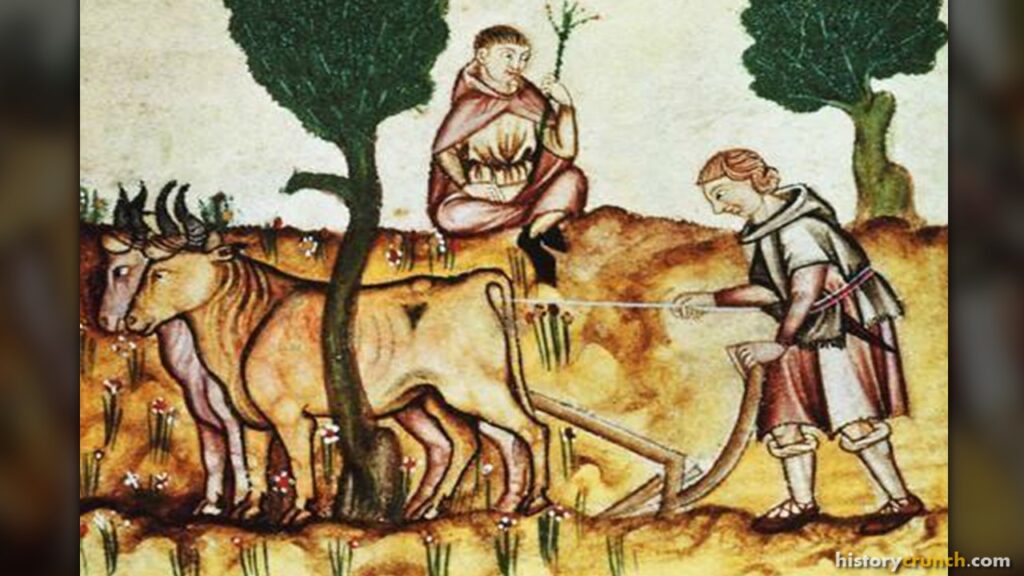
The daily life of a medieval peasant was organized around the needs of the farming calendar and the demands of the feudal system. Peasants rose before dawn and worked from sunrise to sunset, with the rhythm of their days dictated by the seasons. In spring, the main tasks were plowing the fields and planting crops. Summer was spent tending to the crops and caring for livestock. Autumn was the most important time of the year, as it was when the harvest had to be gathered and stored for the long winter ahead. Winter brought fewer farming tasks but was spent repairing tools, caring for animals, and preparing for the next growing season.
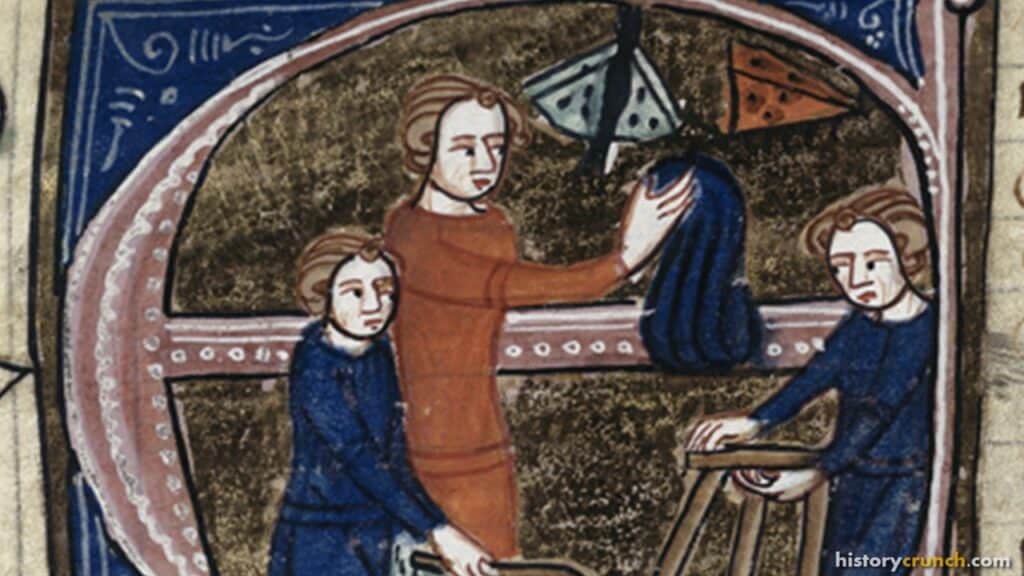
The main crops grown by medieval peasants included wheat, barley, oats, rye, and peas. Most peasants used the three-field systemA farming method that divided land into three sections and rotated which section was planted each year so soil could recover. of farming, which involved dividing their land into three sections and rotating which section was planted each year, allowing the soil to recover its nutrients. As well, peasants kept animals such as cattle, sheep, pigs, and chickens, which provided milk, wool, eggs, and meat. With that said, meat was a rare luxury for most peasants and was usually only eaten on special occasions or feast days. Furthermore, women played an essential role in the daily work of the peasant household. In addition to working in the fields alongside men, women were responsible for cooking, spinning wool, weaving cloth, tending the household garden, and caring for children.
FactsthatCrunchFollow the chain from top to bottom. Tap any step to read what happened.
Obligations and Taxes
One of the heaviest burdens of peasant life was the many obligations and taxes they were required to pay. Serfs were required to work on their lord’s land for a set number of days each week, often two or three days, in addition to tending their own small plots. This meant that a significant portion of a peasant’s time and labor went directly to benefiting their lord rather than their own family. As well, peasants were required to pay the titheA yearly tax of roughly one tenth of a peasant’s produce paid to the Catholic Church., which was a tax of approximately one tenth of their produce paid to the Catholic Church each year. In addition to this, peasants also paid rent to their lord for the right to live on and farm the land.
These obligations placed an enormous burden on peasant households, particularly during years of poor harvest when food was already scarce. For instance, a bad harvest could mean the difference between a family surviving the winter or facing starvation, yet the taxes and obligations to the lord and the Church remained due regardless. As such, food shortages and periods of famine were a constant threat in the lives of medieval peasants.
FactsthatCrunchHow did a single bad harvest push a medieval peasant family toward starvation?
Religion and Community
Despite the hardships of their lives, medieval peasants were deeply religious people and the Catholic Church played a central role in peasant life. The local church was the most important building in most villages and the priest was one of the most important figures in the community. For example, the church bell marked not only prayer times but also the beginning and end of the working day, making it the central timekeeper for the entire village. Sunday was a day of rest, and the whole village gathered for Mass, which was not only a religious event but also the most important social occasion of the week. People shared news, made plans, and caught up with their neighbors after the service.
As well, the Church calendar gave structure to the peasant year, with important religious festivals and saints’ days providing breaks from the relentless routine of work. In general, village life was close-knit and cooperative. Peasants relied on each other for help with large tasks such as haymaking and harvesting, and the shared rhythms of work and worship created strong bonds within communities. In reality, peasant life was not simply one of endless misery. While hardship was constant, there was also laughter, celebration, community, and the deep satisfaction that came from working the land and providing for one’s family in a world that was very different from our own.
FactsthatCrunchThe village church bell was the only clock most medieval peasants ever knew, marking the start and end of the working day for the entire community.
Medieval peasant villages had no clocks or printed schedules. The local church bell told everyone when to rise for work and when to stop, making it the central timekeeper for the entire community. A building meant for prayer also controlled the peasant working day from sunrise to sunset.
Significance of the Life of a Medieval Peasant
The life of a medieval peasant is an important subject for students of the Middle Ages because peasants were the people who made medieval society function. Without the labor of the peasants, the nobility, the Church, and the knights could not have survived. As stated above, peasants made up as much as 90 percent of the population of medieval Europe and their work fed, clothed, and supported everyone above them in the feudal hierarchy. In fact, it was the gradual improvement in the conditions of peasant life, driven by events such as the Black Death and the growth of towns and trade, that helped bring about the end of the feudal system and the beginnings of the modern world. As such, understanding the life of a medieval peasant is essential to understanding the history of the Middle Ages as a whole.
FactsthatCrunchAs the plague spread through Europe in the mid-14th century, serfs abandoned their traditional lands to escape the disease. This mass movement broke apart the social bonds that held the Manor System together and left lords unable to enforce the old rules of serfdom.
Serfs were bound to the land, obligated to work for lords in exchange for protection
Serfdom faded in western Europe by approximately the 15th century as the old order collapsed
Explore Middle Ages · 476 – 1500 CE
Keep exploring Middle Ages with these History Crunch resources.
Key Vocabulary
Feudal system
Serfs
Villein
Wattle and daub
Tithe
Three-field system
Frequently Asked Questions
What is the difference between a free peasant and a serf?
A free peasant could move and change where they lived, while a serf was legally bound to the land. Free peasants, also called freemen, paid rent to their lord in exchange for more rights. Serfs could not leave without their lord’s permission. The most common serf in medieval England was known as a villein.
Were medieval peasants slaves?
Medieval peasants were not slaves, even though their lives were very hard. They had the right to marry and could pass their land on to their children. A lord could not simply sell a peasant or take away their means of survival. Still, peasants had little freedom and almost no chance to improve their lives.
What were peasant homes like in the Middle Ages?
Most peasant homes were simple one room buildings made using wattle and daub. This method used a wooden frame filled with woven sticks and covered in mud, straw, and animal dung. Roofs were thatched with straw and floors were packed earth. With no chimney, smoke from the fire filled the dark, crowded room.
What taxes did medieval peasants have to pay?
Peasants paid the tithe, which was about one tenth of their produce given to the Catholic Church each year. They also paid rent to their lord for the right to farm the land. Serfs had to work on their lord’s land for two or three days each week as well. These burdens stayed due even after a poor harvest.
What was the three-field system of farming?
The three-field system divided a peasant’s land into three sections and rotated which one was planted each year. Leaving one section unplanted let the soil recover its nutrients over time. This helped peasants grow crops like wheat, barley, oats, rye, and peas more steadily. It was a common way to keep farmland from wearing out.
What role did religion play in peasant life?
The Catholic Church was at the center of daily life for medieval peasants. The village church was often the most important building, and the priest was a leading figure. The church bell marked prayer times and the start and end of the workday. Sunday Mass was both a religious event and the main social gathering of the week.
Cite This Article
To cite this article as a source, use one of the formats below.
MLA: Millar, B. “Life of a Medieval Peasant: A Detailed Summary.” HistoryCrunch, 14 October 2026, https://historycrunch.com/life-of-a-medieval-peasant/.
APA: Millar, B. (2026). Life of a Medieval Peasant: A Detailed Summary. HistoryCrunch. https://historycrunch.com/life-of-a-medieval-peasant/
Chicago: Millar, B. “Life of a Medieval Peasant: A Detailed Summary.” HistoryCrunch. October 14, 2026. https://historycrunch.com/life-of-a-medieval-peasant/
Sources
- Jacques Le Goff, Medieval Civilization 400-1500.
- Chris Wickham, Medieval Europe.
- The Met (Heilbrunn Timeline): medieval art
- Barbara Rosenwein, A Short History of the Middle Ages.