The United States in World War II made significant contributions to the Allied war effort in both the European and Pacific Theaters of the conflict. The United States entered the war on December 8th, 1941, the day after Japan launched a surprise attack on the American naval base at Pearl Harbor, Hawaii. Before this point, the United States had followed a policy of isolationismA foreign policy of staying out of other countries’ conflicts and avoiding international involvement. and remained officially neutral, though it had been supplying Britain, the Soviet Union, and China with war materials through the Lend-Lease program since March of 1941. Once in the war, the United States mobilized its enormous industrial capacity and manpower with remarkable speed. In total, approximately 16 million Americans served in the armed forces during World War II, and approximately 407,000 were killed. The United States fought in both the European Theater against Nazi Germany and the Pacific Theater against Imperial Japan, and its contributions in both were central to the eventual Allied victory in 1945.
 FactsthatCrunch
United States Enters World War II
World War II began on September 1st, 1939, when Nazi Germany, under the leadership of Adolf Hitler, invaded the country of Poland. However, the United States did not immediately enter the fighting. In the years before the war, the United States had followed a policy of isolationism, meaning it sought to avoid involvement in the conflicts of other nations. Many Americans believed that World War II was primarily a European conflict and that the United States had no reason to become directly involved. Congress had passed a series of Neutrality Acts in the mid-1930s that placed strict limits on American involvement in foreign wars.
Regardless, President Franklin D. Roosevelt was deeply concerned about the growing threat of Nazi Germany and the expansion of Imperial Japan. Even while being officially neutral, he worked to find ways to support the Allied Powers. The most important of these efforts was the Lend-Lease Act, which was signed into law on March 11th, 1941. The Lend-LeaseA program that let the U.S. send weapons, food, and vehicles to Allied nations without requiring immediate payment. Act allowed the United States to supply weapons, food, vehicles, and other war materials to Allied nations without requiring immediate payment. Over the course of the war, the United States provided approximately 50 billion dollars worth of Lend-Lease aid to Allied nations, including Britain, the Soviet Union, China, and others. As such, even before formally entering the war, the United States was playing an important role in supporting the Allied effort.
The event that brought the United States directly into World War II was the Japanese attack on Pearl Harbor on December 7th, 1941. On that morning, Japanese naval airplanes launched a surprise attack on the American Pacific Fleet at its base at Pearl Harbor, Hawaii. The attack destroyed or damaged eight battleships, sank or damaged three cruisers and three destroyers, and destroyed 180 American airplanes. In total, 2,403 American servicemen were killed and approximately 1,000 more were wounded. The following day, President Roosevelt addressed Congress and described December 7th, 1941, as “a date which will live in infamyThe quality of being remembered for something deeply shameful or shocking..” Congress declared war on Imperial Japan on December 8th, 1941. On December 11th, 1941, Nazi Germany and Italy declared war on the United States, bringing the country into the European Theater of World War II as well.
FactsthatCrunch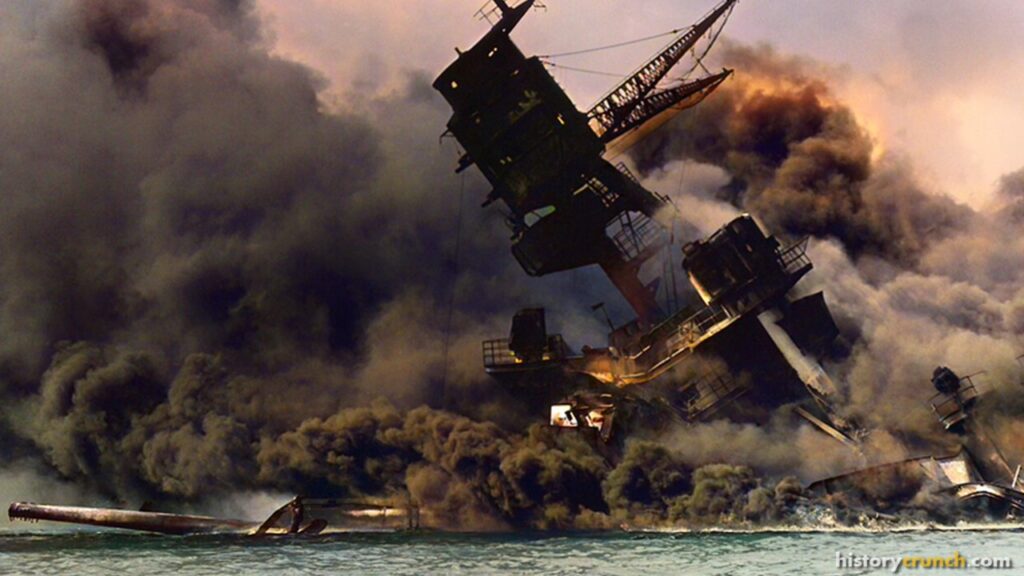 Black & whiteColor
United States in World War II – Army
At the time of Pearl Harbor, the United States military was far smaller than it would need to be to fight a major war on two fronts simultaneously. The Selective Training and Service Act of 1940 had introduced the first peacetime draft in American history and had begun the process of expanding the armed forces, but the scale of mobilization required after Pearl Harbor was immense. The United States rapidly expanded its military through both the draft and voluntary enlistment. By the end of the war, approximately 16 million Americans had served in the armed forces across all branches, including the Army, Navy, Marine Corps, and the Army Air Forces, which became the independent U.S. Air Force in 1947.
Despite the enormous scale of American military expansion, the United States also adopted an important strategic priority from the outset of its involvement in the war. American and British leaders agreed at the Arcadia Conference, held in Washington, D.C. in December of 1941 and January of 1942, that defeating Nazi Germany would be the primary focus of Allied strategy, even though Japan had attacked the United States directly. This policy became known as ‘Germany First’ and shaped American strategic decisions throughout the war. As a result, the majority of American resources were directed toward the European Theater until Nazi Germany was defeated in May of 1945, after which the full attention of the United States turned to the defeat of Japan.
United States in World War II – Major Campaigns and Battles
The United States in World War II participated as part of the Allied Powers alongside Britain, the Soviet Union, Canada, Australia, and other nations. On the opposing side were the Axis Powers of Nazi Germany, fascist Italy, and Imperial Japan. The major campaigns and battles that American forces participated in included: the North African campaign, the Italian Campaign, the D-Day landings and the Northwest Europe campaign, the Battle of Midway, the island-hoppingA Pacific strategy of capturing only key enemy-held islands while bypassing and cutting off others. campaign in the Pacific, and the atomic bombing of Japan.
FactsthatCrunchThe Germany First strategy was an Allied plan that set defeating Nazi Germany as the top military priority, even before defeating Japan. American and British leaders agreed on this plan at the Arcadia Conference, held in Washington, D.C. in late December of 1941 and early January of 1942. This meant the United States would send the largest share of its troops and supplies to the European Theater first, and then shift full attention to Japan after Germany was defeated.
"Because of the Germany First strategy agreed at the Arcadia Conference, more American forces were sent to fight in North Africa and Europe than were sent to the Pacific in the early years of the war."
The North African and Italian Campaigns
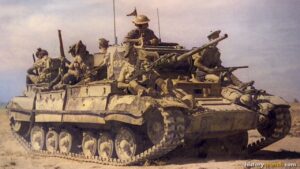
The first major American ground offensive against Nazi Germany took place in North Africa. On November 8th, 1942, American and British forces landed in French North Africa in an operation codenamed ‘Operation Torch’. American forces under General Dwight D. Eisenhower advanced eastward from Morocco and Algeria, while British forces under General Bernard Montgomery advanced westward from Egypt following their victory at the Second Battle of El Alamein. Axis forces in North Africa, caught between the two Allied armies, were squeezed from both directions and surrendered on May 13th, 1943.
Following the end of the North African campaign, American forces participated in the Allied invasion of Sicily on July 10th, 1943, and subsequently in the Italian Campaign that lasted until the end of the war in Europe in May of 1945. American forces under General George S. Patton swept rapidly through western Sicily during the invasion, and then fought their way northward through the difficult terrain of the Italian peninsula over the following two years, contributing to the liberation of Rome on June 4th, 1944.
Can you put these American military campaigns and operations in Europe in World War II in the correct order?
The D-Day Landings and Northwest Europe
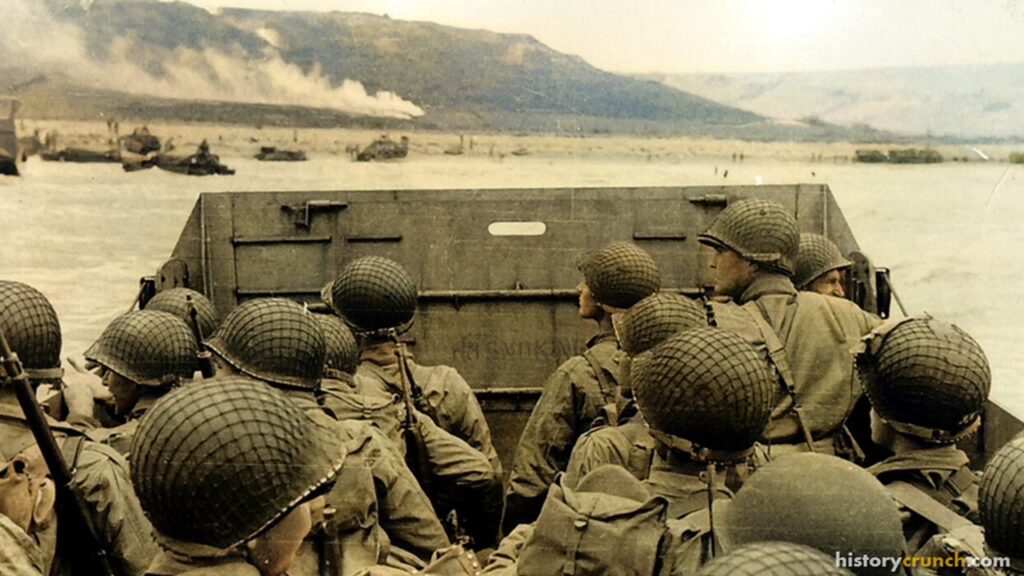
The most significant American contribution to the defeat of Nazi Germany in Europe was the role played by American forces in the D-Day landings in Normandy, France, on June 6th, 1944. As part of the largest amphibiousA military operation that involves moving forces from sea onto land at the same time. operation in history, American forces landed on two of the five invasion beaches, codenamed ‘Utah’ and ‘Omaha’. The fighting at Omaha Beach was particularly intense, as American soldiers landed against well-prepared German defenses and suffered approximately 2,000 casualties on D-Day alone. The overall commander of the Allied invasion force was American General Dwight D. Eisenhower.
Following the successful landings, American forces broke out of Normandy in late July of 1944 in an operation codenamed ‘Operation Cobra’. Under the command of General George S. Patton, the American Third Army swept rapidly through France, liberating large areas of the country within weeks. American forces subsequently advanced into Belgium, the Netherlands, and toward Germany itself. For instance, when German forces launched a major counteroffensive through the Ardennes Forest in December of 1944, in what became known as the ‘Battle of the Bulge‘, American forces bore the brunt of the initial German assault. The American 101st Airborne Division was surrounded at the Belgian town of Bastogne but famously refused to surrender, holding out until relieved by other Allied forces. By the spring of 1945, American and Allied forces had crossed the Rhine River into Germany and were advancing toward Berlin from the west, while Soviet forces advanced from the east. Nazi Germany formally surrendered on May 8th, 1945.
FactsthatCrunchOf the approximately 2,400 total casualties at Omaha Beach on June 6th, 1944, around 1,000 American soldiers were killed, making it the deadliest of the five D-Day landing beaches.
The U.S. 1st and 29th Infantry Divisions landed against well-prepared German defenses at Omaha Beach. By contrast, Utah Beach, the other American landing zone that day, suffered only 197 deaths. The gap between the two beaches came down to terrain: German positions above Omaha gave defenders a direct line of fire across the entire beach, leaving attackers with almost no cover.
The Pacific Theater
While the ‘Germany First’ strategy directed the majority of American resources toward Europe, the United States also fought a major war against Imperial Japan in the Pacific Theater throughout the entire period of American involvement in World War II. The early months of the Pacific War were difficult. Following Pearl Harbor, Japan rapidly captured Guam, Wake Island, Hong Kong, the Philippines, Malaya, and Singapore. The fall of the Philippines in April and May of 1942 resulted in the Bataan Death March, in which thousands of American and Filipino prisoners of war died under brutal Japanese captivity conditions.
The turning point in the Pacific War came at the Battle of Midway, fought from June 3rd to June 7th, 1942. American naval forces, having broken the Japanese naval code and anticipated the Japanese attack, ambushed the Japanese fleet near Midway Atoll in the central Pacific. The battle resulted in the sinking of four Japanese aircraft carriers, a blow from which the Japanese navy never fully recovered. The Battle of Midway halted Japanese expansion in the Pacific and shifted the balance of power in favor of the United States.
From mid-1942 onward, the United States pursued a strategy of ‘island-hopping‘, which involved capturing strategically important Japanese-held islands while bypassing and isolating others. This strategy allowed American forces to advance steadily toward the Japanese home islands while avoiding the enormous cost of attacking every fortified Japanese position. For instance, American forces fought major battles at: Guadalcanal, Tarawa, Saipan, Iwo Jima, and Okinawa, each bringing American forces closer to Japan.
FactsthatCrunchAmerican naval forces, having broken the Japanese naval code, anticipated the Japanese attack and ambushed the Japanese fleet near Midway Atoll. In four days of fighting from June 3rd to June 7th, 1942, American aircraft sank four Japanese aircraft carriers, a loss the Japanese navy never fully recovered from.
Japan controlled the Pacific and was expanding steadily after striking Pearl Harbor and capturing Guam, Wake Island, and the Philippines
Japanese naval expansion stopped, and the United States shifted from defense to a steady advance across the Pacific through island-hopping
Atomic Bombing of Japan
By the summer of 1945, Japan had been pushed back to its home islands and was under sustained American air and naval attack. American airplanes had been carrying out large-scale bombing raids against Japanese cities since early 1945. Regardless, Japan refused to surrender, and American military planners estimated that a land invasion of the Japanese home islands could cost hundreds of thousands of American and millions of Japanese lives.
In response, President Harry S. Truman, who had become president following the death of Franklin D. Roosevelt on April 12th, 1945, authorized the use of a new and devastating weapon. On August 6th, 1945, an American airplane dropped an atomic bomb on the Japanese city of Hiroshima. The bomb destroyed a large portion of the city and killed approximately 70,000 people immediately, with tens of thousands more dying in the weeks and months that followed from radiation and injuries. On August 9th, 1945, a second atomic bomb was dropped on the city of Nagasaki, killing approximately 40,000 people immediately. On August 15th, 1945, Japan announced its surrender, and the formal surrender ceremony took place on September 2nd, 1945, aboard the American battleship USS Missouri in Tokyo Bay. World War II was over.
FactsthatCrunchBoth bombs were dropped by the United States within three days of each other and caused massive immediate casualties. Hiroshima was struck first and suffered the larger immediate death toll. Nagasaki was hit with a different bomb design and killed fewer people in part because surrounding hills contained the blast.
United States in World War II – Home Front
The American home front during World War II was shaped by the enormous demands of fighting a major war on two fronts simultaneously. The United States economy underwent a dramatic transformation as factories converted from producing consumer goods to producing the weapons, vehicles, airplanes, and supplies needed by American and Allied forces. American industrial output during the war was remarkable. For instance, by 1944 the United States was producing more war materials than all of the Axis Powers combined.
The war also brought important social changes on the American home front. Large numbers of women entered the workforce to fill positions vacated by men who had gone to war. Government campaigns such as the ‘Rosie the Riveter’ program encouraged women to take up industrial work, and by 1944 women made up approximately one third of the total American civilian workforce. As well, African Americans served in large numbers in the armed forces, though they did so in racially segregated units for much of the war. Their service contributed to growing pressure for civil rights reforms in the postwar era.
It should also be noted that the home front included one of the most controversial episodes in American history. Following the attack on Pearl Harbor, President Roosevelt signed Executive Order 9066A presidential directive that authorized the forced relocation of over 120,000 Japanese-Americans into internment camps. in February of 1942, which authorized the forced relocation and internmentThe forced imprisonment or confinement of a group of people, especially during wartime. of over 120,000 Japanese-Americans. This was a serious violation of the rights of American citizens that was later formally acknowledged and apologized for by the United States government. Regardless, it ultimately led to the events of the Internment of Japanese-Americans during World War II.
United States in World War II – Significance
World War II was one of the most important events in the history of the United States. First, the scale of the American contribution to the Allied victory was decisive in both the European and Pacific theaters. The United States provided the Allied Powers with enormous quantities of weapons, vehicles, food, and other war materials through Lend-Lease, and American forces played a central role in the key military operations that defeated Nazi Germany and Imperial Japan.
Second, World War II transformed the United States into the world’s dominant military and economic power. The enormous industrial expansion of the war years made the United States the largest and most productive economy in the world, and American military power had demonstrated its ability to project force across two oceans simultaneously. As such, the United States emerged from World War II as the leading power of the western world and the principal opponent of Soviet expansionism in the Cold War that followed.
Third, World War II had important and lasting social consequences for the United States. The service of women and African Americans in the war effort contributed to shifts in attitudes about equality and civil rights that helped lay the groundwork for the Civil Rights Movement of the 1950s and 1960s. The experience of the war also permanently shaped American attitudes toward international engagement, replacing the pre-war tradition of isolationism with a commitment to international alliances and active involvement in world affairs that has remained a feature of American foreign policy ever since.
FactsthatCrunchThe scale of World War II permanently ended the United States prewar policy of isolationism. By 1945 the country had built the largest military in its history, established bases across Europe and the Pacific, and taken on a leading role in shaping the postwar international order.
Explore World War II · 1939 – 1945
Keep exploring World War II with these History Crunch resources.
Key Vocabulary
Isolationism
Lend-Lease
Infamy
Amphibious
Island-hopping
Internment
Executive Order 9066
Frequently Asked Questions
When did the United States enter World War II?
The United States entered World War II on December 8th, 1941, when Congress declared war on Japan. This came one day after Japan’s surprise attack on Pearl Harbor. On December 11th, 1941, Nazi Germany and Italy declared war on the United States, pulling the country into the European Theater as well.
What was the Lend-Lease Act?
The Lend-Lease Act, signed on March 11th, 1941, let the United States supply war materials to Allied nations without demanding immediate payment. It provided weapons, food, and vehicles to Britain, the Soviet Union, China, and others. In total, the United States gave about 50 billion dollars worth of aid, even before formally joining the war.
What was the “Germany First” strategy?
“Germany First” was the Allied decision to focus on defeating Nazi Germany before Japan. American and British leaders agreed to this plan at the Arcadia Conference in late 1941 and early 1942. As a result, most American resources went to the European Theater until Germany surrendered in May of 1945.
Why was the Battle of Midway important?
The Battle of Midway, fought from June 3rd to June 7th, 1942, was the turning point in the Pacific War. American forces had broken the Japanese naval code and ambushed the enemy fleet near Midway Atoll. The battle sank four Japanese aircraft carriers and halted Japan’s expansion across the Pacific.
How did World War II change the United States?
World War II turned the United States into the world’s leading military and economic power. Its huge wartime industry made it the largest economy on Earth and the main rival of the Soviet Union in the Cold War. The war also ended the old policy of isolationism and boosted later demands for civil rights.
Cite This Article
To cite this article as a source, use one of the formats below.
MLA: Millar, B. “United States in World War II: A Detailed Summary.” HistoryCrunch, 1 October 2026, https://historycrunch.com/united-states-in-world-war-ii/.
APA: Millar, B. (2026). United States in World War II: A Detailed Summary. HistoryCrunch. https://historycrunch.com/united-states-in-world-war-ii/
Chicago: Millar, B. “United States in World War II: A Detailed Summary.” HistoryCrunch. October 1, 2026. https://historycrunch.com/united-states-in-world-war-ii/
Sources
- The National WWII Museum
- Max Hastings, Inferno / All Hell Let Loose.
- Antony Beevor, The Second World War.
- Imperial War Museum