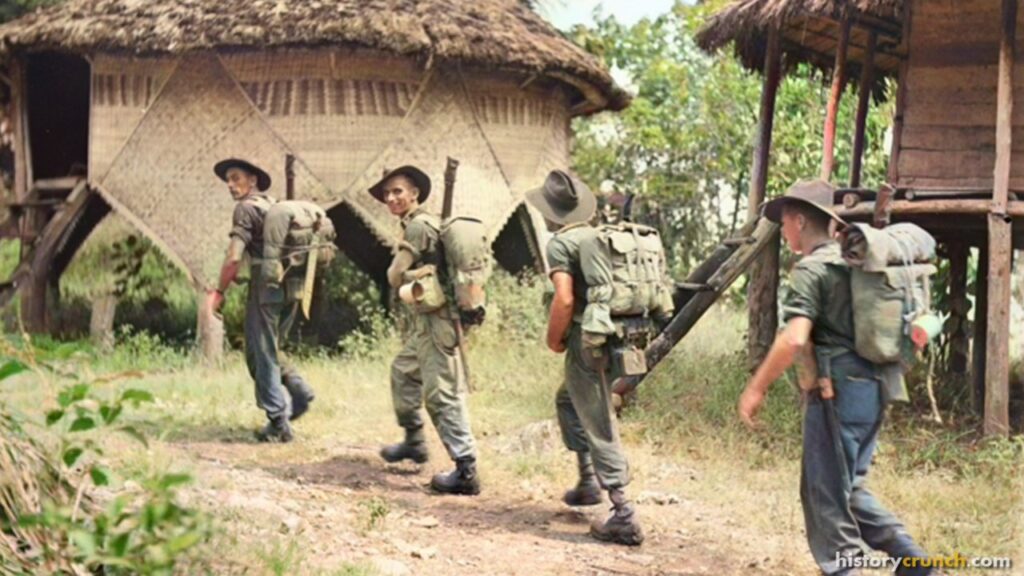
Australia in World War II played a significant and wide-ranging role alongside the Allied Powers. While the war involved the major European powers as its central combatants, it ultimately became a global conflict due to the involvement of countries from around the world. Australia entered World War II in September of 1939 and went on to make major contributions across several theaters of the conflict, including: the Middle East and North Africa, the defense of Singapore, the Kokoda Track campaign in New Guinea, and the overall Pacific Theater of World War II. In total, nearly one million Australians served in the armed forces during World War II, and the conflict was the first time that the Australian mainland itself came under direct enemy attack, making World War II one of the most significant events in Australia’s history.
Australia Enters World War II
World War II began on September 1st, 1939, when Nazi Germany, under the leadership of Adolf Hitler, invaded the country of Poland. Britain declared war on Nazi Germany on September 3rd, 1939, and Australia, as a member of the British CommonwealthA group of nations with historical ties to Britain that often acted together on matters of defense and foreign policy., followed immediately. More specifically, Australian Prime Minister Robert Menzies announced Australia’s entry into the war on September 3rd, 1939, stating that as Britain was at war, Australia was therefore also at war. This was due to Australia’s longstanding ties to Britain and the British Commonwealth.
Support for entering the fighting of World War II was widespread across Australia. As such, the government moved quickly to mobilize, and the Second Australian Imperial Force, known as the 2nd AIFThe Second Australian Imperial Force, the main volunteer army Australia raised to fight overseas in World War II., was established on September 15th, 1939, as the main volunteer overseas fighting force. At the same time, the Citizen Military Forces, known as the CMF, provided home defense. In the early years of the war, Australian forces were deployed primarily to the Middle East to support Britain, following a similar pattern to the deployment of Australian forces in World War I. However, the entry of Japan into the war following the attack on Pearl Harbor on December 7th, 1941, fundamentally changed the nature of Australia’s involvement and brought the war directly to Australia’s doorstep for the first time in its history.
 FactsthatCrunch
Australia Enters World War II: Prime Minister Menzies Declares War on Germany
At 9:15 pm on Sunday the 3rd of September, 1939, Prime Minister Robert Gordon Menzies broadcast a radio address to the nation from the Postmaster-General's Room at the Commonwealth Offices in Melbourne, telling Australians that because Britain had declared war on Germany, Australia was also at war. Because the Statute of Westminster had not yet been ratified by the Australian parliament, Britain's declaration of war applied to Australia by default, making the constitutional basis of the announcement unusual. Within two weeks, on the 14th of September, 1939, Menzies announced plans to raise the Second Australian Imperial Force, a volunteer overseas fighting force of 20,000 men.
Australia in World War II – Army
Australia’s decision to participate in World War II meant that it needed to rapidly expand and equip its armed forces. The 2nd AIF expanded quickly as thousands of Australians volunteered for service, and Australian forces were deployed to the Middle East within months of the war’s outbreak. Over the course of the war, Australian forces served in a wide range of campaigns across multiple theaters. In total, nearly one million Australians served in the armed forces during World War II, and the conflict resulted in 27,073 Australian deaths from enemy action and 23,477 wounded. A further 21,467 Australians were taken prisoner during the war, primarily by Japanese forces, and many of those taken prisoner faced terrible conditions.
As stated above, Australia in World War II participated as part of the Allied Powers alongside Britain, the United States, Canada, New Zealand, and other nations. On the opposing side were the Axis Powers of Nazi Germany, fascist Italy, and Imperial Japan.
How many Australians served in the armed forces during World War II?
Australia in World War II – Major Campaigns and Battles
Australian forces participated in several of the most significant campaigns and battles of World War II across multiple theaters of the conflict. The major campaigns and battles that Australian forces participated in included: the Middle East and North African campaigns, the fall of Singapore, the Kokoda Track campaign, the Battle of Milne Bay, and the overall Pacific Theater of World War II.
Australia in the Middle East and North Africa
The first major overseas deployment of Australian forces in World War II was to the Middle East and North Africa. From 1940 onward, Australian forces fought alongside British and other Commonwealth forces in a series of campaigns against the Axis Powers across Libya, Egypt, Greece, Crete, and Syria. For instance, the 6th, 7th, and 9th Divisions of the 2nd AIF participated in the North African campaign, fighting against Italian and German forces across the deserts of Libya and Egypt. Australian forces played an important role in the siege of Tobruk in Libya, which lasted from April to November of 1941. The garrison of Tobruk, which included a large number of Australian soldiers, successfully held the port against repeated Axis attacks, earning the nickname ‘Rats of Tobruk’ from German forces who had hoped to quickly capture the position. The siege of Tobruk became one of the most celebrated episodes of Australian military history in World War II.
Australian forces also participated in the ill-fated campaigns in Greece and Crete in April and May of 1941, where they fought to defend against a German invasion but were ultimately forced to evacuate in the face of overwhelming force. For instance, Australian troops suffered significant casualties during these campaigns and the subsequent evacuations. As well, in June and July of 1941, Australian forces participated in the Syrian campaign, fighting against Vichy FrenchA French government that collaborated with Nazi Germany after France’s defeat and controlled some overseas territories. forces who were aligned with Nazi Germany. In total, the Middle East and North African campaigns resulted in thousands of Australian casualties across multiple years of fighting.
FactsthatCrunchFrom April 1941 to November 1941, Australian and Allied troops held the port of Tobruk against repeated attacks by Axis forces under General Erwin Rommel. The garrison's stubborn resistance earned its defenders the name Rats of Tobruk, a term Rommel's forces used as an insult that the defenders adopted with pride.
Rommel's Afrika Korps swept across Libya, pushing Allied forces back and threatening Egypt
Tobruk held out for 241 days, breaking Rommel's momentum and showing the Allies that his forces could be stopped in North Africa
Australia and the Fall of Singapore
The entry of Japan into the war following the attack on Pearl Harbor on December 7th, 1941, dramatically changed the nature of Australia’s involvement in World War II. Japanese forces launched a rapid and devastating campaign through Southeast Asia, capturing Hong Kong, Malaya, and the Philippines in quick succession. The most significant disaster for Australian forces in this phase of the war was the fall of Singapore on February 15th, 1942.
Singapore was considered an almost impregnableSo well defended that it seemed impossible to capture or defeat by an enemy. British fortress and a central pillar of the defense of the British Empire in Asia. However, Japanese forces under General Tomoyuki Yamashita advanced rapidly down the Malay Peninsula and attacked Singapore from the north, a direction that its defenses had not been designed to repel. The British and Commonwealth garrison, which included approximately 15,000 Australian soldiers of the 8th Division, was forced to surrender on February 15th, 1942. The fall of Singapore resulted in the largest single surrender of British-led forces in history, and Prime Minister John Curtin, who had become Prime Minister in October of 1941, described it as ‘Australia’s Dunkirk’. The approximately 15,000 Australians captured at Singapore faced years of harsh captivity under the Japanese, and thousands died in prisoner of war camps and on forced labor projects such as the construction of the Burma-Thailand Railway.
Australia in the Kokoda Track Campaign
Following the fall of Singapore, the threat of Japanese attack on the Australian mainland became a real and immediate concern. Japanese aircraft bombed Darwin, in Australia’s Northern Territory, on February 19th, 1942, in the largest foreign attack ever carried out on Australian soil, and further attacks followed in the months afterward. At the same time, Japanese forces were advancing through New Guinea, which lay less than 100 miles (160 kilometers) from the Australian mainland at its closest point.
The most significant campaign fought by Australian forces in defense of Australia was the Kokoda Track campaign, which took place from July to November of 1942. Japanese forces landed on the northern coast of New Guinea in July of 1942 with the intention of advancing overland along the Kokoda Track, a narrow mountain trail approximately 60 miles (96 kilometers) long that crossed the rugged Owen Stanley Mountain Range, and capturing the strategically important port of Port Moresby on the southern coast. Control of Port Moresby would have given Japan a base from which to threaten the Australian mainland and Allied shipping lanes in the Pacific.
Australian forces, initially consisting of poorly equipped and inexperienced militia soldiers of the 39th Battalion, were ordered to hold the track against a Japanese force that significantly outnumbered them. Despite being outgunned and undersupplied, the Australians fought a desperate series of defensive battles along the track throughout July and August of 1942, slowing the Japanese advance at tremendous cost. The conditions on the track were among the most brutal encountered by any soldiers in World War II. For instance, the narrow trail wound through dense jungle, across extremely steep mountain ridges, and through swamps teeming with mosquitoes and leeches. Diseases such as malaria, dysentery, and scrub typhus caused enormous numbers of casualties in addition to those suffered in battle.
By early September of 1942, the Japanese advance had pushed the Australians to within approximately 35 miles (56 kilometers) of Port Moresby. However, Japanese supply lines had been stretched to breaking point and their forces were weakened by disease and starvation. At the same time, reinforcements from the experienced 7th Division of the 2nd AIF, which had been recalled from the Middle East, arrived to strengthen the Australian position. The Japanese were ordered to withdraw in late September of 1942, and Australian forces pursued them back along the track, recapturing the village of Kokoda on November 2nd, 1942. In total, approximately 625 Australians were killed along the Kokoda Track, over 1,600 were wounded, and more than 4,000 suffered from tropical diseases during the campaign.
It should also be noted that Australian forces at the Battle of Milne Bay in August of 1942 achieved another important victory during this period, defeating a Japanese amphibiousA military operation that involves attacking from the sea and landing troops directly onto a shore. landing force at Milne Bay on the southeastern tip of New Guinea. The Battle of Milne Bay was the first time Japanese land forces had been decisively defeated in the Pacific Theater and raised Allied morale at a critical moment in the war.
FactsthatCrunchAustralia in the Pacific Theater
Following the victories on the Kokoda Track and at Milne Bay, Australian forces played an important role in the overall Allied campaign to drive Japanese forces from New Guinea and the wider Pacific. Australian and American forces fought together under the overall command of United States General Douglas MacArthur, who had arrived in Australia in March of 1942 after escaping from the Philippines. Australian General Sir Thomas Blamey was appointed as the Allied land force commander and Australian forces formed a central part of the Allied campaign in the South West Pacific Area.
Australian forces participated in a series of major campaigns to clear Japanese forces from New Guinea and the surrounding islands throughout 1943 and 1944. For instance, Australian troops fought in the Salamaua-Lae campaign, the Huon Peninsula campaign, and a series of other operations that gradually pushed Japanese forces northward. As well, Australian forces participated in the Borneo campaign in 1945, carrying out amphibious landings at Tarakan in May of 1945, at Brunei Bay in June of 1945, and at Balikpapan in July of 1945, in a series of operations that liberated significant areas of Borneo from Japanese control in the final months of the war.
FactsthatCrunchAustralia in World War II – Home Front
World War II had a profound impact on the Australian home front, affecting industry, the role of women, and the relationship between Australia and its traditional ally, Britain. In terms of industrial production, Australia dramatically expanded its manufacturing capacity to support the war effort. For instance, Australian factories produced aircraft, ships, weapons, and a wide range of other war materials throughout the conflict. As well, the arrival of large numbers of American military personnel in Australia from early 1942 onward brought significant changes to Australian society and culture, as the country became an important base for Allied operations in the Pacific.
The war also brought important changes to the role of women in Australia. With large numbers of men serving overseas, women took on a wide range of roles in industry, agriculture, and the armed services. For instance, approximately 67,000 Australian women served in the three women’s auxiliary services during World War II, performing roles in administration, communications, and healthcare. As well, many more women entered the civilian workforce to fill positions vacated by men who had gone to war.
The fall of Singapore in February of 1942 had a profound effect on Australia’s relationship with Britain. The failure of Britain to defend Singapore effectively demonstrated to many Australians that Britain could no longer be relied upon as the primary protector of Australia’s security. Prime Minister Curtin had already begun reorienting Australia’s foreign and military policy toward the United States, famously declaring in December of 1941 that Australia looked to America as its primary partner in the Pacific War. This shift had lasting consequences for Australia’s foreign policy in the postwar era.
The issue of conscriptionA government policy that legally requires citizens to serve in the military rather than volunteering. was also important on the Australian home front during World War II. At the outbreak of the war, conscripted soldiers could only be used for home defense within Australian territory and could not be sent overseas. As the Japanese threat to New Guinea grew, Prime Minister Curtin sought to extend the geographic boundaries in which conscripts could serve. After considerable debate, legislation was passed in January of 1943 allowing conscripted soldiers to serve in most of the South West Pacific Area, which allowed them to be deployed to New Guinea and the surrounding region. As such, the conscription question, which had also been a major issue in Australia during World War I, remained an important and at times controversial political issue throughout World War II as well.
FactsthatCrunchHow did World War II change life on the Australian home front?
Australia in World War II – Significance
World War II was one of the most important and defining events in the history of Australia. First, the scale of Australia’s contribution was enormous for a country of its size. Nearly one million Australians served in the armed forces, and approximately 27,000 were killed as a result of enemy action. This level of sacrifice across multiple theaters of the war demonstrated Australia’s commitment to the Allied cause and cemented its reputation as a significant military nation.
Second, World War II changed Australia’s relationship with the rest of the world in fundamental ways. The fall of Singapore and the threat of Japanese attack on the Australian mainland forced Australia to look beyond its traditional relationship with Britain and forge a new and closer partnership with the United States that has remained a central feature of Australian foreign policy ever since.
Third, the Kokoda Track campaign in particular became one of the most important events in Australian national memory. The image of young and poorly equipped Australian soldiers holding back a determined Japanese advance through some of the most difficult terrain in the world, and ultimately driving the Japanese back across the Owen Stanley Range, became a powerful symbol of Australian courage, endurance, and mateshipA strong Australian cultural value of loyalty, solidarity, and support between fellow soldiers or friends.. As such, World War II, and especially the Pacific campaigns, played an important role in shaping Australia’s sense of national identity in the postwar era.
FactsthatCrunchThe Kokoda Track campaign of 1942 became a defining test of Australian soldiers on home soil, forcing Australians to see their military as independent defenders of their own country rather than forces sent to fight Britain's wars overseas.
The track runs through the Owen Stanley Range in Papua New Guinea, and Australian militia troops, many of them young and poorly equipped, held back a Japanese advance aimed at Port Moresby from July through November 1942. A Japanese capture of Port Moresby could have opened a path toward the Australian mainland, making this the first campaign where Australians fought to protect their own region directly.
The campaign shifted how Australians thought about their military alliances. Before Kokoda, Australia had sent forces to Europe and North Africa under British command. Kokoda made clear that Australia needed to defend its own neighborhood and that its closest partner in that effort was the United States, not Britain.
Australian General Thomas Blamey's public criticism of the militia troops after the campaign caused lasting anger among veterans and their families. That controversy kept public attention on Kokoda for decades and deepened debate about how the government and military leadership treated ordinary soldiers.
Today the Kokoda Track is one of the most recognized symbols in Australian memory of World War II. Australian students, veterans' groups, and political leaders return to it regularly as a reference point for national values of endurance and commitment to defending the region.
Key Vocabulary
British Commonwealth
2nd AIF
Impregnable
Amphibious
Mateship
Conscription
Vichy French
Frequently Asked Questions
When did Australia enter World War II?
Australia entered World War II on September 3rd, 1939, the same day Britain declared war on Nazi Germany. As a member of the British Commonwealth, Australia followed Britain immediately. Prime Minister Robert Menzies announced that because Britain was at war, Australia was also at war.
Why was the fall of Singapore so important for Australia?
The fall of Singapore on February 15th, 1942, was the worst military disaster for Australia in the war. About 15,000 Australian soldiers of the 8th Division were captured and faced years of harsh captivity. The loss also convinced many Australians that Britain could no longer protect their security.
What was the Kokoda Track campaign?
The Kokoda Track campaign was a series of battles fought in New Guinea from July to November of 1942. Australian soldiers held a narrow mountain trail against a larger Japanese force trying to reach Port Moresby. The campaign is remembered as a powerful symbol of Australian courage and endurance.
How many Australians served and died in World War II?
Nearly one million Australians served in the armed forces during World War II. Enemy action caused 27,073 Australian deaths and 23,477 wounded. A further 21,467 Australians were taken prisoner, mostly by Japanese forces, and many suffered terrible conditions in captivity.
Was the Australian mainland attacked during the war?
Yes, World War II was the first time the Australian mainland came under direct enemy attack. Japanese aircraft bombed Darwin on February 19th, 1942, in the largest foreign attack ever carried out on Australian soil. More attacks followed in the months afterward.
How did World War II change Australia’s relationship with Britain?
World War II shifted Australia away from Britain and toward the United States as its main ally. The fall of Singapore showed that Britain could no longer defend Australia on its own. Prime Minister John Curtin declared that Australia looked to America as its chief partner in the Pacific War.
Cite This Article
To cite this article as a source, use one of the formats below.
MLA: Millar, B. “Australia in World War II: A Detailed Summary.” HistoryCrunch, 4 October 2026, https://historycrunch.com/australia-in-world-war-ii/.
APA: Millar, B. (2026). Australia in World War II: A Detailed Summary. HistoryCrunch. https://historycrunch.com/australia-in-world-war-ii/
Chicago: Millar, B. “Australia in World War II: A Detailed Summary.” HistoryCrunch. October 4, 2026. https://historycrunch.com/australia-in-world-war-ii/
Sources
- The National WWII Museum
- Max Hastings, Inferno / All Hell Let Loose.
- Imperial War Museum
- Gerhard L. Weinberg, A World at Arms.