American women played one of the most important roles on the American home frontThe civilian population and everyday economy of a country during a major war, keeping production and daily life running while soldiers fight overseas. and in the armed forces during World War II. When the United States entered the conflict, millions of men left their jobs to serve in the military, and women stepped forward to fill those roles in factories, shipyards, hospitals, and military support units. When the war began and American men began to enlist in the war effort, women were needed in the industrial sectors of the American economy in order to keep the factories operating, and American women would come to play a crucial role in the war effort.
The term “home front” refers to the civilian population and the everyday economy of a country during a major war. While soldiers fought overseas, people at home produced weapons and supplies, grow food, raise money, and keep daily life running. In World War II, the American home front depended heavily on the labor of women, who took on work that had long been closed to them.

What Was World War II?
World War II was a global conflict that lasted from 1939 to 1945 and involved most of the world’s nations. It was fought between two main groups, the Allied powers, which included the United States, Great Britain, and the Soviet Union, and the Axis powers, which included Germany, Italy, and Japan. The war grew out of aggressive expansion by the Axis nations and remains the deadliest conflict in human history.
The United States was hesitant to join the fighting at first. Reluctant to enter the war when it erupted in 1939, the United States quickly committed itself to total warA situation where the entire nation, not just its soldiers, must be organized around the war effort. after the Japanese attack on Pearl Harbor, and that commitment included using all of America’s assets, women included. Total war meant that the entire nation, not just its soldiers, had to be organized around the war effort. As a result, the demand for workers and volunteers reached into nearly every American home.
FactsthatCrunchTotal war is a conflict in which a country uses all of its resources, including its economy, industry, civilian population, and military, to defeat the enemy. It is not limited to soldiers fighting on a battlefield. Governments in a total war direct factories, farms, and workers toward the war effort and may also target the enemy's ability to produce and supply goods.
"During World War II, the United States converted car factories to build tanks and planes, rationed food and rubber at home, and mobilized millions of civilians, making it a clear example of total war."
What Were the Roles of Women Before the War?
Before World War II, most American women did not work outside the home. Very few women had jobs in the workforce, and the vast majority worked in the home as stay-at-home mothers and homemakers, while women who did have jobs at the time were usually limited to roles such as teachers, secretaries, and nurses. Society generally expected women to marry, raise children, and manage the household rather than earn wages.
In fact, women had already been part of the workforce for years, but usually out of financial need. Women were part of the larger workforce before the formal entry of the United States into the war; however, they were mostly women who needed to work, such as poor women, single women, and those helping with their husbands’ or families’ businesses. The war would change both the number of women working and the kinds of jobs they were allowed to do.
FactsthatCrunchWhy Did Women Enter the Workforce During the War?
The main reason women entered the workforce in such large numbers was a severe labor shortage. As millions of men joined the military, factories were left without enough workers to meet the huge demand for war supplies. When the United States entered World War II, production of weapons, tanks, ships, planes, and other military equipment increased dramatically, and as men joined or were drafted into the armed forces, war industries needed to replace their workers, so the government encouraged companies to hire more women in a wider variety of roles.
The government also removed some barriers that had kept certain workers out of defense plants. President Franklin D. Roosevelt‘s Executive Order 8802A presidential order signed by Franklin D. Roosevelt that banned discrimination in defense jobs, opening new roles to previously excluded workers. banned racial discrimination in defense jobs, which helped open new roles for African American workers, while the start of the peacetime draft in 1940 created openings for women as men left their jobs. Even so, employers were slow to hire women at first. In the early stages of the war, women were among the last hired, and it was only when employers realized that the number of available male workers was becoming exhausted that they abandoned some of their discriminatory policies and the demand for women workers increased.
FactsthatCrunchWho Was Rosie the Riveter?
Rosie the RiveterA fictional government campaign character representing the more than six million women who entered the workforce to support the American war effort. was a fictional character used by the United States government in a famous campaign to recruit women into war work. She became the most recognizable image of the working woman during the war, usually shown wearing a denim work uniform and a red kerchief and flexing her arm. In reality, Rosie was not a single person. Instead, Rosie the Riveter represents the more than six million women from a wide variety of backgrounds who entered the workforce to support the American war effort.
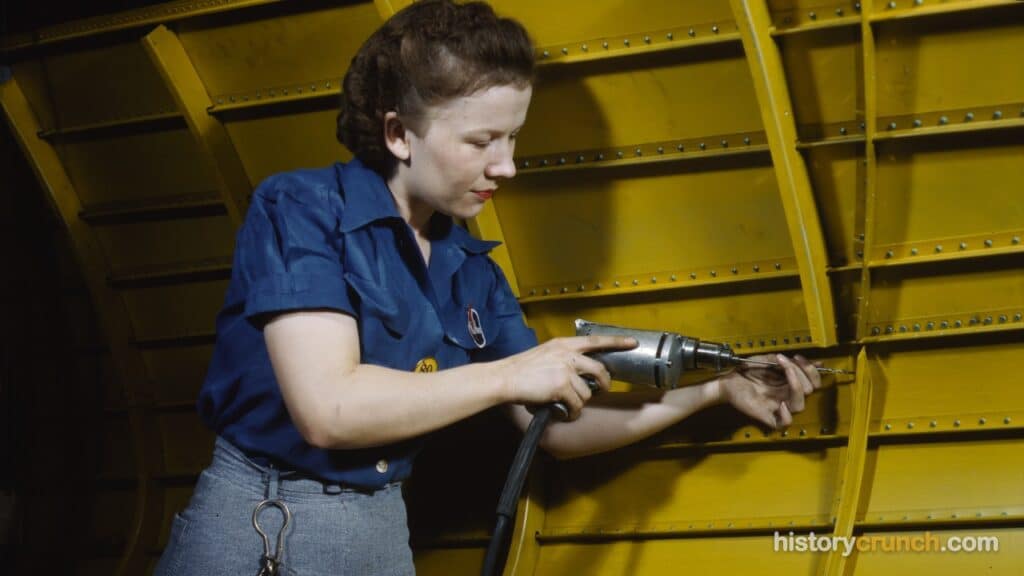
The character came from popular culture before she became a government symbol. The name “Rosie the Riveter” originated with a popular 1942 song written by Redd Evans and John Jacob Loeb, in which Rosie works on an airplane assembly line, has a boyfriend in the Marine Corps, and spends her money on war bonds, and people began using the name to refer to women workers in the defense industry. More specifically, women poured into industries that had once been all male. Millions of women worked in shipyards and factories, laboring as welders, machinists, and riveters.
Rosie the Riveter was a single real woman who worked in a wartime factory.
How Did the War Change the Number of Working Women?
The war caused a dramatic rise in the share of American women who held paying jobs. Between 1940 and 1945, the female percentage of the U.S. workforce increased from 27 percent to nearly 37 percent, and by 1945 nearly one out of every four married women worked outside the home. This shift touched families across the country and challenged old ideas about what women could do.
The change was especially sharp in the aircraft industry. More than 310,000 women worked in the U.S. aircraft industry in 1943, representing 65 percent of the industry’s total workforce, compared to just 1 percent in the pre-war years. Women also drove trucks, ran streetcars, worked on farms, and raised money through war bond drives. As stated above, the government promoted this work as a patriotic duty, and posters, songs, and newsreels urged women to prove they could handle demanding jobs.
FactsthatCrunch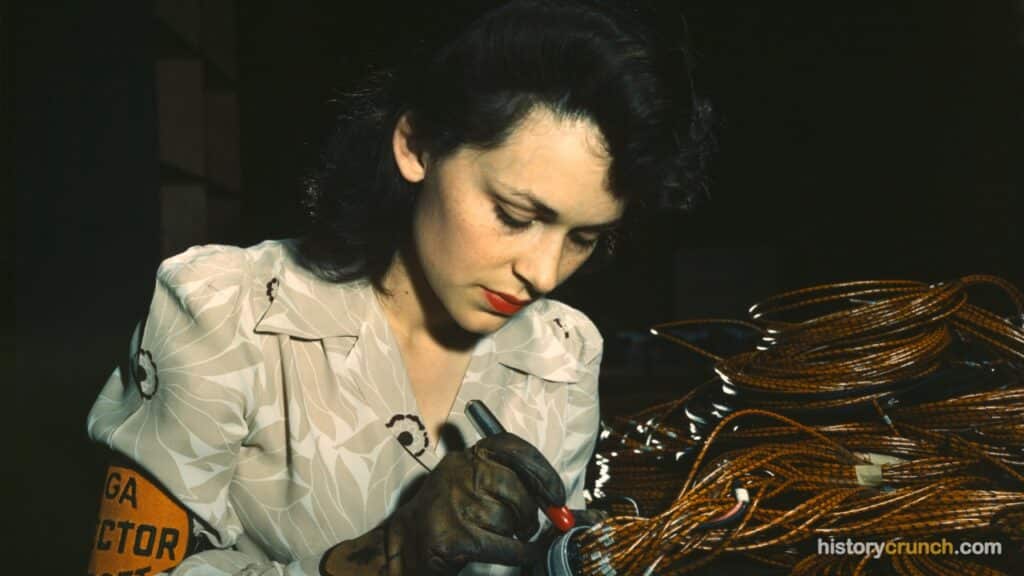
How Did Women Serve in the Military?
Women served in uniform in large numbers for the first time during World War II. More than 350,000 American women joined the United States Armed Forces during World War II, and while women had been serving as Army and Navy nurses for decades, the war led to new opportunities for them to enlist in the Army, Navy, Marine Corps, and Coast Guard. Congress created special branches so women could take on many non-combat jobs and free men to fight.
Each branch of the military set up its own women’s unit. In 1942, Congress created the Women’s Army Auxiliary Corps, later renamed the Women’s Army Corps, or WACThe Women’s Army Corps, the largest women’s military branch during World War II, with 150,000 members performing over 200 different jobs., along with the Women Accepted for Volunteer Emergency Service, known as the WAVES, and the Marine Corps Women’s Reserve, while the Coast Guard established a women’s unit known as the SPARS, and women aviators flew with the Women Airforce Service Pilots, or WASPWomen Airforce Service Pilots, a unit of women aviators who flew military aircraft beginning in 1943, ferrying planes from factories to bases., unit beginning in 1943. The Army’s WAC was the largest of these groups. The Women’s Army Corps was the largest of the women’s branches during World War II, with 150,000 members.
Women in uniform did far more than office work. Women in uniform performed more than 200 different jobs during their service, working as clerks, mechanics, pilots, drivers, gunnery instructors, air traffic controllers, weather forecasters, postal workers, and translators. The WASP pilots played an especially unusual role. Each WASP had already obtained a pilot’s license before service, and they became the first women to fly American military aircraft, ferrying planes from factories to bases and freeing thousands of male pilots for active duty.
Nurses were among the most important women serving overseas. About 59,000 Army nurses served stateside and overseas during the war, and 67 Army nurses were captured by the Japanese in the Philippines in 1942 and held as prisoners of war for over two and a half years. In fact, nurses often worked close to the fighting. More than 1,600 nurses were decorated for bravery under fire and meritorious service, and nurses were in Normandy just four days after D-Day.
FactsthatCrunchMore than 500 U.S. military women died in service during World War II, yet only 16 were killed directly by enemy fire.
Six of those 16 died when German forces bombed Allied positions at Anzio, Italy, in February 1944. Six more were killed in April 1945 when a Japanese kamikaze plane struck the hospital ship USS Comfort as it carried wounded troops toward Okinawa. Most of the remaining deaths came from illness and aircraft or vehicle accidents, reflecting the dangerous conditions women faced even outside direct combat.
What Challenges Did Women Face?
Even as they were needed, women faced resistance and hardship. Some Americans praised women’s patriotism, but others thought it was inappropriate for them to work outside the home, and women experienced sexual harassment and violence at work, in public, and in their homes. Working mothers also struggled to find care for their children, a problem the government tried to ease by funding special nurseries.
Women of color faced even greater barriers. Black, Latina, Native American, and Asian American women faced racism and discrimination in war work and society, and the U.S. government forced Japanese American and Unangax̂ people into incarceration camps. For example, African American women often had to fight just to be hired. African American women struggled to find jobs in the defense industry, and white women were often unwilling to work beside them, and while Black women escaped jobs as domestic servants to work in factories for better wages, most were fired after the war.
FactsthatCrunchExecutive Order 8802, signed by President Franklin D. Roosevelt on June 25th, 1941, banned discrimination in federal defense jobs based on race, but it did not include strong enforcement powers, so many defense plants continued to exclude or segregate African American workers, especially women.
During World War II, African American women entered the paid workforce in large numbers for the first time, but they faced barriers that went beyond what white women encountered. Discrimination in defense industries meant that the promises of Executive Order 8802 often did not reach them in practice.
Significance of American Women in World War II
The work of American women was essential to the Allied victory. Their labor kept the factories running, produced the ships and planes that won the war, and cared for the wounded, all while men were away fighting. In reality, the war could not have been won without the millions of women who filled the gap in the workforce and the armed forces.
When the war ended, however, many women were pushed back out of their jobs. At the war’s end, even though a majority of women surveyed reported that they wanted to keep their jobs, many were forced out by men returning home and by the downturn in demand for war materials. Women veterans also ran into problems using the benefits offered to returning soldiers. Women veterans encountered roadblocks when they tried to take advantage of benefit programs like the G.I. BillA benefit program for returning soldiers that women veterans were often blocked from using despite their military service., and the nation that needed their help in a time of crisis was not yet ready for the greater social equality that would slowly come in the decades to follow.
Still, the experience left a lasting mark on American society. Women had proven that they could do skilled, demanding work once thought suitable only for men. This shift helped lay the groundwork for later movements for women’s rights and for the steady growth of women in the workforce in the decades that followed.
FactsthatCrunchWorld War II pulled millions of American women into paid work and military service for the first time, bringing real gains and real setbacks.
Key Vocabulary
Home front
Total war
Executive Order 8802
Rosie the Riveter
WASP
WAC
G.I. Bill
Frequently Asked Questions
How many American women worked during World War II?
About six million American women entered the workforce during World War II. Many of them worked in defense industries building ships, aircraft, and weapons, while others took jobs in offices, on farms, and in transportation that men had left behind when they joined the military.
Did women fight in combat during World War II?
American women were generally kept out of direct combat, but many served very close to danger. Nurses treated the wounded near the front lines, WASP pilots flew military aircraft within the United States, and some servicewomen were captured and held as prisoners of war, showing that “non-combat” roles could still be extremely risky.
What did the letters WAC, WAVES, and WASP stand for?
WAC stood for the Women’s Army Corps, WAVES stood for Women Accepted for Volunteer Emergency Service, and WASP stood for Women Airforce Service Pilots. Each was a separate branch that let women serve in a specific part of the armed forces, and together they allowed hundreds of thousands of women to wear a military uniform.
Was Rosie the Riveter a real person?
Rosie the Riveter was not one real person but a symbol created for a government recruitment campaign. She stood for the millions of women who took factory and defense jobs during the war, and over the years several real women who worked in wartime plants have been linked to the famous image.
What happened to women workers after the war ended?
Many women were laid off after the war as returning soldiers reclaimed their old jobs and wartime production slowed. Even though a majority of women said they wanted to keep working, they were often pressured to return home, yet the skills and confidence they gained continued to shape American attitudes about women and work for years afterward.
Cite This Article
To cite this article as a source, use one of the formats below.
MLA: Millar, B. “American Women in World War II: A Detailed Summary.” HistoryCrunch, 14 August 2026, https://historycrunch.com/american-women-in-world-war-ii/.
APA: Millar, B. (2026). American Women in World War II: A Detailed Summary. HistoryCrunch. https://historycrunch.com/american-women-in-world-war-ii/
Chicago: Millar, B. “American Women in World War II: A Detailed Summary.” HistoryCrunch. August 14, 2026. https://historycrunch.com/american-women-in-world-war-ii/
Sources
- Gerhard L. Weinberg, A World at Arms.
- The National WWII Museum
- Antony Beevor, The Second World War.
- Max Hastings, Inferno / All Hell Let Loose.