Georgy Zhukov was a Marshal of the Soviet Union who served as the senior military commander of the Soviet armed forces during World War II. Over the course of his military career, Zhukov commanded Soviet forces in some of the most important battles of World War II, including the defense of Moscow, the Battle of Stalingrad, the Battle of Kursk, and the final assault on Berlin. He is remembered as one of the most capable military commanders of the twentieth century.
 FactsthatCrunch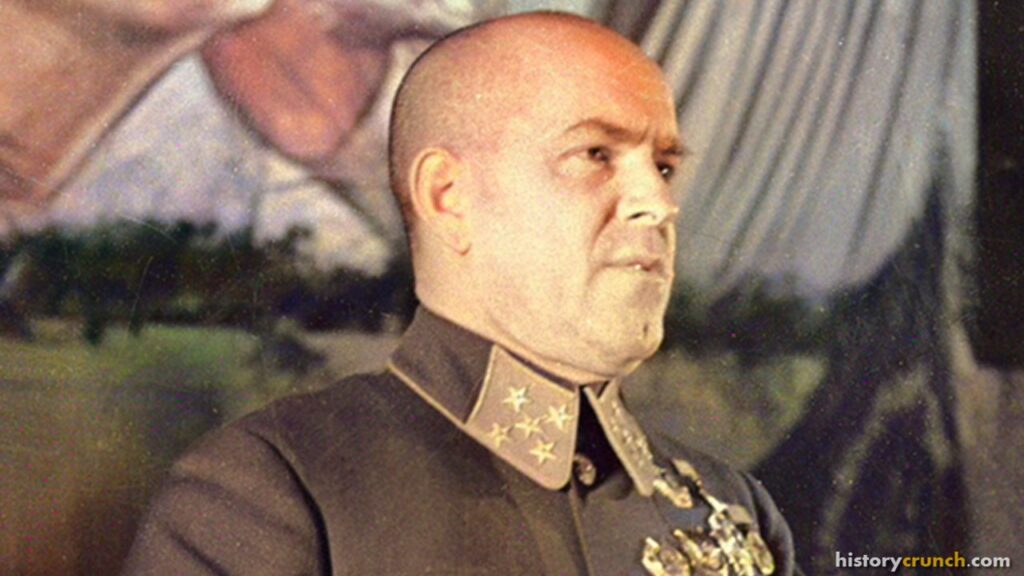
Georgy Zhukov – Early Life
Georgy Konstantinovich Zhukov was born into a poor peasant family in the village of Strelkovka, located approximately 60 miles (97 kilometers) southwest of Moscow. He was born on December 1st, 1896. His father worked as a shoemaker. The family lived in considerable poverty, and Zhukov received only a basic education before being sent to Moscow as a teenager to work as an apprentice furrier for his uncle. Despite his humble beginnings, Zhukov showed an early aptitude for hard work and discipline that would define his military career.
In 1915, Zhukov was conscriptedForced by the government to join the military, whether a person wants to or not. into the Imperial Russian Army and sent to fight in World War I. He served in the cavalry and proved himself a capable and brave soldier. During the war, Zhukov was twice awarded the Cross of St. George, one of the highest military honors available to enlisted soldiers in the Russian Imperial Army, for his bravery in combat. He was also wounded twice during the fighting and was promoted to the rank of non-commissioned officerA military rank earned by an enlisted soldier, such as a sergeant, below the level of a commissioned officer. before the war ended.
FactsthatCrunchIn World War I, the Cross of St. George was one of the highest military honors available to enlisted soldiers in the Russian Imperial Army. Zhukov earned it twice for bravery in combat while serving in the cavalry after being conscripted in 1915. The medal was awarded specifically to enlisted soldiers, not officers, making it a mark of personal courage on the battlefield.
Russia restored the Cross of St. George as an official state decoration in 1992, after the Soviet Union collapsed. It is now awarded to Russian military personnel for battlefield bravery, continuing the same basic purpose the medal held in Zhukov's time. The orange and black ribbon pattern associated with the medal has also become a widely recognized symbol of World War II remembrance in Russia.
A medal Zhukov earned over a century ago still shapes how Russia honors soldiers today.
Georgy Zhukov – Early Military Career
Following the Russian Revolution of 1917 and the end of World War I, Russia descended into a civil war between the Bolshevik Red Army and the anti-Bolshevik White Army. Zhukov joined the Red Army in 1918 and fought in the Russian Civil War, again serving in the cavalry. He distinguished himself during the fighting and was awarded the Order of the Red Banner for his performance in battle. By the end of the civil war in 1921, Zhukov had established a reputation as a skilled and dependable cavalry commander.
Over the following years, Zhukov rose steadily through the ranks of the Soviet military. He studied military science at the Frunze Military Academy and became an early advocate for the use of tanks and armored units in modern warfare. In the 1930s, Zhukov was one of the first tank commanders in the Soviet Army, which placed him at the forefront of the Soviet military’s transition from cavalry-based tactics to modern armored warfare. This experience would prove crucial in the years ahead.
In 1939, Zhukov was given command of Soviet forces in the Mongolian border region, where tensions between the Soviet Union and Japan had led to armed conflict. In the summer of 1939, Zhukov commanded Soviet and Mongolian forces in a decisive battle against Japanese forces at Khalkhin Gol, in what is now Mongolia. The Soviet victory at Khalkhin Gol halted Japanese expansion into Soviet-influenced territory and demonstrated Zhukov’s ability to plan and execute large-scale combined armsA military approach that coordinates infantry, tanks, artillery, and air support together in a single operation. operations involving infantry, tanks, artillery, and air support. For this victory, Zhukov was awarded the first of his four Hero of the Soviet Union medals, the highest honor in the Soviet Union.
FactsthatCrunchAt Khalkhin Gol in the summer of 1939, Zhukov used a combined arms operation to coordinate infantry, tanks, artillery, and air support into a single attack that crushed Japanese forces on the Mongolian border.
Georgy Zhukov – World War II
When Germany launched its massive invasion of the Soviet Union on June 22nd, 1941, in the operation known as ‘Operation Barbarossa‘, the Soviet military was initially overwhelmed. German forces advanced rapidly into Soviet territory, inflicting catastrophic casualties. Joseph Stalin, the leader of the Soviet Union, turned to Zhukov as one of the commanders he trusted most to stabilize the situation. Over the following four years, Zhukov played a central role in virtually every major Soviet military operation of the war.
In the autumn of 1941, German forces advanced to within a short distance of Moscow, and the Soviet capital appeared to be in serious danger of falling. Stalin appointed Zhukov to command the defense of Moscow in October of 1941. Zhukov organized a determined defensive effort that halted the German advance and, in December of 1941, launched a counteroffensiveA large military attack launched in response to an enemy’s attack, aimed at pushing the enemy back. that pushed German forces back from the city. The defense of Moscow was one of the first significant setbacks suffered by Germany in World War II and demonstrated that the Soviet Union was capable of resisting the German advance.
In 1942, Zhukov was appointed Deputy Supreme Commander of the Soviet armed forces, the second highest military position in the Soviet Union below Stalin himself. In this role, Zhukov was involved in the planning of the Soviet counteroffensive at Stalingrad, known as ‘Operation Uranus’, which was launched in November of 1942. The operation encircledSurrounded an enemy force completely so it cannot escape or receive supplies. the German Sixth Army inside the city of Stalingrad and eventually forced its surrender in February of 1943. The Battle of Stalingrad was one of the turning points of World War II and resulted in the destruction of an entire German army. Zhukov was promoted to the rank of Marshal of the Soviet Union in January of 1943, as the fighting at Stalingrad neared its end.
In the summer of 1943, Zhukov played an important role in the planning and execution of the Soviet defense at the Battle of Kursk, the largest tank battle in history. German forces launched a major offensive aimed at destroying the Soviet front lines near the city of Kursk. Zhukov advised Stalin to allow the Germans to exhaust themselves against prepared Soviet defensive positions before launching a counteroffensive. This strategy proved successful. The German offensive was halted, and the subsequent Soviet counteroffensive pushed German forces back in a retreat from which they never fully recovered on the Eastern Front.
In the final stages of the war, Zhukov commanded the 1st Belorussian Front, the Soviet army group tasked with advancing through Poland and into Germany. In January of 1945, Zhukov led the Vistula-Oder Offensive, which drove German forces out of Poland and brought Soviet troops to within 40 miles (64 kilometers) of Berlin. In April of 1945, Zhukov commanded the Soviet assault on Berlin itself. The Battle of Berlin was one of the largest and most intense urban battles of the entire war. Soviet forces captured the city in early May of 1945, and Adolf Hitler committed suicide in his bunker on April 30th, 1945. On May 8th, 1945, Zhukov represented the Soviet Union at the formal ceremony of Germany’s unconditional surrender in Berlin.
FactsthatCrunchThe German invasion of the Soviet Union in 1941 created a crisis that forced Stalin to give Zhukov greater and greater responsibility. Each successful defense gave Zhukov more authority, turning him into the Soviet Union's leading commander by early 1943.
Georgy Zhukov – Later Life and Death
Following the end of World War II, Zhukov was celebrated as a national hero in the Soviet Union. However, his enormous popularity and prestige made him a source of concern for Joseph Stalin, who was suspicious of anyone whose public standing might rival his own. In 1946, Stalin removed Zhukov from his prominent position and assigned him to a series of minor regional military commands far from Moscow, effectively pushing him out of public life. Zhukov’s name was removed from official accounts of the war, and his contributions were downplayed in Soviet publications.
After Stalin’s death in March of 1953, Zhukov’s fortunes improved. The new Soviet leadership recognized his value and appointed him Deputy Minister of Defense. Zhukov supported Nikita Khrushchev’s rise to power, and in 1955 was appointed Minister of Defense, making him one of the most powerful figures in the Soviet government. In 1957 he was made a full member of the PresidiumThe top governing body of the Soviet Communist Party, which held the real political power in the USSR. of the Communist Party, the first military professional to hold that position.
However, Zhukov’s efforts to make the Soviet military more independent from Communist Party control brought him into conflict with Khrushchev. In October of 1957, Khrushchev removed Zhukov from his position as Minister of Defense and stripped him of his party posts. Zhukov retired from public life and spent his remaining years writing his memoirs, though many of his writings were censored by the Soviet government before publication. Following Khrushchev’s own fall from power in 1964, Zhukov’s reputation was gradually rehabilitatedHad a person’s reputation officially restored after a period of disgrace or punishment. and he received the Order of Lenin in 1966. Zhukov died on June 18th, 1974, in Moscow at the age of 77.
FactsthatCrunchWhy Did Stalin Push Zhukov Out of Public Life After World War II?
After the war ended, Zhukov was celebrated as a national hero, and his enormous popularity made Stalin uneasy. Stalin was suspicious of anyone whose public standing might rival his own, so in 1946 he removed Zhukov from his prominent position and assigned him to minor regional military commands far from Moscow. Soviet publications downplayed Zhukov's wartime contributions, and his name was removed from official accounts of the war.
Georgy Zhukov – Significance
Georgy Zhukov was significant for several reasons. First, Zhukov was significant because he played a central role in the defeat of Nazi Germany on the Eastern Front of World War II. The Eastern Front was the largest and most destructive theater of the entire war, and the Soviet Union’s ability to resist and ultimately defeat Germany was the single most important factor in the Allied victory in Europe. Zhukov commanded Soviet forces at each of the major turning points of the Eastern Front, including the defense of Moscow, the victory at Stalingrad, the Battle of Kursk, and the final assault on Berlin. His ability to organize, plan, and execute large-scale military operations under conditions of enormous pressure was central to the Soviet war effort.
Zhukov was also significant because his career reflected the larger story of the Soviet Union during the twentieth century. Born into poverty under the Tsarist system, Zhukov rose to become the most powerful military figure in the Soviet Union through a combination of ability and loyalty to the communist state. His repeated falls from favor under Stalin and Khrushchev demonstrated the dangers that capable and prominent individuals faced within the Soviet political system, where loyalty to the Communist Party was always considered more important than personal achievement. As such, Zhukov’s life illustrates both the opportunities and the limitations that the Soviet system created for those who served it.
Finally, Zhukov was also significant because his reputation endured long after his death and continues to influence how the history of World War II is understood. He is remembered in Russia as the greatest military hero of the war, and a large statue of Zhukov on horseback stands in front of the State Historical Museum in Moscow. Historians outside Russia have also recognized Zhukov as one of the most capable commanders of the entire conflict, noting that the scale of his victories on the Eastern Front exceeded those of any other general on any side of the war. His campaigns against Germany helped bring World War II to an end and shaped the political order of Europe for decades to follow.
FactsthatCrunchZhukov's rise from peasant to Marshal shows that the Soviet system rewarded ability but punished anyone who became too powerful.
Key Vocabulary
Conscripted
Non-commissioned officer
Combined arms
Encircled
Counteroffensive
Presidium
Rehabilitated
Frequently Asked Questions
Who was Georgy Zhukov?
Georgy Zhukov was a Marshal of the Soviet Union and its top military commander during World War II. He led Soviet forces at major battles such as Moscow, Stalingrad, Kursk, and Berlin. Many historians rank him as one of the most capable commanders of the twentieth century.
What battles did Zhukov command during World War II?
Zhukov commanded Soviet forces at every major turning point on the Eastern Front. These included the defense of Moscow in 1941, the counteroffensive at Stalingrad, the Battle of Kursk, and the final assault on Berlin. He also represented the Soviet Union at Germany’s surrender on May 8th, 1945.
Why did Stalin remove Zhukov after the war?
Stalin removed Zhukov in 1946 because his fame as a war hero seemed to threaten Stalin’s own standing. Stalin distrusted anyone whose popularity might rival his own power. Zhukov was sent to minor regional commands, and his wartime role was downplayed in Soviet publications.
What was the Battle of Khalkhin Gol?
Khalkhin Gol was a 1939 battle where Zhukov led Soviet and Mongolian forces to victory over Japan. The win stopped Japanese expansion into Soviet-influenced territory in the region. It also showed Zhukov’s skill at combining infantry, tanks, artillery, and air power, earning him his first Hero of the Soviet Union medal.
How is Zhukov remembered today?
Zhukov is remembered in Russia as the greatest military hero of World War II. A large statue of him on horseback stands in front of the State Historical Museum in Moscow. Historians outside Russia also credit him with victories on a scale no other general matched during the war.
Cite This Article
To cite this article as a source, use one of the formats below.
MLA: Millar, B. “Georgy Zhukov: A Detailed Biography.” HistoryCrunch, 3 October 2026, https://historycrunch.com/georgy-zhukov/.
APA: Millar, B. (2026). Georgy Zhukov: A Detailed Biography. HistoryCrunch. https://historycrunch.com/georgy-zhukov/
Chicago: Millar, B. “Georgy Zhukov: A Detailed Biography.” HistoryCrunch. October 3, 2026. https://historycrunch.com/georgy-zhukov/
Sources
- Imperial War Museum
- Max Hastings, Inferno / All Hell Let Loose.
- Gerhard L. Weinberg, A World at Arms.
- Antony Beevor, The Second World War.