Albert Einstein is one of the most important scientists in all of human history, and his ideas completely changed the way people understand space, time, energy, and the universe. He was a German-born physicist whose theories reshaped modern science and laid the groundwork for discoveries that still shape the world today. Best known for his theory of relativity and the famous equation E = mc², Einstein became a symbol of genius and curiosity, and his life stretched from the quiet towns of nineteenth-century Germany to the laboratories and lecture halls of the United States.
 FactsthatCrunch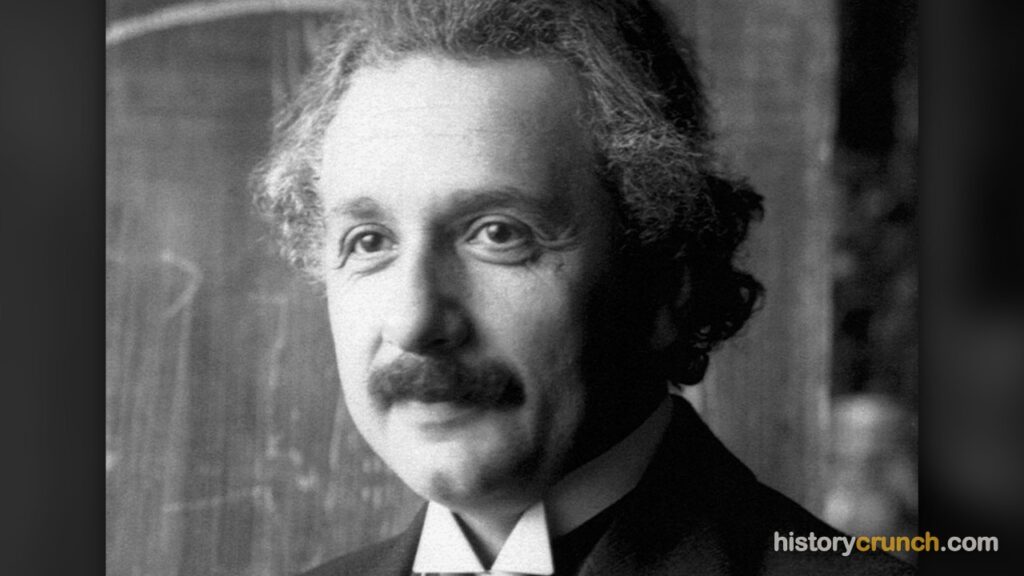
A physicist is a scientist who studies matter, energy, and the forces that govern how the universe works. Einstein was a theoretical physicist, meaning he used mathematics and careful reasoning, rather than only experiments in a laboratory, to explain how nature behaves. His theories described things that had never been seen directly, such as the bending of light by gravity, and later experiments proved that his predictions were correct.
Early Life and Background
Albert Einstein was born on March 14th, 1879, in the city of Ulm, in the German region of Württemberg. His family was a secular Jewish family, meaning they were Jewish by heritage but did not strictly follow religious traditions. Only a short time after his birth, the family moved to Munich, where his father and uncle ran a company that produced electrical equipment.
Einstein grew up in a middle-class household with his younger sister, Maja, who was born two years after him. From an early age he became fascinated by mathematics and science, and he also developed a lifelong love of music, learning to play the violin as a child. In fact, music remained an important part of his life and offered him relaxation long after he became famous.
Einstein began his schooling at the Luitpold Gymnasium in Munich, where he excelled in physics and mathematics but was less interested in subjects that relied on strict memorization. He often disliked the rigid, authoritarian style of some of his teachers, and he preferred to explore ideas on his own. When his family moved to Italy in search of better business opportunities, Einstein stayed behind in Munich for a time before eventually leaving school himself.
In 1895, Einstein tried to enter the Swiss Federal Polytechnic School in Zurich, an important technical university. Although his marks in physics and mathematics were excellent, his scores in other subjects were not high enough, and he did not pass the entrance exam on his first attempt. He then completed additional schooling in Aarau, Switzerland, and was admitted to the Zurich school in 1896 to train as a teacher of physics and mathematics.
FactsthatCrunchRise to Prominence
Einstein earned his teaching diploma in 1901 and became a Swiss citizen that same year. However, he was unable to find a teaching position, partly because his independent and rebellious personality did not impress all of his professors. As a result, he took a job as a technical assistant at the Swiss Patent Office in Bern, where his task was to review inventions.
The patent office turned out to be a surprisingly good place for Einstein to think. More specifically, he was able to finish his official duties quickly and then spend his free time working on the physics problems that fascinated him. During these years he also married Mileva Marić, a fellow physics student he had met in Zurich, in 1903, and the couple went on to have children.
The year 1905 became known as Einstein’s “miracle year” because he published four groundbreaking scientific papers while still working as a clerk. These papers explained the photoelectric effect, described the motion of tiny particles, introduced the special theory of relativity, and presented the famous relationship between energy and mass. In the same year, he also earned his doctorate from the University of Zurich.
These publications slowly brought Einstein worldwide attention within the scientific community. As his reputation grew, he moved from the patent office into university teaching, holding professor positions in Bern, Zurich, and Prague before eventually settling into important academic posts. By the 1910s, Einstein had transformed from an unknown clerk into one of the most respected physicists in the world.
Major Achievements
Einstein’s most famous achievements center on his theories of relativity. His special theory of relativity, introduced in 1905, changed the way scientists understood space and time. It showed that measurements of time and distance are not fixed for everyone, but instead depend on how fast an observer is moving, an idea that completely overturned older ways of thinking.
Out of this work came the equation E = mc², which states that energy and mass are two forms of the same thing. In this equation, energy equals mass multiplied by the speed of light squared, which means that even a tiny amount of matter contains an enormous amount of energy. This single idea would later help explain how the sun produces its power and how nuclear energy works.
Einstein realized that his 1905 theory did not fully explain gravity or acceleration, so he spent roughly the next eight years working on a solution. In 1915, he proposed his general theory of relativity, which described gravity in a completely new way. Rather than treating gravity as a simple force pulling objects together, Einstein explained it as a curving, or bending, of the fabric of space and time itself.
This bold theory was tested during a solar eclipse, when astronomers observed that the light from distant stars bent as it passed the sun, exactly as Einstein had predicted. In reality, this confirmation turned Einstein into an international celebrity almost overnight. His theories also complicated and expanded upon the ideas of Isaac Newton, whose work had guided physics for more than two hundred years.
In 1921, Einstein was awarded the Nobel Prize in Physics. Interestingly, he did not win the prize for relativity, but rather for his explanation of the photoelectric effect, which described how light can knock electrons loose from certain materials. As stated above, this work treated light as both a wave and a stream of tiny particles, and it became one of the foundations of quantum mechanics, another major branch of modern physics.
Later Life
During the 1920s, Einstein became a global figure, traveling across Europe, the Americas, and Asia to give lectures about his discoveries. He was celebrated everywhere he went and received honorary degrees and memberships from leading universities and scientific academies. At the same time, he became more publicly involved in political and social causes, including pacifism, which is the belief in solving conflicts without war, and the Zionist movement, which supported a homeland for the Jewish people.
As a Jewish scientist and an outspoken supporter of peace, Einstein became a target of the Nazi Party as it rose to power in Germany. In late 1932, shortly before Adolf Hitler became chancellor, Einstein made the decision to leave for the United States. He never returned to the country of his birth, and he took a position at the newly founded Institute for Advanced Study in Princeton, New Jersey.
Einstein spent the rest of his life in Princeton, where he continued his research and later became an American citizen. During these years he focused much of his energy on a search for what he called a unified field theory, an attempt to combine the laws of the universe into a single framework. He never completed this goal, and he grew somewhat isolated from younger scientists who were focused mainly on quantum theory.
Einstein’s work on energy and mass had also helped make atomic power possible, and he had signed a famous letter warning that such weapons might be developed. After the atomic bomb was used in 1945, he became a strong voice for nuclear disarmament and worked to warn the world about the dangers of these weapons. Albert Einstein died on April 18th, 1955, in Princeton, at the age of 76.
FactsthatCrunchOn August 2nd, 1939, physicist Albert Einstein signed a letter to President Franklin D. Roosevelt warning that scientists could build an extremely powerful bomb using uranium, and that Nazi Germany might already be working toward one.
Einstein co-wrote the letter with physicist Leo Szilard, who feared Germany would reach nuclear weapons first. The letter is widely seen as the political trigger that pushed the U.S. government to fund serious atomic research for the first time.
Significance of Albert Einstein
Albert Einstein is widely considered the most influential physicist of the twentieth century, and his ideas remain central to science today. His theory of relativity completely shifted how people understand space, time, and gravity, replacing older ideas with a picture of the universe that scientists still use to study the cosmos.
His work continues to guide astronomers as they study everything from the orbits of planets to gravitational waves, which are ripples in space itself. Along with quantum mechanics, relativity forms one of the two great pillars of modern physics. In fact, technologies that many people rely on every day, including satellite navigation systems, depend on the accuracy of Einstein’s theories.
Beyond his scientific achievements, Einstein became a lasting symbol of imagination, curiosity, and independent thinking. His famous appearance and his thoughtful comments on peace, freedom, and human rights made him one of the most recognizable people of his era. For all of these reasons, Albert Einstein remains one of the most admired and studied figures in the history of science.
FactsthatCrunchAlbert Einstein's scientific work, especially his 1905 papers and his general theory of relativity, changed how scientists understand space, time, energy, and the structure of the universe.
His special theory of relativity introduced the equation E=mc², which showed that mass and energy are interchangeable. That relationship became central to nuclear physics and shaped how governments and scientists understood atomic weapons during World War II.
Einstein's 1939 letter to President Franklin D. Roosevelt warned that nuclear chain reactions could be used to build bombs of enormous power. That letter helped push the United States toward funding nuclear research, which eventually became the Manhattan Project.
After the war, Einstein publicly supported international controls on nuclear weapons and worked with other scientists and thinkers to promote peaceful uses of atomic energy. His voice carried weight in public debates about science and responsibility.
His theoretical work laid the groundwork for technologies developed after the war, including GPS satellite systems, lasers, and modern electronics. Scientists still test and build on his ideas today.
Frequently Asked Questions
What Is Albert Einstein Most Famous For?
Albert Einstein is most famous for his theory of relativity and the equation E = mc². These ideas changed the way scientists understand space, time, and energy, and they made Einstein a household name around the world. He is also remembered as a symbol of scientific genius whose bushy hair and thoughtful expression are instantly recognizable.
When and Where Was Albert Einstein Born?
Albert Einstein was born on March 14th, 1879, in the city of Ulm in Germany. His family moved to Munich soon after his birth, and he spent much of his childhood there. The house where he was born no longer stands, but a small plaque marks the spot where it once stood.
Why Did Albert Einstein Win the Nobel Prize?
Einstein won the 1921 Nobel Prize in Physics for his explanation of the photoelectric effect, not for his theory of relativity. The photoelectric effect describes how light can push electrons out of certain materials, and his explanation helped lay the foundation for quantum mechanics. The prize helped confirm his place as one of the leading scientists of his time.
Why Did Albert Einstein Leave Germany?
Einstein left Germany because he was Jewish and openly supported peace, which made him a target of the Nazi Party as it gained power. He moved to the United States in late 1932 and settled in Princeton, New Jersey, where he continued his research. He never returned to Germany and later became an American citizen.
Did Albert Einstein Help Build the Atomic Bomb?
Einstein did not directly build the atomic bomb, but his ideas about energy and mass helped make nuclear power possible. He signed a letter warning that powerful new weapons might be developed, which encouraged research into atomic energy. After the bomb was used, however, he became a strong supporter of nuclear disarmament and world peace.
Cite This Article
To cite this article as a source, use one of the formats below.
MLA: Millar, B. “Albert Einstein: A Detailed Biography.” HistoryCrunch, 14 August 2026, https://historycrunch.com/albert-einstein/.
APA: Millar, B. (2026). Albert Einstein: A Detailed Biography. HistoryCrunch. https://historycrunch.com/albert-einstein/
Chicago: Millar, B. “Albert Einstein: A Detailed Biography.” HistoryCrunch. August 14, 2026. https://historycrunch.com/albert-einstein/
Sources
- J.M. Roberts & Odd Arne Westad, The Penguin History of the World.
- Jerry Bentley & Herbert Ziegler, Traditions & Encounters: A Global Perspective on the Past.