Nazi Germany is the term historians use to refer to Germany during the period in which the Nazi Party, led by Adolf Hitler, held complete control over the country. The Nazi regime existed from January 30th, 1933, when Hitler was appointed Chancellor of Germany, until May 8th, 1945, when Germany surrendered unconditionally at the end of World War II. During that time, the Nazi government dismantled democracy, established a police state, persecuted and murdered millions of people, and led Germany into a catastrophic war that resulted in the deaths of tens of millions across Europe and beyond. Understanding Nazi Germany is essential to understanding the causes and events of World War II and the Holocaust. The main aspects of Nazi Germany include: the rise of Adolf Hitler, Nazi ideology, the Nazi Party and its organizations, life in Nazi Germany, the Holocaust, and Nazi Germany’s role in World War II.
Germany Before Nazi Germany
To understand the rise of Nazi Germany, it is important to understand the conditions that existed in Germany before Hitler came to power. Germany was defeated in World War I in 1918 and was forced to accept the terms of the Treaty of Versailles in 1919. The treaty placed full blame for the war on Germany, required Germany to pay enormous financial reparationsLarge sums of money a defeated country is forced to pay to cover damages caused by a war., stripped Germany of significant territory, and severely limited the size of the German military. These terms caused deep resentment and humiliation among the German population.
Following World War I, Germany became a democratic republic known as the Weimar Republic. The Weimar Republic struggled throughout its existence with economic instability, political violence, and social unrest. The Great Depression, which began in 1929, caused catastrophic unemployment and poverty in Germany and further destabilized the Weimar Republic. These conditions created fertile ground for extreme political movements that promised to restore Germany’s strength and prosperity. The Nazi Party, led by Adolf Hitler, exploited these conditions to build popular support.
Adolf Hitler and the Rise of the Nazi Party
Adolf Hitler was the founder and leader of the Nazi Party and the man most responsible for the rise of Nazi Germany. Hitler was born in Austria in 1889 and moved to Germany before World War I. He served in the German Army during World War I and was deeply embittered by Germany’s defeat. After the war, Hitler became involved in extreme nationalist politics in Munich and joined the German Workers’ Party, which he eventually transformed into the National Socialist German Workers’ Party, known by the shortened name of the Nazi Party.
In November of 1923, Hitler led an attempted overthrow of the Bavarian government in Munich, known as the Beer Hall Putsch. The attempt failed and Hitler was arrested and sentenced to prison. During his imprisonment he wrote his political autobiography, known as Mein Kampf, in which he outlined his political beliefs, including extreme German nationalism, antisemitism, and the idea that Germany needed to conquer new territory to the east, a concept he called ‘lebensraum’. After his release from prison, Hitler rebuilt the Nazi Party and used legal political means to expand its reach.
The economic crisis of the Great Depression allowed Hitler and the Nazi Party to grow rapidly in popularity. In the elections of 1932, the Nazi Party became the largest party in the German parliament. On January 30th, 1933, German President Paul von Hindenburg appointed Hitler as Chancellor of Germany. Hitler moved quickly to consolidate power. The Reichstag Fire of February 1933 was used as a pretext to suspend civil liberties and crack down on political opponents. The Enabling Act of March 1933 gave Hitler the power to pass laws without the approval of parliament, effectively ending German democracy. After the death of Hindenburg in 1934, Hitler combined the offices of president and chancellor, declaring himself Führer and taking complete dictatorial control of Germany. The Night of the Long Knives in June of 1934 saw Hitler order the murder of potential rivals within the Nazi Party itself, eliminating any threat to his authority.
 FactsthatCrunch
Nazi Ideology
Nazi ideology was the set of political and racial beliefs that guided the policies and actions of the Nazi regime. Nazi ideology was built on several main ideas, including: extreme German nationalism, antisemitism, the belief in Aryan racial superiority, anticommunism, and the concept of lebensraumA Nazi belief that Germany needed to conquer eastern territories to gain land and resources for its people..
AntisemitismHatred and persecution directed specifically at Jewish people., the hatred and persecution of Jewish people, was the most central element of Nazi ideology. The Nazis portrayed Jewish people as the enemies of Germany and blamed them for Germany’s defeat in World War I, the economic hardships of the Weimar Republic, and a range of other social problems. This deeply held prejudice provided the ideological foundation for the persecution and eventual genocide of Jewish people during the Holocaust.
The Nazis also promoted the concept of Aryan racial superiority, which held that people of Germanic and northern European heritage were a superior race destined to dominate others. This belief was connected to the pseudoscientific concept of eugenicsA pseudoscientific idea used by the Nazis to justify persecuting and murdering people they labeled racially inferior., which the Nazis used to justify the persecution and murder of people with disabilities, Roma people, and others they considered racially or socially undesirable. The concept of lebensraum, meaning ‘living space’, drove Nazi foreign policy, as Hitler believed Germany needed to conquer large territories to the east of Germany to provide resources and land for the German people.
FactsthatCrunchThe Nazi Party and Its Organizations
The Nazi Party was the political organization through which Hitler and his followers came to control Germany. The party was supported by several powerful organizations that helped enforce Nazi rule and spread Nazi ideology throughout German society.
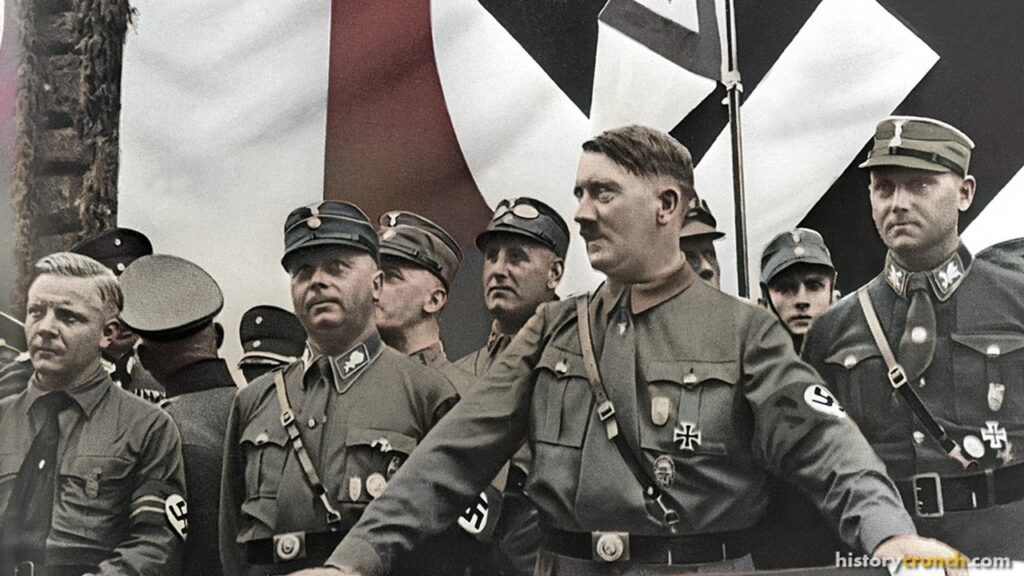
The SA, or Sturmabteilung, was the original paramilitary wing of the Nazi Party. Its members, known informally as ‘Brownshirts’, used violence and intimidation to disrupt political opponents and enforce Nazi authority in the early years of the movement. The SA was eventually overshadowed by the SS, or Schutzstaffel, which became the most powerful and feared organization in Nazi Germany. The SS, originally Hitler’s personal bodyguard unit, grew into a massive organization that ran the concentration camp system, carried out mass atrocities during the Holocaust, and operated as a state within a state under the leadership of Heinrich Himmler.
The Gestapo, the Nazi secret police, worked to identify, monitor, arrest, and eliminate anyone considered a threat to the Nazi regime, including political opponents, Jews, and others. Propaganda in Nazi Germany was controlled by the Reich Ministry of Public Enlightenment and Propaganda, led by Joseph Goebbels, which ensured that all forms of communication in Germany promoted the Nazi message. The Hitler Youth was a Nazi organization for young people that trained boys for military service and indoctrinated Germany’s youth in Nazi ideology.
FactsthatCrunchThe SA and SS were armed organizations that used open force, while the Gestapo worked through surveillance and arrest and the Hitler Youth shaped the next generation through compulsory indoctrination. Together, these four organizations helped the Nazi regime control German society from street level to the schoolroom.
Life in Nazi Germany
Life in Nazi Germany was shaped by the regime’s determination to control every aspect of German society. The Nazi government sought to transform Germany into a nation fully committed to Nazi ideology, military strength, and racial purity. Those who conformed to what the Nazis defined as the ideal German citizen could expect a degree of stability and prosperity, particularly in the years before World War II when the German economy recovered significantly under Nazi economic management. However, for anyone who fell outside the Nazi definition of acceptable German society, life under the regime was characterized by discrimination, persecution, and danger.
The Nazis used propaganda extensively to shape the beliefs and attitudes of the German population. Book burning rallies, held in May of 1933, saw the public destruction of books by Jewish authors and others whose ideas the Nazis considered threatening. Education was reformed to promote Nazi ideology, and by 1936 about 97 percent of teachers had joined the National Socialist Teachers League. The church was pressured to align with Nazi values. The Nazi euthanasia program resulted in the murder of approximately 200,000 people with physical and mental disabilities, whom the regime considered unworthy of life.
FactsthatCrunchBy 1936, 97 percent of public school teachers in Germany were members of the National Socialist Teachers League, known by its German initials NSLB.
The NSLB was shut down in February 1943 on orders from Berlin as part of wartime cutbacks, ending its role as the sole teachers' organization in the Third Reich. Its second leader, Fritz Waechtler, did not survive the war. He was executed by firing squad on April 19th, 1945, ordered by Nazi officials who accused him of defeatism in the final weeks of the conflict.
The Holocaust
The Holocaust was the systematic murder of six million Jewish people and millions of others by the Nazi German government. It is considered one of the most horrific crimes in human history and was the direct result of the Nazi regime’s antisemitic ideology.
The persecution of Jewish people began immediately after Hitler came to power in 1933. Jewish people were progressively stripped of their rights, their businesses, and their property. The Nuremberg Laws of 1935 removed German citizenship from Jewish people and prohibited marriage between Jews and non-Jews. Kristallnacht, in November of 1938, was a nationwide pogromAn organized, violent attack against a particular group, especially Jewish people. in which Jewish businesses, homes, and synagogues were attacked and destroyed. Thousands of Jewish people were arrested and sent to concentration camps.
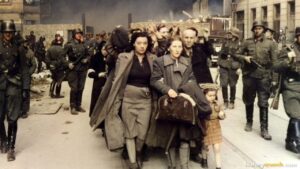
Following the German invasion of the Soviet Union in 1941, the Nazis moved to systematically murder all Jewish people in occupied Europe. Mobile killing units known as the Einsatzgruppen shot more than a million Jewish people in mass executions across Eastern Europe. The Nazi regime then established a network of ghettos, concentration camps, and extermination camps across occupied Europe as part of what the Nazis called the ‘Final Solution’. The most infamous of these was Auschwitz, a combined concentration and extermination camp in occupied Poland where over 1.1 million people were murdered. The Warsaw Ghetto Uprising of 1943 was a significant act of armed resistance by Jewish fighters against the Nazi forces. As Allied forces advanced through Europe toward the end of the war, they liberated the camps and revealed the full scale of Nazi atrocities to the world.
What did the Nuremberg Laws of 1935 do to Jewish people in Germany?
Nazi Germany in World War II
Nazi Germany was the primary cause of World War II in Europe. Hitler’s foreign policy throughout the 1930s was driven by his determination to overturn the Treaty of Versailles, rearm Germany, and expand German territory to the east. The remilitarization of the Rhineland in 1936, the annexation of Austria in 1938, and the annexation of the Sudetenland following the Munich Conference of 1938 were all carried out without significant resistance from Britain or France, whose policy of appeasementA policy of giving in to an aggressor’s demands to avoid conflict, used by Britain and France toward Nazi Germany. repeatedly failed to stop German aggression. The Molotov-Ribbentrop Pact of August 1939 secured a temporary non-aggression agreement with the Soviet Union, removing the last obstacle to Germany’s invasion of Poland.
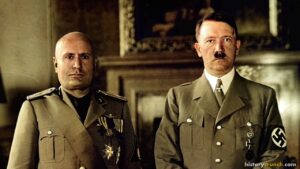
On September 1st, 1939, Germany invaded Poland, and World War II began. Using the rapid and devastating tactics of blitzkriegA fast, overwhelming military attack combining air power and ground forces used by Germany to conquer countries quickly., Germany quickly conquered Poland, Denmark, Norway, France, Belgium, the Netherlands, Luxembourg, Yugoslavia, and Greece. Germany’s alliance with Fascist Italy and Imperial Japan was formalized in the Tripartite Pact of 1940, creating the Axis Powers of World War II. In June of 1941, Germany launched Operation Barbarossa, the invasion of the Soviet Union, which opened the largest and most destructive theater of the entire war. Initially successful, the German advance was eventually halted and reversed, most decisively at the Battle of Stalingrad in 1942 and 1943. As Allied forces closed in from west and east in 1945, Hitler committed suicide in a bunker beneath Berlin on April 30th, 1945. Germany surrendered unconditionally on May 8th, 1945.
FactsthatCrunch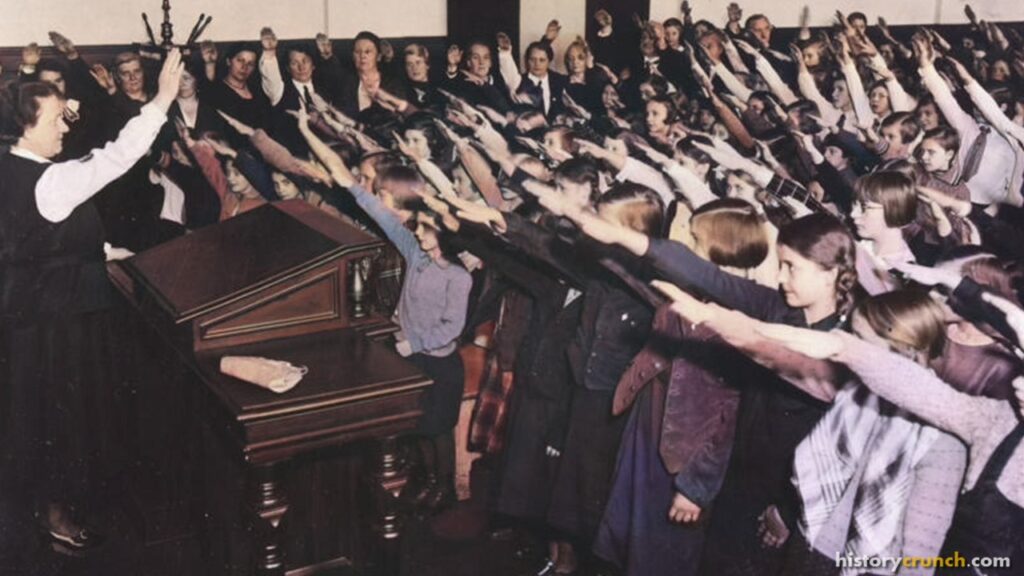 Black & whiteColor
The End of Nazi Germany
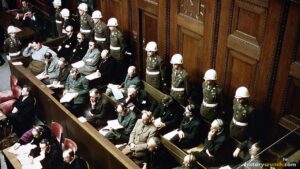
Nazi Germany came to an end on May 8th, 1945, with Germany’s unconditional surrender to the Allied Powers. In the weeks and months that followed, the Allied Powers occupied Germany and began the process of dismantling the Nazi state. The Nuremberg Trials, held from 1945 to 1946, placed surviving Nazi leaders on trial for crimes against peace, war crimes, and crimes against humanity. The trials established important legal precedents for international law and the prosecution of crimes against humanity that continue to influence the world today.
Germany was divided into zones of occupation controlled by the Allied Powers, which eventually led to the creation of two separate German states: the democratic West Germany and the communist East Germany. The destruction and atrocities of Nazi Germany left a profound mark on world history, shaping international efforts to protect human rights, prevent genocide, and hold leaders accountable for crimes committed against their own populations. In all, Nazi Germany remains one of the most studied and analyzed periods in modern history, serving as a powerful reminder of the dangers of unchecked hatred, dictatorship, and the failure of democratic societies to resist the rise of extremism. Click on the links to learn more about the Nuremberg Trials and the Significance of the Holocaust.
FactsthatCrunchThey excited the German ambition to be a 'master race,' which of course implies serfdom for others. They led their people on a mad gamble for domination.
In these lines Jackson told the court how Nazi leaders won over the German public by stirring up hatred and false pride, showing that the regime's crimes began with propaganda long before the war.
Explore World War II · 1939 – 1945
Keep exploring World War II with these History Crunch resources.
Key Vocabulary
Reparations
Lebensraum
Antisemitism
Eugenics
Pogrom
Blitzkrieg
Appeasement
Frequently Asked Questions
When did Nazi Germany begin and end?
Nazi Germany lasted from January 30, 1933, to May 8, 1945. It began when Adolf Hitler was appointed Chancellor of Germany. It ended when Germany surrendered unconditionally to the Allied Powers at the close of World War II in Europe.
How did Hitler turn Germany into a dictatorship?
Hitler used a mix of legal steps and force to seize total control. The Reichstag Fire in February 1933 gave him an excuse to suspend civil liberties. The Enabling Act of March 1933 then let him pass laws without parliament, ending German democracy.
What did the term lebensraum mean to the Nazis?
Lebensraum means “living space,” and it shaped Nazi foreign policy. Hitler believed Germany needed to conquer large territories to the east for land and resources. This idea helped justify the invasion of Poland and the Soviet Union.
What was the difference between the SA, SS, and Gestapo?
Each group enforced Nazi rule in a different way. The SA, or “Brownshirts,” used street violence in the early years. The SS ran the concentration camps and carried out the Holocaust, while the Gestapo served as the secret police that hunted down suspected enemies.
What happened to Nazi leaders after the war?
Surviving Nazi leaders were tried at the Nuremberg Trials from 1945 to 1946. They faced charges of crimes against peace, war crimes, and crimes against humanity. These trials set important legal rules that still guide international law today.
How many people were killed in the Holocaust?
The Nazis murdered six million Jewish people during the Holocaust, along with millions of others. Victims also included Roma people, people with disabilities, and political opponents. The largest killing site was Auschwitz, where more than 1.1 million people died.
Cite This Article
To cite this article as a source, use one of the formats below.
MLA: Millar, B. “Nazi Germany: A Detailed Overview.” HistoryCrunch, 16 September 2026, https://historycrunch.com/nazi-germany-overview/.
APA: Millar, B. (2026). Nazi Germany: A Detailed Overview. HistoryCrunch. https://historycrunch.com/nazi-germany-overview/
Chicago: Millar, B. “Nazi Germany: A Detailed Overview.” HistoryCrunch. September 16, 2026. https://historycrunch.com/nazi-germany-overview/
Sources
- Michael Burleigh, The Third Reich: A New History.
- Ian Kershaw, Hitler (biography).
- USHMM