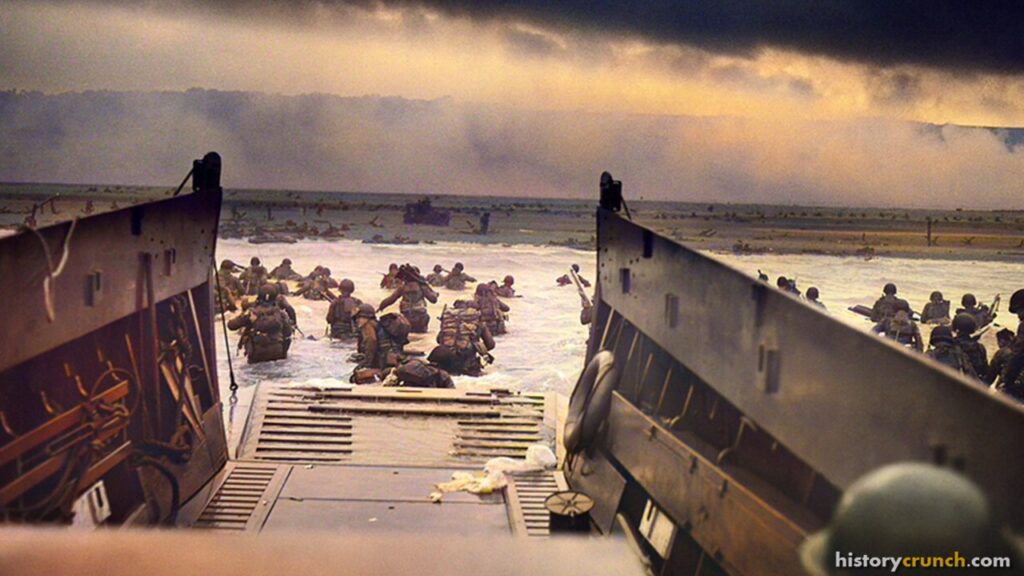
The Normandy Invasion (also known as D-Day) is considered to be one of the most important battles in World War II and all of human history. The Normandy Invasion began on June 6th, 1944 and was part of the larger Allied attack to open a front in Europe and begin the liberation of France from Nazi control. The larger Allied plan of attack was codenamed Operation Overlord and involved a large attack on northern France, including: amphibiousA military operation that launches an attack from the sea directly onto a shore. landings, naval bombardment and an assault by airborneSoldiers who are transported and dropped into battle by parachute from aircraft. forces the night before.

Normandy Invasion (D-Day) of World War II – Background
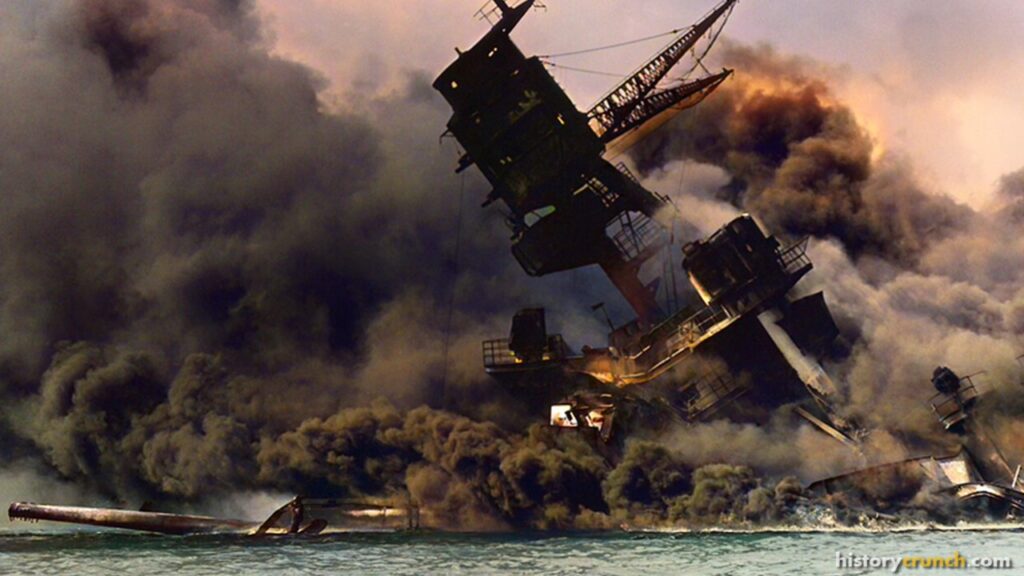
The Second World War began on September 1st, 1939 when Nazi Germany invaded the nation of Poland. As the war progressed, major battles occurred in European battlefields, including: Battle of France, Battle of Britain, Operation Barbarossa and the Battle of Stalingrad. Throughout these early years of World War II, the United States remained on the sidelines, since it was practicing a foreign policy based on the principles of isolationismA foreign policy where a country stays out of other nations’ conflicts and alliances.. However, this changed on December 7th, 1941 when Japan surprise attacked the United States during the attack on Pearl Harbor. This event brought the United States into the fighting of World War II, including direct involvement in both the European and Pacific Theaters of the war.
Throughout the early years of the war (1939 to 1941), the Nazi German forces were moving rapidly across Europe and capturing large portions of territory. In fact, Germany experienced a great deal of success, with its blitzkrieg tactics, during the Battle of France and the early portion of Operation Barbarossa. However, Nazi Germany experienced two major failures in the European theater of war. First, was the Nazi German failure to knock Britain out of the Second World War during the Battle of Britain. This proved important as it allowed the Allies a place to plan and launch their attacks against Nazi forces in western Europe. The second failure of the Nazis was the Battle of Stalingrad. It occurred in 1942 and 1943 and saw Soviet Union forces successfully stand their ground against Nazi forces at the Soviet city of Stalingrad. These two failures set the stage for the Allied liberation of Europe and the Normandy Invasion (D-Day) of World War II.
In fact, by 1944, the Allied nations had made significant gains in Europe. The Soviet Union was pushing back German forces in the East, following the Battle of Stalingrad, and the Allies had defeated Axis powers in North Africa and launched the Italian Campaign. However, western Europe remained under Nazi German occupation, and a large-scale invasion of France was necessary to open a Western FrontA new battle zone opened in western Europe when Allied forces invaded France, forcing Germany to fight on multiple sides..
FactsthatCrunchJapan's attack on Pearl Harbor on December 7th, 1941 ended American isolationism and brought the United States into World War II.
Before that, the United States stayed on the sidelines for over two years while Nazi Germany conquered much of Europe.
Normandy Invasion (D-Day) of World War II – Summary
As mentioned previously, the Normandy Invasion was codenamed ‘Operation Overlord’. Planning for the operation began in 1943, with United States General Dwight D. Eisenhower appointed Supreme Allied Commander. The plan was to land on the Normandy coast of France, which was less fortified than other regions like Pas-de-Calais. In fact, the Allies used strategies of deception to mislead the Nazis on where they were going to attack. Called ‘Operation FortitudeThe Allied deception plan using fake armies, double agents, and false radio signals to mislead Nazi Germany about the D-Day attack location.‘, it was designed to mislead Nazi Germany about the timing, location, and strength of the D-Day invasion of Western Europe in 1944. The success of the Normandy Invasion (Operation Overlord) depended heavily on convincing the Germans that the main Allied attack would occur elsewhere. Through fake armies, double agents, and deceptive radio traffic, Operation Fortitude proved to be successful in confusing the Nazi forces.
Operation Overlord began on the morning of June 6th, 1944, with both a naval bombardment of the Normandy beaches as well as an airborne assault by Allied airborne infantry. Allied naval ships used their large guns to shell the region of Normandy that the Allies planned to carry out their amphibious landing in the morning. As well, in the cover of night, thousands of Allied airborne troops parachuted behind enemy lines near Normandy. The goal of the airborne operation was to disrupt Nazi supply lines and to remove key Nazi defenses in the region. More specifically, at around midnight, over 13,000 paratroopers from the United States 82nd and 101st Airborne Divisions and British 6th Airborne Division dropped behind enemy lines to secure bridges, disrupt German communications, and defend flanks.
At roughly 6:30am on the morning of June 6th, 1944, the amphibious assault at Normandy began. The Normandy Invasion is still remembered today as the largest amphibious assault in human history as it involved Allied forces crossing the English Channel from Britain to attack the beaches of northern France. The United States, Britain, France and Canada were the main participating countries in the amphibious landings of the Normandy Invasion. Each country landed on their own codenamed beaches with the goal of pushing back the Nazi defenses and opening the beach for Allied heavy weapons. The United States’ beaches were Utah and Omaha, Britain’s beaches were Gold and Sword, and Canada’s beach was Juno. Free French forces also supported the British on the Sword beach.
All countries landed on the morning of June 6th, 1944 and faced difficult resistance from Nazi soldiers. The Nazis had built a line of defenses along the high ridges along the beaches that consisted of heavy artillery, concrete bunkers and machine gun nests. Since the Nazis had the advantage of the high ground, they were able to inflict heavy losses on the Allied soldiers as they tried to cross the beaches. However, the Allied attack had worked and the United States, Britain and Canada were all able to open their beaches to further Allied reinforcements and heavy weaponry. The Allies suffered over 10,000 casualtiesSoldiers killed, wounded, captured, or missing during a battle. in the battle while the Germans suffered between 4,000 and 9,000.
The Normandy Invasion was a resounding success for the Allies and was an important stepping stone to the eventual liberation of western Europe from Nazi control.
FactsthatCrunchCan you match each D-Day beach to the country that landed there?
Normandy Invasion (D-Day) of World War II – Significance
The Normandy Invasion (D-Day) is one of the most significant events in all of the Second World War. Today, the Normandy Invasion is remembered as the largest amphibious invasion in human history with nearly 160,000 Allied troops participating in the D-Day attacks. As well, the invasion was important because the Allies used much of their forces in the campaign. For instance, the Allies amassed an enormous force that consisted of 5,000 ships and landing craft, 11,000 aircraft, and 156,000 troops on the first day alone.
As well, the Normandy Invasion is considered important because it was a major turning point in the war. As stated above, the Nazis had experienced a great deal of success in the early years of World War II. However, by 1944, the Nazis were struggling to maintain control over the conquered territories in Europe. As a result, D-Day marked the beginning of the end of Nazi Germany’s occupation of Europe. The opening of a new front in France forced Nazi Germany to face a multi-front war. For instance, at the time, the Nazis were fighting Allied units in the east and Italy. As such, the opening of a new front in France forced Germany to spread its defenses even thinner than they already were. For example, it allowed the Allies to liberate Paris by August of 1944 and push toward Germany from the west.
FactsthatCrunch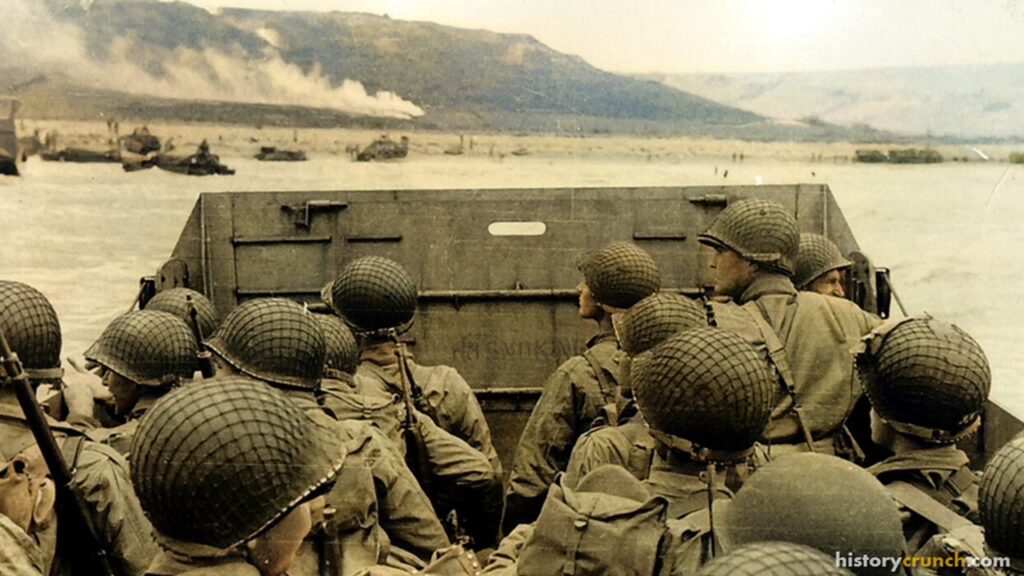 Black & whiteColor
Explore World War II · 1939 – 1945
Keep exploring World War II with these History Crunch resources.
Key Vocabulary
Isolationism
Blitzkrieg
Amphibious
Operation Fortitude
Airborne
Western Front
Casualties
Frequently Asked Questions
When did D-Day happen?
D-Day took place on June 6th, 1944, during World War II. The airborne drops began around midnight, and the amphibious landings started at about 6:30am. The attack was part of a larger plan to free western Europe from Nazi control.
What was Operation Overlord?
Operation Overlord was the Allied code name for the full invasion of northern France. Planning began in 1943, and General Dwight D. Eisenhower served as Supreme Allied Commander. The plan combined naval bombardment, airborne drops, and large amphibious landings on the Normandy coast.
What were the five D-Day beaches?
The five landing beaches were Utah, Omaha, Gold, Juno, and Sword. The United States landed at Utah and Omaha, Britain at Gold and Sword, and Canada at Juno. Free French forces also supported the British at Sword beach.
Why did the Allies land at Normandy instead of Pas-de-Calais?
The Allies chose Normandy because it was less heavily fortified than Pas-de-Calais. A deception plan called Operation Fortitude tricked the Germans into expecting the main attack elsewhere. It used fake armies, double agents, and false radio traffic to confuse Nazi forces.
Why was D-Day a turning point in World War II?
D-Day marked the beginning of the end of Nazi control over western Europe. It opened a new Western Front, forcing Germany to fight on several sides at once. This stretched German defenses thin and helped the Allies free Paris by August 1944.
How many troops took part in D-Day?
About 156,000 Allied troops landed on the first day, making it the largest amphibious invasion in history. The force included around 5,000 ships and landing craft and 11,000 aircraft. The Allies suffered over 10,000 casualties during the battle.
Cite This Article
To cite this article as a source, use one of the formats below.
MLA: Beck, Elias. “Normandy Invasion (D-Day) of World War II: A Detailed Summary.” HistoryCrunch, 2 October 2026, https://historycrunch.com/normandy-invasion-d-day-of-world-war-ii/.
APA: Beck, E. (2026). Normandy Invasion (D-Day) of World War II: A Detailed Summary. HistoryCrunch. https://historycrunch.com/normandy-invasion-d-day-of-world-war-ii/
Chicago: Beck, Elias. “Normandy Invasion (D-Day) of World War II: A Detailed Summary.” HistoryCrunch. October 2, 2026. https://historycrunch.com/normandy-invasion-d-day-of-world-war-ii/
Sources
- Max Hastings, Inferno / All Hell Let Loose.
- Imperial War Museum