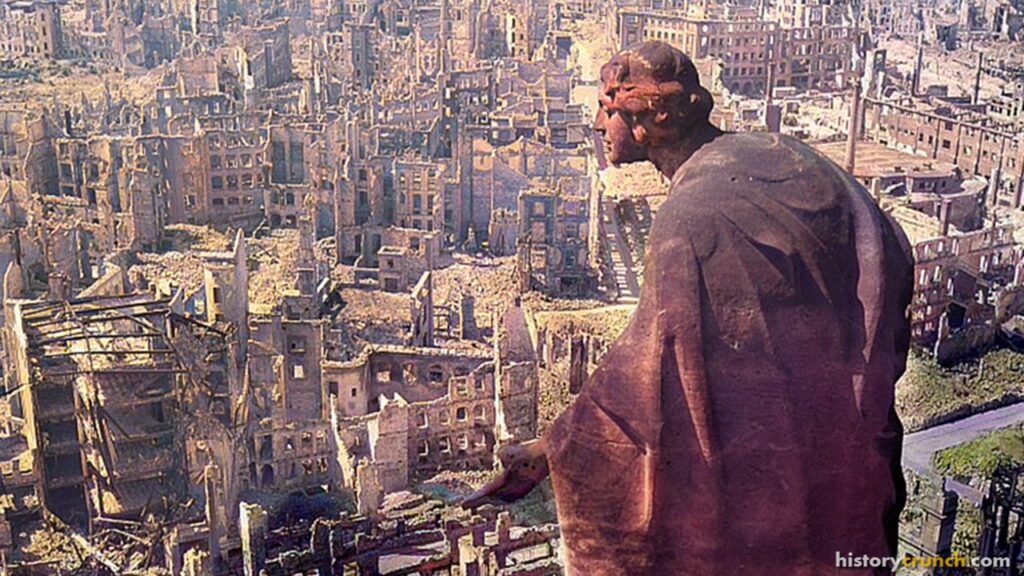
The bombing of Dresden in World War II was carried out by British and American air forces in February of 1945. It remains one of the most controversial periods of World War II due to the level of destruction carried out against the city. Once known for its unique architecture, the German city of Dresden was reduced to ruins in a series of devastating bombings. Thousands of civilians died in the firestormA massive, uncontrolled blaze so intense it creates its own wind and consumes entire city districts. that engulfed the city. Today, historians debate the ethical ramificationsThe moral consequences or questions about right and wrong that follow from an action. of the bombing of Dresden.
 FactsthatCrunch
Bombing of Dresden in World War II – Background
World War II began on September 1st, 1939 when Nazi Germany, under the leadership of Adolf Hitler, invaded the country of Poland. The war unfolded as a series of major battles that spanned both the European and Pacific Theaters of war. In Europe, the early years of World War II were dominated by battles, such as: Battle of France, Battle of Britain, Operation Barbarossa and the Battle of Stalingrad. The later years saw the Allies liberate Europe through the invasion of Sicily and the Normandy Landings on D-Day. As such, by 1945, when the bombing of Dresden occurred, the Allied nations were in the process of liberating Europe and pushing Nazi German forces back into their own territory.
In fact, by 1945, the Allies had embraced strategic bombingUsing air power to destroy an enemy’s factories, roads, and public confidence rather than only attacking soldiers on a battlefield. as an important strategy. This strategy saw the Allied nations use their air power to destroy Nazi Germany’s industrial capacity, infrastructureThe basic systems a country needs to function, such as roads, railways, and communication networks., and morale among its citizens. For instance, major cities across Germany, including Hamburg, Cologne, and Berlin, had already suffered massive aerial bombardments.
Dresden is a city in Germany that is the capital of Saxony, one of the German states. It was a major transportation and communication hub, serving as a rail and road center that connected the Eastern and Western fronts during World War II. It was also a relatively important military hub. In fact, the bombing aimed to disrupt German troop movements and supply lines. However, Dresden also had a reputation as a cultural city, known for its architecture, art, and historical significance. As such, it proved to be a significant target.
What was the main goal of the Allied strategy of strategic bombing against Nazi Germany?
Bombing of Dresden in World War II – Summary
During the Second World War, Dresden was heavily bombed by British and American forces. The bombings of Dresden took place over four separate raids in 1945, between February 13th and 15th, 1945. The raids involved many aircraft, with 722 British RAF bombers and 527 American Air Force bombers. Combined, the British and American air forces dropped an unprecedentedNever done or seen before on that scale. amount of explosives, with almost 4,000 tons of bombs dropped on Dresden.
The raids used a mix of high-explosive bombs and incendiary devicesWeapons designed to start fires rather than destroy by blast alone., designed to create a firestorm, which is a massive, uncontrolled blaze that consumed entire districts. In fact, temperatures in the city reportedly reached over 1,800°F (1,000°C). The heat was so intense that it incinerated buildings and people. Historic buildings, churches, and entire residential neighborhoods were destroyed. For instance, as a result of the bombings, more than 1,600 acres of the city were destroyed, and approximately 25,000 people were killed. However, the exact death toll is unknown as the German government at the time falsified the casualty figures. Regardless, historians agree that approximately 90% of the city center of Dresden was destroyed.
After the initial raids, a few other random attacks occurred, mainly in an attempt to disrupt the railroads and thus prevent travel. There were few reported deaths from these subsequent raids.
Bombing of Dresden in World War II – Significance
As mentioned previously, the bombing of Dresden in World War II is a highly controversial event. It was questioned whether the bombing of Dresden was justified, and as a result, the bombing has become a debated topic in World War II history.
The United States defended the bombing as justified as they said that the attack helped to limit transport and communication links that had been instrumental in the Nazi German war effort. Since the war, researchers have supported some aspects of the raids, but have said that others, such as the bombings of homes and bridges outside the city center were not necessary. Some critics of the bombing of Dresden have since stated that the city had no military significance and that the attack by the British and American forces was not proportionateMatched in size or severity to the military goal being achieved. to the military gains. Some critics even view it as an act of terror or even a war crime, although it has never been treated as such. Historians continue to debate whether Dresden was a legitimate military target or an excessive act of destruction.
FactsthatCrunchHow did people judge the bombing of Dresden in World War II?
Explore World War II · 1939 – 1945
Keep exploring World War II with these History Crunch resources.
Key Vocabulary
Strategic bombing
Incendiary devices
Firestorm
Unprecedented
Infrastructure
Proportionate
Ethical ramifications
Frequently Asked Questions
When was Dresden bombed in World War II?
Dresden was bombed over four raids between February 13th and 15th, 1945. British and American air forces carried out the attacks near the end of the war. By then the Allies were pushing Nazi German forces back into their own territory.
How many people died in the bombing of Dresden?
About 25,000 people are thought to have died in the Dresden raids. The exact number is unknown because the German government at the time falsified the casualty figures. Most deaths came from the firestorm that swept through the city.
Why was Dresden chosen as a target?
Dresden was a major transportation hub that linked the Eastern and Western fronts. The bombing aimed to disrupt German troop movements and supply lines. It also served as a rail and road center and held some military importance.
What is a firestorm and why did it happen?
A firestorm is a massive, uncontrolled blaze that consumes entire districts. The raids used high-explosive bombs and incendiary devices to create one on purpose. Temperatures reportedly reached over 1,800°F (1,000°C), destroying buildings and people.
Why is the bombing of Dresden controversial?
The bombing is controversial because many question whether the destruction was justified. Some critics say Dresden had little military value and call the attack an act of terror. Others defend it as a way to cut transport links used in the Nazi war effort.
Cite This Article
To cite this article as a source, use one of the formats below.
MLA: Woida, K.L. “Bombing of Dresden in World War II: A Detailed Summary.” HistoryCrunch, 2 October 2026, https://historycrunch.com/bombing-of-dresden-in-world-war-ii/.
APA: Woida, K. L. (2026). Bombing of Dresden in World War II: A Detailed Summary. HistoryCrunch. https://historycrunch.com/bombing-of-dresden-in-world-war-ii/
Chicago: Woida, K.L. “Bombing of Dresden in World War II: A Detailed Summary.” HistoryCrunch. October 2, 2026. https://historycrunch.com/bombing-of-dresden-in-world-war-ii/
Sources
- Imperial War Museum
- Gerhard L. Weinberg, A World at Arms.
- The National WWII Museum