Capitalism is the most significant economic system of the last several centuries and continues to have a profound impact on the world today. For example, it is a driving force in the economies of many modern democratic nations. With that said, historians acknowledge several different forms of capitalism today, including: laissez-faire capitalism and the welfare state. In general, each form of capitalism differs in the level of government involvement in the economy. As well, capitalism has a long and interesting history that has shaped it into the economic system that we have today.
 FactsthatCrunch
Capitalism first began during the Industrial Revolution.
Principles of Capitalism
Capitalism as an economic system focused on a few central principles, such as: economic freedom, private ownershipThe right of individuals to own property such as land, businesses, products, or ideas., competition, self-interest and self-reliance. Each of these principles demonstrates why capitalism and its related ideologies of laissez-faireAn economic policy where the government stays out of the economy and lets individuals handle their own financial affairs freely. capitalism and classical liberalism are all right-wing systems.
Economic freedom is an important element of capitalist or classical liberal societies because it allows people individual choice in their economic decision-making. For instance, economic freedom in classical liberal societies (ex. England during the Industrial Revolution), is largely centered around free trade and free market economy. Under these systems, government intervention is low and instead most economic decisions are determined by individual consumers and producers. As such, people are given the freedom and choice on how to earn and spend their money, and on what goods and services they would like to produce or consume.
Private ownership is the idea that individuals should have the ability to own property, which could include: land, businesses, products, ideas, etc. For example, during the Industrial Revolution, entrepreneurs began to use their wealth to establish privately owned factories, mines and mills. This allowed individuals to control what they produced, how it was produced and for whom they were producing it. Before the development of capitalism, these decisions would have been controlled by the government. Thus, private ownership shifted the economic decision-making from the government to the people. Private ownership can be seen in modern societies in that people own their own homes, businesses or other forms of property.
Competition is another central principle of capitalism. Under more collectivist systems, the government controls the means of production and therefore there is little to no competition. Laissez-faire capitalism introduced the idea that individuals and businesses should compete against each other and their success should be determined by the market forces of supply and demand. Therefore, consumers had the ability to decide the success of a business based upon whether they purchased the good or service. Supporters of capitalism argue that competition benefits society in a number of ways, including: it lowers the price of goods and services as producers compete for the business of consumers, and it fosters innovation of goods and services as companies compete to outdo each other. For example, modern companies such as Apple and Samsung compete for consumers’ business which causes them to innovate their phones with new features, while still trying to keep costs as low as possible.
Self-interest is the idea that individuals should act, economically, in their own best interest. Further to this idea, supporters of capitalism argue that individuals should constantly seek to improve their own well-being over that of the collective society. For example, self-interest is apparent in the decision-making process of most business owners during the Industrial Revolution. They generally made decisions to increase their own wealth over the economic or personal well-being of their workers. While this method of thinking led to issues such as child labor, the business owners of the time benefited greatly. Regardless, supporters of economic individualism argue that self-interest was positive for society as a whole through its indirect impacts. For instance, when wealthy business owners acted based on self-interest they were working to improve the economic standing of their overall company. If the company gained more income, it could then use that income to hire more workers and provide more goods or services. Therefore, the belief was that everyone acting in their own self-interest would in the end create more jobs and economic activity to improve the overall economy of a society.
Finally, similar to self-interest, self-reliance is the idea that individuals should be responsible for their own well-being and should not rely on the government for assistance. For example, in modern welfare capitalist states, the government provides many social programs to assist citizens. A social program is a government-funded program that is, in general, universally provided to all citizens of the country. There are many examples of social programs in modern democratic nations, including: old age pensions, some form of government funded healthcare, public education, welfare, etc. However, as stated previously, economic individualism like laissez-faire capitalism is in favor of people being responsible for themselves and therefore the government should not intervene in the economy in order to provide assistance. It was argued that self-reliance would push individuals to work harder and would therefore benefit the society more as a whole.
FactsthatCrunchWhich description fits each main principle of capitalism?
History of Capitalism
As stated above, the history of capitalism is long and interesting. The basic principles of capitalism first emerged in the 14th century, during the end of the Middle Ages and the growth of Renaissance city-states, such as Venice, Florence and Genoa. However, modern capitalism, as we know it today, emerged during the period of industrialization in Europe in the 18th and 19th centuries. Spurred on by the ideas of Adam Smith, and other influential thinkers, capitalism became the dominant economic system that helped propel the events of the Industrial Revolution. Now, capitalism has shifted and adopted other principles, but still remains a vital component of modern democratic states.
FactsthatCrunch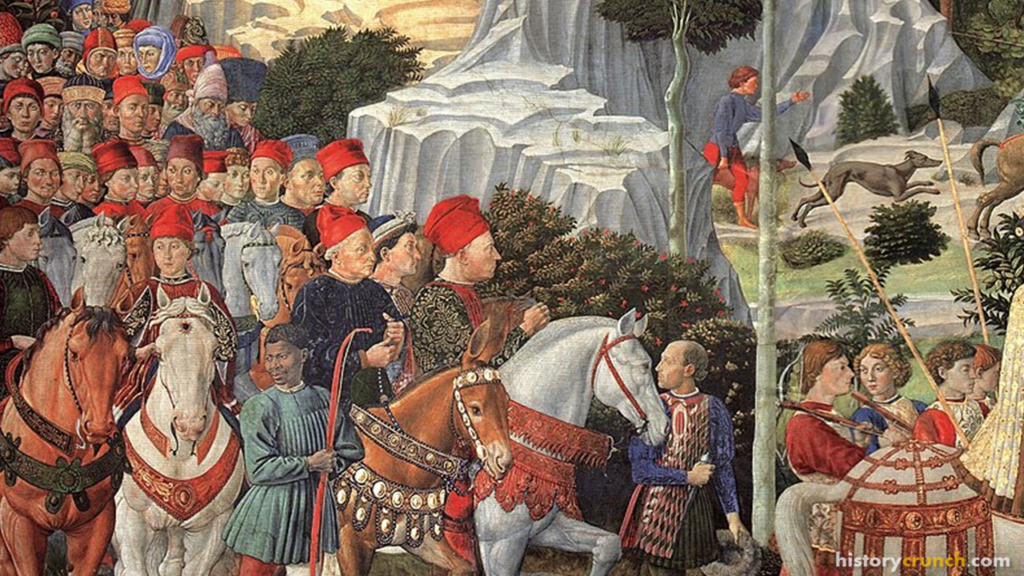
Early History of Capitalism
As stated above, capitalism has a long history and has developed and changed over the centuries. However, historians date the very early beginnings of capitalism to the end of the Middle Ages in Europe. In fact, during the Middle Ages, most of Europe lived under a system called ‘feudalism‘. In short, this was when poor peasants worked land owned by nobles in exchange for protection. As such, at the time, wealth and power was tied to land ownership rather than money. However, over time, markets for trade and banking systems began to grow across Europe. In fact, capitalistic principles began to emerge during the time of the Italian city-states in the Renaissance.
Italian city-states, in the 14th and 15th centuries, such as Venice, Florence, and Genoa played a significant role in the formation of early capitalism. In fact, powerful Renaissance families such as the Medici Family created banks that funded trade and even governments. The rise of the powerful families, along with the advent of finance and banking laid the foundation for capitalism. In fact, merchant trade became a powerful force, during this time, that allowed merchants and artisans to create wealth and establish free trade.
The 16th century was also important to the development of capitalism, since the Age of Exploration played a significant role in establishing trade and economic markets. In fact, with the discovery of the Americas and new sea routes to Asia, European nations expanded trade and their colonies across the world. For instance, natural resources such as gold, sugar, coffee, and tobacco were important in advancing wealth and economic growth for the main European countries of Britain, France, Spain and Portugal.
Furthermore, the European powers and their colonies followed an economic policy known as ‘mercantilism‘, which aimed to increase national wealth by controlling trade and accumulating gold and silver for the home country. More specifically, the colonies supplied raw materials to Europe while the mother countries manufactured goods, which they then traded around the world. Historians consider mercantilismAn economic system where governments controlled trade and tried to build national wealth by accumulating gold and silver. to be the precursor to modern capitalism. In fact, modern capitalism was established in response to the supposed failings of mercantilism as an economic system.
FactsthatCrunchCapitalism in the Industrial Revolution
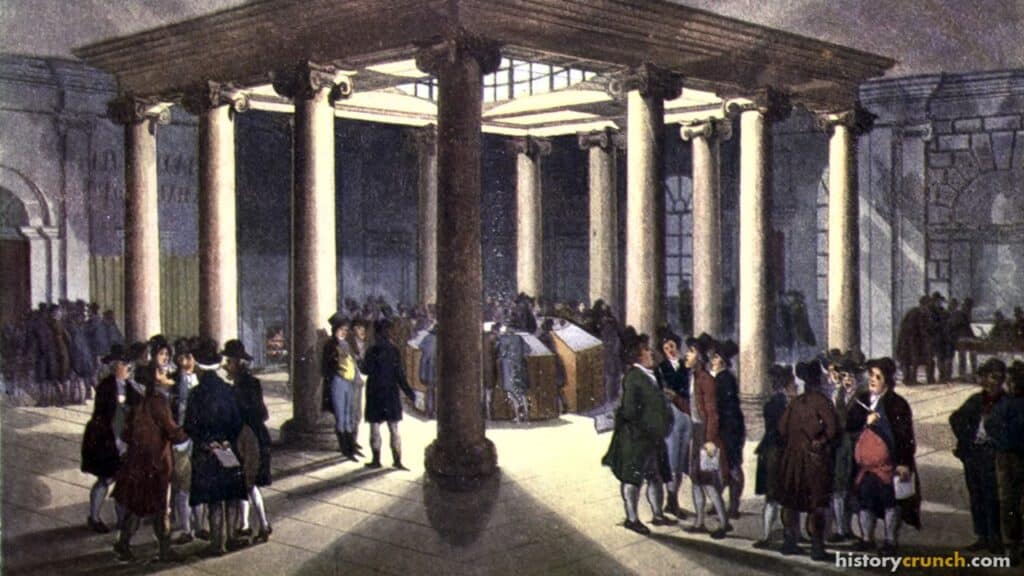
Modern capitalism, as we know it today, first emerged during the 18th century and the events of the Industrial Revolution. The Industrial Revolution is a significant event in world history because it transformed European and North American societies from being based on agriculture production to industrial production. This caused a mass migration of people from the rural countryside to the city-centers as people moved in search of work in the newly developed factories of the time.
The factory system is a term that historians use to refer to the development of centralized factories or mills that produced goods on a mass scale. Throughout the 1700s, inventors such as Richard Arkwright, Eli Whitney, James Hargreaves, and Edmund Cartwright, developed machines and techniques that helped improve production, especially in terms of the textile industry. The textile industry was based on the development of cloth and clothing, and was the main industry that benefited from the early developments of the Industrial Revolution. For example, some of the main textile related inventions of the Industrial Revolution included: power loom, spinning jenny, flying shuttle, water frame and cotton gin.
As the 18th century went along, some people began to reject the principles of mercantilism. For example, in 1776 Scottish economist Adam Smith published his famous written work “An Inquiry into the Nature and Causes of the Wealth of Nations” which is often shortened to “Wealth of Nations”. The book challenged the idea that the government should control the economy and instead proposed the idea of free trade and competition with a lesser role of the government. The ideas of this book would eventually lay the foundation for the principles of capitalism, which is an economic system that supports the idea of free trade and choice as a way of achieving prosperity. The emergence of capitalism was vitally important to the start of industrialization and the Industrial Revolution.
Capitalism caused the Industrial Revolution because industrialization required significant work and investment from individuals and not necessarily the government. For example, in Britain, where the Industrial Revolution began, wealthy entrepreneurs were important because they used their wealth to create factories and mines. This investment from individuals, whose actions were guided by the profit motiveThe desire to earn money that drives individuals and businesses to invest and produce goods or services., would not have been possible without the emergence of capitalism. Furthermore, as the Industrial Revolution began the individualistic principles of capitalism helped create a climate wherein industrialization exploded, and eventually spread worldwide.
FactsthatCrunchWhy is Richard Arkwright's Cromford Mill (1771) often called the first modern factory?
Arkwright's Cromford Mill in Derbyshire, England, brought workers, water-powered machines, and coordinated production together under one roof in a way that small home workshops never had. It ran on a fixed schedule, divided tasks among many workers, and used the water frame to spin cotton faster and more consistently than hand labor could. These features (centralized power, machinery, division of labor, and strict supervision) became the model that factory owners across Britain and eventually the wider world copied.
Capitalism in the 19th and 20th Centuries
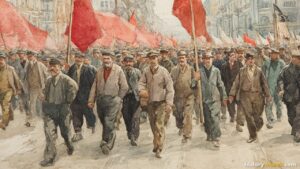
However, by the mid-1800s the economics of the Industrial Revolution began to shift with the emergence and development of socialism. During the early 19th century many people began to question whether or not laissez-faire capitalism was meeting the needs of all people in society. Laissez-faire capitalism was the dominant economic system in Europe at the time and, in general, was based upon little or no government intervention in the economy. In fact, some argued that laissez-faire capitalism was causing a wide income gap in society between business owners and the working class. Socialism developed as a response to how some felt about laissez-faire capitalism and its apparent failings. For example, early socialists argued that laissez-faire capitalism led to several issues of the Industrial Revolution, including: child labor, dangerous and dirty working conditions and a lack of basic workers’ rights.
Therefore, socialism is a left-wing economic system that favors government intervention in the economy in order to try to decrease the imbalances created by laissez-faire capitalism. In general, socialism was favored by working class people, as it sought to create a more equitable distribution of income. With that said, historians acknowledge several different types of socialism that each formed over different periods of time. For instance, early socialist movements that developed in the timeframe of the Industrial Revolution included Utopian Socialism, Marxism, and Democratic Socialism. The central difference between these types of socialism is the degree to which they support government intervention and what types of political systems they are combined with.
Pure capitalism with no government involvement is rare. Most countries, including the United States, follow a mixed economyAn economic system that blends free market capitalism with government regulation and publicly funded social programs., combining free markets with government regulations, social programs, and protections for workers.
FactsthatCrunchBoth Luddites and early socialists responded to the same industrial inequalities, including low wages, lost jobs, and poor conditions. The key difference is method: Luddites struck directly at machines in a specific trade, while early socialists built theories and movements aimed at changing the overall economic structure.
Capitalism Today
After World War II, many nations adopted capitalist economies, while others experimented with socialism or communism. Over time, globalization and international trade made capitalist systems even more interconnected. This eventually led to a consumer culture that has come to dominate the economic landscape. Mass production and advertising in the 20th century created a consumer-driven economy, where goods like cars, radios, and later smartphones became widely available to most people. Now, technology companies like Apple, Amazon, Facebook, Netflix and Google represent a new phase of capitalism, where data and digital services are as valuable as physical goods.
FactsthatCrunchDuring the Industrial Revolution, capitalism ran on physical goods: factory owners invested private money to build mills and mines, hired workers to produce cloth, iron, and coal, and sold those products in open markets. Entrepreneurs such as Richard Arkwright built water-powered textile mills in Britain in the 1770s, turning raw cotton into cloth at a scale no cottage industry could match. Profit came from owning machines, raw materials, and the buildings that housed them.
Today a large share of capitalist activity runs on digital services rather than physical goods. Companies sell software, streaming content, cloud storage, and advertising, products that have no weight and need no warehouse. Firms such as Apple and Samsung still compete on hardware, but much of their revenue now comes from app stores, subscriptions, and digital platforms that Adam Smith could not have imagined in 1776.
The shift from steam-powered factories to digital platforms is a new chapter, but the core capitalist principles of private ownership, competition, and the profit motive have driven both eras.
Forms of Capitalism
Capitalism as an economic system has shifted and changed over time. Modern capitalism, found in countries such as the United States, Canada, Australia and England, has several elements of socialism as well. Economists refer to this as ‘Welfare-State Capitalism’ or a ‘Mixed Economy‘. Whereas, pure capitalism, as was more common in the 19th century, is often referred to as ‘laissez-faire capitalism’.
FactsthatCrunchWhat do economists call an economy that mixes capitalism with government social programs such as healthcare and pensions?
Laissez-Faire Capitalism
Often, laissez-faire capitalism is also referred to as free market capitalism or market capitalism. Simply put, laissez-faire translates to “leave us alone” meaning that the government should remain out of the economy and instead allow individuals to freely carry out their own economic affairs. Historically, laissez-faire capitalism was most common during the 18th and 19th centuries in the timeframe of the Industrial Revolution. At the time, it was a revolutionary idea, because in the previous centuries, mercantilism had been the dominant economic system. In general, mercantilism is viewed as an economic system that favored heavy government control and regulation. At the time, absolute monarchs ruled over vast empires and controlled almost all aspects of the economy. However, prominent thinkers, including Adam Smith, began to argue against mercantilism in favor of an economic system with more freedom for individuals. The development of capitalism as an economic system, sought to reject the idea of government control of the economy and instead put the focus on individuals. On the economic spectrum, laissez-faire capitalism is a right-wing ideology that is fundamentally based on: private ownership, competition, free trade, self-reliance, self-interest, and the principles of supply and demand.
FactsthatCrunchWelfare State Capitalism
While laissez-faire capitalism is often associated with the 18th and 19th centuries and the time period of the Industrial Revolution, the welfare state is best associated with the 20th century and modern democratic nations. During the 19th century many people began to question whether or not laissez-faire capitalism was meeting the needs of all people in society. In fact, some argued that laissez-faire capitalism was causing a wide income gap in society between the business owners and working class. It was during this time period that the ideas of socialism developed. In general, socialism is a left-wing economic system that favors government intervention in the economy in order to try to decrease the imbalances created by laissez-faire capitalism. For instance, socialism supports the idea of government-funded social programs such as pensions and social assistance. These programs would be funded by those wealthy enough to afford the taxation while they would benefit those who were less well off financially. The ideas of socialism spread throughout Europe and North America and had a profound impact on capitalism. Essentially, it caused laissez-faire capitalism to adopt many of the principles of socialism, while also maintaining several of the main principles of laissez-faire capitalism. Therefore, the welfare stateA system that combines capitalist principles like private ownership with socialist-inspired government social programs for citizens. is placed near the center of the economic spectrum and takes a mixed approach to economics.
Often, the welfare state is also referred to as a mixed economy. Historically it developed out of the ideas of socialism and laissez-faire capitalism during the 20th century and can best be seen in the events of the Great Depression. During this time period, governments around the world, including the United States, transformed their economies to include elements of socialism. This was done in order to benefit working class people who were struggling in the economic downturn of the Great Depression. As such, the welfare state includes principles from both sides of the economic spectrum. For example, welfare states maintain many principles of laissez-faire capitalism, including: private ownership, competition, free trade, self-reliance, self-interest, and the principles of supply and demand. However, these same welfare states also adhere to socialist-based principles, such as: public ownership, cooperation, collective-interest, and government regulation to ensure the equitable distribution of income.
FactsthatCrunchIn 1889, Germany under Otto von Bismarck created one of the world's first national old-age pension systems.
Workers, employers and the government all paid into the program. Bismarck hoped these social programs would win workers away from socialist parties, and other countries later copied the idea as they built welfare states.
Industrial Revolution timeline · 1760 – 1840
Key Vocabulary
Laissez-faire
Mercantilism
Private ownership
Profit motive
Factory system
Mixed economy
Welfare state
Frequently Asked Questions
What is capitalism in simple terms?
Capitalism is an economic system based on private ownership, competition, and free trade with limited government control. Individuals and businesses make their own economic choices about what to produce, buy, and sell. Its main principles include economic freedom, self-interest, and self-reliance. These ideas make capitalism a right-wing economic system.
Who is considered the father of capitalism?
Scottish economist Adam Smith is often called the father of capitalism. In 1776 he published “An Inquiry into the Nature and Causes of the Wealth of Nations,” usually shortened to “Wealth of Nations.” The book argued against government control and supported free trade and competition. His ideas helped lay the foundation for modern capitalism.
What is the difference between laissez-faire capitalism and a welfare state?
Laissez-faire capitalism has little or no government involvement in the economy, while a welfare state mixes capitalism with socialist ideas. Laissez-faire was common during the 18th and 19th centuries and the Industrial Revolution. Welfare states, or mixed economies, are found in modern nations like the United States and Canada. They keep private ownership but also fund social programs.
How did capitalism cause the Industrial Revolution?
Capitalism helped cause the Industrial Revolution because industrialization needed private investment rather than government funding. In Britain, wealthy entrepreneurs used their own money to build factories and mines. Their actions were guided by the profit motive, which capitalism encouraged. This individual investment made the rapid growth of industry possible.
Where did capitalism first begin?
The earliest principles of capitalism appeared in the 14th century as the Middle Ages ended in Europe. Italian city-states such as Venice, Florence, and Genoa played a key role through trade and banking. Powerful families like the Medici created banks that funded trade and governments. Modern capitalism later emerged during industrialization in the 18th and 19th centuries.
Cite This Article
To cite this article as a source, use one of the formats below.
MLA: Beck, Elias. “Capitalism: A Detailed Overview.” HistoryCrunch, 28 September 2026, https://historycrunch.com/capitalism/.
APA: Beck, E. (2026). Capitalism: A Detailed Overview. HistoryCrunch. https://historycrunch.com/capitalism/
Chicago: Beck, Elias. “Capitalism: A Detailed Overview.” HistoryCrunch. September 28, 2026. https://historycrunch.com/capitalism/
Sources
- The Science Museum Group
- Fordham Modern History Sourcebook