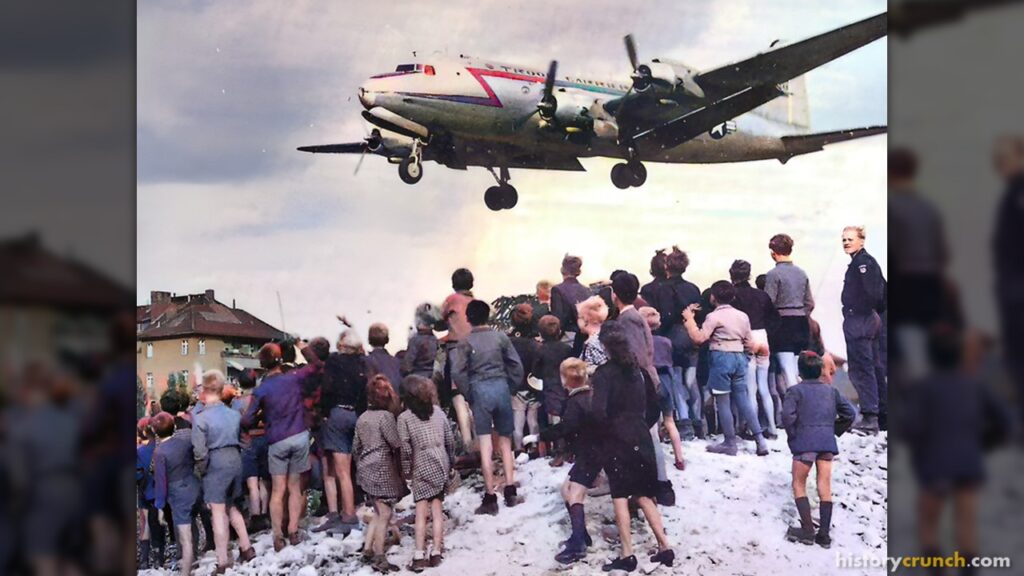
The Berlin Airlift was an important event in the early years of the Cold War, which saw the Western Allies (France, Britain, and the United States) supply West Berlin during the Berlin Blockade from June of 1948 to May of 1949. The Berlin BlockadeThe Soviet Union’s 1948 cutting off of all road, rail, and canal access to West Berlin to force the Western Allies out. was when the Soviet Union cut off all land and rail access to West Berlin in an attempt to force the Allies out of the city.
 FactsthatCrunch
The Berlin Blockade, which began on June 24th, 1948, was the direct trigger for the Berlin Airlift. Each step in the chain followed from decisions made at the end of World War II about how to divide Germany and its capital city.
What Was the Cold War?
The Cold War was a major world event that took place from approximately 1945 until 1991. In general, the Cold War was a period of increased tensions and hostility between the superpowersNations with enormous military and political strength capable of influencing events worldwide. of the United States and the Soviet Union (USSR). It was characterized by a global struggle between capitalism and communism, with both sides competing for influence around the world. Although it never escalated into direct war between the superpowers, it involved proxy wars, nuclear arms races, and ideological confrontations. The Berlin Blockade was a high point in tensions in the early Cold War, while the Berlin Airlift was the Allied response to the blockade. Both events were significant to the early years of the Cold War and set the stage for the heightened tensions of the next few decades.
Berlin Airlift – What Caused It?
When World War II came to an end in 1945, the Allied powers (USA, Britain and the Soviet Union) held conferences to discuss how Germany should be divided up upon its defeat. The first conference was held at Yalta in February of 1945 and the second was held at Potsdam in July of the same year. The agreements ultimately led to the splitting of the defeated Germany into four Allied occupation zones with portions controlled by the Soviet Union, United States, Britain and France.
After the division of the country, Berlin (the capital of Germany) was located entirely in the Soviet Union controlled portion of the country. Due to the agreements at the Yalta and Potsdam Conferences, Berlin was also split into four portions between the same four Allied Powers. As such, West Berlin was controlled by the three capitalist and democratic nations (France, Britain and the United States), while East Berlin was controlled by the communist Soviet Union. This is significant, because most historians agree that the Berlin Blockade was an example of heightened tensions along ideologicalRelated to a set of political or economic beliefs, such as capitalism or communism, that guide how a society is organized. lines between the United States and the Soviet Union. In fact, heightened tensions between the two superpowers were a key attribute of the overall Cold War.
The Soviet Union was unhappy with this arrangement and sought to control the entire city of Berlin. Firstly, the Soviet Union had been invaded twice by Germany in recent history and they had no interest in promoting the reunification of Germany, which is what the United States, Britain and France were attempting. As well, the Soviets were concerned about the promotion of a capitalist city within the middle of their zone. As such, Joseph Stalin, the communist dictator of the Soviet Union, decided to attempt to capture control over the entire city of Berlin.
As stated above, the Berlin Blockade was one of the first major crises of the Cold War. It lasted from June 24th, 1948 to May 12th, 1949. It began when the Soviet Union blocked all road, rail, and canal access to West Berlin in an attempt to force the Western Allies out of the city. Joseph Stalin could not forcibly remove the other Allied powers from Berlin, since that would mean direct warfare. At the time, the United States was the only nation to have an atomic bombA weapon of massive destructive power; in 1948, only the United States possessed one., and Stalin had to respect that any direct warfare with the United States would likely result in nuclear warfare. He therefore, in 1948, ordered the closing of all rail lines, canals, and roads that entered West Berlin through the Soviet sector. This ‘blockade’ of the city effectively cut off West Berlin from food and fuel supplies. Stalin was essentially trying to force the surrender of West Berlin and hoped that a lack of supplies would cause the United States and its allies to give up the city.
As far as the Allies were concerned, withdrawal from the city was not an option. In particular the United States was afraid that if they withdrew from Berlin, then communism would run rampant in the rest of Europe. For example, American President Harry S. Truman declared, “We are going to stay, period.” Using military force to strike back against the Soviet blockade was not necessarily an option since it increased the risk of turning the Cold War into an actual war between the superpowers. As such, the United States and its allies sought another way to resupply the city of Berlin.
FactsthatCrunchWhy did Stalin blockade West Berlin, and why did the Allies refuse to leave?
Berlin Airlift – Summary
The only way for the Allies to supply their sectors in Berlin was to fly in supplies. As such, the Allied nations launched the Berlin Airlift, which was a massive operation to supply West Berlin with food, fuel, and other essential resources by air. In fact, for nearly a year, Allied planes landed in Berlin in order to deliver over 2.3 million tons of supplies. Stalin and the Soviets could do little to stop the planes, since any attempt to shoot down the Allied planes would risk the chance of war with the United States and its atomic arsenal.
The Berlin Airlift was code-named “Operation Vittles” and later became known as the Berlin Airlift. At the beginning of the operation, the planes delivered about 5,000 tons of supplies to West Berlin every day; by the end, those loads had increased to about 8,000 tons of supplies per day. As stated previously, the Allies carried about 2.3 million tons of cargo in all, over the course of the Berlin Blockade and Airlift. In fact, during the airlift an Allied plane supposedly took off or landed in West Berlin approximately every 30 seconds.
By the spring of 1949, when it became clear that the Allies would stand firm and not give in to Stalin’s blockade tactic, Stalin finally decided to lift the blockade. The Allies maintained control over their sectors of Berlin.
Berlin Airlift – Candy Bomber
An interesting story from the time of the Berlin Airlift was that of the ‘Candy Bomber’. United States Air Force pilot Gail Halvorsen became famous during the Berlin Airlift for dropping candy to German children from his plane. He dropped the candy by using small parachutes made from handkerchiefs. His small act of kindness stood out amid the backdrop of the Cold War and the Soviet Union’s blockade of West Berlin. In fact, Halvorsen also inspired a larger operation known as ‘Operation Little Vittles’ that saw thousands of candy packages dropped by other Allied pilots.
Berlin Airlift – Significance
The Berlin Airlift was one of the most significant events of the early stages of the Cold War. For instance, it demonstrated the effectiveness of Western unity through the events of the Berlin Airlift, which successfully sustained West Berlin without pushing the world into a war. Also, the success of the Berlin Airlift was a geopolitical defeat for Joseph Stalin and the Soviet Union, since they were forced to back down once the blockade proved ineffective. In fact, the Berlin Airlift prevented Berlin from falling to communism and Soviet rule. This was significant because the city of Berlin would go on to be a central figure of the entire Cold War with later developments, such as the construction of the Berlin Wall and then the fall of the Berlin Wall.
As well, the Berlin Airlift was a major victory for the Allied nations and displayed their ability to overcome Soviet aggression through non-violent means. This was important because it gave the Allies a successful strategy to use throughout the rest of the major incidents of the Cold War. That strategy was ultimately centered on stopping the spread of communism and limiting (as much as possible) the reach and power of the Soviet Union. For instance, the Truman Doctrine, in reference to the foreign policy strategy of American President Harry S. Truman, sought to prevent the spread of Soviet influence, wherever possible. Historians refer to this as ‘containment‘ in that the United States was attempting to contain Soviet expansionism. The Berlin Airlift can be seen as one of several examples of American containmentThe American strategy of limiting the spread of Soviet power and communist influence wherever possible., alongside the Korean War.
The Berlin Blockade and Airlift were also important because they helped the Allied powers solidify their relationship against the Soviet Union and would eventually lead to the creation of the North Atlantic Treaty Organization (NATOAn alliance formed by the Allied powers seeking mutual military protection against the Soviet Union.), which is an agreement that sought mutual protection for Allied powers against the Soviet Union.
Explore Cold War · 1947 – 1991
Keep exploring Cold War with these History Crunch resources.
FactsthatCrunchTap each impact to read what it led to.
Key Vocabulary
Berlin Blockade
Superpowers
Ideological
Proxy wars
Atomic bomb
Containment
NATO
Frequently Asked Questions
When did the Berlin Airlift take place?
The Berlin Airlift ran from June of 1948 to May of 1949, lasting nearly a year. It began in response to the Berlin Blockade, which started on June 24th, 1948. The Soviet Union finally lifted the blockade on May 12th, 1949, when it became clear the Allies would not give up the city.
Why did the Soviet Union blockade West Berlin?
The Soviet Union blocked West Berlin to try to force the Western Allies out of the city. Joseph Stalin did not want a capitalist, democratic city sitting inside his occupation zone. He also opposed the Allied plan to reunify Germany, since Germany had invaded his country twice before.
How much supply did the Berlin Airlift deliver?
Allied planes delivered over 2.3 million tons of supplies during the operation. Early on, planes carried about 5,000 tons each day, which rose to about 8,000 tons daily. At its busiest, an Allied plane took off or landed in West Berlin about every 30 seconds.
Who was the Candy Bomber?
The Candy Bomber was United States Air Force pilot Gail Halvorsen, who dropped candy to German children. He used small parachutes made from handkerchiefs to float the treats down from his plane. His kindness inspired a larger effort called Operation Little Vittles, which saw thousands of candy packages dropped.
Why was the Berlin Airlift important in the Cold War?
The Berlin Airlift kept West Berlin out of Soviet hands without starting a war between the superpowers. It showed that the Allies could resist Soviet pressure through peaceful means. The success also strengthened Allied unity and helped lead to the creation of NATO.
Cite This Article
To cite this article as a source, use one of the formats below.
MLA: Beck, Elias. “Berlin Airlift: A Detailed Summary.” HistoryCrunch, 9 October 2026, https://historycrunch.com/berlin-airlift/.
APA: Beck, E. (2026). Berlin Airlift: A Detailed Summary. HistoryCrunch. https://historycrunch.com/berlin-airlift/
Chicago: Beck, Elias. “Berlin Airlift: A Detailed Summary.” HistoryCrunch. October 9, 2026. https://historycrunch.com/berlin-airlift/
Sources
- Wilson Center Digital Archive
- Vladislav Zubok, A Failed Empire.
- John Lewis Gaddis, The Cold War: A New History.